
May 2026 | Volume 17, Issue 2
Inside this Issue:
- What will be the fate of these frost damaged soybeans?
- EPA approves dicamba herbicides with new rules for Mid-Atlantic growers
- Fundamentals of Nutrient Management Training – June 24–25, 2026
- FHB Risk Assessment for Maryland
- Maryland Pesticide News (January to March 2026)
- Manganese Deficiency Showing Up in Wheat
- Space Still Available for UMD-TAPS Competitions!
- Cereal Leaf Beetle in Wheat Fields
- Time to Review BL!T and Pesticide Label
- Cover Crop Initiative
-
Regional Crop Reports
Regional Crop Reports -
Weather Outlook
Weather Outlook -
University of Maryland Agriculture & Food Systems Faculty Directory
University of Maryland Agriculture & Food Systems Faculty Directory
Time-to-Review-BL!T-and-Pesticide-Label
By Emily Zobel, UME- AgFS Agent, Dorchester County
If you have not done so yet this year, now is an ideal time to review the pesticide labels for any newly purchased chemicals for updates to PPE requirements, endangered species statement, updated drift reduction methods and any update on runoff/erosion and spray drift migration measures. Several pesticides now have endangered species statements, as well as runoff/erosion and spray drift mitigation menu requirements. These requirements will ask you to plan your pesticide applications in advance to determine whether you are subject to mitigation.
The endangered species statement requires you to check EPA’s Bulletin Live! Two (BL!T) website (https://www.epa.gov/pesticides/bulletins) for the presence of any Pesticide Use Limitation Areas (PULAs) around the application site. If EPA requires additional mitigations in these areas, those pesticide-specific requirements will be outlined on the printable bulletin’s found on BL!T website. Directions on how to use the BL!T website can be found on the EPA website, or you can contact your local extension agent for help.
Labels might also have statements requiring you to take extra steps to reduce runoff/erosion or spray drift. These steps vary based on the properties of the pesticide, target crops and directions for use. Spray drift mitigations include drift buffers, which are influenced by nozzle selection, boom height and adjuvants. Runoff/erosion mitigation is based on a point system in which the number of points required (3-9 points) is based on the pesticide’s potential for moving off-target. Mitigation points are available for field characteristics, cropping practices, and soil conservation programs.
Worksheets to help calculate runoff mitigation points and spray drift buffer reductions can be found on the EPA’s website (https://www.epa.gov/pesticides/mitigation-menu). For more information or help navigating the BL!T website or the migration menus, visit the EPA’s website or contact Emily Zobel at ezobel@umd.edu or by phone at 401-228-8800.
This work was supported by the Crop Protection and Pest Management program (CPPM) of the USDA National Institute of Food and Agriculture (NIFA), project award no. [313986], from the U.S. Department of Agriculture’s National Institute of Food and Agriculture.
Space Still Available for UMD-TAPS Competitions!
Nicole Fiorellino, Extension Agronomist
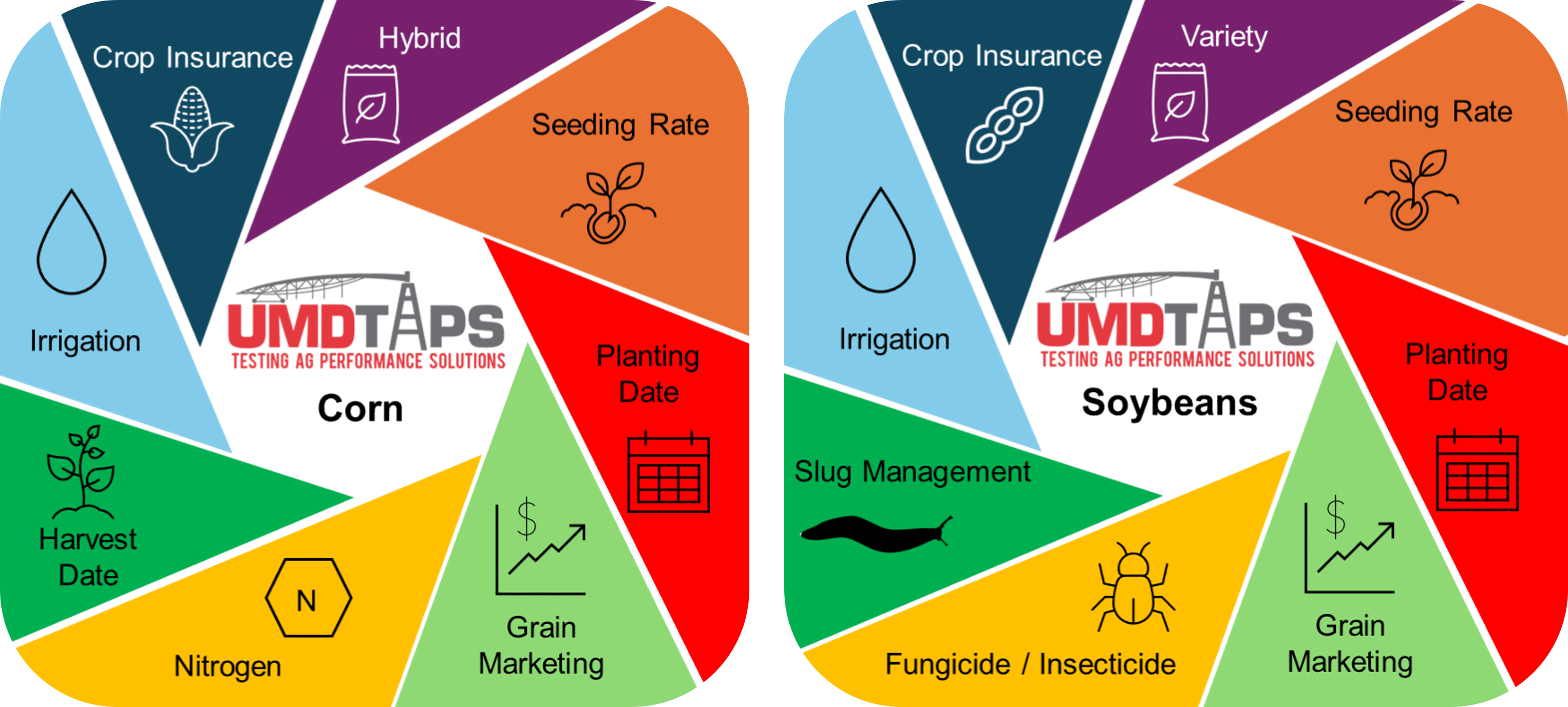
Hurry, before time runs out! There is still time to sign up to participate in the UMD-TAPS Corn and Soybean Competitions for 2026! While we have planted our first round of plots, we will plant the rest in about two weeks – plenty of time to get a team together and register!
UMD-TAPS is a farm simulator which provides participants with a zero-risk opportunity to make novel or even extreme management decisions and experience the in-field outcomes of those decisions without risking personal field space or profitability. The management decisions participants make are executed in replicated small plots at the Wye Research and Education Center in Queenstown, Md. This competition framework means anyone can participate – no field space is required for participation. Competition participants make decisions about variety selection, seeding rate, fertility, pest management, irrigation management, and grain marketing throughout the growing season. We encourage producers to take advantage of the grain marketing component of the competition as grain marketing is often an under-utilized management strategy to increase farmer profitability. The goal of the competition is to identify which suite of management decisions will result in the most profitable team, most nutrient efficient team, and highest yielding team, who will all receive prize money at the results reveal dinner following the growing season.
Interested applicants can sign up at go.umd.edu/UMDTAPS2026 or by scanning the QR code below. We have five soybean teams and eight corn teams remaining! For any questions, please reach out to Dr. Nicole Fiorellino at nfiorell@umd.edu.
Fundamentals of Nutrient Management Training – June 24–25, 2026
Build your knowledge and prepare for the Maryland Nutrient Management Certification Exam at this two-day training hosted by the Maryland Department of Agriculture. Learn key topics including nutrient management regulations, soil science, fertility, nutrient cycles, and plan development taught by university and government experts.
Ideal for certification candidates, farmers, consultants, and natural resource professionals looking to sharpen their skills.
The $65 registration fee (non-refundable) includes training materials, reference manuals, and breakfast and lunch both days. Space is limited, and pre-paid registrations are accepted on a first come, first served basis. Register by June 12, 2026.
For registration and more details about Fundamentals of Nutrient Management Training

FHB Risk Assessment for Maryland 5-4-2026
By Nidhi Rawat, Small grains Pathologist, UMD
Wheat across Maryland, including the Eastern Shore, is now flowering, the stage when yellow anthers emerge from the wheat heads. This is the critical window for FHB infection and the optimal timing for an FHB-targeted fungicide application. If you have planted a susceptible variety, consider an application at early flowering (when anthers are visible) or within the recommended window shortly thereafter.
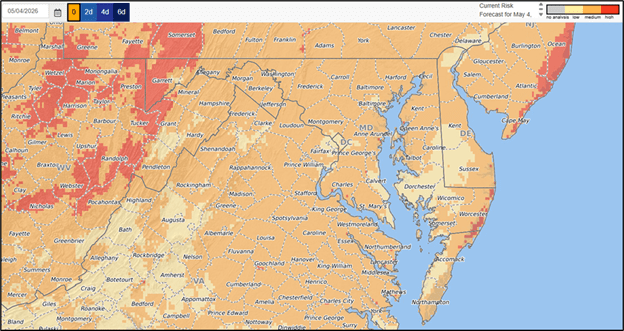
With forecasted showers and thunderstorms this week, conditions are expected to become more favorable for Fusarium head blight (FHB/head scab). The FHB risk map currently indicates moderate FHB risk in the region, and it can further increase quickly over the next several days, especially in susceptible varieties, if warm, humid conditions persist.
For FHB control, use triazole-containing fungicides such as Miravis Ace, Prosaro, Prosaro Pro, or Sphaerex. These products also provide activity against other foliar fungal diseases (e.g., powdery mildew and rusts), although those are not currently a major concern. Avoid strobilurin-containing fungicides at this stage. These products do not need to be tank-mixed with another fungicide for FHB control, and they should be applied at the full labeled rate.
For best coverage of wheat heads, follow label guidance and use appropriate application practices. In general, aerial application at a rate of 5 gallons per acre or ground application at 15 gallons per acre with 300-350 um droplet size is recommended. Spray nozzles should be angled at 30°- 45° down from horizontal, toward the grain heads, using forward- and backward-mounted nozzles or nozzles with a two-directional spray, such as Twinjet nozzles.
Maryland Crop Scouting School
Join us for a hands-on Crop Scouting School focused on building practical skills for identifying and managing pests, diseases, and crop issues in the field. Participants will learn how to scout effectively, recognize key problems, and make informed management decisions using Integrated Pest Management (IPM) principles. This program is designed for farmers, crop consultants, and ag service providers looking to improve their field diagnostics and decision-making. This event covers common pests in row crop and vegetable production systems.
WYE Research and education center
Date: June 25, 2026 | Thursday
Time: 9:00 am to 2:45 pm | Cost: $10
Location: Wye Research and Education Center, 124 Wye Narrows Drive, Queenstown, MD 21658
Registration: https://www.eventbrite.com/e/maryland-crop-scouting-school-at-wye-tickets-1988090629591?aff=oddtdtcreator
Central Maryland Research and Education Center (Clarksville location)
Date: September 24, 2026 | Thursday
Time: 9:00 am to 2:45 pm | Cost: $10
Location: Central Maryland Research and Education Center, 4240 Folly Quarter Road, Ellicott City, MD 21042
Registration: https://www.eventbrite.com/e/maryland-crop-scouting-school-at-wye-tickets-1988090629591?aff=oddtdtcreator
Agronomy News is a statewide newsletter for farmers, consultants, researchers, and educators interested in grain and row crop forage production systems. This newsletter is published by the University of Maryland Extension, Agriculture & Food Systems Agronomy Team every month during the growing season and will include topics pertinent to agronomic crop production. The subscription is free.