
Manganese Deficiency Showing Up in Wheat
Hayden Schug & Ben Beale
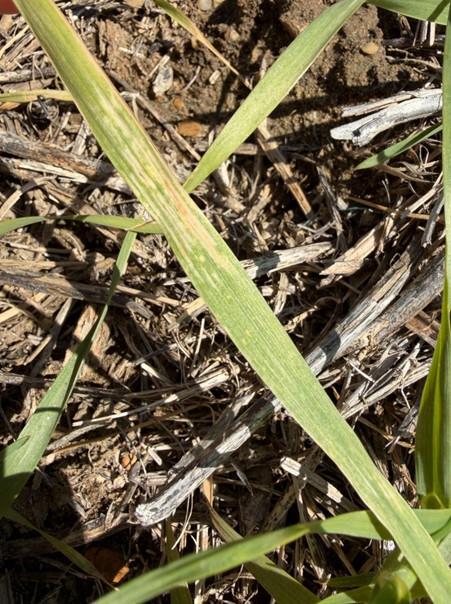
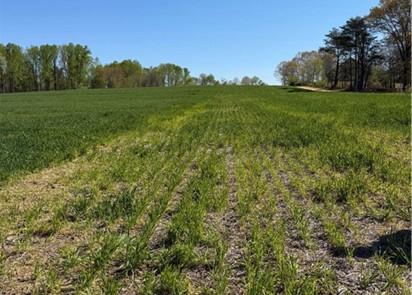
Manganese deficiency has shown up in some wheat fields in Southern Maryland this spring, notably in areas with higher soil pH. Manganese (Mn) plays an important role in photosynthesis, so deficiencies typically appear as chlorotic streaks on leaves, with pale coloration on younger leaves. Older leaves may develop small gray to white spots. Manganese deficiency also causes plant stunting, with severe deficiency resulting in plant death. The effects of Mn deficiency are often most noticeable after the spring nitrogen application and during periods of rapid growth. These symptoms can look very similar to nitrogen deficiency, which can make diagnosis challenging, especially in fields that are already borderline on nitrogen. However, yellowing from nitrogen deficiency typically appears first on older leaves, as nitrogen is mobile within the plant and will be translocated to new tissue from old leaves. Manganese deficiency is often associated with high pH soils and soils with inherently low Mn levels; thus the symptoms will appear in patches or patterns in the field that follow past lime applications.
In many cases, manganese deficiency is not caused by a true lack of manganese in the soil, but rather reduced availability or uptake by the plant. Soil pH plays a major role in this. As pH increases, manganese becomes less available, particularly in soils with a pH above 6.5. Fields that have received repeated applications of lime-amended biosolids often trend toward higher pH over time. While these materials can provide nutrients and organic matter, they can also create imbalances that limit nutrient uptake, even when soil test levels of nutrients appear adequate.
Environmental conditions can also influence manganese availability. Cool, wet soils early in the season can limit the nutrient uptake, as well as dry conditions, like the ones we are currently experiencing. These factors can cause symptoms to appear unevenly across a field, often showing up in streaks or patches that follow soil type or application patterns. Manganese also plays a role in overall plant efficiency, so deficiencies can reduce growth and vigor during key stages of development. In some cases, this can contribute to pale coloration that resembles nitrogen deficiency, especially when environmental conditions are limiting growth. Symptoms may also become more noticeable after nitrogen applications, as increased growth can highlight underlying manganese limitations.
From a management standpoint, confirming the issue with tissue testing is recommended when possible, as visual symptoms can overlap with other nutrient deficiencies. If manganese deficiency is identified and the crop is still early enough in development, a foliar manganese application can help alleviate symptoms. The application of ½ to 1 pound of actual manganese through manganese sulfate or a chelated manganese is recommended. Manganese sulfate is typically much cheaper than chelated manganese products. Apply with at least 20 gallons of water. However, long-term management should focus on maintaining balanced soil fertility and monitoring soil pH, and in most cases, reducing the use of lime. Growers should pay attention to soybeans grown in those same areas, as they are also likely to have issues with manganese deficiency. Soybeans symptoms consist of interveinal chlorosis of the new leaves and plant stunting.