

EB-2024-0722 | November 2025
Municipal Water Access for Adopt-A-Lot Program Participants & Establishing an Irrigation Account for Property Owners & Renters
By Serena Newton, Extension Program Assistant
Introduction
This document is a resource for Baltimore City, Maryland Adopt-A-Lot participants, property owners, and renters who use or plan to use municipal water on their land.
This publication is divided into the following:
- About the Adopt-A-Lot Program
- Instruction Section 1: For Adopt-A-Lot Program participants
- Instruction Section 2: For property owners & renters requesting an irrigation account
- Scenarios
The instruction sections answer:
- How do I get water services turned on for my Adopt-A-Lot?
- How do I establish an irrigation account as a property owner or renter?
- What do I do if I have a problem with my water bill?
- What resources are available to reduce my water bill?
The scenario section describes the steps an Adopt-A-Lot Participant or property owner would take in hypothetical situations.
About the Adopt-A-Lot Program
What is the Adopt-A-Lot Program?
The Baltimore City Department of Housing and Community Development (DHCD)’s Adopt-A-Lot program allows Baltimore City residents, businesses, civic or nonprofit organizations, and neighborhood groups to tend city-owned vacant lots in their community (DHCD, 2024a). The DHCD and Department of Public Works (DPW) provides water to stewards of city and privately owned community open space for a flat rate of $120 from March 1st through November 1st. After November 1st, existing water connections are disconnected until the following season.
What Can I Do on an Adopted Lot?
According to the DHCD (2024a), “An Adopt-A-Lot license holder can create community spaces that include, but is not limited to:
- Community Gardens
A community garden is a garden collectively managed by a group of people producing not-for-profit fruits, vegetables, flowers or plants for attractive appearance. These types of applications will require additional vetting and site plans. - Clean and Green Spaces
Clean and green spaces are primarily maintenance and minimal beautification. Examples include mowed grass with perhaps a neighborhood sign and/or small flower beds. - Recreational Spaces
Recreational spaces include chess parks, horseshoe pits, meditation spaces and other passive recreational activities. These types of applications will require additional vetting and site plans.”
Instructions Section 1: For Adopt-A-Lot Participants
Question: How do I get water services turned on for my adopted lot?
Answer: Use the Water Access Program
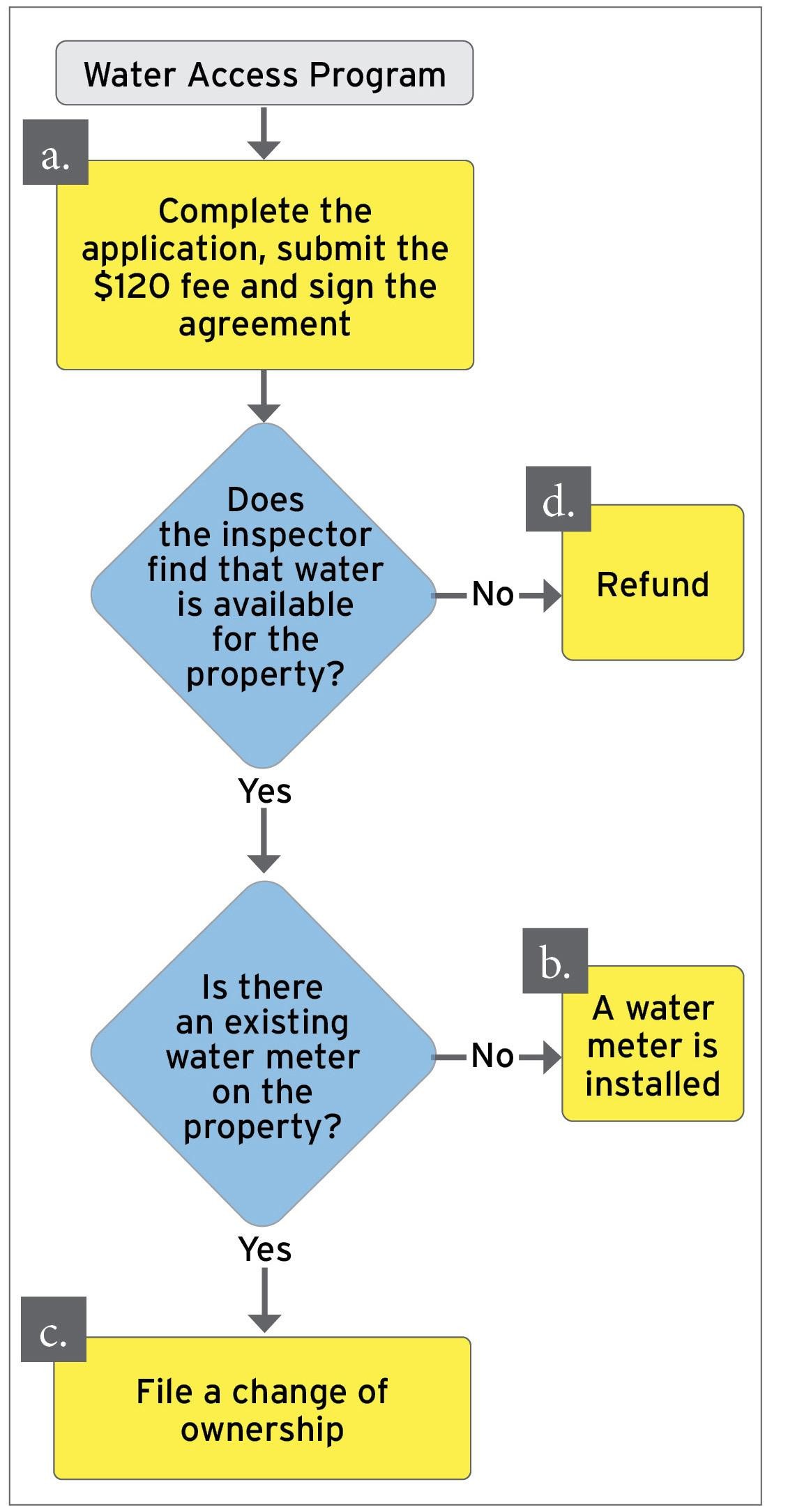
The Baltimore City Department of Housing & Community Development (DHCD) and Water Department provide water to stewards of city and privately owned community open space for a flat rate of $120 from March 1st through November 1st through the Water Access Program. After November 1st, existing water connections are disconnected until the following season (DHCD, 2024a).
For questions or concerns about the Water Access Program: Contact the Baltimore City DHCD at 410- 396-4111 or email DevelopmentInfo@baltimorecity.gov.
a. Complete the application:
Complete the application and make the payment of $120.00 on the Buy Into Bmore interactive map by following the instructions and applications outlined by Baltimore Greenspace at the following link(s):
Instructions: https://baltimoregreenspace.org/resources/
Application: https://buyintobmore.baltimorecity.gov/
After the DHCD reviews your application, they will email you a Water Access Agreement. Sign and return the agreement.
b. If water is available, but no water meter is installed:
If water is available at the adopted lot, an inspector will install a device. The inspector will explain how you can attach your irrigation system to the device.
c. If an existing water meter is in place:
File a Change of Ownership application with Baltimore City DPW: https://publicworks.baltimorecity.gov/sites/ default/files/Change%20of%20Info%20%20 Sheet.pdf
Mail form to:
Baltimore City Department of Public Works
Customer Support & Services Division
200 N Holliday St, Room 400
Baltimore, MD 21202
d. If water is not available on the lot:
If water is not available, you will get a full refund within 90 days (Baltimore City DHCD, 2024b)
Instructions Section 2: For Property Owners & Renters Establishing An Irrigation Account
Question 1: How do I establish an irrigation account as a property owner or renter?
Answer: It depends on the presence of a water meter.
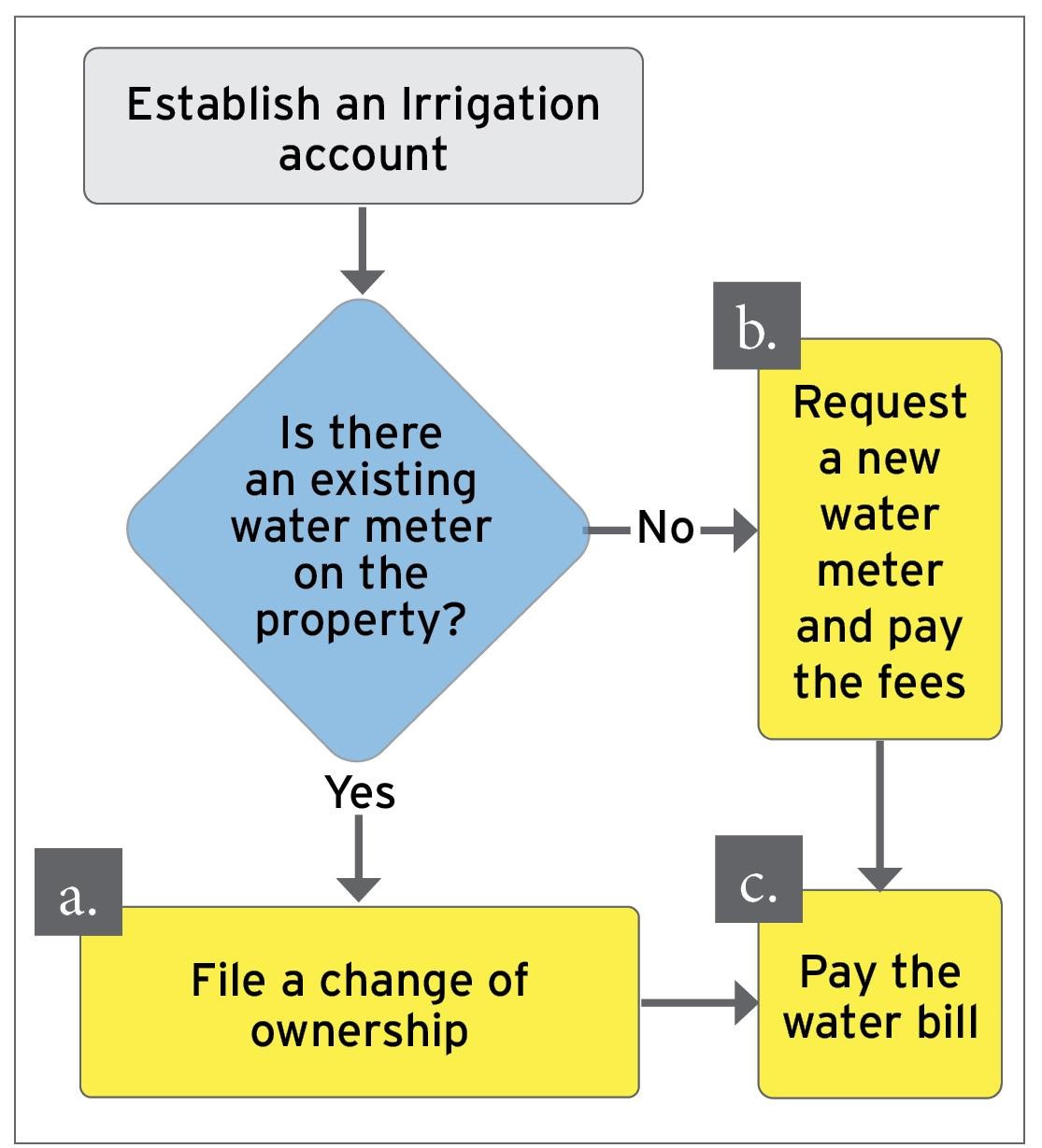
a. If there is a water meter on the property:
File a change of ownership with the Baltimore City DPW by filling out the form at: https://publicworks.baltimorecity.gov/sites/ default/files/Change%20of%20Info%20%20 Sheet.pdf
Mail the form to the Baltimore City DPW at:
Customer Support & Services
200 N Holliday St, Room 400
Baltimore, MD 21202
b. If there is no water meter on property:
Call the Baltimore City DPW at 410-396-5398 to establish a new account. Submit new account paperwork via United States Postal Service (USPS) or email DPW.Billing@baltimorecity.gov. Submit your payment by mailing a certified check to the Baltimore DPW through USPS. When the DPW receives the paperwork and payment, the Rates and Revenue section will:
- Confirm that they have received everything or request missing documentation from you.
- Set up the billing account in the billing system.
- Coordinate the meter installation process and send the meter information to you. City or DPW representatives install meters that have a flow pipe under 3” in diameter. Approved contractor installs meters that have a flow pipe above 3” in diameter.
There is a fee to purchase the water meter and a fee to turn on the water meter. These fees depend on the size of the water meter. To find these fees, visit https://publicworks.baltimorecity.gov/rates-and-fees and click the “Miscellaneous Fees” link (rates effective 2025).
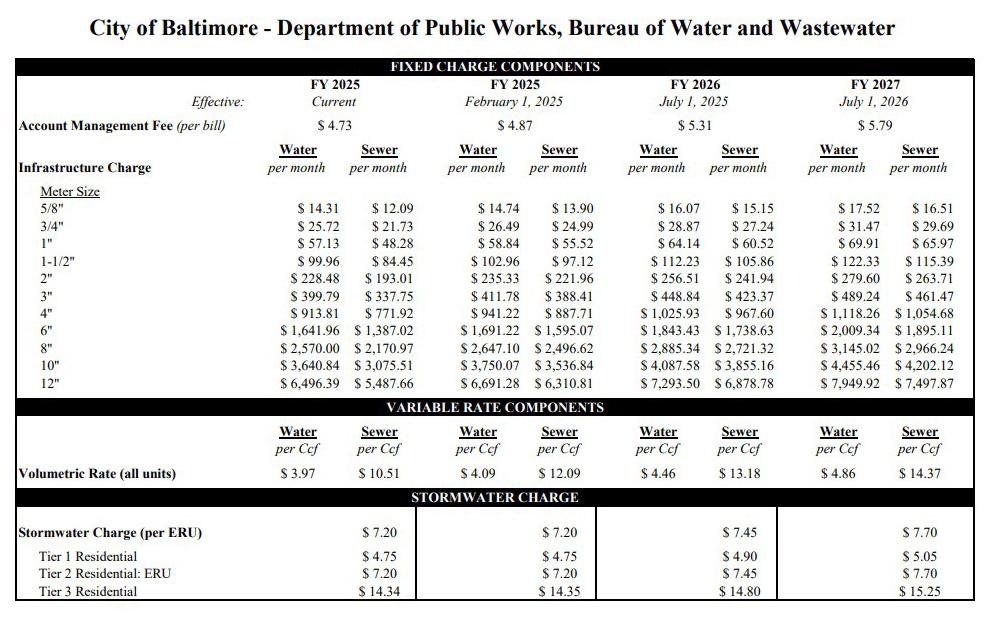
c. Pay the Water Bill (see Table 1 below):
The monthly infrastructure charge is based on the size of the water meter. Property owners can request to have a smaller meter installed (DPW, 2017). For information on how to request a smaller meter visit: https://publicworks.baltimorecity.gov/smaller-meter-requests.
Property owners are also charged for volumetric water consumption. Specifically, property owners are charged per CCF (100 cubic feet) of water that passes through their meter during the billing period. One CCF equals 748 gallons.
Payment options:
- Online-Visit the City of Baltimore Department of Finance customer payment portal to make payments through different options including autopay or email (Baltimore City Department of Finance, 2024).
- In person- Visit the Abel Wolman Municipal Building, 200 Holliday St, Baltimore, MD 21202 (more locations may become available).
- By phone:
Credit card: 866-377-0765
Check (ACH): 866-377-0765
Question 2: What do I do if I have a problem with my water bill? (Irrigation accounts only)
Answer: Monitor water consumption, billing, and payment information:
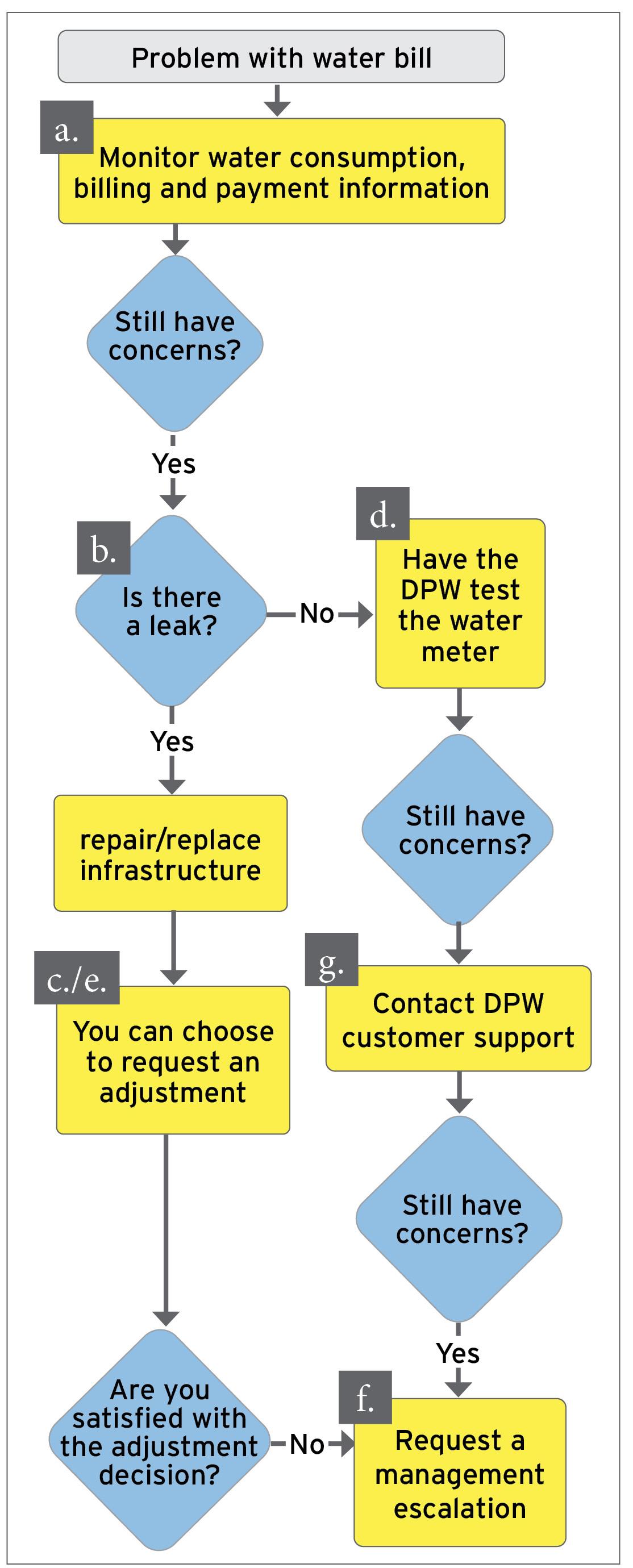
a. Start by registering on the DPW customer self-service portal using your account number, activation code, and an email address (DPW, 2024a). Next, contact Customer Support and Services if you have not received your activation code: 410-396-5398 or dpw.billing@baltimorecity.gov. Finally, Check the bill for details. There are a few reasons why your water bill might be different than what you expected:
- The meter billing was estimated. Consult “Read Type” under “Meter Reading Details” on your bill to see if the meter reading was “estimated” or “actual.” If the DPW cannot access the water meter, they can use an estimated read to bill the account instead of an actual read. An estimated read is temporary and based on the daily average usage. Once an actual read is recorded, any necessary adjustments are applied to the account.
- Your bill is for a period other than approximately 30 days.
- You used a different amount of water than you expected.
If you still have concerns after considering these factors, check your building for potential unexpected water use, such a dripping faucet. These are easier to diagnose and repair than a problem with the water meter.
b. Determine if there is an interior/situational leak (the water lost from the leak returns to the sanitary water system). Check for leaks in appliances, interior plumbing, etc.
c. Determine if there is an underground leak (The water lost from the leak does not return into the sanitary sewer system):
- Shut off the valve to the main water line. If the meter still indicates water usage, then there may be a leak. Continued movement on the meter indicates a leak at the property (Baltimore City DPW, 2024b).
- If hourly consumption data is available in your customer self-service portal, check the results of the test in the portal or have a Customer Support & Services Representative check the results through their system.
- If hourly consumption data is not available in your customer self-service portal, a field investigator can check the meter and look for the reason for higher water consumption (Baltimore City Code, Art. 24., 2019).
d. Request an underground leak billing adjustment:
- The adjuster will check their system to see if consumption decreases. An adjustment is calculated from the consumption of water from the last billing period prior to the leak and is multiplied by each individual bill of service within the affected billing period. Fifty percent of the additional water and sewer usage is deducted from the 3 consecutive highest bills doing the time of the leak.
- An adjustment may only be granted to a property once a year. No more than three consecutive bills are eligible. An adjustment cannot be made if a leak is active or the known leak has not been repaired. Requests must be noted on a Water and Sewer Adjustment Request Form. DPW should be notified within 60 days after receiving an excessive bill.
- If approved, the adjustment will appear on the water bill approximately 4 weeks after the request was received.
e. If no leak can be found, have the water meter tested:
**The meter flow test fee is $109. There is no meter test fee if the meter doesn’t pass the test.
- Water meter with a flow pipe under 3” in diameter: The meter is taken to the DPW meter shop to be tested and then a report is issued.
- Larger water meter: Evaluated on a case-bycase basis (Baltimore City DPW, 2024d).
f. Request an interior/situational usage billing adjustment
- An adjustment is calculated from the consumption of water from the last billing period prior to the leak and is multiplied by the total days of service within the affected billing period. Fifty percent of the additional water usage is deducted from the amount owed.
- An adjustment may only be granted at a property once every year. No more than three consecutive bills are eligible. An adjustment cannot be made if an active leak or the known leak has not been repaired. Requests must be noted on a standardized Water and Sewer Adjustment Request Form.
- If approved, the adjustment will appear on the water bill approximately 4 weeks after the request is received.
g. Request a management escalation if you disagree with the adjustment amount:
- Notify a DPW Billing Analyst by phone at 410-396-5398, via email at DPW.Billing@baltimorecity.gov, or in person at DPW Customer Support and Services Division: 200 Holliday St., First Floor, Room 8 Baltimore, MD 21202. You will need the account number and address of the service.
- The Billing Analyst works with the Section/ Division Manager and the Chief, if necessary, to render a determination (Baltimore City Code, Art. 24., 2019).
- You are informed of the decision and of your right to appeal.
Question 3: What resources are available to reduce my water bill?
Answer: There are suitable water affordability programs and payment plans that can assist stewards of lots in Baltimore City, if qualified.
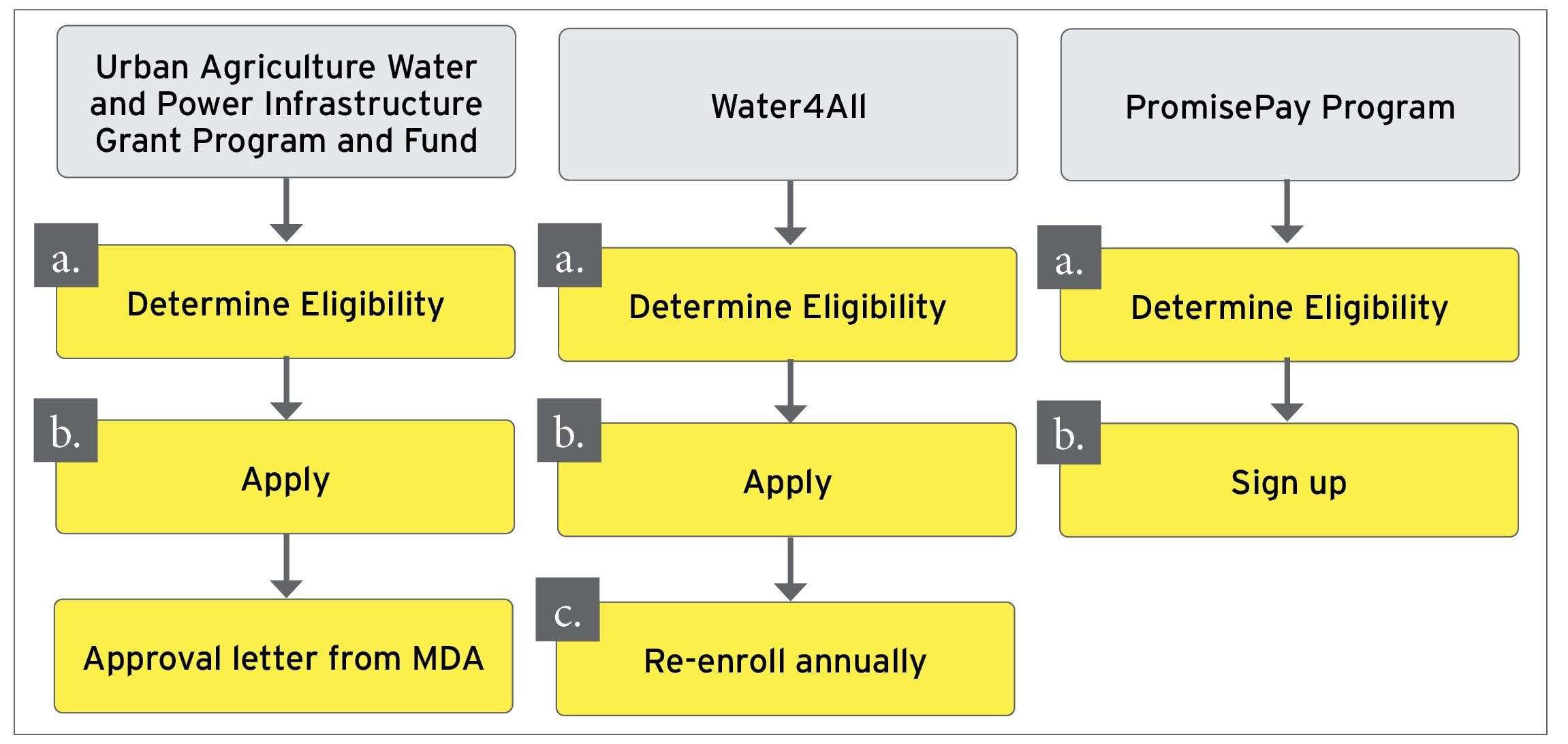
Urban Agriculture Water and Power Infrastructure Grant Program and Fund:
The Maryland Department of Agriculture (MDA) provides up to 87.5% of the cost to purchase and/ or install water meters, water pipes, irrigation hoses, electric meters, electrical lines, or other approved equipment. Grants are accepted on a first-come basis (Tharpe, 2023).
a. Eligibility criteria: Grant applications are accepted from individual growers, organized for-profit agricultural businesses, and non-profit organizations. Applicants must produce a farm product that generates a minimum of $1,000 in sales or donations annually, and operations must be located in urban areas as defined by the United States Census Bureau.
b. Apply: Download the application from the MDA Urban Agriculture Water & Power Grants website. Fill out the application and include the required documentation such as a bid from an authorized contractor. Mail or take the application to 50 Harry S. Truman Parkway, Annapolis, MD 21401. If the application is approved, you will receive an approval letter from the MDA.
PromisePay Program:
PromisePay payment plans are flexible, interest-free payment plans that allow eligible customers to keep their water account in good standing. (DPW, 2024c)
a. Eligibility criteria: Baltimore City residential, multifamily, and commercial water customers with a balance on their water bill of at least $50 are eligible for a payment plan.
b. Sign up: Sign up in three steps at https://baltimore.promise-pay.com/
- Choose a plan.
- Make your first payment. PromisePay accepts credit or debit cards, bank transfers (ACH), and Venmo.
- Pay off your balance over time.
Water4All:
Water4All calculates the maximum amount residents should pay for annual water and sewer services, based on their household size and annual income. Your annual discount through the Water4All program is the difference between the maximum amount you should be paying and what your estimated annual water and sewer bill is. (DPW, 2023).
a. Eligibility criteria:
- Income is less than 200% of federal poverty guidelines
- You are either (the following definitions are from DPW, 2023):
- A homeowner “whose name is on the water bill.”
- A tenant “whose name is on the water bill and who pays the city directly for water and sewer service.”
- A tenant “whose name is NOT on the water bill, who does NOT pay the city directly for water and sewer service, and who can provide both:
- A lease that clearly states the tenant is responsible for paying water and sewer services separately from the rent.
- A lease that clearly states the amount to be paid monthly by the tenant for those services or a copy of the monthly invoice for water and sewer services from the landlord or the landlord’s management company”.
b. Apply:
Apply online on the Water4All Website or download and print the form and drop it off at
3939 Reisterstown Rd,
Baltimore, MD 21215.
After you apply, it may take up to three months to see the discount on your bill.
c. Re-enroll annually:
- You can re-enroll and check your status online at this website: https://cityservices.baltimorecity.gov/water4all/Initial-Eligibility-Check
- Call (410) 396-5555 if you have questions.
Scenarios
Scenario 1: Adopt-A-Lot Participant
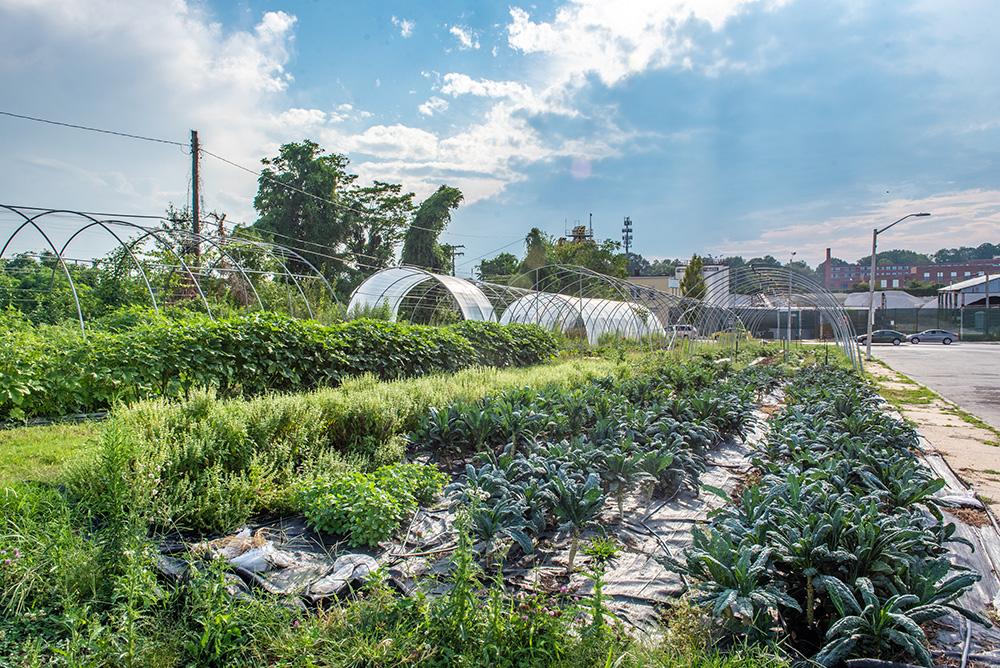
A neighborhood organization that runs a community garden through the Adopt-A-Lot program wants to use municipal water. The organization is eligible to access municipal water through the Water Access Program because they are participating in the Adopt- A-Lot Program. The organization completes the Water Access application after February 13th, but before the end of the last week of October. They use the Buy Into Bmore interactive map to complete the application by following the instructions outlined by Baltimore Green Space. Through the Water Access Program, they pay a flat rate of $120 for water from March 1st through November 1st. The fee establishes an irrigation account and includes the installation of the meter. Monthly charges for water usage are based on the size of the meter. After November 1st, existing water connections are disconnected until the following season.
Scenario 2: Property Owner Establishing an Irrigation Account
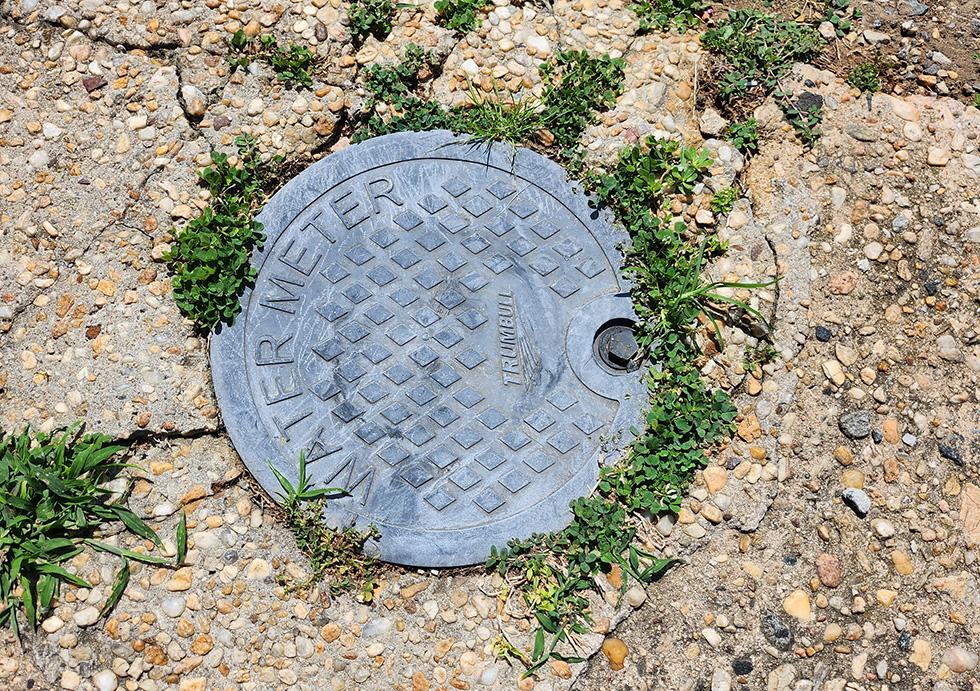
An individual just bought property and wants to use municipal water to irrigate their plot. They are not eligible to access municipal water through the Water Access Program because they are not participating in the Adopt-A-Lot Program. They look for and find a water meter (see Figure 6).
They need to use the water meter, so they file a change of ownership with the Baltimore City DPW They begin paying their water bill by setting up an online portal through the DPW.
They pay the bill each month using the portal and they can monitor their bill at any time.
After verifying that they are eligible, they apply online for the Maryland Department of Agriculture Urban Agriculture Water and Power Infrastructure Grant Program for funds to purchase their irrigation equipment.
Scenario 3: Problem with Water Bill
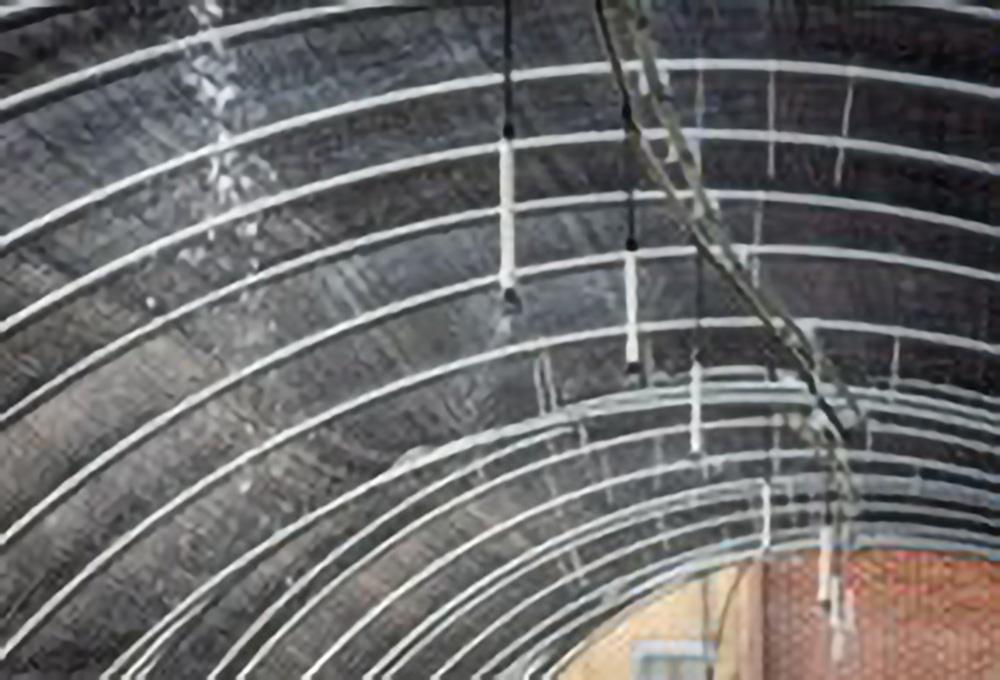
After the first five months of irrigation account usage, a property owner realizes that their bill was higher than normal. The bill indicates that an actual read was used (and not an estimated read), and the meter reading period was the typical 30 days. The property owner checks to see if there is a leak in their irrigation equipment, and they do not find anything. They hire a licensed plumber or engineer to determine if there’s an exterior leak on their lot.
The professional finds a leak, so they request a leak adjustment with DPW/CSSD. They can access the leak adjustment form at https://publicworks.baltimorecity.gov/water-and-sewer-adjustmentrequest- form. Per DPW policy, a customer can be granted an adjustment for up to (3) three months (of highest consecutive CCF usage) for water and sewer charges accumulated on the account.
- If they do not get approved for an adjustment, they can apply for a management escalation. The management escalation will be presented to the Escalation and Adjustment Committee to warrant a decision regarding the request. If the property owner doesn’t agree with the decision from the committee, they can go to the Office of Water Advocacy & Customer Appeals (WACA) for a billing dispute.
Please note: The Office of Water Advocacy & Customer Appeals is a neutral intermediary created to promote fairness to customers dealing with water and sewer billing disputes. WACA Serves as a customer advocate, conducts problem-solving investigations regarding water/wastewater billings, and advises customers on available water discount programs.
If the property owner’s request is approved after the management escalation, the adjustment will appear on their statement 4 weeks later.
Conclusion
Access to municipal water is essential for the successful stewardship of urban agriculture in Baltimore City. This guide provides clear, step-by- step instructions for Adopt-A-Lot participants, property owners, and renters to access water in Baltimore City. Whether accessing water through the Water Access Program or setting up an individual irrigation account, users can find support through city resources, billing assistance programs, and infrastructure grants.
If you need additional information, please contact:
DHCD: 443-984-5757
DPW: dpw.billing@baltimorecity.gov, or 410-396- 5398
References
Baltimore City Department of Housing & Community Development (DHCD). (2024a). Adopt-a-lot program. https://dhcd.baltimorecity.gov/nd/adopt-lot-program
Baltimore City DHCD. (2024b). Water Access Program. https://dhcd.baltimorecity.gov/water-access-program
Baltimore City Code, Art. 24. (2019, August 12). Baltimore City DPW. Regulations on Customer Service and Support for Water, Wastewater, and Storm Water Billing.
Baltimore City Department of Public Works (DPW). (2017, March 8). Meter reduction requests. https://publicworks.baltimorecity.gov/smaller-meter-requests
Baltimore City DPW. (2022). Requesting a water bill adjustment. https://publicworks.baltimorecity.gov/higher-normal-water-bill/requesting-water-bill-adjustment
Baltimore City DPW. (2023). Water4all Now Accepting Applications. https://publicworks.baltimorecity.gov/water4all
Baltimore City DPW. (2024a). Customer Self-Service Portal. https://waterbillportal.baltimorecity.gov/#Login
Baltimore City DPW. (2024b). Higher Than Normal Water Bill. Baltimore City DPW. https://publicworks.baltimorecity.gov/water-billing-information/problems-your-water-bill
Baltimore City DPW. (2024c). PromisePay. https://baltimore.promise-pay.com/
Baltimore City DPW. (2024d). Water Bill Review Process. https://publicworks.baltimorecity.gov/problems-your-water-bill/water-bill-review-process
Baltimore City DPW. (2025). Rates and fees. https://publicworks.baltimorecity.gov/rates-and-fees
Baltimore City Department of Finance. (2024). Online Payments. https://finance.baltimorecity.gov/citizen-services/online-payments
Tharpe, B. (2023, June 20). Urban Agriculture Water & Power Grants. https://mda.maryland.gov/resource_conservation/Pages/Infrastructure-Grants.aspx
Thank you to Neith Little, Andrea Franchini, Tiara Matthews, Bill Tharpe, Dr. Rachel Rosenberg Goldstein, Mark Cameron, and Paul Goeringer for their assistance.
SERENA NEWTON
snewton5@umd.edu
This publication, Municipal Water Access for Adopt-A-Lot Program Participants & Establishing an Irrigation Account for Property Owners & Renters (EB-2024-0722), is a part of a collection produced by the University of Maryland Extension within the College of Agriculture and Natural Resources.
The information presented has met UME peer-review standards, including internal and external technical review. For help accessing this or any UME publication contact: itaccessibility@umd.edu
For more information on this and other topics, visit the University of Maryland Extension website at extension.umd.edu
University programs, activities, and facilities are available to all without regard to race, color, sex, gender identity or expression, sexual orientation, marital status, age, national origin, political affiliation, physical or mental disability, religion, protected veteran status, genetic information, personal appearance, or any other legally protected class.
When citing this publication, please use the suggested format:
Newton, S. (2025). Municipal Water Access for Adopt-A-Lot Program Participants & Establishing an Irrigation Account for Property Owners & Renters (EB-2024-0722). University of Maryland Extension. go.umd.edu/ EB-2024-0722