
Maryland is a state of "wonders" with lots to see, do, learn and enjoy! Becoming a Certified Maryland Master Naturalist is an exciting way to explore our beautiful state and to help preserve its environmental wealth. The idea for a Maryland Master Naturalist Program took shape 2005. In 2008, under the direction of the University of Maryland Extension Maryland Master Naturalist Program Coordinator and guided by a Steering Committee, the program framework was created. By spring, 2010, the first pilot volunteer training was conducted in the Piedmont Region of the state at the Howard County Conservancy. The pilot volunteer training for the Coastal Plain was conducted in February 2011 at Adkins Arboretum. Since then, more than 50 facilities/organizations have hosted or co-hosted the Maryland Master Naturalist Volunteer Training throughout the state.
Our Mission, Goals & Vision
Our Mission:
The Maryland Master Naturalist Program develops and engages a robust corps of individuals to serve as stewards of Maryland’s natural resources and ecosystems through science-based education and volunteer service in their communities.
Supporting definitions:
- Individuals are all people who become Maryland Master Naturalists as well as those influenced by their outreach efforts.
- Stewardship embodies awareness, sound knowledge, understanding, respect, responsibility, and ongoing personal commitment to conservation and preservation.
- Natural resources and ecosystems through science-based education focuses specifically on plants, wildlife, microorganisms, soil, water, air, climate, weather, geology, ecology and environmental issues in Maryland’s coastal plain, piedmont, and mountain eco-regions taught by qualified natural resources experts.
- Volunteer service commits Maryland Master Naturalists to interpret and share many things including their passion and knowledge of ecological principles, of Maryland’s natural history and resources, and of native species – and to take leadership in conservation and resource preservation in their communities.
- Communities include the numerous neighborhoods, workplaces, volunteer locations, parks, places of worship, schools, committees, and other gathering places and activities where Maryland Master Naturalists spend time.
Our Goals:
- Promote awareness and appreciation of ecological resources in the State of Maryland
- Develop a network of trained volunteers to serve as catalysts for local environmental conservation through education, research, and stewardship
- Provide a structured, science-based program to educate and certify individuals who maintain their lifelong learning quests as Maryland Master Naturalists
- Engage individuals in environmentally-focused volunteer service within their communities
Our Vision:
The state of Maryland demonstrates to the world, by its actions at the individual, community, policy, and practice levels, its commitment to creating and maintaining a healthy planet.
Program Overview
PROGRAM OVERVIEW
The Maryland Master Naturalist Program provides interested individuals, age 18 and over, with the opportunity to gain and/or increase knowledge and skills in order to contribute to environmental education, conservation, research, and other stewardship programs as a volunteer with facilities/ organizations throughout the state.
Approved facilities/organizations serve as Maryland Master Naturalist Program Host Sites where these volunteers are engaged and the Volunteer Training is administered by a trained Program Facilitator. Taught by qualified instructors in the environmental field using a statewide approved course outline along with The Maryland Master Naturalist's Handbook, instructors may include University faculty, University of Maryland Extension Specialists, Maryland Department of Natural Resources professionals, professional environmental educators, experienced Maryland Master Naturalists, and other experts with a demonstrated knowledge in the subject matter being taught as well as an ability to communicate that knowledge to a lay audience. Program Facilitators customize the training by including Host Site and/or region-specific activities, speakers, and resources.
The Maryland Master Naturalist Program and its Volunteer Training were developed and are continuously refined by the State Program Coordinator and the Steering Committee with the intention of providing a balanced, integrated, practical course in natural resource and ecosystem science of the three physiographic regions of Maryland:
- Coastal Plain Region: farthest to the east and includes all the low-lying areas from the shores of the bay to the Atlantic Ocean. Eastern Cecil, Kent, Queen Anne's, Caroline, Talbot, Dorchester, Wicomico, Somerset, Worcester, Anne Arundel, Prince George's, Calvert, Charles and St. Mary's Counties are all in our Coastal Plain Region, along with the eastern part of Baltimore City and Baltimore County.
- Piedmont Region: more centrally located and crossed by rivers descending toward the Chesapeake Bay. Eastern Frederick, Carroll, Harford, Howard, Montgomery, and western Cecil Counties are in the Piedmont, along with the western part of Baltimore City and Baltimore County.
- Mountain Region: consists of western Maryland and characterized by the Appalachian Plateaus, Ridge and Valley, and Blue Ridge provinces of the state. This region includes Garrett, Allegany, Washington and western Frederick Counties.
Core topics introduced in the Maryland Master Naturalist Volunteer Training include:
- Maryland Natural History
- Flora & Fauna
- Fundamentals of Ecology
- How Humans Have Affected the Landscape
- Teaching and Interpretation
- The Science of Science
Following the Volunteer Training component of the program, individuals are expected to commit to returning 40 hours in volunteer service annually then pursue 8 hours of advanced training after the first year in order to achieve and maintain Certified Maryland Master Naturalist Status.
Program Structure
PROGRAM STRUCTURE
The Maryland Master Naturalist Program is defined as:
A science-based natural resource training program jointly sponsored statewide by University of Maryland Extension (UME), Maryland Department of Natural Resources (DNR), and other state and local agencies and organizations. Partnerships with state and local environmental organizations, agencies, and citizen groups support a network of locally directed Host Sites around the state that may form Chapters. Program Facilitators administer and coordinate volunteer training programs using The Maryland Master Naturalist's Handbook following core curriculum guidelines.
The statewide program will:
- Train Program Facilitators
- Approve new Host Sites and potential Chapter formations
- Coordinate participant application, registration, payment, and certification processes
- Produce and distribute training materials to Maryland Master Naturalist volunteer trainings
- Manage statewide online Program Management Platform (PMP)
- Maintain an Environmental Educators list as a resource for Program Facilitators to locate potential instructors
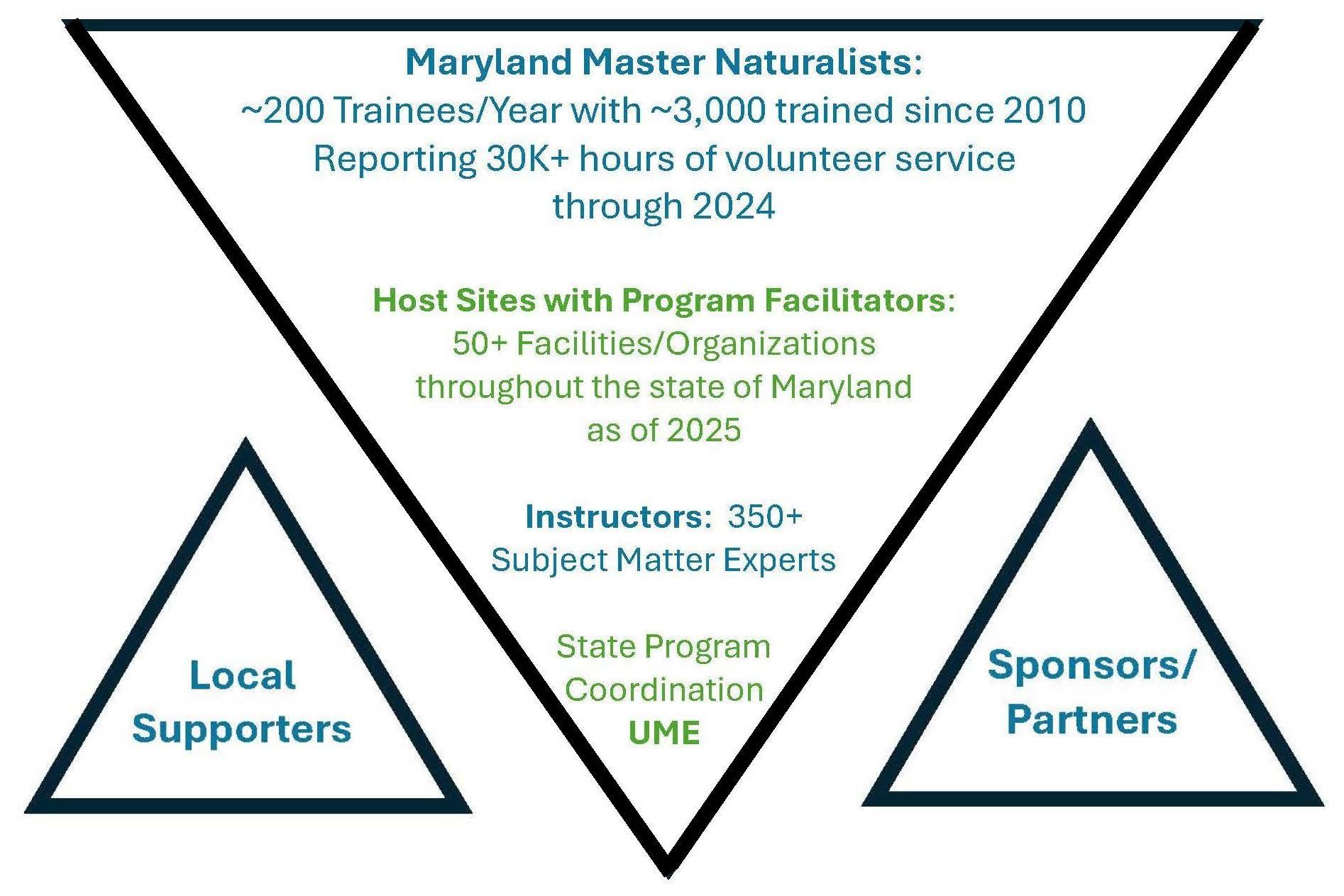
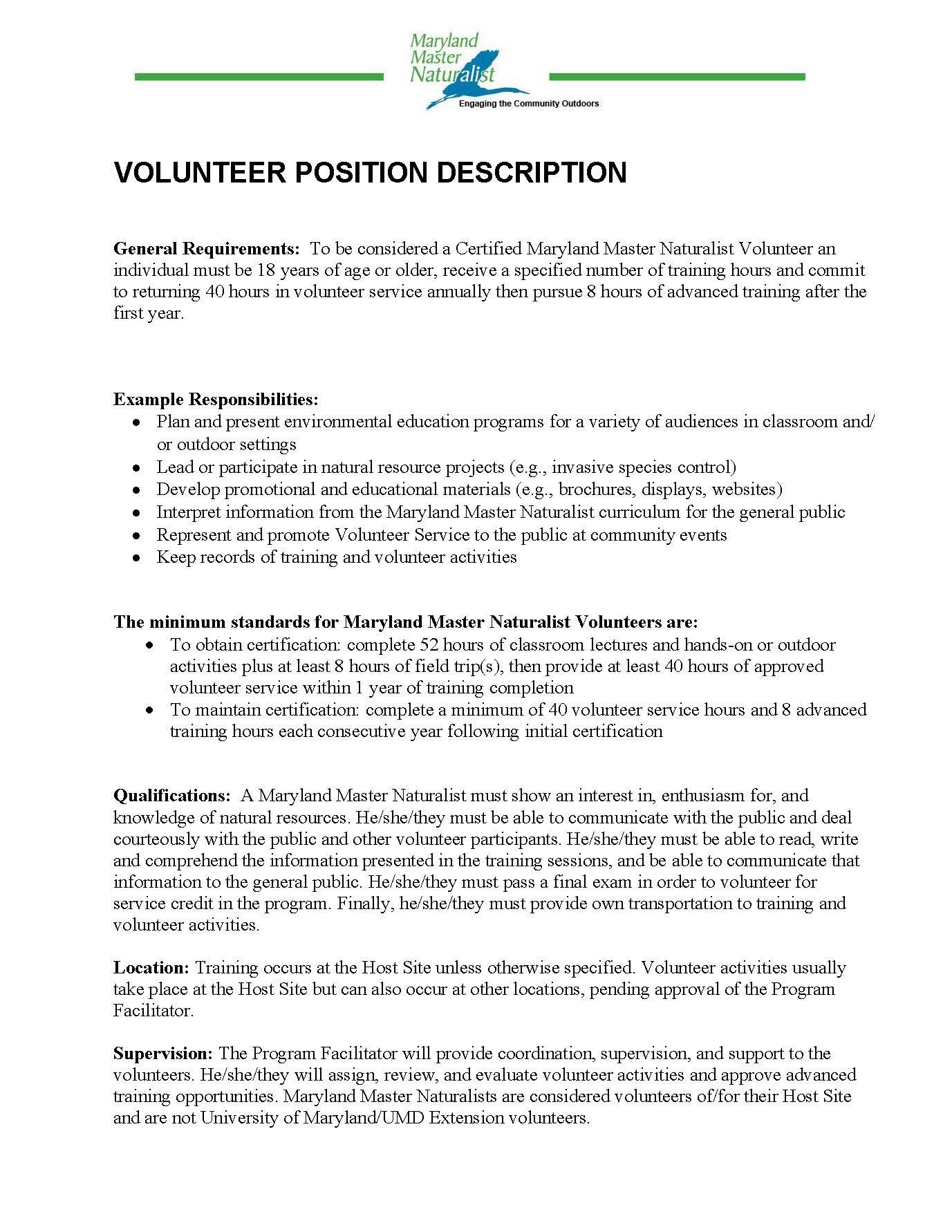
MARYLAND MASTER NATURALIST VOLUNTEERS: To be considered a Certified Maryland Master Naturalist Volunteer an individual must be 18 years of age or older, receive a specified number of training hours and commit to returning 40 hours in volunteer service annually then pursue 8 hours of advanced training after the first year (see Volunteer Position Description).
Program Status Levels:
Trainee: a program participant from acceptance into the program through completion of classroom training and required field trips in the Maryland Master Naturalist Volunteer Training Program.
Intern: a program participant from successful training completion, including passing the final exam, through the completion of the first 40 hours of volunteer service. This Internship is normally completed within 12 months of the end of classroom training. However, Interns may take 2 years to complete their internship upon agreement of the Program Facilitator and/or State Program Coordinator. Anyone who fails to complete the volunteer service requirement does not become a Certified Maryland Master Naturalist.
Certified (Active): an Intern who has completed the initial 40 hour volunteer service requirement. To maintain certified status requires a minimum of 40 hours of volunteer service and 8 hours of advanced training annually and is valid for one calendar year. These service hours are recorded in the state's online Program Management Platform (PMP) and approved by the Program Facilitator. A Certified Maryland Master Naturalist must have a current, signed Volunteer Agreement in the PMP. Certified Maryland Master Naturalists are encouraged to support Trainees and Interns, helping to guide newcomers through a successful volunteer experience. This qualifies as volunteer service. Also see "Mentor" below.
Alumnus: a formerly Certified Maryland Master Naturalist who no longer maintains their annual active volunteer service and/or advanced training requirements. Return to active status after more than 2 years as an Alumnus may require additional training at the discretion of the Host Site Program Facilitator and/or the State Program Coordinator.
Inactive: a formerly Certified Maryland Master Naturalist or Intern who is temporarily unable to fulfill Certified Maryland Master Naturalist requirements. Participants may remain on leave of absence for 1 or 2 years at a time upon the approval of their Host Site Program Facilitator. A notation confirming the Inactive status is placed in the volunteer’s file. Return to active status after more than 2 years as an Inactive Maryland Master Naturalist may require additional training at the discretion of the Host Site Program Facilitator and/or the State Program Coordinator.
Terminated: anyone no longer wishing to be part of the program or someone who has been removed.
Mentor: a volunteer who has maintained their certification status for a period of 2 years and is in good standing with the program and the State Program Coordinator. This individual will act as a resource for knowledge and skill in assisting other volunteers as assigned by their Program Facilitator.
Transfer: anyone from outside Maryland with Master Naturalist-type certification. Must present proof of prior training and certification and must purchase The Maryland Master Naturalist's Handbook. Transfers will be assigned to a local Program Facilitator who will determine Host Site capacity then evaluate the Transfer's training needs and the transfer must submit all necessary forms, comply with Host Site volunteer policy criteria, and successfully pass the volunteer training final exam as a take home test.
PROGRAM FACILITATORS: Individuals who are in the position to administer volunteer programs at their local facility/organization, known as a Host Site, or to coordinate the training and/or volunteer service when it takes place at an alternate site within their region. They are required to schedule Program Facilitator training with the statewide program then schedule/conduct a Maryland Master Naturalist Volunteer Training using The Maryland Master Naturalist's Handbook following core curriculum guidelines, and engage/track their trained Maryland Master Naturalist volunteers.
Program Facilitators will monitor Applicants, Trainees, Interns, and Certified Maryland Master Naturalist volunteers and schedule meetings/activities/opportunities at least once or twice each year to foster a sense of comraderie with their corps of Maryland Master Naturalist program participants.
HOST SITES: Facilities/organizations where a volunteer training program is held and the facility/organization at/for which a Maryland Master Naturalist volunteers. A Host Site must be associated with a trained Program Facilitator who coordinates the Maryland Master Naturalist Program at/for that facility/organization.
There can be multiple Host Sites within one region, and a Host Site application is made to the statewide program.
Chapters: Chapters may be formed and are self-governed by a board made up of officers and committee chairs. They consist of one or multiple facilities within a Maryland physiographic region where volunteers come together for training and volunteer activities. The responsibilities of a Chapter are to recruit volunteer members, plan and produce training courses, and work with local supporters to organize service projects. Chapters are self-supporting.
- Any Program Facilitator associated with an environmental facility, agency or organization wishing to form a Chapter in their local area can apply to the State Program Coordinator.
- A Maryland physiographic region can consist of one or more Chapters.
- A Chapter must have at least one trained Program Facilitator.
- Chapters must adhere to Chapter Guidelines set by the State Steering Committee.
Chapter Representative: Each Chapter has one member designated to sit on the State Steering Committee and to communicate on a regular basis with the State Program Coordinator.
INSTRUCTORS: The Maryland Master Naturalist Volunteer Training Program is taught by qualified instructors in the environmental field using a statewide approved course outline and The Maryland Master Naturalist's Handbook. Instructors may include University faculty, University of Maryland Extension Specialists, Maryland Department of Natural Resources professionals, professional environmental educators, experienced volunteer Maryland Master Naturalists, and other experts with a demonstrated knowledge in the subject matter being taught as well as an ability to communicate that knowledge to a lay audience. Program Facilitators customize the training by including Host Site and/or region-specific activities, speakers, and resources.
STATE STEERING COMMITTEE: Ensures the successful execution of the Maryland Master Naturalist mission. Members are active as chairperson or member of sub-committees that provide guidance in developing program policy, creating training guidelines, establishing curriculum, developing curriculum resources, sponsoring conferences and advanced training, designing a rewards program, overseeing marketing, fundraising and promotional efforts, assisting Host Sites/Chapters in identifying qualified instructors, and in locating needed resources. The committee includes at least one representative from each sponsoring/ partnering agency and at least one Host Site or Chapter Representative from each Maryland region.
Term of service on the Steering Committee is an appointment of one year. Service terms are renewable. The Steering Committee is composed of sub-committees. A Chairperson is appointed for each sub- committee. Steering Committee members are required to serve on at least one sub-committee. Steering Committee meetings will be held up to four times a year. Sub-committees will meet as needed.
Committee members are encouraged to attend all scheduled meetings during their year(s) of service. The duties of the Steering Committee are subject to change based on program needs.
STATE PROGRAM COORDINATOR: Serves as University of Maryland Extension's liaison, working with Program Facilitators, Host Sites, Chapter Representatives, Steering Committee, and Sponsors/Partners as well as the public to oversee the day-to-day operations of the program. Serves as Chapter Advisor as needed. May be aided by a State Program Assistant (funding-depedent) who assists the State Program Coordinator in the development and implementation of the program and maintains communication with the Program Facilitators, Host Sites,Volunteers, and public.
LOCAL SUPPORTERS: Individuals, organizations, non-profits, and citizen groups who want to support the program’s Host Sites with:
- Financial gifts or grants
- Instructors
- A Host Site location
- Equipment and materials
- Volunteer service opportunities
- Advanced training courses
SPONSORS/PARTNERS: Organizations or agencies, granting foundations, and corporations that are environmentally conscious and committed to assisting the program through financial and/or in-kind donations.
A Sponsor may sign a Memorandum of Understanding (MOU) with University of Maryland Extension signifying a long term relationship if they so choose.
This document defines the commitment and contribution agreement for both parties.
Sponsor logos may appear on program printed materials. A sponsor representative has the opportunity to sit on the Steering Committee.
Volunteer Position Description
Volunteer Requirements
MARYLAND MASTER NATURALIST
VOLUNTEER REQUIREMENTS
A Certified Maryland Master Naturalist is a person trained to contribute to environmental education, conservation, research, and other stewardship programs as a volunteer. Volunteer applicants include people interested in natural history and ecology such as retirees, parents, nature lovers, environmental/nature center staff, persons in professional fields such as rangers, biologists, teachers, and others. Participants must be 18 years of age or older.
A Certified Maryland Master Naturalist must submit to being screened, interviewed, and accepted into the training program by a Host Site offering the training. Persons participating in the volunteer training will be charged a fee which will be used to cover the cost of The Master Naturalist's Handbook, support statewide program administration and State office staff, and possibly provide additional publications, supplies, and materials. Participants are considered Trainees until they complete the 60 hours of classroom and field trip requirements and pass the final exam, then they are considered Interns and can begin accruing their required volunteer hours for certification. Once a minimum of 40 hours of service has been performed, reported, and approved, they become Certified Maryland Master Naturalists. Maryland Master Naturalists are considered volunteers of/for their Host Site and are not University of Maryland/UMD Extension volunteers.
PROGRAM PARTICIPATION REQUIREMENTS
Core Curriculum: 60 hours total
- Must complete the training: a minimum of 52 hours which include classroom lectures, labs (at least 10 hours of the course spent in hands-on experience), group projects, class presentations, etc., plus a minimum of 8 hours of off-site field trip(s). Classroom lecture time may include brief breaks; lunch is not counted in the 60 hours.
- Must pass the final exam: an open-resource take-home assessment with ample retake opportunities and support to achieve a passing grade of at least 70% as scored by the Program Facilitator.
Volunteer Commitment
- 40 hours of volunteer service under the supervision of a Program Facilitator
- May be a self-directed activity with the approval of a Program Facilitator
- Opportunities are developed by local supporters and Host Sites
- Placements are aligned with individual skills and determined by Host Site Program Facilitators
Annual Re-Certification Volunteer Service and Advanced Training
- Minimum of 40 additional hours of volunteer service annually, and
- Minimum of 8 hours of advanced training annually, which may consist of lectures, educational field experiences, conferences, briefing sessions, or coursework (in-person or online)
- Maintain a current Volunteer Agreement signed/dated every 3 years in the online PMP
BENEFITS OF BECOMING A
MARYLAND MASTER NATURALIST VOLUNTEER
- Opportunity to attend basic and advanced training programs on environmental issues
- Learn new skills
- Meet and work with other people with similar interests
- Gain personal satisfaction from volunteering
- Declare allowable, non-reimbursed, out-of-pocket expenses for income tax purposes
RESPONSIBILITIES OF MARYLAND
MASTER NATURALIST VOLUNTEERS
- Follow the guidelines and procedures set forth in these pages and those of the Host Site
- Be considerate, respect others' competencies and work as a member of a team with all professional and volunteer staff
- Accept assignments within their comfort level and that are compatible with personal interests and skills
- Keep an accurate record of volunteer service and advanced training hours and enter this information on a regular basis in the state online Program Management Platform (PMP) for review by the Program Facilitator
- If the Host Site has a volunteer reporting process/system, also comply with those requirements
- Attend regularly scheduled Host Site meetings and actively participate whenever possible
- Help new volunteers feel accepted
- Stay in good standing with the Host Site
RESPONSIBILITIES OF EXTENSION
- Provide Program Facilitators with the necessary training and materials to carry out Maryland Master Naturalist Volunteer Training programs
- Promote program activities and events through state communication channels
- Provide feedback to help improve trainings
APPLICATION, INTERVIEWING/SCREENING, AND SELECTION
Each Maryland Master Naturalist Prograram applicant must:
- Complete an application (this information will help the Host Site/Program Facilitator determine suitability of the applicant to the program)
- Participate in an interview
- Have at least 2 references verified
- Submit to and pass Host Site background check protocol
Selection for the program is managed solely by the Host Site and/or Program Facilitator. Screening is necessary to ensure selection of persons suited to the program and volunteer service at/for the Host Site. The interview is conducted by the Program Facilitator or their designee. Host Site staff and/or volunteers may be used in conducting interviews and checking references. To maintain confidentiality, those persons checking references and conducting interviews may be required to sign a separate confidentiality statement with the Host Site. An interview (formal or informal) must be conducted with each applicant either in person or by phone using a recommended list of questions. Individual interviews are preferable to group interviews, since this format better ensures candid and confidential responses.
BACKGROUND AND REFERENCE CHECKS
- Each Host Site has its own background check protocol and every applicant is expected to participate fully and completely in that process, the results of which will determine whether or not the individual will be accepted as a volunteer at/for that Host Site
- The interviewer is required to check the Maryland Sex Offender Registry for each applicant
- If references or other screening procedures indicate that further clarification of a person's qualifications is required, fingerprinting may be necessary and at the discretion of the Host Site/ Program Facilitator
- Reference checks provide additional insight into how well the applicant can work with others. They may also provide additional information about the applicant that could be useful in matching the skills of the volunteer with the service required
- A reference check may be conducted by phone or by mail using a recommended list of questions, and a minimum of 2 references is required
CONFIDENTIALITY
All personal information, verbal or written, collected from applicants is to be treated as confidential information. Any/all hard copies of applications, interview responses, and evaluation information must be kept in a locked file, and electronic files must be secure. Only those responsible for supervision of volunteers and reference checking of applicants should have access to confidential information. Host Site volunteer records are to be kept in separate files in a secured place accessible only by trained staff. This is necessary for liability reasons and for the protection of the volunteer as well as program clientele. It is the responsibility of the volunteer to make sure that the contact information on their application and service record are kept current and accurate with both the Host Site and in the state PMP.
APPLICANT NOTIFICATION
The applicant should be informed by the Program Facilitator as to the decision of acceptance or non- acceptance. Payment of the registration fee to the University of Maryland for the volunteer training is required upon acceptance into the program.
REGISTRATION
Once accepted into a Maryland Master Naturalist Volunteer Training Program by a Host Site/ Program Facilitator, an applicant will be invited to register for the training. Follow all directions and adhere to all deadlines provided by the Program Facilitator. Failure to do so may result in loss of the opportunity to join that training. All Trainees must be registered in order to participate in the program.
Registration Process:
- Pay the stated registration fee to the University of Maryland
- Review and sign the Volunteer Agreement
- Review and sign or decline the Photo Release
- Complete any materials required by the Host Site
Registration Fee Refund/Reimbursement Policy:
- A non-refundable $25 processing fee is included in the registration fee
- If an individual withdraws from a volunteer training up to 6 weeks prior to the first class they
- If an individual withdraws within the 6 weeks prior to but before training begins, and the Program Facilitator can fill their slot, the registration fee may be refunded minus the $25 processing fee, however if the Program Facilitator is unable to fill that slot, then the registration fee is forfeited
- If an individual withdraws from a volunteer training after it has begun, they forfeit their registration fee and must return their Handbook
- Forfeited registration fees cannot be transferred to a future training without the Program
- may receive a refund minus the $25 processing fee
- Facilitator's express consent
CLASS ATTENDANCE AND MAKE UP PROCEDURES
A Trainee is expected to attend every class session, including the field trip(s). A missed session must be made up. There must be an agreement between the two facilitators if a makeup class is at another Host Site. Field trip day(s) count as class and attendance is mandatory for certification. If a field trip is missed due to unforeseen circumstances, the Program Facilitator must approve an alternate selection. A relevant advanced training class (approved by the Program Facilitator) can count as a make-up. If an advanced training class is used as a make-up, then for that individual, it does not also count as advanced training.
QUIZZES AND EXAM
It is recommended that pre- and post assessments be administered by instructors. Instructors may incorporate quizzes into the training program as they see fit. All Trainees must pass a final exam. This exam will test the Trainees‟ basic knowledge of a broad range of natural resource topics and basic ecological principles. Near the end of training, the Program Facilitator will distribute an open resource final exam and give Trainees at least one week before collecting completed finals. The finals will be graded by the Program Facilitator with a passing grade of 70 percent required for the Trainee to progress to Intern. If a Trainee does not have a passing grade, the Program Facilitator can provide opportunities to improve the grade until the Trainee passes. Once the final has been graded and a Trainee passes, a certificate of training completion is earned and the Trainee becomes an Intern. Certificates will be distributed to Interns in a manner determined by the Program Facilitator.
RECORD KEEPING AND COMMUNICATIONS
- Host Sites/Program Facilitators are responsible for maintaining contact with all Maryland Master Naturalist volunteers they train and for coordinating programs with the State Program Coordinator.
- The Maryland Master Naturalist Program's online Program Management Platform (PMP) interactive website accepts applications and registrations, and provides volunteers with the means for signing the Volunteer Agreement and Photo Release Form as well as entering and tracking volunteer hours and advanced training hours. It also has the capacity for Program Facilitators and/or the State Program Coordinator to send e-mail reminders, conduct instructor communications, and manage other data sharing and recording. Host Sites may also have their own online Volunteer Management Systems (VMS). Maryland Master Naturalists are expected to utilize this/these platform(s).
- Each Trainee will be entered into the state's GoogleGroup Listserv to ensure access to statewide communications. Host Sites may also have their own means of communicating.
- Alternative communication modes may be made available by the Host Site/Program Facilitator, upon request, to individuals without access to computers and e-mail.
Recognition and Benefits
RECOGNITION AND BENEFITS
Those individuals who complete their training and required service hours will receive:
- Access to the statewide Program Management Platform (PMP) for volunteer service and advanced training hours reporting
- Statewide GoogleGroup Listserv inclusion/access
- A Maryland Master Naturalist Volunteer Training certificate of completion and transition from Trainee to Intern status
- A Certified Maryland Master Naturalist certificate and transition from Intern to Certified status
- Milestone service recognition icon
- Nomination for awards as merited/available
What Constitutes A Master Naturalist Volunteer Service Activity?
WHAT CONSTITUTES A MASTER NATURALIST
VOLUNTEER SERVICE ACTIVITY?
The activity must be consistent with the Maryland Master Naturalist Program mission.
The purpose of volunteer work is to provide a service to the community with regard to natural resources, and to help the volunteer gain knowledge and experience. Projects must either involve educating the public or enhancing the natural resources of the state. All ideas for volunteer projects must be approved in advance by the Program Facilitator. If the Program Facilitator has difficulty deciding whether a project is appropriate, they should consult with the State Coordinator. The first 40 hours of the first year volunteer activities (during the Master Naturalist Intern period) should be conducted at, or to the benefit of/on behalf of, the site which hosted the Master Naturalist's training. Subsequent service hours during the first year can be performed offsite at the approval of the Program Facilitator.
Volunteer activity requirements for successive years may occur elsewhere but still require the approval of the Program Facilitator. All volunteer hours should be recorded by the volunteer in the online Program Management Platform (PMP). Planning meetings and events, committee and administrative work, and time spent preparing for activities should also be included and recorded.
What counts as volunteer hours? Any activity that benefits, enhances or educates the public about Maryland natural resources counts as volunteer service hours. An activity that primarily benefits the volunteer (planting/ maintaining a native plant garden in own backyard) will not count as volunteer hours. Only Maryland Master Naturalists scheduled to give a presentation may include preparation time as part of volunteer service hours. Travel time can be counted in excess of 30 minutes. Advocacy work cannot be counted as volunteer time. See the next page for suggested examples of volunteer service and note that this list is neither exhaustive nor exclusive.
Suggested examples of volunteer service may include:
Education/Interpretation, Public Information, etc.:
- Educators at natural areas answering questions and as a resource for visitors
- Educators at teaching stations
- Program assistance at public events, informational/educational booths
- Demonstration site creation, interpretation, and maintenance
- Outreach activities for environmental organizations
- Lead public education/talks to community groups, school groups
- Design, creation or production of communication materials
- Write or edit brochures, fact sheets and other educational material
- Local land stewards
- Public field trips such as nature hikes
- Lead environmental workshops
- Develop audiovisual materials
Field/Research/Surveys:
- Field assistants for species and natural community surveys
- Data collection
- Research
- Early Detection/Rapid Response network for invasive species
- Conservation projects such as restoration assistance
- Wetland sampling, classification, and mapping
- Bird banding, census counts of other flora/fauna
- Plant collection and herbarium assistance
- Ecological inventory of public lands
Habitat & Interpretive Facilities Enhancement/Development:
- Wetland restoration
- Trail building and maintenance
- Erosion control
- Building boardwalks, observation platforms, kiosks
- Construction and placing of next boxes
- Organizing stream cleanup
- Weed removal
- Trail maintenance
Administrative Coordination for a Host Site:
- Planning or coordinating a Maryland Master Naturalist volunteer training or advanced training
- Serving on a board or committee
- Maintaining volunteer data
- Editing/writing newsletter/communications
- Clerical work
- Communications coordination
- Photography
- Social media
Volunteer Service & Project Guidelines
VOLUNTEER SERVICE & PROJECT GUIDELINES
Volunteer Service
Volunteer service hours are those direct contact hours spent on Maryland Master Naturalist projects approved by Program Facilitators, Host Sites, or local Chapters. Time spent on Host Site or Chapter leadership positions, such as serving as a Board or Committee member, should also be eligible for service hours credit. Host Sites and Chapters, at their discretion, may limit the number of such volunteer hours credited to the individual's annual volunteer requirement.
Service may involve a series of short, unrelated volunteer experiences, a long-term commitment to a single project or resource, or anything in between. A Maryland Master Naturalist may earn their hours working independently or as part of a team. Maryland Master Naturalist volunteer hours can come in the form of outreach, such as educational or interpretive services, assistance to statewide sponsor or local partner programs and/or research, or simply manual labor that benefits local natural resources.
For a Maryland Master Naturalist volunteer, the opportunity to do meaningful and interesting work is the reward. Maryland Master Naturalist trainees will vary in their abilities. Some will want volunteer opportunities to be presented to them, while others will see a need and want to design their own project. Maryland Master Naturalists should be encouraged to design volunteer projects that are interesting to them and capitalize on their individual talents. Volunteer service must be dedicated to the beneficial management of the natural resources and natural areas within their communities and the service must be for public benefit, not personal gain or private use.
Much of the time, Maryland Master Naturalist volunteers are volunteering with state agencies and other organizations. Maryland Master Naturalist volunteers should follow any volunteer guidelines of the organization for which they are volunteering. These may include a separate application and screening, additional training, and additional reporting of volunteer hours. It is fine if both the organization and the Maryland Master Naturalist program, Host Site or Chapter each recognize and count those volunteer hours. Maryland Master Naturalist volunteers who are also Maryland Master Gardener volunteers should choose which program they are representing for any given volunteer hours. Volunteer hours between these two programs may not be simultaneously counted. We refer to this as Double Dipping and it is strictly prohibited.
Out-of State Volunteer Service
Individuals who live in states neighboring Maryland are still welcome to participate in the Maryland Master Naturalist program. Their volunteer service must be done in Maryland or on behalf of a Maryland-based Host Site in order to count towards the program. There may be opportunities for regional projects that cross state borders, and those may be evaluated by the State Program Coordinator and/or Program Facilitators/Host Sites on a case-by-case basis.
Maryland Master Naturalist Volunteer Projects
& Private Organizations & Landowners
Not all projects must be done on public lands or with public organizations. Projects with private not- for-profit organizations that have natural resource or environmental education missions are acceptable (i.e., arboreta, conservancies, non-municipal nature centers, etc.). With these projects, volunteers must still adhere to the No Advocacy guideline for the program. Projects on other private lands (such as individual landowner properties) may be approved, but must have a clear public benefit that outweighs any financial gain to the landowner. The project should directly benefit natural resources in the broader locality. Program Facilitators should evaluate proposed projects to ensure they are not simply performing free landscape work on private lands. If Maryland Master Naturalist Host Sites are offering programs for individuals or private organizations such as private schools, they must ensure that these programs also are available to other individuals and private organizations in the community in order to avoid discrimination.
GUIDELINES FOR WORKING WITH THE PUBLIC
- Identify self as a Maryland Master Naturalist volunteer when participating in events. Always wear a name badge associating you with your Host Site.
- Do not endorse brand name products or recommend a particular company.
- A Maryland Master Naturalist may be asked to make presentations for special events, fairs and festivals conducted by individual businesses. Businesses may offer honoraria to the Maryland Master Naturalist program/Host Site(s) for specific services. This type of activity is permitted as long as the following criteria are met:
- Limited to a single event, or well-defined series of special events
- Does not overwhelm volunteer resources or reduce effectiveness of other activities
- Will further the educational goals of the program
- Made available to other similar businesses to avoid the appearance of partiality
- The presence is advertised and promoted prior to the event
- The identity and affiliation of the Maryland Master Naturalist is clear and unmistakable
- Maryland Master Naturalists will be given a separate designated area to educate customers to help maintain our reputation for impartiality and objectivity
- See section below, Accepting Money for more information
WORKING WITH OTHER AGENCIES
AND ORGANIZATIONS
Educational and volunteer efforts are often furthered through cooperative programs with other groups. Formal partnerships must be approved by the State Program Coordinator.
USING MASTER NATURALIST TITLE/ACCEPTING MONEY
- Only active, Certified Maryland Master Naturalists may call themselves a Maryland Master Naturalist.
- A Master Naturalist cannot lend his/her/their name and title to promote or advertise a private business (e.g. wearing a Maryland Master Naturalist name tag while working for a business as a paid employee). An implied association with or endorsement of a commercial product or business is improper and grounds for dismissal from the program.
- Maryland Master Naturalists may present their title and qualifications as Certified Maryland Master Naturalist Volunteers on job applications.
- Maryland Master Naturalists are expected to identify themselves as such only when doing unpaid public service work under the auspices of the program. Volunteers are advised not to advertise their place of business that they own or where they are employed. Because the program is a source of unbiased, research-based information, the following are considered inappropriate: appearing as a commercial activity, having association with commercial products, or giving implied University endorsement of any product or place of business.
- When asked to make presentations to groups, Maryland Master Naturalists may accept honorariums which are used to support program goals and activities and must be given to the Program Facilitator for program use. Under no circumstance should volunteers accept money or gifts for themselves for services provided while acting as a Maryland Master Naturalist.
PROTOCOL FOR WRITING/EDITING/PRODUCING
EDUCATIONAL MATERIALS
- Ask for permission and give proper credit to information sources used in articles for Maryland Master Naturalist newsletters and other print or electronic media.
- Articles for local newspapers or electronic media, Maryland Master Naturalist newsletters, and other materials developed by volunteers must be reviewed and approved by the Program Facilitator or State Program Coordinator prior to distribution or release.
- All educational materials purchased and/or developed by/for the state program (e.g. slides, photography, PowerPoint presentations, tools, herbarium mounts, books, etc) are the exclusive property of the Maryland Master Naturalist Program, University of Maryland Extension. When purchased and/or developed by/for a Host Site or Sites, these materials are the exclusive property off that/those Host Site(s).
Advanced Training
ADVANCED TRAINING
Advanced training helps Maryland Master Naturalist volunteers continually refresh and increase their knowledge and understanding of Maryland ecosystems. To maintain Certified status, Maryland Master Naturalists must obtain a minimum of 8 hours of advanced training annually after becoming certified (this is not required while an Intern). In order to receive credit, the volunteer must report training hours in the online PMP by the end of each calendar year though it is helpful to report hours as they are accrued. All advanced training is subject to review and approval/rejection by the Program Facilitator. Any questions regarding the validity of an advanced training activity should be directed to the Program Facilitator prior to engaging in that activity. Advanced training hours may not include travel time, but may include meal and break times.
Advanced training promotes continued learning and development by requiring volunteers to pursue opportunities to focus on specific topics that interest them and support their volunteer service at the Host Site. Advanced training should not duplicate any content that has been covered in the initial training but should cover the subject in more depth or from a different, yet still scientifically valid, perspective. Experienced Maryland Master Naturalists can use advanced training as an opportunity to develop tools/skills with which they can work in more advanced volunteer efforts, possibly with additional responsibilities or leadership roles.
Advanced training opportunities may vary in length and academic rigor and may be made available directly through University of Maryland, UMD Extension, other universities, community colleges, Maryland Department of Natural Resources, parks, natural resources organizations, nature centers, libraries, etc. Many Maryland Master Naturalist Program Host Sites offer programming that satisfies the advanced training requirement.
Program Facilitators should consider the following questions when developing or approving advanced training opportunities. How does the Advanced Training opportunity: Promote continued learning and development of naturalist skills? Provide knowledge and skills that support volunteer efforts? Provide an opportunity to further focus interests in specific topics? Build on the core curriculum covered by the initial training? Provide natural resource information applicable to Maryland? Relate to some aspect of natural history or nature interpretation?
Program Facilitators are encouraged to notify Maryland Master Naturalists of approved advanced training opportunities that exist locally and statewide. The statewide Maryland Master Naturalist GoogleGroup Listserv is a source for locating advanced training opportunities.
An advanced training should:
- Focus on an aspect of Maryland's natural or environmental science/culture/history
- Be a formal training or class
- Take place in Maryland (if in-person) or clearly relate to Maryland (if online)
- Have an outdoor component (ideally)
- Be pre-approved by a Program Facilitator if not in compliance with the above criteria
Some examples that are not Maryland Master Naturalist advanced training:
- Watching a stand-alone TV show/movie/video (even if it is Maryland nature-related) - this IS acceptable if part of a course/event
- Birding with friends
- Identifying trees at your cabin with family
- Reading a Maryland natural history book
Responsibilities of Extension
RESPONSIBILITIES OF EXTENSION
- Provide Program Facilitators with the necessary training and materials to carry out Maryland Master Naturalist Volunteer Training programs
- Promote program activities and events through state communication channels
- Provide feedback to help improve trainings
The Maryland Master Naturalist Program is sponsored by University of Maryland Extension and was founded with the support of the Maryland Department of Natural Resources, the Maryland Association for Environmental and Outdoor Education, the Alliance of Natural Resource Outreach and Service Programs, the Howard County Conservancy, and Nature Forward. Today, more than 50 facilities and organizations around the state serve as Maryland Master Naturalist Program Host Sites.