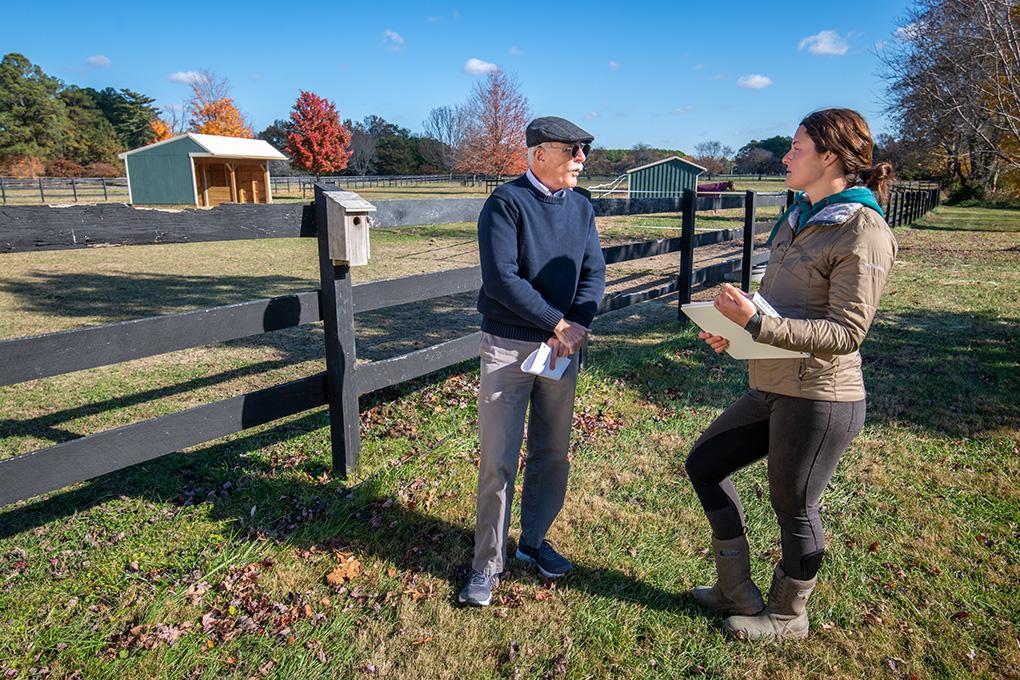
The Agriculture and Food Systems Program has key programs providing assistance and support to the County's agricultural community. In addition, state-wide programs provide comprehensive assistance including marketing, farmers markets, environmental quality and many integrated programs.

Field Scouting

Wheat

June 24, 2025

Poolesville

Growth stage: Feekes 11.4 (mature)

A few kernels sprouting in the field.

June 20, 2025

Laytonsville

Growth stage: Feekes 11.4 (mature)

Yield estimate: 55 bu/A (average of 67, 52, 72, 28, & 57 bu/A in 5 spots throughout the field).

Overall, Fusarium in less than 1% of kernels. In lowest yielding spot, kernels were small or had some type of fungal damage.

June 9, 2025

Laytonsville

Growth stage: Feekes 11.2 (doughy consistency)

Some Fusarium present

June 5, 2025

Poolesville - Fields 1 & 2

Growth stage: Feekes 11.2 (doughy consistency)

Some Fusarium present

May 23, 2025

Poolesville - Fields 1 & 2

Growth stage: Feekes 11.1 (milky ripe)

May 19, 2025

Laytonsville

Growth stage: Feekes 11.1 (milky ripe)

May 14, 2025

Poolesville - Fields 1 & 2

Growth stage: Feekes 10.5.4 (beginning of ripening and maturation)

May 9, 2025

Laytonsville

Growth stage: Feekes 10.1 (heading); some heads just starting to flower


May 2, 2025

Poolesville - Field 1

Growth stage: Feekes 10.1 (heading)

Cereal leaf beetle: high population of larva (1-3 per flag leaf), with a few adults found throughout the field. Threshold is 1 larvae per flag leaf, especially if prior to heading.

Beneficial insects present include lady beetle larva and spiders.

Poolesville - Field 2

Growth stage: Feekes 10.1 (heading)

Cereal leaf beetle: 0-1 larva per plant


April 24, 2025

Laytonsville

Growth stage: Feekes 9 (ligule of flag leaf visible)

Insects present: aphids (avg of 3 aphids per 10 sweeps); cereal leaf beetle (very low population); spiders

Soil moisture: very dry in top inch; a little bit of moisture at 3-4 inches

Disease present: powdery mildew on lower leaves

Powdery mildew threshold: average of 5 pustules in the upper leaves. For fungicide ratings, see the Fungicide Efficacy for Control of Wheat Diseases from the Crop Protection Network.

Corn

Aug. 18, 2025

Poolesville

Growth stage: R6 (physiological maturity)

102 day corn

Grey leaf spot scattered on lower and upper leaves.

No western bean cutworm or fall armyworm moths caught in traps.

July 29, 2025

Poolesville

Growth stage: R4 (dough)

102 day corn

Some grey leaf spot present on lower leaves.

No western bean cutworm or fall armyworm moths caught in traps.

July 16, 2025

Poolesville

Growth stage: R3 (milk)

102 day corn

The top several rows of kernels not pollinated (likely due to hot, dry weather). One ear had corn earworm feeding (sweet corn nearby).

June 5, 2025

Poolesville

Growth stage: V6-V7

Estimated plant population: 30-31 plants per acre

Insect pests present (none of concern): tarnished plant bug, weevil species

Beneficial insects present: lady beetles, spiders

May 23, 2025

Poolesville

Growth stage: V5

Corn has outgrown slug damage.

General notes for this time of year: Summer annuals (pigweeds, foxtail, crabgrass, etc.) beginning to emerge. As we approach sidedressing, take note of yellowing corn in low areas that sat wet.

May 14, 2025

Poolesville

Growth stage: V4

Slug damage: minor, and only in pockets across the field.

May 2, 2025

Poolesville

Growth stage: V1

Soil moisture: dry on surface; some moisture in 2-4 inches (estimated 25% available water holding capacity based on NRCS’ Estimating Soil Moisture by Feel and Appearance)

Soybeans

Sept. 3, 2025

Poolesville

Double crop beans: R5 (beginning seed). Aphids still present, but in lower numbers than last week. Still lots of predators (lady beetles and green lacewings) to continue to keep the population in check.

Aug. 28, 2025

Poolesville

Double crop beans: R5 (beginning seed). Beans filling out pods on lower part of the stem; pods on upper part of stem just beginning to fill out. Aphids present in moderately high numbers (150-200/plant); threshold is 250/plant. High number of lady beetle adults and larvae also present (2-4/10 sweeps). Low numbers of brown marmarated stink bugs, green cloverworm, green stinkbug, silver spotted skipper, and spiders present.

Aug. 18, 2025

Poolesville

Full season beans: R5 (beginning seed). Beans filling out pods on lower part of the stem. Minimal insect feeding on leaves. Insect pests present: Japanese beetles, brown marmorated stink bug, and silver spotted skipper (all low numbers).

Double crop beans: R3 (beginning pod). Pods starting to develop at the uppermost nodes. Lots of lady beetle adults and larvae present (3-4 per 10 sweeps)! Other beneficial insects present include spiders, and spined soldier bug. Insect pests present include green cloverworm, potato leafhopper, green stinkbug, and tarnished plant bug (all low numbers).

July 29, 2025

Poolesville

Double crop beans: R1 (beginning flowering). Minimal insect feeding on leaves. Insect pests present include green cloverworm, potato leafhoppers, and Japanese beetles (all low numbers). Beneficial insects present include spiders and lady beetle larva.

July 16, 2025

Poolesville

Full season beans: R3 (beginning pod). Minimal insect feeding on leaves. Insects present include Japanese beetles, green cloverworm, and bees

Double crop beans: V3; minimal insect feeding.

June 24, 2025

Poolesville

Growth stage: R1 (beginning flowering)

June 5, 2025

Poolesville

Growth stage: V2 

Estimated plant population: 125,000 plants per acre

Minor insect and slug feeding

Regrowth on beans whose first true leaves were eaten (cotyledon leaves intact).

May 23, 2025

Poolesville

Growth stage: VC-V1 (first unifoliate leaves beginning to unfold to fully unfolded)

Minimal slug damage and insect feeding.

General notes for this time of year: Continue to scout for slug damage. Summer annuals (pigweeds, foxtail, crabgrass, etc.) beginning to emerge.

May 14, 2025

Poolesville

Growth stage: VE-VC (emergence - unfolding of unifoliate leaves)

No slug damage seen.

May 2, 2025

Poolesville

Field planted.

Sweet Corn

CORN EARWORM TRAPS

DICKERSON

Sept. 3, 2025

280 (31/day; heavy pressure, 2-3 day spray interval)

Aug. 25, 2025 

73 moths (10/day; moderate pressure, 4-day spray interval)

Aug. 18, 2025

Trap deployed

BROOKEVILLE

Sept. 2, 2025

8 moths (1/day); trap taken down

Aug. 27, 2025

81 moths (9/day; moderate pressure, 4-day spray interval)

Aug. 18, 2025

102 moths (8/day; moderate pressure, 4-day spray interval)

Aug. 5, 2025

43 moths (6/day; moderate pressure, 4-day spray interval)

July 29, 2025

Caught 108 moths (15/day; heavy pressure, 2-3 day spray interval)

July 22, 2025

Caught 49 moths (12/day; heavy pressure, 2-3 day spray interval)

July 18, 2025

107 moths (35/day; heavy pressure, 2-3 day spray interval)

July 15, 2025

Trap deployed

POOLESVILLE - LOCATION 1

July 31, 2025

12 moths (0.9/day); trap taken down

July 18, 2025

 49 moths (1/day; low pressure, 5-day spray interval)

July 11, 2025

16 moths (1.1/day; low pressure, 5-day spray interval)

June 26, 2025

27 moths (4.5/day; moderate pressure, 4-day spray interval recommended if between green silk and just before harvest)

June 20, 2025

trap deployed

POOLESVILLE - LOCATION 2

Sept. 3, 2025

45 moths (9/day); trap taken down

Aug. 27, 2025 

107 moths (15/day; heavy pressure, 2-3 day spray interval)

Aug.18, 2025

86 moths (9/day; moderate pressure, 4-day spray interval)

Aug. 8, 2025

63 moths (8/day; moderate pressure, 4-day spray interval)

July 31, 2025

Trap deployed

Vegetables

POOLESVILLE

Aug. 25, 2025

Tomatoes: Some blossom end rot. No aphids, very few white flies.

July 11, 2025

Cucumbers: Some scattered plants showing signs of wilt. Only a few cucumber beetles present.

Onions: White onions ~ 30% ready to harvest

Tomatoes: Some blossom end rot in tomatoes that are close to harvest; check calcium levels in plant.

Zucchini: Some scattered plants showing signs of wilt. 

Research

Manure Injection

Data being analyzed! Information coming soon.

Turf Non-Synthetic Herbicide Efficacy

Data being analyzed! Information coming soon.

Soil Health

Data being analyzed! Information coming soon.

Explore Montgomery County & Statewide Programs

  • Close Encounters with Agriculture Logo

    Close Encounters with Agriculture

    Close Encounters with Agriculture

    Annual award-winning agriculture, environment, and nutrition education program offered to Montgomery County fourth-grade students.

  • Agricultural Nutrient Management Program

    Nutrient Management

    Nutrient Management

    Plan writing assistance provided to farmers.

  • Beginning Farmer Logo

    Small Farm Workshops

    Small Farm Workshops

    Beginning Small Farm Workshop services are offered annually, please contact mocoinfo@und.edu.

  • picture of Strawberries

    Commercial Horticulture

    Commercial Horticulture

    UME provides educational programming and materials, applied research results, and consultations to assist arborists, landscapers, and nurseries. 

  • picture of a man manually spraying crops in a field.

    Pesticide Safety & Training

    Pesticide Safety & Training

    Agricultural assistance provided to producers and businesses with timely information regarding pesticide use. 

  • Apple orchard

    Fruit and Vegetable Production

    Fruit and Vegetable Production

    Assistance provided to increase the productivity and profitability of farmers while protecting natural resources.

  • Bakyard Chickens

    Animal Science

    Animal Science

    Applied research and research-based educational program designed to help growers and managers of beef and dairy cattle, goat, horse, poultry, sheep, and other animals. 

  • Combine harvesting corn

    Agricultural Production

    Agricultural Production

    Program offerings to increase productivity, profitability, and protect soil health, and water quality for row crop producers.

  • Two people practice safe use of hand tools on an urban farm in Baltimore, MD

    Urban Agriculture

    Urban Agriculture

    Resources designed for urban farmers and urban agriculture entrepreneurs.

  • UME Logo

    UME Agriculture & Food Systems

    UME Agriculture & Food Systems

    The University of Maryland Extension conducts applied research and educational programs for grain marketing/production, oilseeds, horticulture, floriculture, livestock, and conservation.

  • Terminating the cover crop with a shielded herbicide application.

    Weed Management

    Weed Management

    The University of Maryland Extension program assist growers in developing effective weed management programs for agronomic and vegetable crops.

  • Small Flock Feed in Store

    Farm and Agribusiness Management Programs

    Farm and Agribusiness Management Programs

    The University of Maryland Extension helps Maryland producers and agribusinesses improve their business management skills, increase profitability, and fulfill long-term goals.

  • Combine harvesting grain

    Grain Marketing

    Grain Marketing

    Grain marketing information as well as topics related to farm risk management including custom rates, crop budgets, and lease agreements.

  • Picture of produce

    Agriculture & Farmers Market Promotion & Regulations

    Agriculture & Farmers Market Promotion & Regulations

    The Agriculture Marketing Program assists individuals with plans, develop profitable, sustainable marketing opportunities to enhance Maryland’s agricultural economy.

  • Solar panel in field

    Maryland Energy Extension

    Maryland Energy Extension

    The University of Maryland Extension program helps facilitate sustainable energy decisions for agricultural producers, landowners, businesses and residents throughout Maryland.

  • MD Flag Shutterstock

    Integrated Programs

    Integrated Programs

    State and Federal program resources for all agriculture-related topics.

Year of the Woman Farmer