
Practices to reduce Listeria prevalence in fruit packinghouses
By Leyu Kalkidan M.S. Student in Plant Sciences & Macarena Farcuh, Ph.D. Assistant Professor and Extension Specialist University of Maryland, College Park.
What is Listeria Monocytogenes and what disease symptoms does it cause?
Listeria monocytogenes is a bacterium naturally found in soil, irrigation water, and animal manure that can contaminate fresh fruit and vegetables and other ready-to-eat or RTE foods. When enough of the bacteria is ingested, it can cause symptoms ranging from mild fever and diarrhea (listerial gastroenteritis) in more healthy individuals, to listeriosis— an invasive human disease which causes seizures or even death in 20-30% of cases. The most sensitive to listeriosis are the elderly, immunocompromised individuals, and especially pregnant women, in which miscarriage can occur due to infection.
How can Listeria Monocytogenes contamination happen and why is it a threat?
In general, Listeria monocytogenes is present everywhere in the natural environment and can enter produce processing or packinghouse facilities through dirt tracked in on shoes or on the surface of produce as well as through contaminated irrigation water. Once produce is contaminated, and enters the packinghouse, Listeria can spread through dump tank and flume water (especially if sanitizer concentrations are not frequently monitored and adjusted) as well as packing line surfaces such as brushes, rollers, and dividers harboring Listeria from previous contact with contaminated fruit. While sanitizers may be applied to packing line surfaces, they may not always kill all Listeria present, especially if time and conditions have allowed the bacteria to multiply and or form biofilms.
Furthermore, Listeria is a unique pathogen. It can grow and survive on cold storage crates/bins (as low as 31°F and survive as low as -0.4°F), in the crevices of hard to clean surfaces (drying fans, underneath the refrigeration evaporator coils, or other hard to reach equipment) for months at a time, and even be found in water pooled around drainage holes where unexpected splashing can contaminate fruit and food-contact surfaces. It can also grow in some acidic and alkaline conditions (grow between pH of 4.3 to 9.4 and survive under 4.3). Moreover, it is also able to develop biofilms, which are a protective layer of sugars and fatty acids the bacteria produce and hide under, like the plaque produced by bacteria on our teeth. Therefore, despite its near uncontrollable prevalence in the packinghouse, its survival abilities and human health risk has caused the FSIS (Food Safety and Inspection Service, USDA) to have a “zero tolerance” policy for Listeria monocytogenes detection in all ready-to-eat foods.
What are some key recommendations for fruit growers and packing houses on reducing Listeria Monocytogenes contamination?
- Water Source is Key: Use potable water for all post-harvest washing, cooling, grading operations. Water taken from wells, springs, creeks, rivers must be filtered and disinfected with chlorine to meet potable water standards.
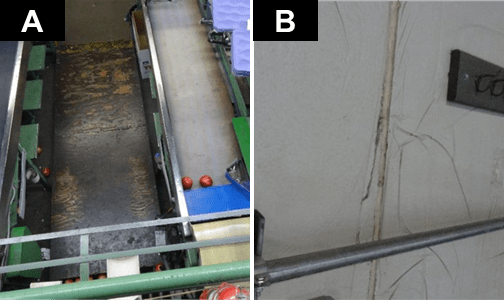
- Create an Environmental Monitoring and Control Program: Assess areas in the facility that are prone to harbor Listeria monocytogenes, including ready-to-eat contact surfaces such as water tanks, conveyor belts and brushes or other water-filled or moist areas in the facility such as floor drainage holes or floors underneath packing lines. Create plans to differentiate, label, and sanitize each high-risk area/equipment (or in some cases plan to replace or rebuild; see Figures 1a and b) and improve the plan over time as Listeria testing is continually conducted before and after sanitizing.
- One way to find high risk sites is by creating a diagram of the flow of foot traffic in the facility as well as product/packaging flow to understand where Listeria-harboring produce and shoes might encounter other components of the operation.
- Listeria can be effectively removed by heat washing (with water at least 170°F) or steaming pre-cleaned (with chemical sanitizer) utensils, tools and other small items or removable equipment parts which has shown effective, especially when already chemically sanitized. Heat wash items that are in contact with RTE foods separately from those that are not and avoid boiling temperature sensitive materials.
- Listeria grows best in high moisture conditions, so reduce areas or points of humidity and moisture accumulation in storage units and all sites of the facility (floors, walls, and non-food-contact equipment). Ensure that “wet” and “dry” equipment are separated to avoid cross contamination (Figure 2).
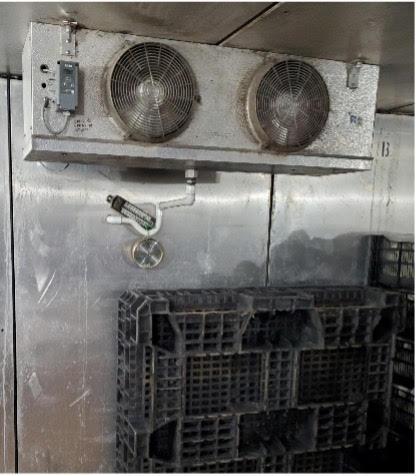
- Avoid storage of fresh fruits and vegetables directly underneath refrigerator evaporation coils as studies have shown that water drippings from such units can commonly contain L. monocytogenes. This can be done by marking a no-product zone on the floor below the refrigeration unit (Figure 3).
- Monitor and Adjust Chlorine/ peroxyacetic acid (PAA) sanitizer Concentrations: Chlorine will inactivate when exposed to dirt and debris (leaves, stems, etc.) and specifically become less effective in pH above 7-8 (most effective in pH 6.5-7). PAA is less affected by debris but still must be tested.
- Use titration or chemically impregnated paper strip kits as well as pH tests to monitor chlorine/PAA concentrations and pH in water storage tanks and flumes.
- Create a plan to test chlorine or PAA-treated water in flume tanks and other water sources hourly, daily or at whatever frequency is needed for operations.
- Reapply PAA/chlorine as needed after testing until maximum limit (4mg/L) is reached or when concentration of chlorine/PAA cannot be reached due to high concentration of debris. Dump out water if maximum chlorine or debris concentrations are reached and restart with potable water (always use potable water if possible).
- Choose Hygienic Materials: Select and maintain food contact surfaces made from materials like stainless steel and 100% nylon, which are easier to clean and sanitize compared to wood, some plastics, and horsehair brushes.
- Implementing Ultraviolet Irradiation Technology: Studies show that ultraviolet irradiation is effective in reducing Listeria and could be a non-chemical sanitizing technique that could achieve similar or higher disinfection without leaving residues or affecting produce quality and taste. If feasible at large scale, consider implementing ultraviolet technology to disinfect certain key points on the packing line. Since ultraviolet irradiation can cause equipment damage and weathering over time (particularly to rubber such as rubber in conveyor belts), consider consulting equipment manufacturers and aim to monitor equipment integrity and quality regularly.
This article appears in May 2026, Volume 17, Issue 4 of the Vegetable and Fruit News