
Fusing together high school education and applied, real-world experience, welding students in the North Point High School Career and Technical Education (CTE) program are receiving real world experience through a project designed to manufacture bigger dredges for oyster farmers.
In aquaculture, dredges are used to drag the seafloor to harvest oysters for sale. Traditional dredges, which haven’t changed since they were first developed in the 1800s, are approximately 42-44 inches in width, says Parker, but increasing the size could help farmers with oyster leases increase their yield, thus becoming more profitable in a challenging industry.
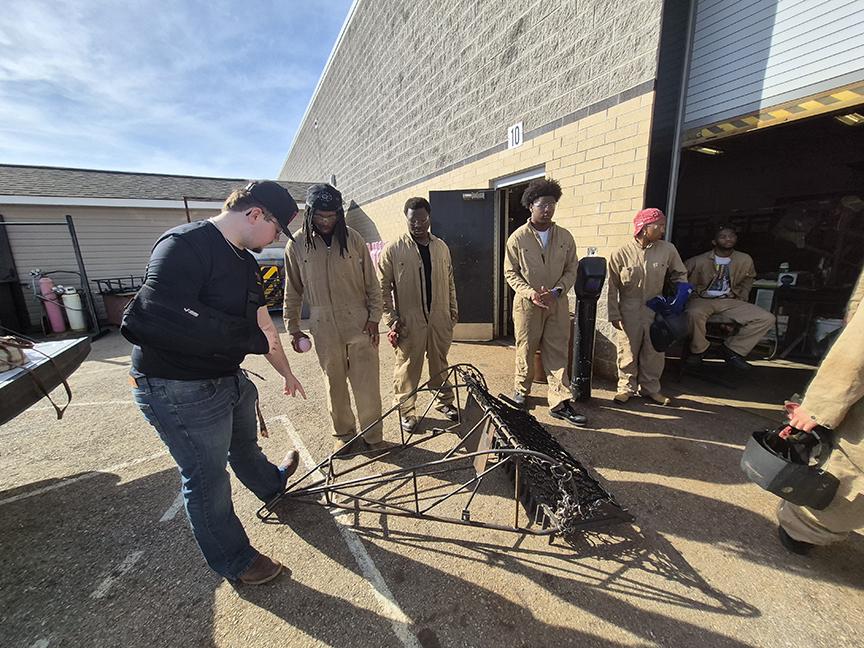
Initiated by University of Maryland Extension (UME) Principal Agent Matthew Parker, the partnership with the North Point High welding program creates a learning opportunity for the students, UME faculty, and the aquaculture industry. “Aquaculture goes back for centuries in Maryland, so this partnership is a great way to involve the kids in a way that they will benefit from in terms of seeing a project from its inception,” said Frank Holiday, welding instructor at North Point High in Charles County, Md.
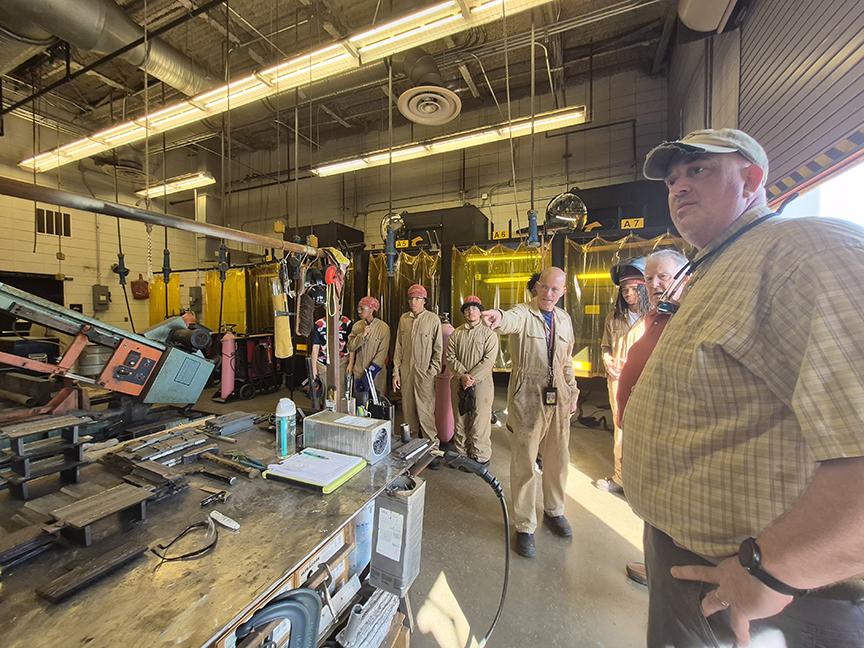
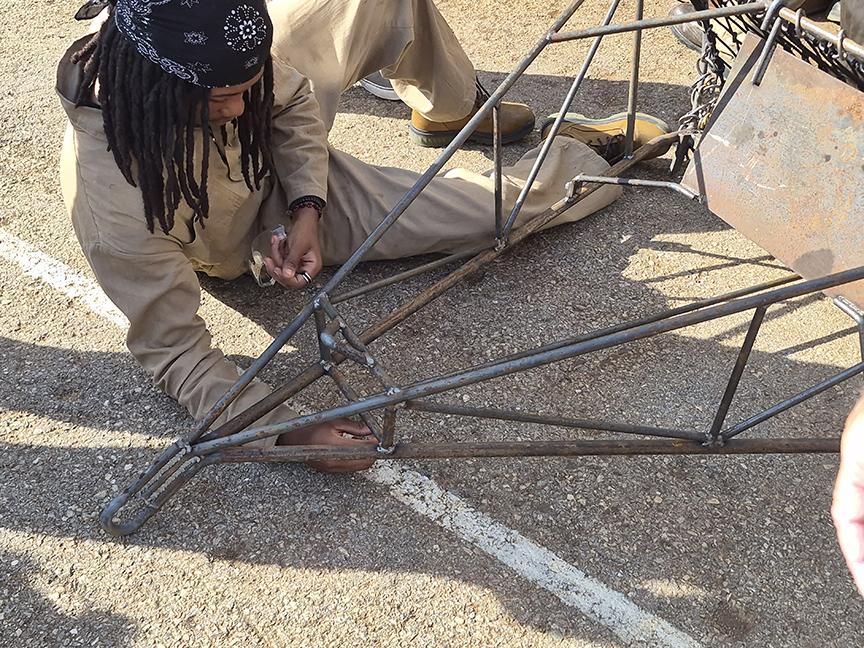
The students will tour Seed to Shuck Ventures, headquartered in Cambridge, Md., to see an equipment manufacturing facility and evaluate a standard dredge to understand what needs to be done to engineer a larger size. They will be privy to the budgeting discussions regarding the funds provided by the U.S. Department of Agriculture - National Institute of Food and Agriculture (USDA-NIFA) grant supporting the project, as well as determining the design, material needs, ordering, and the actual manufacturing of several bigger dredges. They will also be involved in quality control before the dredges are put into the water to be tested for efficacy of the new design.
“We’ve always talked about how we can be better and more efficient at harvesting oysters because the boats are really big, but the dredges are not,” said Parker. “It’s a big mismatch.”
While wild-caught oyster harvesting is regulated by the state which limits the dredge size, oyster farmers using leases are allowed to use larger dredges, but obtaining one can be difficult and expensive for a farmer who isn’t sure it will work on their leased beds. Dredges manufactured by the students will be available for farmers to try out and determine if the investment will be a wise one for their needs. Funding is also available through the grant to assist aquaculture farmers in upgrading their boat rigging to be able to pull the larger size.
The new dredges will be tested by Madison Bay Seafoods on their leases to determine the efficiency, and an environmental assessment will be conducted by the University of Maryland Center for Environmental Science (UMCES) to determine if there are any negative impacts to the Chesapeake Bay.
“The cost of inputs like oyster seed has quadrupled in the last 10-12 years, so you want to harvest as much as you can to be profitable, but you don’t want to go in there with a bulldozer and wreck everything at the same time,” Parker said. “We have to look at both the economic benefits and the trade off in environmental problems, if there are any, and try to maximize them both.”
The CTE students at North Point will be integrally involved in each step of the process learning not only about welding, but also about business, budgeting, design, production, assessment and quality control.
“Everybody always says, ‘in the real world,’ but these kids don’t get to see it till they’re out of school,” said Holiday, who has been teaching with North Point for seven years, and in the fabrication industry for 20 years prior to that. “There’s no better way to incorporate the real world than to bring the real world into the classroom.”
If the larger-sized dredges do work for individual oyster farmers, that could potentially mean less time on the water, the ability to harvest more bushels on a single pass thereby using less gas and energy to harvest, as well as the ability to bring oysters to shore sooner to be cooled to prevent any food-borne illnesses, impacting not only the farmer’s bottom line, but also the consumer looking for fresh, safe oysters.
“We thought it would be some good workforce development for these students to show them some industries they may not have thought of before,” said Parker. “For now this is a one-time project, but maybe other CTE programs will see what we’re doing here and consider more ways to partner with the ag tech sector.”
“In this day and age, it’s challenging to find kids who actually want to work with their hands, so this partnership is a great opportunity,” said Daniel Kaple, principal at North Point High School. “A big part of our vision here at North Point is that we want our students to leave feeling empowered, knowing they can have an impact on their communities, no matter what their career choice.”
To learn more about aquaculture research at the University of Maryland Extension, go to https://extension.umd.edu/programs/agriculture-food-systems/program-areas/animal-science/aquaculture/.