

FS-2025-0749 | April 2026
Using Augmentative Biological Control for Managing Thrips and Mites in High Tunnels and Greenhouses
By Veronica Yurchak, P.h.D., Extension Specialist for Commercial Vegetable Production
Pest Overview
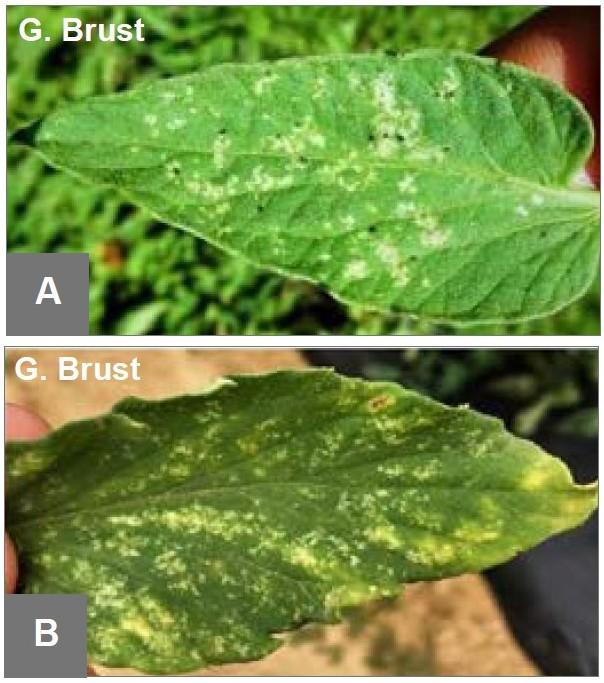
Thrips and mites are significant pests in Maryland high tunnels, responsible for direct feeding damage to crops as well as disease transmission. Adult thrips are small (1/16 in), yellowish-orange insects with fringed wings. They use their rasping-sucking mouthparts to pierce plant tissues and ingest fluids from leaves and fruits. While direct feeding damage by thrips does occur (Figure 1), the primary damage results from the vectoring of diseases such as Tomato spotted wilt virus (TSWV), a serious disease of tomatoes with the potential to cause significant economic losses. Several species of thrips damage Maryland vegetables, including eastern flower thrips (Frankliniella tritici), western flower thrips (Frankliniella occidentalis) onion thrips (Thrips tabaci), and tobacco thrips (Frankliniella fusca).
Depending on temperature, the thrips life cycle may be as short as two weeks, with up to eight generations occurring in a single year. Both the larval and adult stages cause feeding damage, and their broad host range makes management challenging. Early in the growing season, thrips are typically problematic in greenhouses and high tunnels where proper sanitation practices, such as crop debris removal and weed management, are not followed. Several common weed species, including prickly lettuce, chickweed, spiny amaranth, lambsquarters, black nightshade, and shepherds’ purse can harbor thrips and act as hosts for TSWV. Following recommended sanitation practices can significantly reduce the likelihood of outbreaks for both thrips and mites.
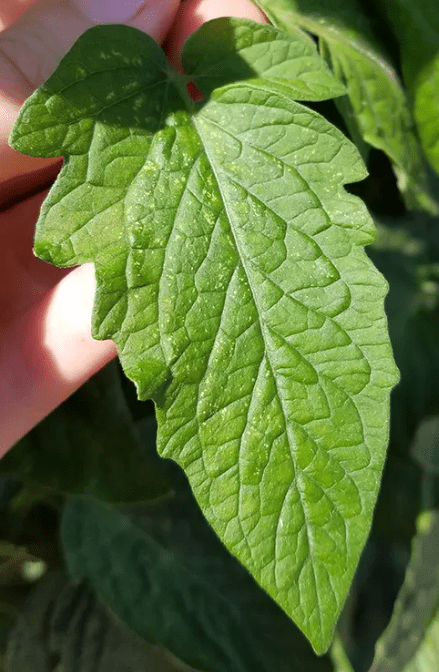
In Maryland, two spotted spider mites (family: Tetranychidae), russet mites (family: Eriophyidae), and broad and cyclamen mites (family: Tarsonemidae) can all contribute to pest damage in greenhouse and high tunnel vegetable production. The warm, dry conditions within these environments favor rapid mite development, enabling them to complete a generation in as little as 5-7 days. Mite damage typically appears as small whitish marks on the top surface of the leaf (Figure 2) and later progresses to cause yellowing, browning, and eventual death of leaves or whole plants. Early detection is key for controlling both thrips and mites, and preventative tactics including the release of biological control agents can successfully delay and/ or prevent large infestations from occurring.
Commercially Available Biological Control Agents:
Augmentative biological control is a pest management tactic whereby natural enemies are intentionally released into an environment to reduce pest populations and prevent outbreaks. Several biocontrol organisms can be used to control thrips and mites in high tunnels (Table 1). The ability of each biocontrol organism to successfully manage a pest will depend, in part, on the size of the pest population when the biocontrol agent is released. Table 1 indicates which biocontrol agents are more suitable for preventative use and which can effectively control an existing outbreak. When choosing a biocontrol agent for augmentative releases, it is important to understand the required environmental conditions for each species, as their efficacy will vary based on temperature and humidity levels. The optimal temperature and humidity ranges for each listed organism can be found in Tables 2 and 3, respectively.
| Biocontrol Organism | Thrips | Spider mites | Russet mites | Cyclamen mites | Broad mites | Feeds on Pollen |
|---|---|---|---|---|---|---|
| Amblyseius swirskii | Preventive | No control | No control | No control | Preventive | Yes |
| Neoseiulus cucumeris | Preventive | No control | No control | Preventive | Preventive | No |
| Phytoseiulus persimilis | No control | Reactive | No control | No control | No control | No |
| Feltiella acarisuga | No control | Reactive | No control | No control | No control | No |
| Neoseiulus californicus | No control | Preventive | Preventive | Preventive | Preventive | Yes |
| Orius insidiosus | Preventive | Secondary target | No control | No control | No control | Yes |
*This table is not a comprehensive list of all commercially available biocontrol agents for thrips and mite
control.
| Biocontrol organism | Optimum temperature range (°F) |
|---|---|
| Amblyseius swirskii | ~72–88 °F |
| Neoseiulus cucumeris | ~55–85 °F |
| Phytoseiulus persimilis | ~58–80 °F |
| Feltiella acarisuga | ~68–80 °F |
| Neoseiulus californicus | ~50–100 °F |
| Orius insidiosus | ~60–95 °F |
| Biocontrol organism | Optimum humidity range |
|---|---|
| Amblyseius swirskii | ~55-85% |
| Neoseiulus cucumeris | ~70-80% |
| Phytoseiulus persimilis | ~60-90% |
| Feltiella acarisuga | ~80-90% |
| Neoseiulus californicus | ~60-75% * can tolerate humidity as low as 40% |
| Orius insidiosus | ~60-90% |
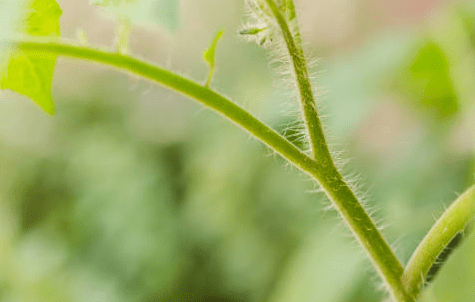
For all biocontrol organisms listed, be sure to check the product recommendations for information regarding release rates within specific crops, as rates can vary between crops. The efficacy of some predaceous mites, for example, is often lower in tomatoes compared to other vegetable crops due to the presence of trichomes, or small hairs, on tomato stems and leaves (Figure 4). Trichomes provide a form of defense for the plant by restricting the movement of insect and mite pests; however, they can similarly impede the movement of predaceous mites over the surface of the plant. As a result, higher release rates are often recommended in tomatoes compared to other crops.
Recommended biocontrol agents for thrips and mite control in high tunnel production include four species of predaceous mites: Amblyseius swirskii, Neoseiulus cucumeris, Phytoseiulus persimilis, and Neoseiulus californicus, as well as one species of predatory gall midge: Feltiella acarisuga. Minute pirate bugs (Orius insidiosus) are generalist predators that can further contribute to overall pest control in high tunnels.
Amblyseius swirskii
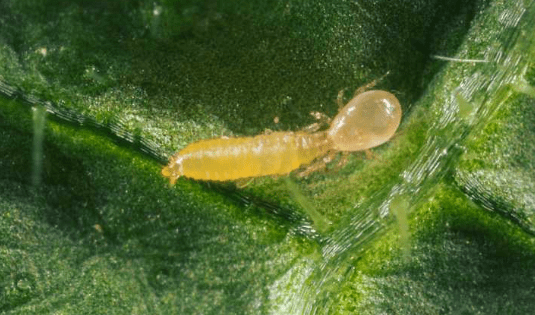
A. swirskii (Figure 3) is a commonly used predatory mite that attacks a diversity of small, soft bodied pests, including thrips and whiteflies. The life cycle of A. swirskii is made up of 5 developmental stages, and development from egg to adult occurs within a week under optimal temperature and humidity conditions. Under favorable environmental conditions, adult mites can live for several weeks and consume about 10 thrips larvae per day. A. swirskii mites are highly mobile and disperse primarily by walking. However, adults will not move far unless prey are scarce or shelter is limited. Although all immature stages and adult A. swirskii mites are predatory, they are only able to attack egg and early larval stage thrips and are therefore most effective when used as a preventative tactic. Releases should therefore occur when thrips populations are low. A. swirskii is not an effective biological control agent for managing pest mite species.
Optimal environmental conditions for pest suppression
A. swirskii mites can develop and reproduce under temperatures ranging from 59°F to 96°F, but optimal conditions for predation have been found to be temperatures between 71°F and 89°F (Table 2) with a relative humidity between 55% to 85% (Table 3).
Neoseiulus cucumeris
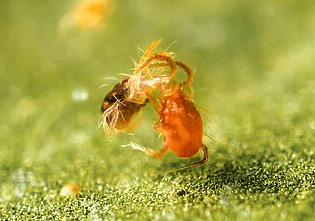
N. cucumeris is a predatory mite recommended for thrips control as well as control of spider, cyclamen, and broad mites in high tunnel production. Both nymph and adult stages are predatory, but all stages will only attack first larval stage thrips. Establishment of N. cucumeris can take up to four weeks and should therefore be made preventatively, before thrips/mite infestations have been detected. Because N. cucumeris will also feed on eggs and immature stages of other predatory mites, they are better used alone or in combination with non-mite biocontrol organisms.
Optimal environmental conditions for pest suppression
N. cucumeris is most effective at temperatures between 54°F and 86°F (Table 2) and 70% to 80% relative humidity (Table 3). Under optimal conditions, adult mites consume an average of one thrips per day.
Phytoseiulus persimilis
P. persimilis (Figure 3) is a specialized mite predator that provides quick knockdown of web-spinning spider mites, including the two-spotted spider mite. Both nymph and adult stages of P. persimilis feed on all developmental stages of spider mites. Adults are voracious predators and can consume up to twenty eggs or mites per day. The development rate of P. persimilis is very similar to spider mites, thus, populations of predatory mites can increase rapidly and reduce spider mite populations very quickly. However, because they are such efficient spider mite hunters, P. persimilis will typically exhaust their food supply over time and starve. Thus, reintroduction during the season may be necessary in the event of an additional pest outbreak, as persistent P. persimilis populations will not occur in the absence of spider mites. Preventative introductions before spider mites are present will result in adult P. persimilis dispersal and cannibalism. Thus, augmentative releases should occur only after mite presence has already been detected.
Optimal environmental conditions for pest suppression
P. persimilis performance is strongly impacted by humidity, with the most effective pest control occurring between 60% to 90% relative humidity (Table 3). Predation is severely reduced when relative humidity falls below 60%. Optimal temperatures for pest control range from 55°F to 81°F (Table 2). P. persimilis will not effectively control spider mites above 86°F.
Feltiella acarisuga
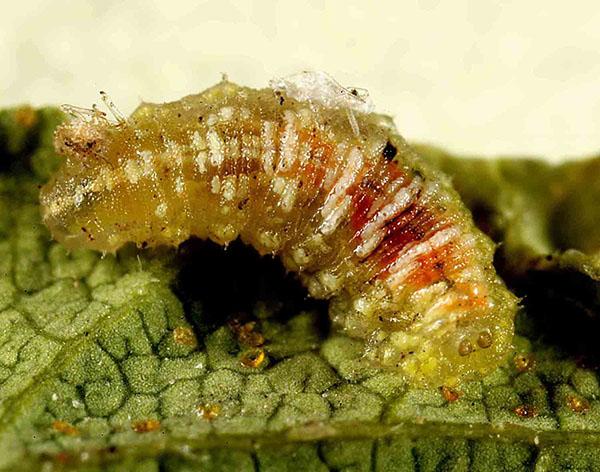
The predatory gall midge F. acarisuga (Figure 6) is one of the most effective natural enemies of spider mites due to their flying and prey detecting capabilities combined with a high feeding potential. The larval stage is predatory and feeds exclusively on all life stages of spider mites, while adult midges feed on nectar. Each larval midge can consume at least 15 adult mites, 30 mixed developmental stages, or 80 eggs per day. Weekly releases have been found to be highly effective for controlling spider mites in tomato, pepper, and cucumber. Predatory midges require relatively large prey populations to become established and are therefore more effectively used to control spider mite outbreaks, rather than as a preventative treatment. Upon release, female adult midges will seek out mite outbreaks to lay eggs, and after hatching, larvae feed exclusively on spider mites. Releases of F. acarisuga can be combined with other species of predatory mites for reactive and sustained spider mite control. Unlike many species of predatory mites, the efficacy of F. acarisuga predation is not affected by the presence of trichomes on stems and leaves, making them a very good option for spider mite control in cucumbers and tomatoes. F. acarisuga is not an effective biological control agent for controlling thrips.
Optimal environmental conditions for pest suppression
F. acarisuga eggs and larvae do not survive above 86°F or below 30% relative humidity. A minimum 50% relative humidity is required for normal development. Optimum temperature and relative humidity for pest control range from 64°F to 80°F (Table 2) and over 80% relative humidity (Table 3), but predation levels will remain constant over a greater range of environmental conditions when prey abundance is high.
Neoseiulus californicus
N. californicus is a predatory mite that feeds on all life stages of a variety of pest mite species. Two-spotted spider mites are the preferred food source; however, they can also be used preventatively for management of broad mites, cyclamen mites, and some species of russet mites. N. californicus is best used against low to moderate pest densities. When used to control existing outbreaks, N. californicus is best used in conjunction with other biocontrol agents.
Several studies have shown N. californicus and P. persimilis can be combined to provide improved spider mite control. During times of especially low prey availability, N. californicus will also feed on pollen. N. californicus is less susceptible to pesticides and may be more compatible with crop management programs with more intensive spray programs than some other predatory mite species. N. californicus is not an effective biological control agent for controlling thrips.
Optimal environmental conditions for pest suppression
N. californicus is effective over a wide range of temperature and humidity conditions. Optimum conditions for mite control range from 54°F to 104°F (Table 2) with relative humidities between 65% and 75% (Table 3). However, unlike other predatory mites, it can tolerate lower humidity levels above 40% relative humidity.
Orius insidiosus (Minute pirate bugs)
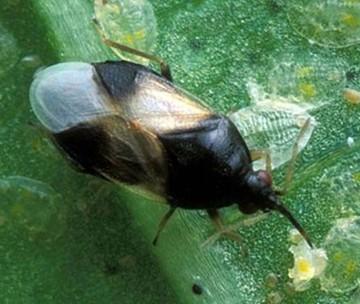
Minute pirate bugs (Figure 7) are generalist predators that feed on a variety of small pest species, including thrips and mites. Further, they are one of the only commercially available biocontrol organisms capable of attacking adult thrips. Immature and adult Orius are predatory and will often continue to kill thrips even when they do not need to eat. When prey is scarce, Orius can survive on a diet of pollen and nectar. Thus, the presence of flowering plants can help increase survival and population establishment in high tunnel systems.
Optimal environmental conditions for pest suppression
Minute pirate bugs perform over a wide range of temperatures (59°F - 94°F; Table 2) and survival rates are highest when relative humidity is over 60% (Table 3).
Tips for Ordering, Storage and Release
When ordering biological control agents, most suppliers require overnight shipping to reduce transport time and ensure live delivery. Keep in mind, however, that live organisms are subject to availability and may not always be available for immediate shipping. In general, ordering earlier in the week and avoiding holidays is recommended. Be sure to check shipping instructions with individual suppliers and remember to account for expedited shipping costs when implementing biological control tactics. Predatory mites can typically be purchased in slow-release sachets (small bags containing mites) or shakers for direct application. Sachets allow for slow migration of mites onto vegetable crops; however, release rates will vary by species and supplier. Upon delivery, use products as quickly as possible; most suppliers suggest using products within 18 hours. If short-term storage is necessary, check recommendations provided with individual products as the environmental conditions for optimum survival during storage will vary with species.
Overall, pest control efficacy is highest when plant leaves are touching, allowing mites to disperse more easily throughout the crop. Shakers are more commonly used in hotspot areas to provide a boost in crops where sachets are already present. For shaker-style products, store horizontally to ensure uniform application across crops. Because the instinct for many insects and predaceous mites is to travel upwards, upright storage of shaker containers will result in a large percentage of mites accumulating in the upper portion of the container, resulting in uneven application.
When purchasing F. acarisuga to combat spider mite infestations, pupae will commonly be shipped in pots, which should be placed on the ground at the beginning of crop rows. Pot lids must be pierced to enable the adult midges to emerge, and releases are most successful when done late at night or early in the morning when environmental conditions are cooler and more humid. Orius releases are also best performed during early morning or late evening to improve establishment success.
Biological Control vs. Pesticides
Biological control agents provide some advantages over pesticide sprays for thrips and mite management in high tunnels. Many of the biocontrol agents discussed work actively against egg and larval stages, which are often very difficult to see/detect. They can also attack pests in small crevices which pesticide spraying often misses. Further, integrated pest management (IPM) recommendations encourage insecticide sprays only when pest thresholds have been reached. Several biocontrol organisms can be introduced before pests become established and therefore serve as an excellent preventative tactic to delay the buildup of pest populations and postpone the use of insecticides and miticides. When chemical controls are needed, the Mid-Atlantic Commercial Vegetable Production Recommendations guide contains recommendations for management of thrips and mites in high tunnels. Table 4 provides information about the compatibility of many of the recommended insecticides available for use in high tunnel vegetable production with the predatory mite species discussed above. Additional preventative releases of biocontrol agents may be needed to maintain low pest densities after a successful pesticide application, depending on the compatibility of the pesticide product used.
| Active Ingredient | A. swirskii | A. cucumeris | P. persimilis | N. californicus |
|---|---|---|---|---|
| abamectin | Likely Incompatible | Likely Incompatible | Likely Incompatible | Likely Incompatible |
| acequinocyl | No data available | Likely Compatible | Potentially Incompatible | No data available |
| azadirachtin | Potentially Incompatible | Potentially Incompatible | Potentially Incompatible | Potentially Incompatible |
| Bacillus thuringiensis var aizawai | Likely Compatible | Likely Compatible | Likely Compatible | Likely Compatible |
| Bacillus thuringiensis var israelensis | Likely Compatible | Likely Compatible | Likely Compatible | Likely Compatible |
| Bacillus thuringiensis var kurtaski | Likely Compatible | Likely Compatible | Likely Compatible | Likely Compatible |
| Beauveria bassiana | Potentially Incompatible | Likely Compatible | Likely Compatible | No data available |
| beta-cyfluthrin | Likely Incompatible | Likely Incompatible | Likely Incompatible | Likely Incompatible |
| bifenazate | Likely Compatible | Likely Compatible | Potentially Incompatible | Likely Compatible |
| bifenthrin | Likely Incompatible | Likely Incompatible | Likely Incompatible | Likely Incompatible |
| chlorfenapyr | Likely Incompatible | Likely Incompatible | Likely Incompatible | Likely Compatible |
| cyantraniliprole + abamectin | No Data Available | No Data Available | No Data Available | No Data Available |
| cyflumetofen | Likely Compatible | Likely Compatible | Likely Compatible | Likely Compatible |
| cyromazine | No Data Available | Likely Compatible | Potentially Incompatible | Likely Compatible |
| deltamethrin | Likely Incompatible | No Data Available | No Data Available | No Data Available |
| dinotefuran | Likely Incompatible | Likely Incompatible | Likely Incompatible | Likely Incompatible |
| etoxazole | Likely Compatible | Potentially Incompatible | Potentially Incompatible | Potentially Incompatible |
| fenpyroximate | Likely Incompatible | Likely Incompatible | Likely Incompatible | Potentially Incompatible |
| flonicamid | Likely Compatible | Likely Compatible | Likely Compatible | Likely Compatible |
| flubendiamide | No Data Available | Potentially Incompatible | No Data Available | No Data Available |
| flupyradifurone | Likely Compatible | No Data Available | No Data Available | No Data Available |
| hexythiazox | Likely Compatible | Likely Compatible | Likely Compatible | Likely Compatible |
| malathion | Likely Incompatible | Likely Incompatible | Likely Incompatible | Likely Incompatible |
| metaflumizone | Likely Compatible | Likely Incompatible | No Data Available | No Data Available |
| methoxyfenozide | Likely Compatible | No Data Available | No Data Available | No Data Available |
| novaluron | No Data Available | No Data Available | Likely Compatible | No Data Available |
| paraffinic oils | Likely Incompatible | Likely Incompatible | Likely Incompatible | Likely Incompatible |
| potassium salts of fatty acids | Likely Incompatible | Likely Incompatible | Likely Incompatible | Likely Incompatible |
| pymetrozine | Likely Compatible | No Data Available | No Data Available | No Data Available |
| pyrethrins | No Data Available | No Data Available | No Data Available | Potentially Incompatible |
| pyridaben | Likely Incompatible | Likely Incompatible | Likely Incompatible | Likely Incompatible |
| pyriproxyfen | No Data Available | No Data Available | No Data Available | No Data Available |
| rosemary oil + peppermint oil | Likely Incompatible | Likely Incompatible | Likely Incompatible | Likely Incompatible |
| spinosad | Potentially Incompatible | No Data Available | Likely Compatible | No Data Available |
| spiromesifen | Likely Compatible | No Data Available | No Data Available | Likely Compatible |
| spirotetramat | Likely Compatible | Likely Incompatible | Likely Incompatible | Likely Compatible |
| sulfoxaflor | Likely Compatible | No Data Available | Likely Compatible | No Data Available |
| thiamethoxam | No Data Available | No Data Available | Likely Incompatible | Potentially Incompatible |
*Compatibility ratings are conservative. Products were rated as “potentially incompatible” if any adverse effects had been reported, even when additional studies reported no effect. Results based on a literature review of numerous studies investigating the effects of pesticides on the predatory mite species listed.
Sources Consulted
Assis, C., Gondim, M., Siqueira, H. (2018). Synergism to acaricides in resistant Neoseiulus californicus (Acari: Phytoseiidae), a predator of Tetranychus urticae (Acari: Tentranychidae). Crop Protection, 106, 139-145.
Fiedler, Z., Sosnowska, D. (2014). Side effects of fungicides and insecticides on predatory mites, in laboratory conditions. Journal of Plant Protection Research, 54(4), 349-353.
Knapp, M., van Houten, Y., van Baal, E., Groot, T. (2018). Use of predatory mites in commercial biocontrol: current status and future prospects. Acarologia., 58, 72-82.
Koller, M., Knapp, M., Schausberger, P. (2007). Direct and indirect effects of tomato on the predatory mite Neoseiulus californicus feeding on the spider mite Tetranychus evansi. Entomologia Experimentalis et Applicata, 125, 297-305.
Kuk, Y., Kim, S. (2018). Effects of selected insecticides on the predatory mite, Phytoseiulus persimilis (Acari: Phytoseiidae). Journal of Entomological Science, 53(1), 46-54.
Lopez, L. (2023). Meet Amblyseius swirskii (Acari: Phytoseiidae): a commonly used predatory mite in vegetable crops. Journal of Integrated Pest Management, 14(1), 20; 1-10.
Mar Fernández, M., Medina, P., Wanumen, A., Del Estal, P., Smagghe, G., and Viñuela, E. (2017). Compatibility of sulfoxaflor and other modern pesticides with adults of the predatory mite Amblyseius swirskii. Residual contact and persistence studies. BioControl, 62, 197-208.
Osborne, R.S., Kumar, V., Leppa, N., Osborne, L.S. (2019). Featured Creatures: Feltiella acarisuga (Vallot). University of Florida. Publication Number EENY-269.
Raworth, D.A. (2001). Control of Two-spotted Spider Mite by Phytoseiulus persimilis. Journal of Asia- Pacific Entomology, 4(2), 157-163.
Van Houten, Y.M., Glas, J.J., Hoogerbrugge, H., Rothe, J., Bolkmans, K.J.F., Simoni, S., van Arkel, J., Alba, J.M., Kant, M.R., Sabelis, M.W. (2013). Herbivory-associated degradation of tomato trichomes and its impact on biological control of Aculops lycopersici. Experimental and Applied Acarology, 60, 127-138.
Willden, S., Schmidt-Jeffris, R., Loeb, G. (2022). Neoseiulus californicus- Predatory Mite Fact Sheet. Cornell New York State Integrated Pest Management.
Wyenandt, A. & van Vuuren, M. (coordinators); Hamilton, G., Hastings, P., Owens, S., Sánchez, E., VanGessel, M., & Wyenandt, A. (eds.) (2026). Mid- Atlantic Commercial Vegetable Production Recommendations, 2026/2027. Available from University of Maryland at https://extension.umd.edu/resource/mid-atlantic-commercial-vegetable-production-recommendations-eb-236/
You, Y., Lin, T., Zeng, Z., Fu, J., Liu, X., Lin, R., Zhang, Y. (2016). Laboratory evaluation of sublethal effects of four selective pesticides on the predatory mite N. cucumeris (Oudemans) (Acari: Phytoseiidae). Systemic and Applied Acarology, 21(11), 1506-1514.
VERONICA YURCHAK
vjohnso4@umd.edu
This publication, Using Augmentative Biological Control for Managing Thrips and Mites in Maryland High Tunnels (FS-2025-0749), is a part of a collection produced by the University of Maryland Extension within the College of Agriculture and Natural Resources.
The information presented has met UME peer-review standards, including internal and external technical review. For help accessing this or any UME publication contact: itaccessibility@umd.edu
For more information on this and other topics, visit the University of Maryland Extension website at extension.umd.edu
University programs, activities, and facilities are available to all without regard to race, color, sex, gender identity or expression, sexual orientation, marital status, age, national origin, political affiliation, physical or mental disability, religion, protected veteran status, genetic information, personal appearance, or any other legally protected class.
When citing this publication, please use the suggested format:
Yurchak, V. (2026). Using Augmentative Biological Control for Managing Thrips and Mites in Maryland High Tunnels (FS-2025-0749). University of Maryland Extension. go.umd.edu/FS-2025-0749