

Understanding Maryland's New Heat Stress Standards
Understanding heat stress and heat-related illness can help maintain safety when working in hot conditions. Among farm workers, heat stroke is the leading cause of work-related death. Maryland's heat stress standard (COMAR 09.12.32) went into effect on September 30, 2024. Maryland Occupational Safety and Health (MOSH) Heat Stress Standards apply to both indoor and outdoor workplaces where employees are exposed to a heat index at or above 80 degrees Fahrenheit for more than 15 minutes per hour. For agriculture this would include outdoor fields and pastures any indoor facilities such as poultry house, dairy barns, greenhouse, ect, where the heat index is above 80 degrees Fahrenheit. MOSH is currently working on developing additional resources and guidance documents. Below is a summary of what you need to know to comply with the standard and some resource to help you and your farming operation. A more detailed list of the requirements can be found online on the MOSH website: https://www.labor.maryland.gov/labor/mosh/moshheatstress.shtml
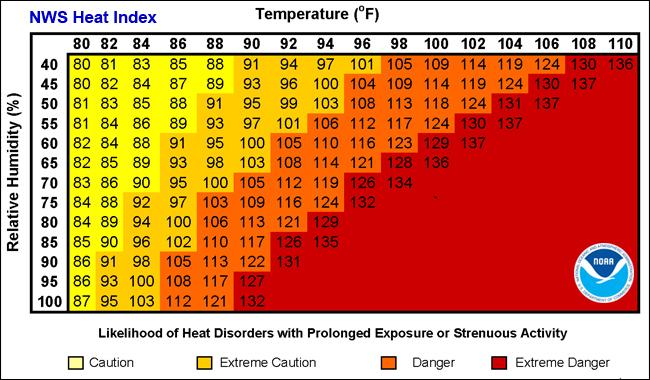
The heat index shall be monitored by the employer throughout the work shift. Heat index can be monitored using direct measurement of temperature and humidity (Figure 1), the National Weather Service, or other recognized sources, or the NIOSH Heat Safety Tool application (https://www.cdc.gov/niosh/heat-stress/communication-resources/app.html). Employers shall develop, implement, and maintain an effective Heat-Related Illness Prevention and Management Plan (HRLPM plan) in writing. This plan must be available to their employees and MOSH upon request. The plan should include but is not limited to information about drinking water availability, spaces for employees to cool-off, procedures for heat acclimatization and trainings on how to recognize the symptoms of heat-related illness and how to respond to suspected heat-related illness. MOSH has created a guide to help employers in developing this plan. It can be found online at https://bit.ly/MOSHHMPGuide . If you like a paper copy, please reach out to your local extension office.
Acclimatization is the physiological adaptation of the body to a hot environment over time. Employees who are newly exposed to heat or are returning from 7 or more days of absence are to be provided with acclimatization for a period of up to 14 days. During the acclimatization period, employees are to be closely monitored through regular observation and/or communication. An acclimatization schedule should be included in the HRIPM plan.
Cooling or Shaded areas are to be provided for employee rest periods. If a shaded area is not feasible or would not be effect for cooling area the cooling with an indoor mechanical ventilation system may be used as an alternative.
Suitably cool drinking water must be provided to employees at no cost and located as close to the work area as practicable. Each employee should have at least 32 ounces of water per hour available to them.
High heat procedures should be implemented when working in an area where the heat index reaches or exceeds 90°F. This procedure shall include a modified work and rest schedule to protect employees from heat-related illness that is adjusted for environmental conditions, workload, and the impact of required clothing and PPE. Rest periods should be a minimum of 10 minutes every 2 hours when the heat index is above 90°F and below 100°F. When the heat index is above 100°F, rest periods should be a minimum of 15 minutes every hour. These procedures should be included in the HRIPM plan.
Employers should have an emergency response plan. This plan shall include procedures for worksite communication, response, monitoring and care, emergency services contact, and transport.
Employees and supervisors covered by this standard must receive heat stress training annually, and immediately following an incident at the worksite involving a suspected or confirmed heat-related illness. The training must be presented in a manner that employees can understand. Training records shall be maintained for one year and provided to MOSH upon request.
Heat stress prevention training materials in both English and Spanish from OSHA and various health organization, ag groups and extension programs can be found at https://go.umd.edu/HeatStressAG.
This article is featured in the Vegetable and Fruit News, Vol. 16, Issue 2.
Vegetable and Fruit News is a statewide publication for the commercial vegetable and fruit industries and is published monthly during the growing season (April through October). Subscribers will receive an email with the latest edition.
Subscribe