
Thrips and Tomato Spotted Wilt Virus: Why Early Season Management Matters
By Hayden Schug, Agent, Charles County, UMD, Ben Beale, Principal Agent, St. Mary’s County, UMD,; Veronica Yurchak, Extension Vegetable Specialist, UMD.
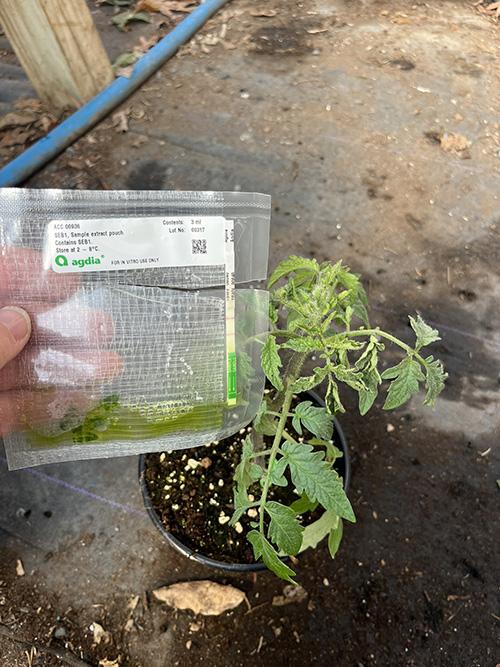
Thrips are a persistent early-season pest in vegetable and ornamental production, particularly in greenhouses and high tunnels. Their ability to reproduce quickly, hide within plant tissue, and transmit viruses makes them especially challenging to manage once populations become established. In Southern Maryland, tomato spotted wilt virus (TSWV) has already been confirmed in tomato transplants this season. Such an early detection should serve as a warning to everyone to take proactive steps to minimize thrips populations and potential sources of TSWV.
TSWV was a significant issue for several growers last year in both high tunnels and field production. Historically, TSWV was a sporadic problem most commonly found in high tunnel production. Over the last three years, we have seen an increase in the incidence of both thrips and TSWV in both early high-tunnel production and later in the season in the field. There are a number of factors driving this change. The most important in our opinion are an increase in thrips insecticide resistance, growers with both ornamental and transplant production on the same farm or house, and changes in the thrips population.
Thrips acquire the virus as larvae that feed on infected plant material and are capable of transmitting it for the rest of their lives as adults. Because of this biology, it does not take a large population to create a serious problem. In fact, a single viruliferous thrips is enough to transmit tomato spotted wilt virus in a seedling house. Once a plant is infected, there are no treatment options, and the plant serves as a permanent source of the virus. TSWV can only be spread by thrips feeding. It is not seed-borne and can not be spread by touch, unlike tobacco or tomato mosaic virus. If you can eliminate infected plants and thrips, you can eliminate the virus. This is easier said than done.
Greenhouses and seedling houses are particularly high-risk environments. Warm temperatures allow thrips to complete their life cycle quickly, and continuous plant presence allows populations to persist year-round. One commonly overlooked risk factor is the presence of houseplants, overwintering ornamentals and weeds in or near seedling production areas. These plants can be carriers of TSWV without presenting symptoms. These plants can also harbor thrips without showing obvious damage, allowing populations to build unnoticed. When vegetable or flower seedlings are introduced, thrips readily move onto these highly susceptible plants, increasing the risk of virus transmission at a very early growth stage.
Sanitation is one of the most effective and least expensive tools for thrips and virus management. Before starting seedlings or moving transplants into a greenhouse or high tunnel, growers should clear the structure of all weeds, plant debris, volunteer plants, and house plants/ ornamentals. These materials can serve as both thrips habitat and virus reservoirs. Benches, trays, and equipment should be cleaned and, when possible, disinfected. Removal of plants immediately outside the greenhouse or high tunnel is also a good practice and can help remove hidden thrip populations. Removing unnecessary plants, including decorative or personal houseplants, from production spaces can significantly reduce the chance of introducing thrips or carrying the virus into a clean house. Opening the houses for a few days during freezing temperatures is also helpful, but should not be relied upon fully.
In situations where thrips or virus issues occurred the previous season, treating the structure before planting may be warranted. This can include targeted insecticide applications, biological control releases, or other control measures appropriate for the production system. The goal is to reduce thrips populations to the lowest possible level before susceptible crops are present, hopefully zero. Once seedlings or transplants are in the house, control becomes much more difficult, and the consequences of failure are higher. Our worst cases of TSWV occur when infection occurs early in the greenhouse from thrips feeding on young transplants.
Many of our farms have vegetable and ornamental production occurring in the same operation. In these cases, it can be difficult to effectively manage TSWV, especially if the greenhouses have ornamental and vegetable plants present at the same time. Growers are encouraged to at least use separate greenhouses for tomato and pepper transplants and ornamental plants, even if it means heating two structures. Another option is using exclusionary thrips screening or netting over the vegetable transplants to exclude thrips. Unfortunately, none of these methods are fool proof, as thrips can travel between houses, and exclusionary netting must be removed for plant care.
Thrips management is ultimately about prevention and timing. Waiting until feeding damage or virus symptoms appear is often too late to prevent losses. Early sanitation, careful inspection of incoming plant material, and eliminating potential thrips reservoirs can greatly reduce risk. Given the confirmed presence of tomato spotted wilt virus in Southern Maryland this season and its impact in previous years, growers should assume risk is present and plan accordingly.
Monitoring
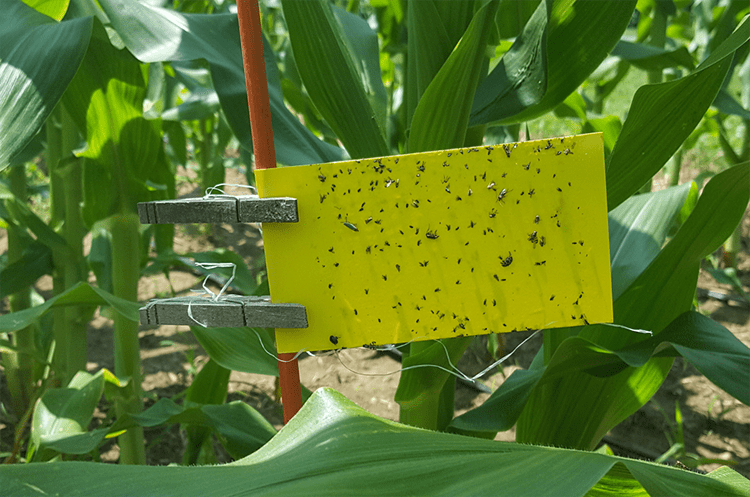
One way to monitor for thrips both before and after treatments is by using sticky cards. These cards are readily available online and are relatively inexpensive. Blue cards function best for attracting thrips, but yellow cards work as well. They function similarly to flypaper, using a sticky surface to trap insects. Thrips are attracted to the bright colors of the cards, making them easier to detect once captured. Sticky cards can be used to assess whether thrips remain after a treatment and to track changes in pest populations over time. They are also effective for monitoring other common greenhouse pests, including fungus gnats and whiteflies. Cards should be placed just above plant canopies to be most effective.
Resistant Cultivars
There are several cultivars of tomatoes that offer resistance to TSWV that is conferred through the Sw-5b gene. If TSWV is a persistent issue, you may consider using one of these cultivars. Cultivars with TSWV resistance include Amelia, Bella Rosa, BHN 602, BHN 1021, Big Beef Plus, Contessa, Dixie Red, Firebird, Mountain Gem, Mountain Glory, Mountain Majesty, Mountain Merit, Patsy, Primo Red, Red Bounty, Red Defender, Red Morning, Red Mountain, Red Snapper, Roadster, STM 2255, and SV 7101. In Southern Maryland, we have experienced symptoms appearing on the fruit of resistant cultivars. Scientists believe this is most likely the result of the defense mechanism not being expressed as strongly in the reproductive parts of the plant. Unfortunately, growers in North Carolina and New Jersey experienced true resistance breaking variants of the TSWV virus, causing symptoms on resistant cultivars. It is not widespread, but certainly something to keep an eye on in Maryland.
Biological Management
Using biological control methods for thrips can be challenging, especially when there are concerns about TSWV, since a single thrips is capable of transmitting the virus to plants. However, when resistant cultivars are being used, biological controls can still be an important tool for managing thrips populations as part of an integrated pest management program.
Biological controls should be used preventively rather than as a reactionary control method. Once thrips populations reach high levels, biological control alone is often no longer effective because beneficial insects are unable to reduce populations quickly enough. For best results, biologicals should be released in greenhouses or high tunnels before thrips are detected, or when populations are at very low levels, so they have time to establish and keep populations suppressed.
The most commonly recommended biological control agents for thrips include predatory mites, which primarily feed on thrips larvae and are best used early in the production cycle. Minute pirate bugs can also provide strong suppression of both larval and adult thrips once established, particularly in flowering crops (adults eat pollen as a food source).
Biological controls are most effective when combined with good sanitation, exclusion practices, and regular scouting. In production systems with a history of tomato spotted wilt virus, growers should carefully evaluate whether biological control alone provides sufficient protection, as maintaining very low thrips populations is critical for reducing virus risk.
Here is some more information on biological controls: https://www.google.com/url?q=https://extension.umd.edu/sites/extension.umd.edu/files/2026-02/Greenhouse%2520BioControl%2520Website%2520Article%2520Version.pdf&sa=D&source=docs&ust=1770419610699668&usg=AOvVaw0zykEwYyinzY5kmVmS72tb
Chemical Management
Chemical control of thrips is challenging for several reasons. In addition to their rapid life cycle and high reproductive potential, thrips often shelter within flowers and buds where they are difficult to reach with insecticides, and many populations have developed resistance to multiple insecticide classes. When insecticides are used, achieving thorough coverage is critical. Apply sprays using a small droplet size to improve contact and penetration into tight plant structures where thrips reside.
Insecticide applications should begin before peak thrips activity to target adults prior to egg laying. Application intervals typically range from three to seven days, depending on temperature, thrips pressure, and crop growth stage. To slow the development of insecticide resistance, rotate among different modes of action rather than relying on a single product. Research suggests using one insecticide or combination of products for a single thrips generation (approximately two to three weeks) before switching to a different class. No single insecticide will provide complete thrips control.
Always read and follow the pesticide label for application instructions, rates, safety precautions, and use restrictions. A list of insecticides labeled for thrips management in tomatoes is provided below; be sure to verify product-specific restrictions based on your production system.
| IRAC Group | Active Ingredient | Example Product(s) | Efficacy | Comments |
|---|---|---|---|---|
| 3A | pyrethroids | Bifenthrin, others | fair* | |
| 4A | dinotefuran | Venom, Scorpion, Safari | good | Safari = suppression only |
| 4A | imidacloprid | Admire | good | soil use only |
| 4A | acetamirprid | Assail | good | |
| 5 | spinosad | Entrust | good* | not for use in production of field transplants |
| 5 | spinetoram | Radiant | good* | supplemental label through October 2026 |
| 6 | abamectin | Agri-Mek | good | |
| 13 | chlorfenapyr | Pylon | excellent | Greenhouse use only. Do not use on tomatoes with a diameter <1” when mature |
| 15 | novaluron | Rimon | good | slow-acting |
| 21A | tolfenpyrad | Torac | fair | |
| 28 | cyclaniliprole | Harvanta 50SL | fair | |
| 29 | flonicamid | Beleaf | excellent | slow-acting |
| 30 | isocycloseram | Incipio | excellent |
* indicates known insecticide resistant populations and potential for decreased efficacy
This article is featured in the Vegetable and Fruit News, Vol. 17, Issue 1.