

FS-999 ❘ 2014
Recognizing and Preventing Internal Parasites (Worms) in Small Flocks
By: Jonathan Moyle, Nathaniel Tablante, Daniel Bautista, Tom Tabler, Dustan Clark and Kayleigh Moyle
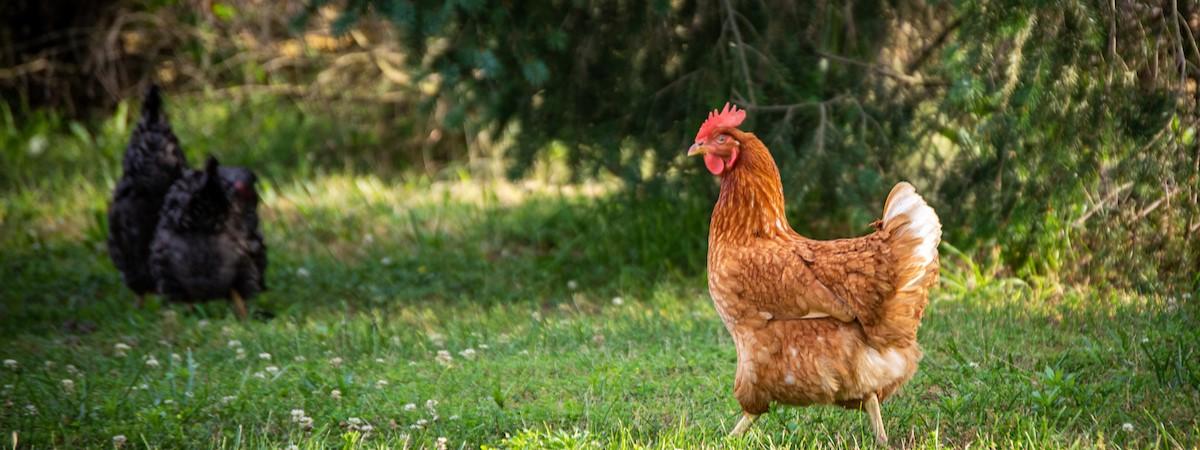
Internal parasites (worms) can affect all types of poultry. They are found throughout the world and can cause production losses and increased mortality in flocks. Commercial poultry producers use confinement to help prevent infections from internal parasites. Free-range backyard flocks may acquire these parasites as they interact with the environment.
What Are Poultry Internal Parasites?
The five most common internal parasites found in backyard flocks are:
- Ascaridia sp.- round worms
- Heterakis gallinarum - cecal worms
- Capillaria sp. - hair and crop worms
- Syngamus trachea - gapeworms
- Raillietina sp. - tape worms
Coccidiosis, caused by protozoan parasites of the genus Eimeria, is discussed in a separate factsheet.
What Do They Look Like and How are They Spread?
Round Worms (Ascaridia)
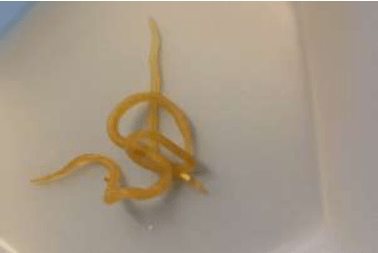
Round worms are one of the most common internal parasites found in small flocks (Photo 1). They are usually in the small intestine but birds with heavy infestations can have worms in other parts of the digestive system, as well as in the reproductive system.
Rarely, eggs laid by infected birds may contain round worms. Adults round worms range from 1.5 -4 inches. Females are larger than the males. Round worms spend their lives in the host and can begin producing eggs 28-30 days after infecting the host. Round worms’ eggs can remain infective in the environment for up to 3 years.
Round worms are spread when birds consume embryonated/infective eggs that are found in the environment. The eggs are shed in the feces of infected birds and they become infective (outside of the bird) in 10-12 days under ideal conditions. Birds with a mild infection of round worms will show few signs of disease. However, more severe infections can result in depression, diarrhea, slower growth, and weight loss.
While most birds will recover from infections on their own, sometimes it is advisable to treat the birds to improve production. Birds that are infected with ascarids can be treated with piperazine products. While there is usually no withdrawal period for peperazine products, be sure to follow the product label.
The withdrawal period is the amount of time that must pass after the product has been given before the meat or eggs can be consumed. This time period can be different for meat and eggs even when using the same product.
Cecal Worms (Heterakis gallinarum)
Cecal worms are found in the ceca of the host (Photo 2). They are mostly known for their role in transmitting Blackhead in turkeys and chickens. Adults are small, between 3/8 - 3/4 inches long and usually don’t cause a noticeable loss in production. Eggs can remain infective in the environment for up to 4.5 years and can be transmitted to the host from the environment or when they consume earthworms. Because earthworms may consume cecal worm eggs, they can be involved in the spread of cecal worms and round worms. Cecal worms tend to be seasonal based on the population of earthworms.
Birds with cecal worms can be treated with several different products that may include one of the following active ingredients: Phenothianzine, Hygromycin, Meldane (Coumaphos), Albendazole, Fenbendazole, Ivermectin, or Levamisole.
Only Hygromycin (Hygromix) is approved for poultry. The other products are extra-label use and require a prescription from a licensed veterinarian. Again, it is important to read and follow all instructions on the label when administering any drugs to poultry and to follow all withdrawal periods before consuming the meat or eggs.
Hair and Crop Worms (Capillaria)
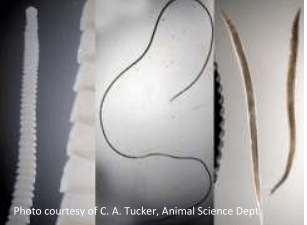
Hair and crop worms (Capillaria sp.) are found mainly in the small intestine of poultry, although a few species may be found in the esophagus and crop (a portion of the alimentary tract used for storing food prior to digestion), and even the mouth in heavy infections.
The worms are small and thin, often resembling hair or thread. Females are much larger than males and range from 2/5 - 2.4 inches long, depending on species. The worm eggs are operculated (have plugs) at both ends.
In most cases, an earthworm (an intermediate host) is required to complete the lifecycle and chickens are infected when they eat the earthworms. Symptoms may include malnutrition, emaciation, anemia, inflammation and damage of the crop, esophageal walls, or small intestine. Death may result if the infection is heavy.
Treatment with Hygomycin, Meldane (Coumaphos), Levamisole or Fenbendazole can help birds that have hair and/or crop worms.
Gapeworms (Syngamus trachea)
Backyard flocks occasionally can get Gapeworms. They also are occasionally called “forked worms” because males and females are joined together in a permanent state of mating, resulting in a Y shape.
Worms attach to the trachea, are red and vary in length from 2/5 - 3/4 inches with males being smaller. Earthworms and slugs play an important role in the life cycle and spread of gapeworms, with the larvae remaining viable up to 3 years in earthworms.
There are currently no drugs approved for commercial use to treat gapeworms.
Tape Worms (Raillietina sp.)
Several species of tapeworms affect backyard flocks; however, R. cesticillus is the most common. Tape worms in chickens can grow to be over 12 inches in length and are found in the small intestines with the worm’s scolex (head) usually buried in the bird’s mucosal lining, causing a mild lesion.
Tapeworms require an intermediate host; that is, they must live in another species, such as darkling beetles and other insects, before they can infect poultry.
There are no approved products for treating birds with tape worms.
Controlling Avian Internal Parasites Begins with a Clean Environment
Raising birds on wire or with deep litter can help prevent parasite infestations. Using pesticides also can lower the number of insects and invertebrates which are sources of infection in birds. However, free-range poultry will most likely encounter parasites at some time.
Monitor your flock for signs of internal parasite infestation. Identify the parasite likely to be the cause before determining the proper treatment for the most effective control. Help is available from University of Maryland Poultry Extension Specialists, County Extension Educators and veterinarians educated in poultry health in order to get the safest, most targeted and effective, and resistant-free de-wormer medications for your birds.
Are Poultry Internal Parasites a Risk for Humans?
While occasionally a round worm may end up in an egg and cause an unsightly appearance, there is no risk to humans or other mammals from avian internal parasites.
If You Think Your Flock has Internal Parasites…
Call the Maryland Department of Agriculture (MDA) at 410-841-5810 for assistance, risk assessment or possible testing.
If you have an unusually high level of mortality on your farm, the dead birds, or live birds that show the same symptoms, may be submitted for necropsy to a regional MDA Animal Health Diagnostic Laboratory. Call ahead for submission requirements and further instructions at the numbers provided below:
| Region | Facility | Phone |
|---|---|---|
| Western Shore | Fredrick Lab | 301-600-1548 |
| Eastern Shore | Salisbury Lab | 410-543-6610 |
References
Kahn, C.M. Line, S. (Eds.), 2005. The Merck Veterinary Manual, 9thedition. Merck and Co. Inc., White House Station, New Jersey, USA, pp. 2231-2236.
Jonathan Moyle
jmoyle@umd.edu
University of Maryland Extension
Nathaniel Tablante
nlt@umd.edu
University of Maryland Extension
Daniel Bautista
bautista@udel.edu
University of Delaware
Tom Tabler
Mississippi State University Extension
F. Dustan Clark
fdclark@uark.edu
University of Arkansas
Kayleigh Moyle
kmoyle@email.uark.edu
University of Arkansas
This publication, Recognizing and Preventing Internal Parasites (Worms) in Small Flocks (FS-999), is a part of a collection produced by the University of Maryland Extension within the College of Agriculture and Natural Resources.
The information presented has met UME peer-review standards, including internal and external technical review. For help accessing this or any UME publication contact: itaccessibility@umd.edu
For more information on this and other topics, visit the University of Maryland Extension website at extension.umd.edu
University programs, activities, and facilities are available to all without regard to race, color, sex, gender identity or expression, sexual orientation, marital status, age, national origin, political affiliation, physical or mental disability, religion, protected veteran status, genetic information, personal appearance, or any other legally protected class.
When citing this publication, please use the suggested format:
Moyle, J., Tablante, N., Bautista, D., Tabler, T., Clark, F.D., & Moyle, K. (2014). Recognizing and Preventing Internal Parasites (Worms) in Small Flocks (FS-999). University of Maryland. go.umd.edu/FS-999
More Resources
-
Avian Diseases for Concern
Avian Diseases for Concern -
Infectious Laryngotracheitis (ILT): Know the Symptoms and What to Do if Your Flock is Affected
Infectious Laryngotracheitis (ILT): Know the Symptoms and What to Do if Your Flock is Affected -
Feather Pecking and Cannibalism in the Backyard Flock
Feather Pecking and Cannibalism in the Backyard Flock -
Recognizing and Preventing Marek's Disease in Small Flocks
Recognizing and Preventing Marek's Disease in Small Flocks -
Recognizing and Preventing Mycoplasma gallisepticum (MG) Infection in Poultry
Recognizing and Preventing Mycoplasma gallisepticum (MG) Infection in Poultry -
Recognizing and Preventing Avian Pox in Small Flocks
Recognizing and Preventing Avian Pox in Small Flocks