
Mock strawberry, also called false strawberry and Indian mock-strawberry (Potentilla indica, formerly Duchesnea indica), is a non-native weed that grows throughout Maryland. A member of the rose family (Rosaceae) and a cousin of the cultivated strawberry, its fruits are edible but not flavorful or juicy compared to the familiar garden strawberries (genus Fragaria).
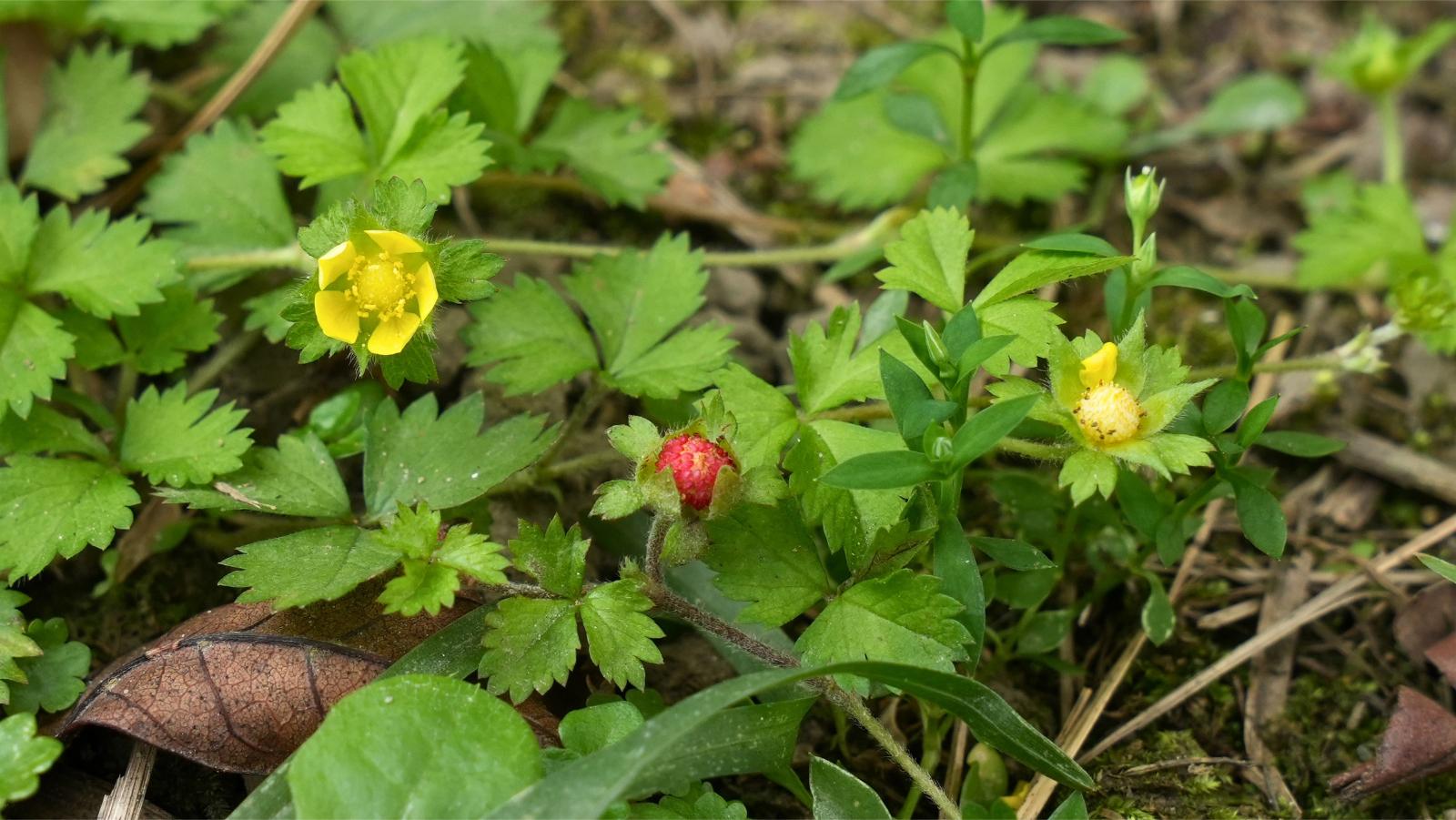
Indian mock strawberry is a groundcover with yellow flowers and fruits that resemble strawberries.
Photo via Adobe Stock.
Identification
- Growth habit: prostrate/trailing groundcover less than 1 foot tall; stolons (above-ground runners) root at the nodes (where leaves join the stem)
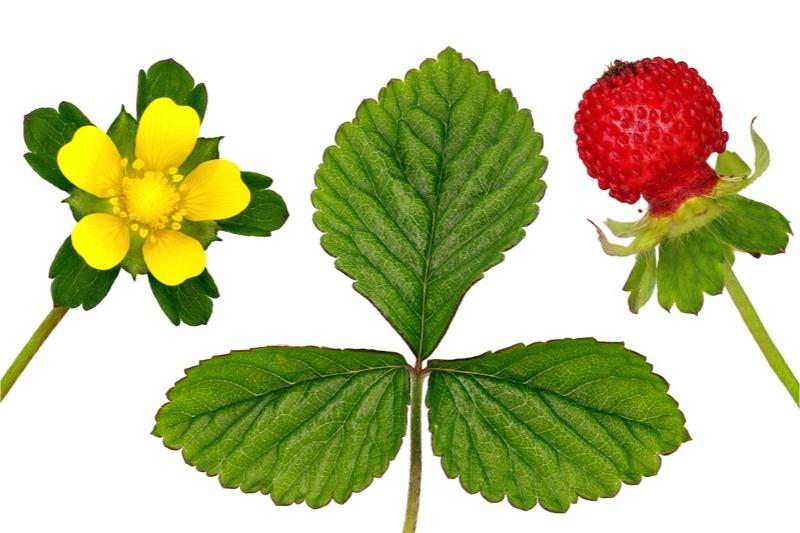
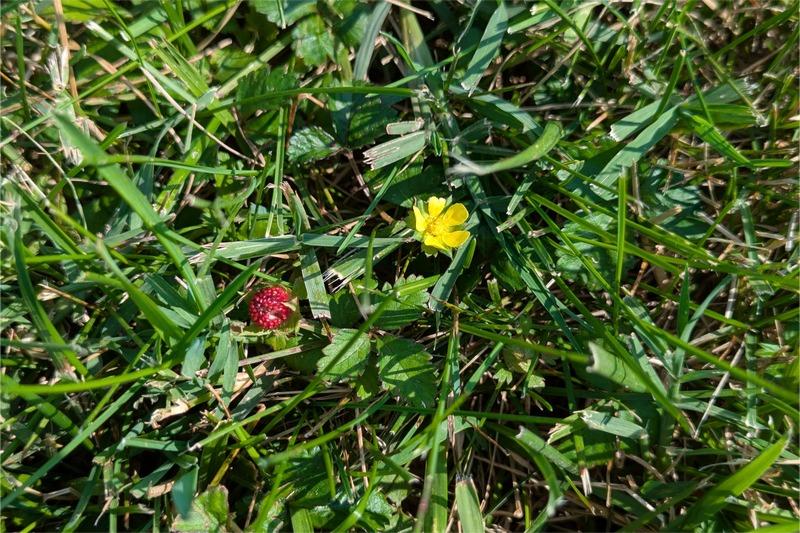
- Flowers: yellow, with 5 petals; less than 1 inch wide; produced singly on long stalks
- green sepals, roughly the same length as the petals, are visible behind the petals
- large green bracts (leaf-like appendages) with 3 lobes or teeth are prominent behind the flower
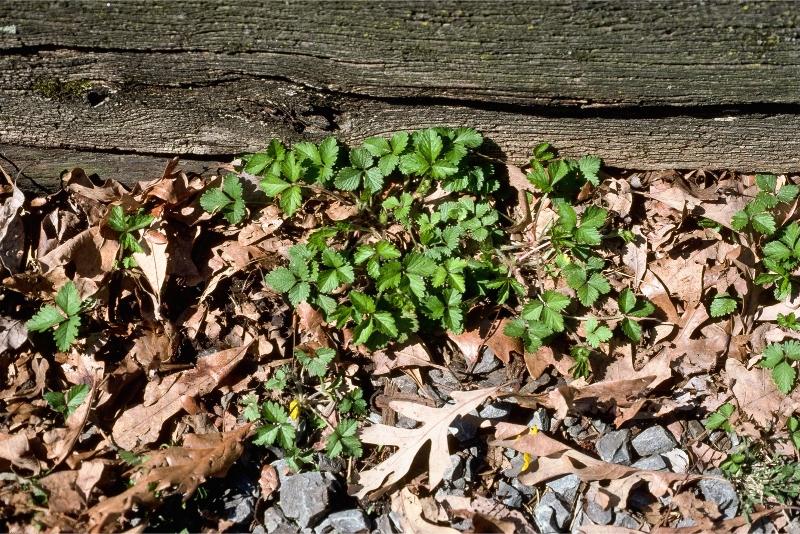
- Leaves: divided into 3 leaflets (trifoliate), similar to strawberry leaves
- sparsely hairy underside with a fairly smooth upper surface
- long petiole (stalk connecting the leaf to the stem), with sparse white hairs lying nearly flat against its surface
- each leaflet has a short stalk (just a few millimeters long) connecting it to the petiole
- leaflets are roughly oval in shape and have coarse marginal teeth (serrated edges)
- alternate leaf arrangement
- Stems: covered in downy or silky hairs
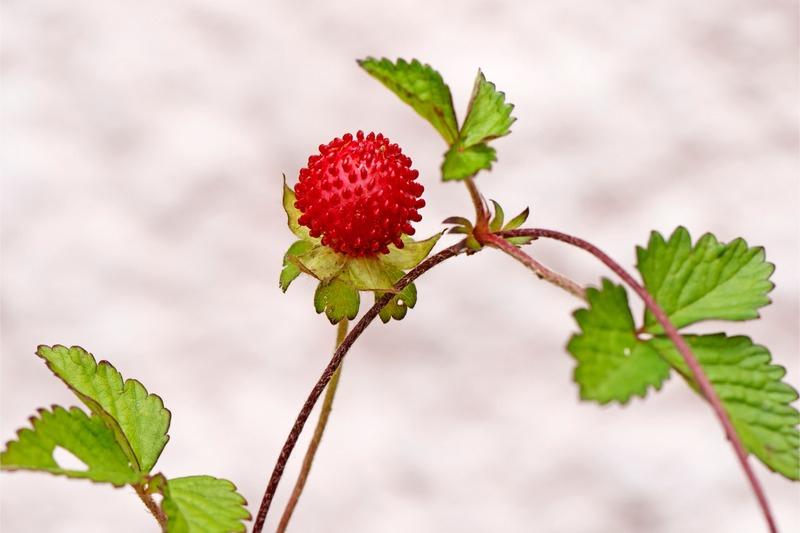
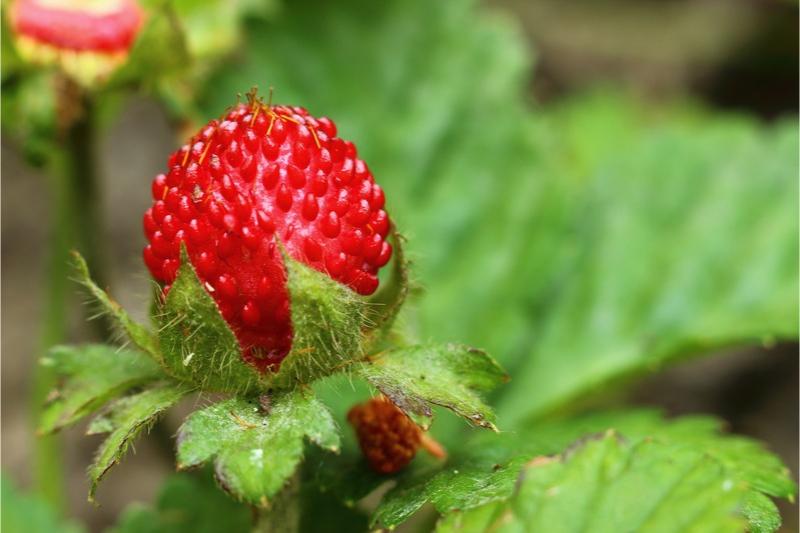
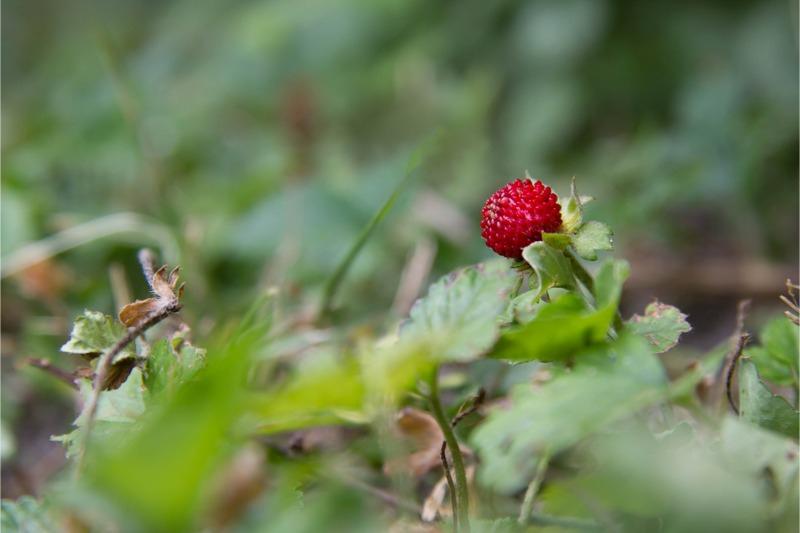
- Fruit: typically less than ½ inch wide and similar-looking to a strawberry, but the seeds project out from the fruit's surface and are the same red color; the leafy bracts that were behind the flower remain behind the fruit
Similar species
Other species of cinquefoil (genus Potentilla) will have flowers of a similar shape and color, such as common cinquefoil (Potentilla simplex). Mock strawberry leaf teeth have a blunt tip whereas common cinquefoil leaf teeth end in a more distinct point. Common cinquefoil (and some other cinquefoil species) tend to have 5 leaflets instead of 3, but there can be some overlap.
Edible strawberry species like the native species wild strawberry (Fragaria virginiana) and woodland strawberry (Fragaria vesca, which is uncommon in Maryland) are difficult to distinguish from mock strawberry when plants are not flowering or fruiting, because the foliage shape and growth habit are very similar.
- The leaf-edge teeth on wild strawberry tend to be more pointed than the blunter teeth of mock strawberry.
- Wild strawberry leaves have more noticeable hairs on their upper surface as well as along the edges of the leaf undersides.
- In bloom, strawberries have white (or more rarely for some cultivated varieties, pink) flowers, not yellow like mock strawberry.
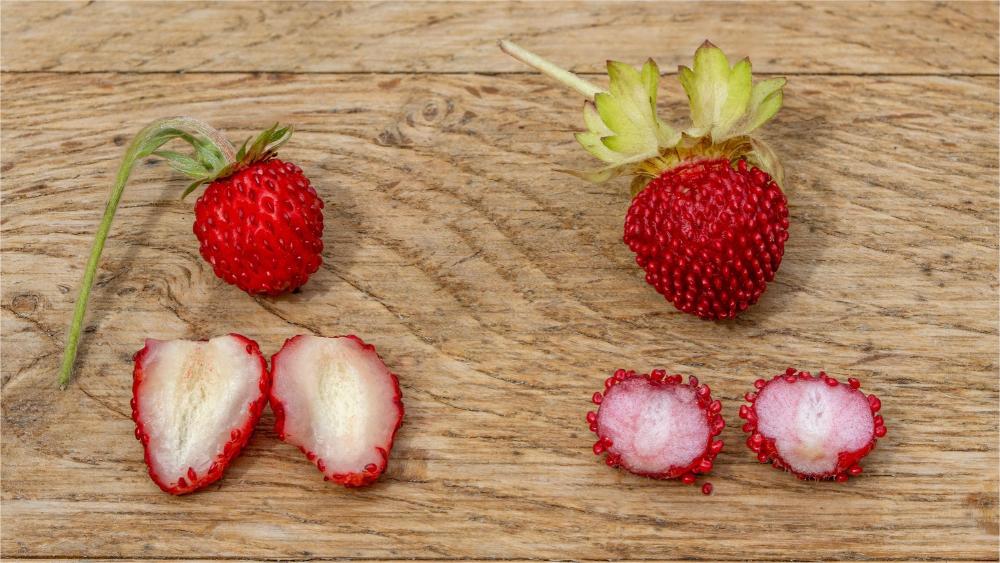
- Strawberry fruits generally have seeds that lie more flush with the surface of the fruit (and which can be more tan in color), but this is less of a reliable trait than flower color and fruit taste.
- Mock strawberry fruits have little taste, lacking the distinctive, strong flavor of true strawberries.
- Strawberry fruits hang downward from their stalks, while mock strawberry fruits are more upright.
Life cycle and reproduction
Mock strawberry is a perennial: it lives for several years. Blooms can appear any time from mid-spring through summer and into autumn, although peak flowering in Maryland seems to be April and May. These plants tend to keep their leaves through the winter as an evergreen.
This species spreads by stolons and by seed. Once seedlings have grown about 5 leaves, they can begin to develop stolons.
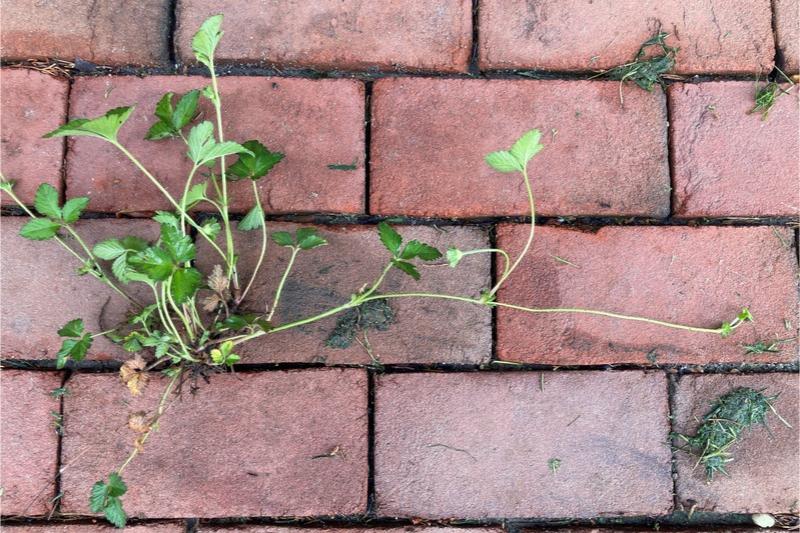
Photo: Rachel Rhodes, University of Maryland Extension
Conditions that favor growth
Mock strawberry prefers moist soil and tolerates shade, growing low enough to avoid much mowing damage. It can out-compete turfgrass where the lawn isn't getting enough sun and in areas that stay damp or which are over-irrigated.
Mock strawberry management in lawns
General lawn care practices that discourage weeds
Maintain healthy, dense turf that can compete with weeds and prevent weed germination and establishment. Fertilize the lawn as recommended (based on season and turf type), mow high, and overseed cool-season lawns each autumn to keep the lawn dense and better able to crowd-out seedling weeds. Core-aerate to reduce soil compaction. Learn about fertilizing, mowing, overseeding, and aeration in the resource: Maintaining an Established Lawn.
Mechanical management
Hand pulling or using a manual weeding tool are the primary means of mechanical weed control. Due to mock strawberry's spreading growth habit, it can be hard to pull up in lawns, but that can slow its spread. Manual removal when the soil is moist makes the task easier. Pulling up or digging out individual plants is a viable option at the beginning of an infestation (when the plants are not yet abundant) and for young mock strawberry plants, but more extensive patches of the plant may require stripping off the sod entirely.
Manage Weeds Without Chemicals
Chemical management
Herbicide use should always be a last resort when managing weeds. Check for any local pesticide restrictions before buying and applying a product. For example, the Montgomery County pesticide law does not allow most synthetic pesticides (which includes herbicides) to be used on lawns. The active ingredient glyphosate is also prohibited on lawns in Baltimore City.
Learn about herbicide classifications and terminology:
Herbicide Options for Managing Common Lawn Weeds
Post-emergent herbicide
Spot-treat individual mock strawberry plants or infested areas with a liquid broadleaf herbicide applied in autumn. Look for a product with one or more of the following active ingredients: 2,4-D, MCPP (mecoprop), dicamba, or triclopyr. An application of non-selective herbicide may work, but would also damage any turfgrass exposed to the herbicide.
CAUTION: Do not spray herbicides containing dicamba over the root zone of desirable trees and shrubs. Roots or leaves may absorb this ingredient and be substantially damaged. Refer to the product label for other precautions.
References
Lorenzi, H.J., Jeffery, L.S. (1987). Weeds of the United States and Their Control. Van Nostrand Reinhold Company.
Neal, J.C., Uva, R.H., et. al. (2023). Weeds of the Northeast. (Second edition.) Comstock Publishing Associates.
Phillips, C.E., Fisher, V.J. (1970). Weeds of the Northeast: Aids to Their Identification by Basal-Leaf Characteristics. University of Delaware Agricultural Experiment Station.
Still have a question? Contact us at Ask Extension.