
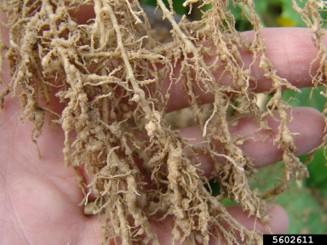
Fig 1.) Galls on cucumber roots caused by root-knot nematode. Gerald Holmes, Strawberry Center, Cal Poly San Luis Obispo, Bugwood.org
Checking for Root-Knot Nematodes in Vegetable Crops
By Emily Zobel, AgFS agent, Dorchester County
As the growing season winds-down, it is a good time to examine crop roots for nematode feeding damage. Nematodes are a highly diverse group of small roundworms that have adapted to nearly every ecosystem. Many nematodes are free-living and contribute to soil health through their role in the cycling of nutrients. A small subset of nematodes are plant-parasitic, which can cause major losses in vegetable crops on commercial farms, greenhouses, and in home gardens. While there are several types of plant-parasitic nematodes that can damage vegetable crops, root knot nematodes (RKN) (Meloidogyne spp.) are one of the most common ones found in Maryland.
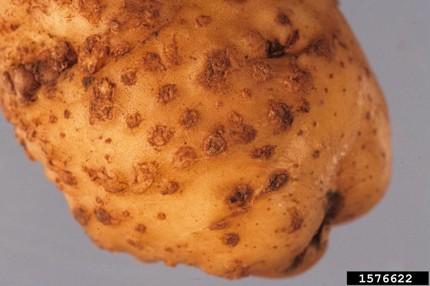
Above ground symptoms are similar to many other root diseases or environmental factors that limit water and nutrient uptake. These symptoms consist of wilting during periods of moisture stress, stunted plants, chlorotic or pale green leaves, and reduced yields. Plants might show signs of nutrient deficiency, even if the soil has sufficient nutrients, and if the addition of fertilizers did not seem to alleviate the deficiency symptoms. These symptoms are often seen in random spots within the field and will proceed down the row. The most characteristic symptoms of RKN are roots that have knots or galls (swollen areas) on them (Fig 1). Both large and small roots will have round swellings on them. The entire root system may be shallow with areas that are dead or branched excessively. For root vegetables RKN feeding galls form along the marketable portion of the plant, and will affect marketability directly (Fig 2).
To check plants, dig—do not pull up– plants that are showing problems and some of the plants that border these problematic plants. Moist ground will make the whole process much easier. Wash the roots with water and inspect the roots of the plants for the tell-tale symptoms of RKN, i.e., galls on the fine and larger roots of a plant. Uninfected roots will be white, smooth and thin.
Virginia Tech is the closest lab to send nematode samples. More information and sample submission forms can be found on their website (https://bit.ly/vt-soil-testing). It is recommended to send two samples, one sample from the diseased areas and one from areas within the field that are not showing any diseased symptoms. When taking a sampling, use a soil probe to take soil cores 6-8 inches deep in between plants within a row. Take 20-25 samples across the field and mix all the cores together in a clean plastic bucket. After mixing thoroughly, place one pint of the soil in a plastic bag. Management strategies will vary depending on the nematode species present and your cropping system. No control technique ever eliminates nematodes from soil, and populations will grow during the season.
- Crop rotation to non-host crops is typically one of the first steps taken when nematodes are a problem.
- Planting resistant varieties is a good strategy but they may not always be available. They should be grown as part of an IPM rotation, and should not be grown every year or they may lose their efficacy as a management tool.
Certain cover crops can decrease RKN severity and crop damage. Rapeseed (a relative of canola) can be planted in late September early October in Maryland at a rate of 800,000-900,000 seeds per acre. It should be grown throughout the fall, winter and early spring. Tilling it under in mid-March through mid-April. Rapeseed crops do have a high sulfur requirement, so be sure your field has adequate levels of sulfur in your soils for this cover crop. The key is getting a good solid stand of the cover crop so that weeds do not grow along with the crop as many weed species can act as hosts for RKN.
For a summer cover crop to use is sorghum-Sudangrass. It can be planted following an early season vegetable crop such as cucumber, pea or snap bean. Planting seed at 20 lbs/a in mid to late July has been shown to produces enough biomass to reduce RKN populations. For best control, the sorghum-Sudangrass crop should be chopped while green into smaller pieces and incorporated into the soil by mid-October. Adding poultry litter or poultry litter compost into the sorghum-Sudangrass biomass produces the most effective reduction in nematodes.
- Soil fumigants or nematicides can be effective in reducing RKN damage to vegetable roots, but they will not eliminate them from the soil, but roots will be protected long enough for a crop to be produced. More information on fumigants and nematicides can be found in the Mid-Atlantic Commercial Vegetable Production Recommendations guide.
This article appears in September 2026, Volume 17, Issue 8 of the Vegetable and Fruit News
Vegetable & Fruit News is a research-based publication for the commercial vegetable and fruit industry available electronically from April through October. Published by the University of Maryland Extension Agriculture and Food Systems team.
Subscribe