
Thinking About Spraying Weeds Before Harvest? Read This First
Kurt Vollmer, Weed Management Specialist, University of Maryland Extension
If you’re planning one last herbicide spray before harvest to deal with leftover weeds, you might want to reconsider. Here are five important things to keep in mind:
1. It’s too late to spray.
Even though glyphosate can be used up to seven days before harvesting corn or soybeans, many other herbicides can’t be used this late in the season. For example:

- Glufosinate-based products like Liberty® and Interline® must be used before corn reaches the V6 stage (or 70 days before harvest), and before soybeans reach the R1 stage.
- 2,4-D-based products like Enlist One® and Enlist Duo® also can’t be used after R1.
- Older herbicides like Cobra® (lactofen) shouldn’t be used after the R6 stage or within 45 days of soybean harvest.
2. Herbicides don’t work as well on big weeds.
The bigger and older the weed, the harder it is to kill. As weeds grow it’s harder for systemic herbicides like 2,4-D to be absorbed and moved through the plant. Even contact herbicides like Liberty® or Cobra® may not work well if they don’t fully cover the plant. Some damage may be visible, but the weed can still survive.
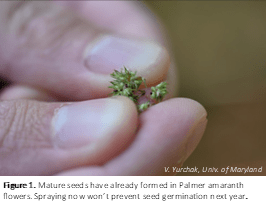
3. The weeds have likely already made seeds.
Once weeds flower, they usually produce viable seeds within 2–3 weeks. Spraying now won’t stop all seed production. That means those weeds have already made seeds that could cause problems next year (Figure 1).
4. Be careful around bees and flowers.
Most herbicides are relatively nontoxic to bees, but it’s still important to be cautious. Both Liberty® and Enlist® labels prohibit applications when flowers are blooming or when bees or other pollinators are nearby (Figure 2).
5. Spraying now won’t improve yields.
Killing weeds now might make harvesting a bit easier, but the yield damage is already done. For best results, weeds should be controlled before the V4 stage in both corn and soybeans. After that point, crops can usually compete better with weeds.
Bottom line:
Most of the weeds in your field are already near the end of their life. Spraying them now won’t do much. Instead, focus on steps you can take later this season—or next year—to prevent the same problem from happening again. Understanding what went wrong this season—whether it was timing, product choice, or resistance issues—can help you build a better management plan next year.
This article appears in October 2025, Volume 16, Issue 7 of the Agronomy News.