
Soybean Sudden Death Syndrome
By Hayden Schug, AgFS Agent, University of Maryland Extension, Charles County
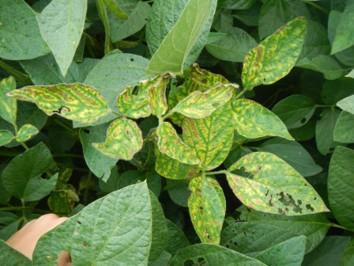
This time of year, symptoms of soybean sudden death syndrome (SDS) begin appearing in our fields (Fig 1). We have noticed more suspected SDS than usual this year in Southern Maryland which is unusual given the drier planting season we had, but the increased moisture recently could have led to the development of more foliar symptoms than typical. It is important not to confuse SDS with other problems, such as spider mite damage, that may still warrant treatment.
SDS is caused by the soilborne fungus Fusarium virguliforme and several other closely related Fusarium species, which typically infects soybean roots early in the growing season. Cool, wet soils favor root infection, but leaf symptoms generally do not appear until later in the reproductive growth stages. The fungus produces toxins that move from the roots into the leaves, causing the yellowing and tissue death that is commonly associated with SDS.
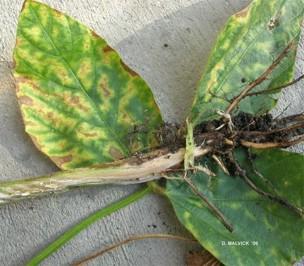
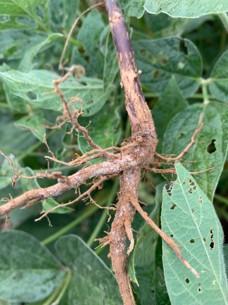
Symptoms begin as yellow spots between the leaf veins, interveinal chlorosis. These areas expand and turn brown while the major veins remain green. Severely affected plants may drop their leaflets, leaving the leaf stalks (petioles) still attached to the stem. Roots may also be rotted, and blue fungal growth is sometimes visible on their surface under high moisture conditions and later in the season (fig 2). Typically SDS is patchy throughout a field or can be concentrated where plants are already stressed from another underlying issue. Leaf symptoms alone should not be relied upon for a definitive diagnosis. Brown stem rot and other diseases can easily resemble SDS confusing field diagnosis. With SDS, the central pith generally remains white, with the surrounding tissue discolored (fig 3). Brown stem rot causes browning within the pith.
There is no rescue treatment for SDS once symptoms appear. Foliar fungicides do not effectively control the disease because the fungus is already established in the roots early on in the growing season. It is important however to mark affected areas now so that the field history can be used to help guide management decisions in the future. For fields with a history of SDS, select varieties with strong SDS resistance ratings and consider a seed treatment with demonstrated activity against the disease. These practices reduce risk but do not eliminate it as there are no completely resistant varieties currently available. Also, consider sampling affected fields for soybean cyst nematodes, which can increase SDS severity when both are present. If soybean cyst nematode is confirmed, select varieties with resistance to both SDS and soybean cyst nematode. Contact your local Extension office if you need help confirming the diagnosis.