
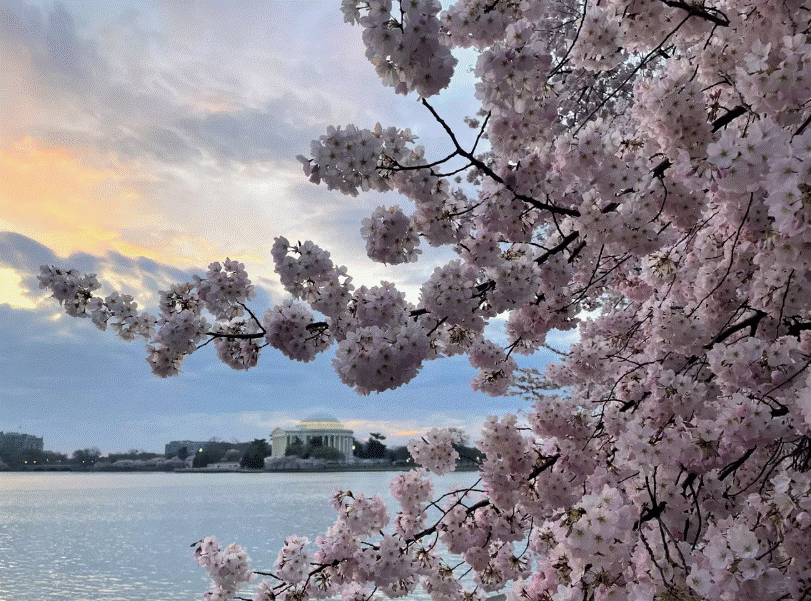
Sigal Goldstein, University of Maryland Class of 2028
Cherry blossoms (Prunus serrulata) are widely associated with the cycle of life and death, symbolizing both renewal and the fleeting nature of existence. The Japanese term “sakura” captures this dual meaning, reflecting beauty alongside temporality (Kamiyama, 2026). While cherry blossoms are seen as a natural symbol of spring in the wider Washington, D.C. area, their consistent beauty is actually the result of careful scientific management and human intervention. Cherry blossoms reliably return each year, despite their short, two-week bloom period. This consistency is achieved through scientific practices such as grafting and the deliberate control of environmental conditions. In Washington, D.C., the region's climate and the concentration around the Tidal Basin create the conditions for a distinct “peak bloom” that marks a visible and celebrated transition into spring, which occurred on March 26th this year.
What makes cherry blossoms appear uniform and predictable is the application of controlled propagation methods. Consistent blooming refers to the reliable, year-to-year return of blossoms with predictable timing and quality, while synchronous blooming describes how many trees flower at the same time within a single season. The combination of consistent and synchronous blooms creates the dramatic “peak bloom” effect. Techniques such as grafting and stem cuttings are among the most common methods for achieving this outcome. Grafting involves inserting a dormant twig into a living tree to exchange genetic material, enabling genetically identical coloration, faster growth, and greater disease resistance. Additional methods, such as cross-pollination and selective cultivation, further ensure that cherry blossom trees maintain their signature appearance and resilience. Rather than occurring naturally, these trees are carefully reproduced and managed to preserve their iconic look.
Even with human control, cherry blossoms remain highly sensitive to environmental conditions. The typical lifespan of the flowers is only 7-10 days, though under ideal conditions, such as cool, calm, and dry conditions, they can last up to 14 days after peak bloom. However, adverse conditions, many of which are intensified by climate change (e.g., hot, rainy, windy, and stormy weather), can shorten the blooming period by 3-5 days, ending it earlier than normal (National Park Service, 2026). Not all trees bloom at the same time, either; some follow a staggered pattern, greeting a gradual spread of blossoms rather than a single simultaneous moment (Coleman, 2026).
Ultimately, while cherry blossoms may appear to be a natural and effortless symbol of spring, their beauty depends on a delicate balance of scientific intervention and environmental stability.
Works Consulted
Coleman, D. (2026, March 5). A Photo Timeline of the DC Cherry Blossom Bloom. Cherry Blossom Watch. https://cherryblossomwatch.com/cherry-blossoms-progression/
Kamiyama, R. (2026). Understanding Marginal Landscapes Through Japanese Cherry Blossoms. The IAFOR International Conference on Arts & Humanities in Hawaii 2026 Official Conference Proceedings, 51–71. https://papers.iafor.org/wp-content/uploads/papers/iicah2026/IICAH2026_100777.pdf?t=8
National Park Service. (2026, March 26). Bloom watch—Cherry blossom festival. U.S. Department of the Interior. National Park Service. https://www.nps.gov/subjects/cherryblossom/bloom-watch.htm