

Scouting for Tar Spot in Corn
By Andrew Kness, Senoir Agriculture Agent, Harford County, University of Maryland Extension

Cooler than normal temperatures and intermittent rain and fog throughout the month of May made for favorable conditions for tar spot development. The fungus that causes tar spot on corn (Phyllachora maydis) prefers somewhat cooler temperatures and intermittent leaf wetness; conditions which we had for the better part of a month in May. The recent switch to hot temperatures will suppress tar spot development. I have had a couple of reports of tar spot, the earliest being June 25, so it would not surprise me if it is lingering at low levels in other fields too. This is by far the earliest detection of this disease in Maryland. Early infections can be potentially concerning if weather conditions remain cool. However, heat will break the infection cycle until cooler weather returns in late August/September.
With that being said, you will notice how rapidly tar spot disease probability has dropped off since the middle of June (Figure 1). This drastic drop is driven by the return of hot temperatures. This heat wave should arrest tar spot development, and if these temperatures continue, will keep this disease at bay until cooler temperatures return.
It would be a wise idea to scout your fields for tar spot (and other diseases) as they approach tassel (VT)—I would recommend starting around V10 and monitoring through early grain fill. Tar spot symptoms are characterized by small, round, slightly raised black lesions on the surface of leaves (Figure 2). If you notice tar spot established in your corn during this timeframe, you will want to consider a fungicide application around VT-R2 to manage the disease (and others); however, if you are only noticing one or two lesions on a leaf, it is no reason to panic. If you are already planning on a fungicide application at tassel, you will get good suppression of tar spot, along with other important foliar diseases. Do not forget about other diseases, such as gray leaf spot. Conditions for gray leaf spot are very high right now and will stay high since the pathogen that causes this disease favors hotter temperatures.
If you find tar spot while scouting, or suspect you have found it, please send me a note or call me (410-638-3255) as we continue to monitor the spread of this disease in Maryland.
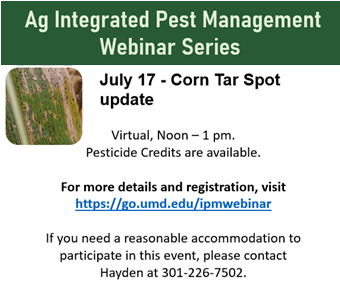
Ag Integrated Pest Management Webinar Series
Date: July 17, 2025 | Time: noon to 1:00 PM
Location: Online (via Zoom)
Description: Corn Tar Spot update
For more information and registration: https://go.umd.edu/ipmwebinar
This article appears in July 2025, Volume 16, Issue 4 of the Agronomy News.