
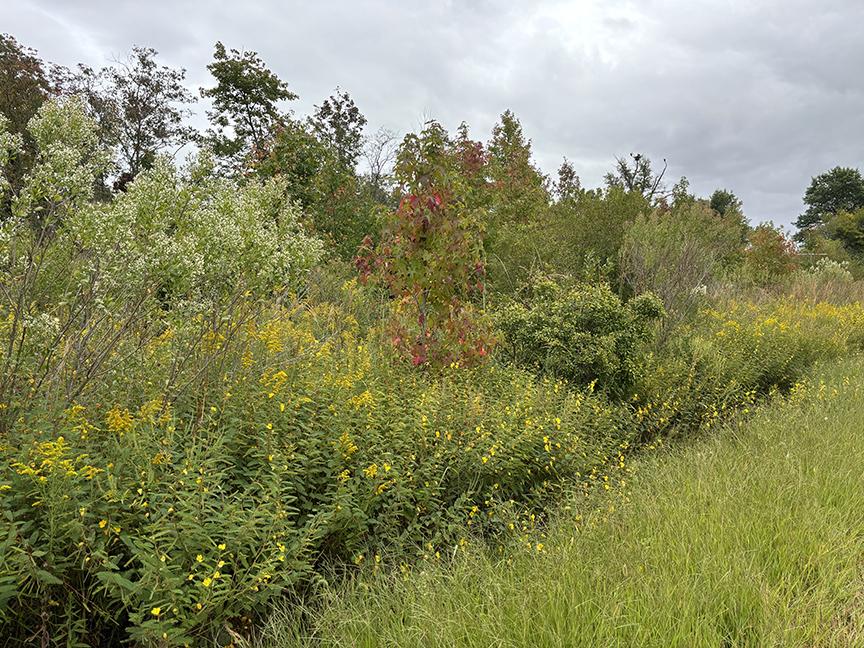
Are you considering planting trees and shrubs on your property? You aren’t alone. Many Marylanders have taken advantage of county- and state-funded programs that seek to afforest or reforest landscapes by incentivizing high-density woody plantings.
Planting projects can lead to a slew of benefits – they can stabilize riparian areas, increase soil carbon, enhance water quality, and provide shade. In addition, well-planned planting projects can create or enhance wildlife habitat. Early successional habitat, which is characterized by open canopy conditions and mixtures of young trees, shrubs, and grasses, plays a critical role in many wildlife species’ life cycles. This habitat, however, accounts for only a fraction of the total terrestrial habitat across Maryland and has declined as forests mature.
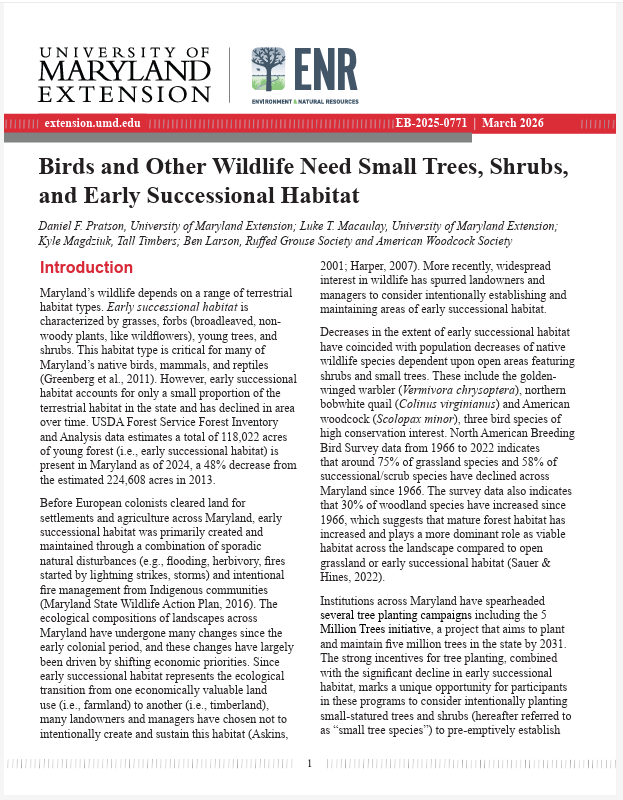
In our recent Extension Bulletin, I worked with Luke Macaulay (Wildlife Specialist with UMD), Kyle Magdziuk (Biologist with Tall Timbers), and Ben Larson (Conservation Director with the Ruffed Grouse Society/American Woodcock Society) to help landowners intentionally plan planting projects that use short trees and shrubs to emulate early successional habitat. Our publication offers several useful tools, including a list of recommended tree and shrub species; planting preparation and spacing considerations; advice on continued management; and highlights from two different projects that have used planting to create habitat for wildlife dependent on early successional conditions.
Although early successional habitat conditions naturally persist for short periods of time, they play an important role in sustaining wildlife. Planting small trees and shrubs in marginal, open land can help increase early successional habitat’s representation across Maryland’s landscape and can contribute to tree planting initiatives. Be sure to read our publication as you plan and carry out your next restoration planting project!
Access the publication through any of the links below:
Webpage shortened link:
https://go.umd.edu/EB-2025-0771
QR Code:

Shortened PDF link:
https://go.umd.edu/EB-2025-0771-DownloadablePDF