
The American sycamore (Platanus occidentalis L.), a member of the plane tree genus, is native to a broad portion of the Middle and Eastern portions of North America, extending from south-central Texas to southern Maine. Sycamore trees (sometimes referred to as “buttonwood” trees) are most often found in low-lying, riparian areas across Maryland, although they are also common pioneer hardwood species in abandoned fields and mining sites. Interestingly, sycamores tend to persist through most successional stages and are often present in mature, “climax” forests, given their ability to live around 200-500 years.
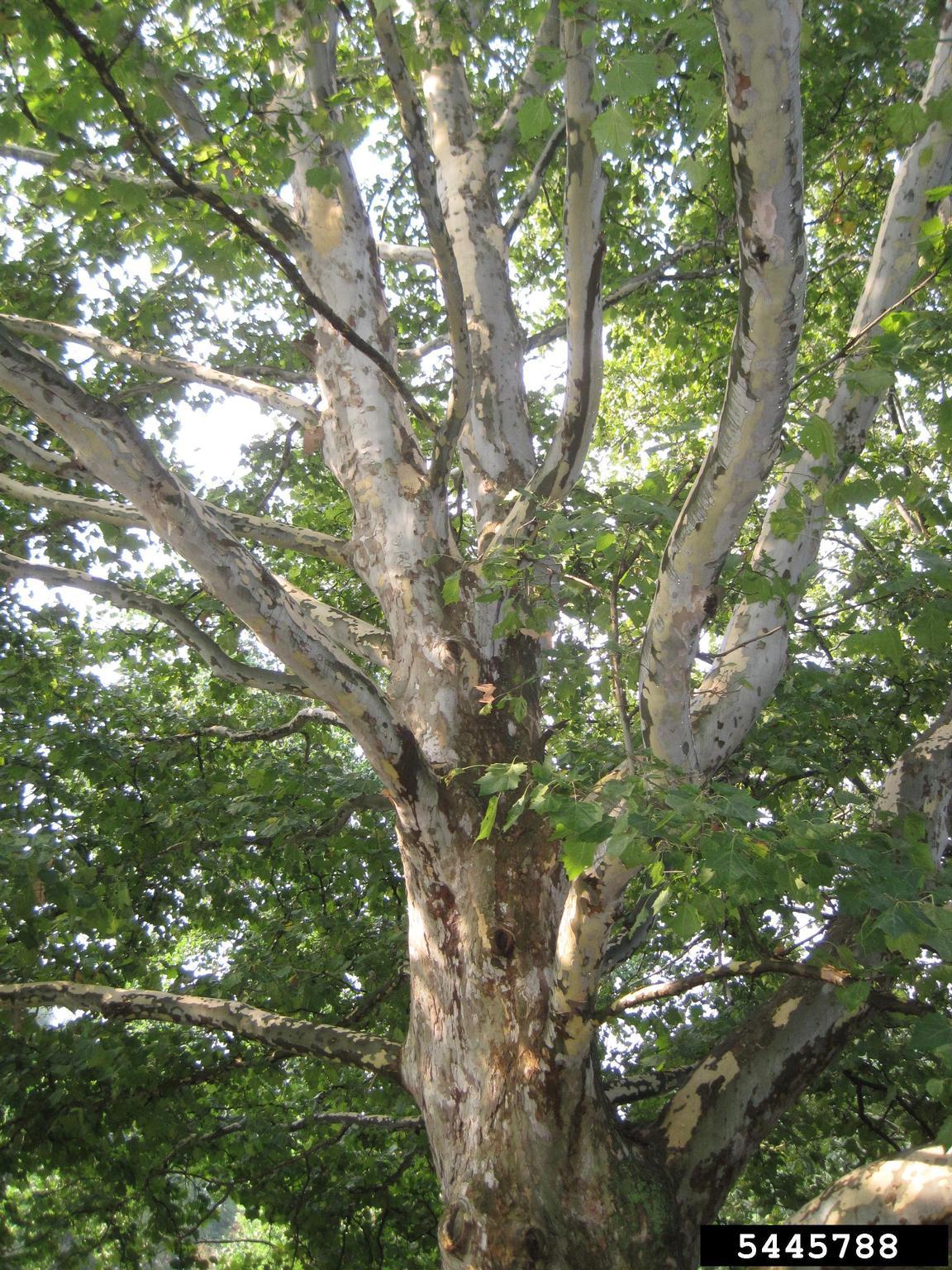
American sycamore trees are monoecious, which means that both male and female flowers are found on a single tree. The heartwood of old sycamores often rots out and creates habitat for wildlife including black bears and cavity-nesting birds. The broad leaves of sycamores provide ample shade, one of the many reasons why these trees are often planted in suburban and urban areas across the state. Sycamore bark is brittle and easily flakes off trunks as they grow and expand; the mottled brown, grey, and white patches across sycamore trunks make these trees easily recognizable.
American sycamores can be harvested for their timber, which is used for applications ranging from furniture to butcher’s blocks. In the Mid-Atlantic and Appalachian regions where sugar maple (Acer saccharum) trees are less common, some people collect sycamore sap to produce syrup. American sycamore is also utilized for woody biomass purposes; saplings can be purposely coppiced (cut at the stump to promote future re-sprouting) on timed rotations to feed biomass markets.
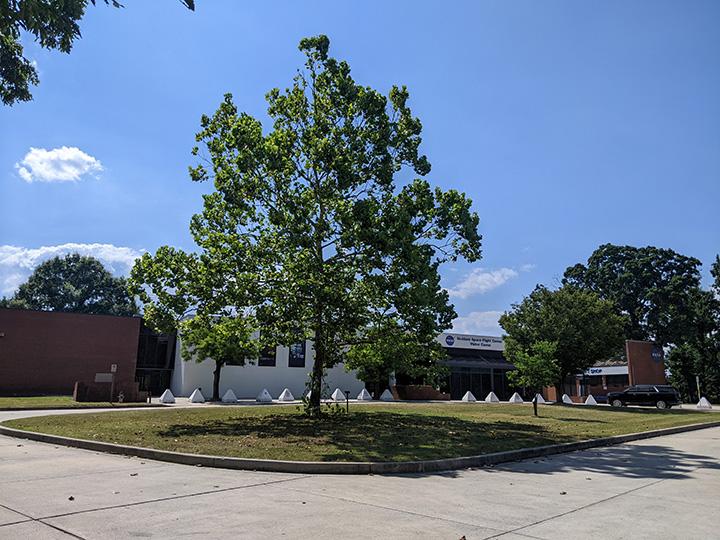
Currently, the largest measured tree in Maryland is an American sycamore (clocking in with an incredible circumference of 27 feet and a height of 145 feet!) located in Montgomery County, at the Dickerson Conservation Park. The C&O Canal Towpath also hosts an abundance of extremely large sycamores growing alongside the path. During the Apollo XIV mission in 1971, Astronaut Stuart Roosa, a former US Forest Service smoke jumper, carried a variety of tree seeds on the mission. The seeds were germinated upon the mission’s return and have been planted across the county – many of the surviving “moon trees” are American sycamores, one of which is currently located at the Goddard Space Flight Center in Greenbelt, Maryland.
Sources:
Maryland Big Tree Program. https://www.mdbigtrees.org/websitedata
Burns, R., and Honkala, B. Silvics of North America Volume 2. Hardwoods. United States Department of Agriculture (USDA), Forest Service, Agriculture Handbook 654.
Taylor-Ide, L. & Collins-Simmons, S. American Sycamore Sap & Syrup: What We Know and What We Don’t. Future Generations University. https://woodlandstewards.osu.edu/sites/woodlands/files/imce/20240913%20American%20Sycamore%20Sap%20%26%20Syrup.pdf