

EB-2026-0828 | September 2026
Measuring, Modeling, and Managing Soil Organic Carbon in Maryland Agriculture
By Dr. Gurpal S. Toor, University of Maryland, College Park and Dr. Suzanne Dorsey, Maryland
Department of the Environment.
Overview

Soil organic carbon is fundamental to healthy, productive soils because it supports soil structure, nutrient cycling, water-holding capacity, and resilience to weather extremes. COMET-Farm is a free US Department of Agriculture (USDA) decision-support tool that estimates how agricultural management practices may affect soil carbon and greenhouse gas emissions. It is particularly useful for comparing how different management scenarios may affect soil organic carbon over time. However, its default estimates should not be interpreted as direct measurements of the amount of carbon currently stored in a field, particularly in fields where drainage, manure history, or other site-specific conditions strongly influence soil carbon. Because these field-specific conditions and management histories may not be fully represented, COMET-Farm is generally better suited for comparing changes in soil carbon under different management scenarios than for estimating how much carbon is currently present. Therefore, it should be viewed as a decision-support tool rather than a substitute for direct field measurement. COMET-Farm is discussed in this publication because it was evaluated in the Maryland field study presented in Lucas et al. (2026); its inclusion does not constitute an endorsement of COMET-Farm over other soil-carbon modeling tools.
1. Why soil organic carbon is important–and why change takes time
Soil organic carbon (SOC) is the carbon contained in soil organic matter and plays a key role in soil health. It influences soil structure, water and nutrient dynamics, biological activity, and resilience to drought and intense rainfall. In Maryland agriculture, farmers, agricultural advisors, and conservation professionals are increasingly interested in SOC because of soil-health programs, conservation planning, greenhouse-gas accounting, supply-chain initiatives, and emerging carbon markets. However, SOC changes slowly and can vary considerably within and among fields.
Practices such as cover crops, reduced tillage, diversified crop rotations, perennial vegetation, and long-term applications of manure or compost can gradually increase or help maintain SOC. However, the rate and direction of SOC change depend on soil type, climate, drainage, cropping system, and management history.
Carbon is continually added to soil through crop residues, roots, manure, and other organic inputs while simultaneously being lost through microbial decomposition. Because annual gains or losses are often small compared with the large amount of carbon already stored in soil, detecting measurable changes usually requires repeated sampling over several years using consistent methods. SOC also varies within and among fields; therefore, careful baseline and resampling designs are important when measuring change.
Rather than expecting rapid increases in SOC, farmers and land managers should view these practices as long-term investments that improve both soil health and the sustainability of crop production. Because meaningful SOC changes can take years to detect directly, models such as COMET-Farm can help evaluate potential long-term changes under different management scenarios. However, model outputs must be interpreted appropriately and should not be treated as direct measurements of the amount of SOC currently stored in a field.
2. Understanding SOC stock and SOC change
When assessing SOC, landowners and managers should recognize that SOC stock and SOC change are not the same. SOC stock is the amount of carbon currently stored within a defined soil depth and area. It depends on SOC concentration, soil bulk density, sampling depth, and coarse fragments such as gravel or stones. For example, two fields may both have 2% SOC, but differences in bulk density can lead to different SOC stocks at the same sampling depth. Because management can also change soil bulk density and the mass of soil within a fixed depth, careful comparisons over time may require using an equivalent soil mass approach (see Section 7b). In contrast, SOC change is the increase or decrease in SOC stock over a defined period.
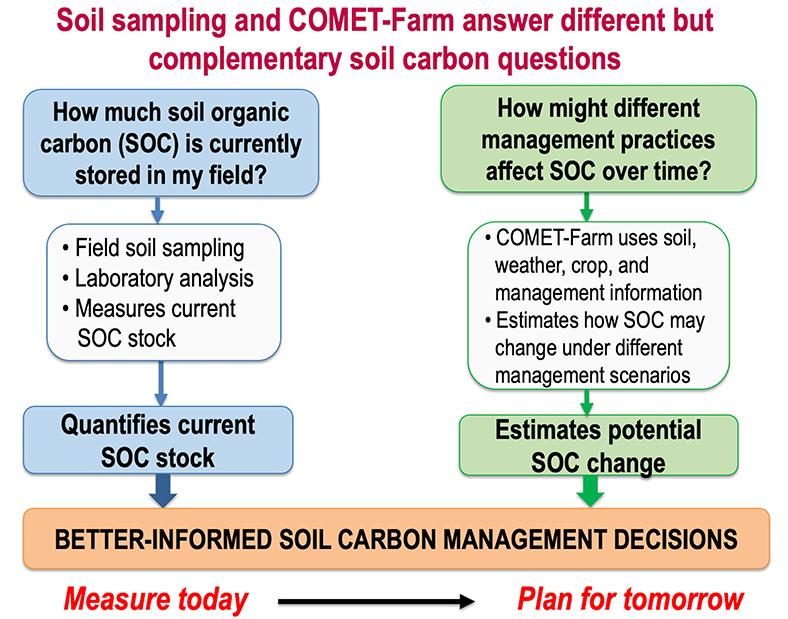
Figure 1 illustrates how field sampling and laboratory analysis can quantify current SOC stock, whereas COMET-Farm can estimate potential SOC change under different management scenarios.
3. How COMET-Farm was evaluated in Maryland
A research team from the University of Maryland, Colorado State University, and the Maryland Department of the Environment evaluated SOC estimates for 15 working farm fields representing diverse soils and management histories across Maryland. The fields were distributed across the Piedmont and Coastal Plain physiographic regions and were selected to capture variation in soil texture, hydrology, and climate, while also considering farmers’ willingness to participate. See Lucas et al. (2026) for technical details of the study. The study compared measured SOC stocks with estimates generated using two modeling approaches: COMET-Farm and a separately run field-specific DayCent model. The comparison included:
- Measured SOC stocks based on direct field sampling and laboratory analysis;
- COMET-Farm estimates using farmer-reported management information together with the tool’s generalized default model inputs; and
- Field-specific DayCent estimates using more detailed soil and land-use information and adjusted model parameters.
COMET-Farm is designed for nontechnical users and therefore relies on generalized inputs and parameters for some model components. Running DayCent separately allows expert modelers greater flexibility to modify model inputs and parameters to represent site-specific conditions.
Management histories for each field covered approximately 20 years and included crop rotations, tillage, manure use, irrigation, and other field-level practices. The researchers asked two questions: (1) How accurately did the models estimate existing SOC stocks? and (2) How consistently did the two modeling approaches estimate the direction and magnitude of SOC change over time?
4. What the researchers found
The Maryland study revealed several practical findings about how SOC model estimates should be interpreted. These findings concern the accuracy of modeled SOC stocks, consistency in the direction of modeled SOC change, and the influence of field-specific conditions on model performance.
a. Default COMET-Farm estimates did not closely match measured SOC stocks
Across the 15 Maryland fields studied by Lucas et al. (2026), measured SOC stocks in the upper 8 inches ranged from approximately 17 to 74 megagrams of carbon per hectare (Mg C/ha), equivalent to about 7.6 to 33.0 tons of carbon per acre. This range reflects differences in soil texture, drainage, topography, organic inputs, and management history. COMET-Farm generally underpredicted existing SOC stocks, although individual estimates could fall above or below the measured values; the overall prediction error was about 18.8 Mg C/ha (8.4 tons C/acre). Lower prediction error indicates closer agreement between modeled and measured SOC stocks. The largest errors occurred in intermittently poorly drained fields with high measured SOC.
b. Field-specific DayCent modeling improved estimates of existing SOC stocks
The field-specific DayCent model incorporated additional field information and parameter adjustments, including changes intended to better represent restricted drainage and slower decomposition under wet conditions. This modeling improved agreement with measured SOC stocks, reducing the overall prediction error from about 18.8 Mg C/ha (8.4 tons C/acre) with COMET-Farm to about 7.9 Mg C/ha (3.5 tons C/acre). However, prediction error remained, indicating that field-specific modeling improved—but did not eliminate— differences between modeled and measured SOC stocks.
c. COMET-Farm and field-specific DayCent produced the same direction of SOC change in most fields
When the researchers compared modeled SOC change from 2000 to 2022–2023, the two modeling approaches produced the same direction of SOC change in 13 of the 15 fields. However, the magnitude of predicted SOC change differed between the models, with a typical difference of about 4.4 Mg C/ha (2.0 tons C/acre), and the modeled direction differed in the remaining two fields.
d. Drainage and manure history can affect SOC estimates
Poorly drained soils can accumulate more SOC because prolonged wetness restricts oxygen and slows decomposition. Likewise, repeated manure applications can add substantial organic carbon over time. COMET-Farm default assumptions may not fully represent these field conditions and management histories. Both conditions occur in Maryland agriculture, including on Coastal Plain fields. Therefore, producers and advisors should interpret COMET-Farm estimates with additional caution for poorly drained or historically manure-amended fields.
5. Where COMET-Farm is most useful
The study supports using COMET-Farm primarily to compare management scenarios rather than treating its default SOC stock estimates as measurements of current SOC stock on Maryland farms. COMET-Farm is a whole-farm greenhouse gas accounting tool that estimates carbon dioxide, methane, and nitrous oxide emissions and carbon sequestration under baseline and alternative management scenarios; SOC change is one component of these estimates. Accordingly, its greatest value for soil-carbon management is in evaluating how modeled outcomes may differ among management scenarios rather than in determining the amount of SOC currently stored in a field.
Maryland also uses COMET-Farm-based modeling to estimate agricultural soil carbon contributions to state climate goals. The statewide approach combines COMET-Farm simulations with Maryland-specific information on cropland and management-practice adoption, including best management practice (BMP) data that Maryland reports to the Chesapeake Bay Program (Amin et al., 2024). At this broader scale, modeling can help evaluate the potential contribution of agricultural management practices to climate goals, but it does not replace field measurements when current SOC stock at a specific site must be determined.
6. How Maryland farmers can use COMET-Farm effectively
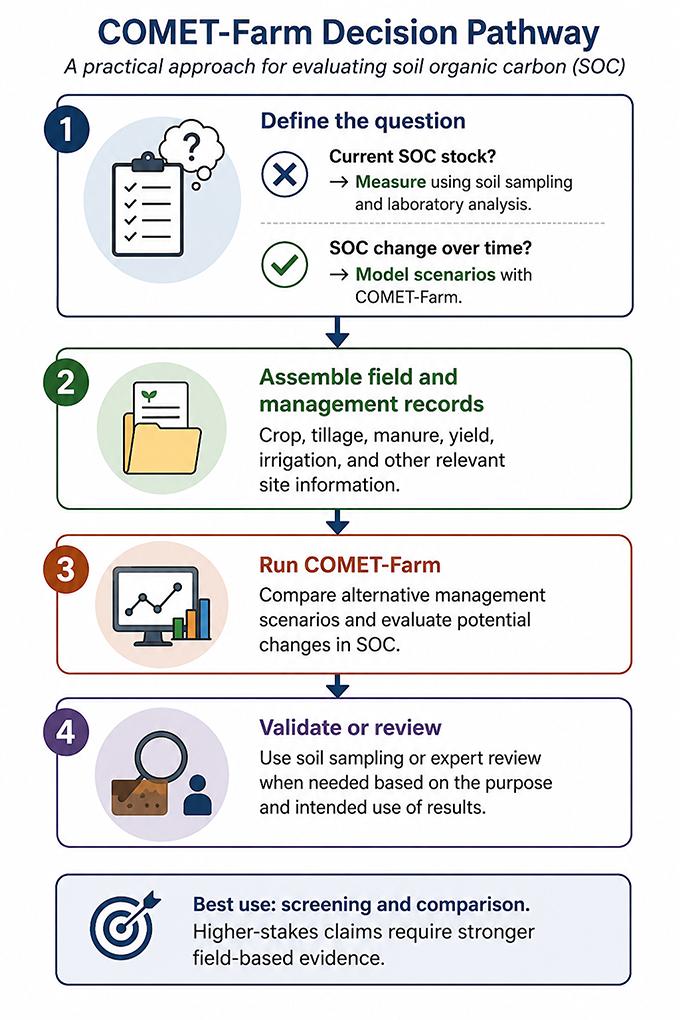
Maryland farmers can use COMET-Farm most effectively by matching the tool to the question being asked and by using accurate field and management information. Figure 2 summarizes a four-step decision pathway: define the soil-carbon question, assemble field and management records, compare management scenarios, and determine whether field measurements or expert review are needed. This approach helps distinguish routine scenario evaluation from applications that require stronger field-based evidence.
a. Compare realistic management scenarios
COMET-Farm can help compare the potential effects of plausible management alternatives, such as:
- Conventional tillage versus reduced tillage or no-till;
- Current rotation versus a rotation with more small grains, forage, or cover crops;
- Residue removal versus residue retention;
- No organic amendment versus manure or compost application; and
- Irrigated versus non-irrigated management, where applicable.
For these comparisons, focus on differences between management scenarios rather than on the estimated SOC stock for a single year. Use realistic practices that the farm operation could sustain economically and agronomically.
Model results can also help identify fields where modeled SOC gains are small, where two management options appear similar, or where results are sensitive to assumptions. These fields may warrant a closer review of management records, targeted soil sampling, or consultation with an agronomist or soil scientist.
Scenario results can also support conservation and climate-planning discussions with University of Maryland Extension, USDA–Natural Resources Conservation Service (NRCS), soil conservation districts, consultants, and other agricultural advisors. They can help identify potential benefits and tradeoffs before a producer invests in a practice. However, modeled estimates should be described as projections or estimates rather than field measurements.
b. Use complete and accurate field information
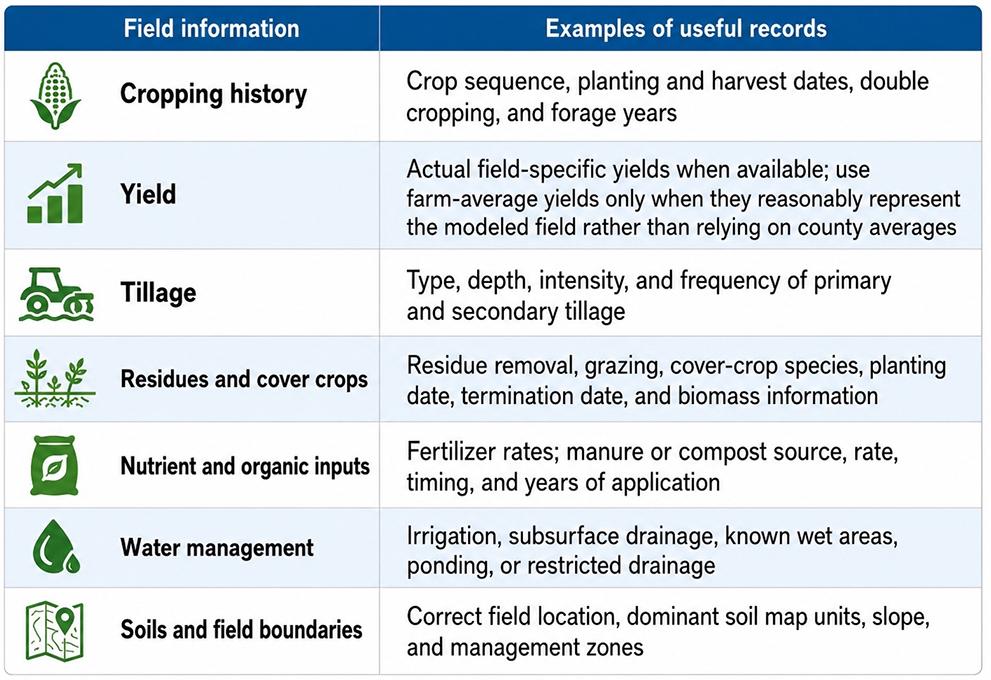
The quality of model outputs depends on the quality of the information entered. Before running a scenario, assemble the most complete and accurate field history available using field-specific records whenever possible. Incomplete or inaccurate records can substantially affect modeled results. Figure 3 summarizes the types of information that are especially useful for producing reliable model outputs.
When exact historical information is not available, document the assumptions used so that future model runs can be interpreted and reproduced. Also record the date of each model run and, when available, the COMET-Farm version, as model inputs, methods, and interface options may change over time.
c. Account for Maryland field conditions
Soils, hydrology, topography, and management histories vary widely across Maryland’s Coastal Plain, Piedmont, and western regions. Consider these field-specific conditions when entering information into COMET-Farm and interpreting its results.
Poorly drained and artificially drained soils:
Fields with seasonal saturation, depressional areas, and soils classified as dual hydrologic soil groups such as C/D and A/D may store more carbon than default simulations suggest. In a dual hydrologic soil group, the first letter describes the soil under drained conditions and the second describes it under undrained conditions. Artificial drainage can also alter soil aeration and decomposition. COMET-Farm incorporates mapped soil information and user-entered management data, but detailed drainage history may not be fully represented in the standard COMET-Farm simulation. Therefore, retain records of drainage improvements, tile installation, ditch maintenance, and persistent wet zones to help interpret model results and evaluate their reliability.
Manure and poultry litter history:
Long-term applications of dairy manure, poultry litter, compost, or other organic amendments can increase carbon inputs, but the effect depends on application rate, material composition, frequency and duration of applications, soil conditions, tillage, and erosion. Historical applications may not be fully represented if records are incomplete. Maryland nutrient management records can provide valuable information on application timing and rate.
Variable soils on the Coastal Plain:
Some fields on Maryland’s Eastern Shore contain strong contrasts in soil texture, drainage, and elevation over short distances. A single field-level result may mask important management zones. Where practical, compare model results with yield maps, soil survey information, drainage patterns, and zone-based soil sampling.
Piedmont and western Maryland soils:
Sloping fields may lose carbon-rich topsoil through erosion and redistribute soil downslope. Stony, shallow, or highly variable soils can also complicate SOC sampling and stock calculations. Conservation practices that reduce erosion may protect existing SOC even when model estimates show only modest carbon gains.
d. Evaluate the whole-farm system
A practice that increases modeled SOC may also affect yield, nitrogen availability, phosphorus loss risk, fuel use, labor, herbicide needs, soil moisture, and planting timeliness. Select practices based on their effects on the whole-farm system. For many Maryland operations, the most practical strategy is to improve soil function while maintaining profitability and meeting nutrient management and water quality goals.
Because SOC changes gradually, management decisions should not be based on modeled SOC gains alone. Management practices are most effective when they can be sustained over time while providing agronomic, economic, soil health, and water quality benefits.
7. Beyond modeling: measurement, verification, and program requirements
Modeling and field measurements serve different purposes in soil-carbon assessment. The appropriate approach depends on whether the goal is to estimate current SOC stock, detect change over time, or meet verification and program requirements.
a. When soil sampling is needed
Modeling cannot replace soil sampling when a decision requires an accurate estimate of current SOC stock or field-based evidence of SOC change. Consider direct measurement when:
- Establishing a baseline for a carbon-credit, ecosystem-service, or supply-chain claim;
- Verifying whether SOC changed after several years of management;
- Comparing fields with contrasting drainage, soil texture, or manure histories;
- Making a high-value land, lease, or conservation investment decision for which SOC is an important consideration;
- Investigating a model result that conflicts with field knowledge; or
- Documenting soil-health outcomes for research, demonstration, or program evaluation.
Soil sampling, together with bulk density measurements and laboratory analysis, remains the foundation for quantifying current SOC stock. Models complement, but do not replace, field measurements. When both current conditions and future changes matter, the two approaches complement each other: measurements establish current SOC stock, while models estimate how alternative management practices may influence SOC over time.
b. How to obtain reliable SOC estimates
A reliable soil-carbon sampling plan should define the sampling depth, account for soil bulk density and coarse fragments (gravel and stones), use consistent sampling locations or a statistically valid resampling design, include enough independent samples to represent within-field variability, and use consistent field and laboratory methods over time. Composite samples may be appropriate, but independent replication is needed when variability or change must be quantified.
For monitoring SOC change, the sampling design must be capable of distinguishing change over time from natural within-field variability. SOC concentration alone is not enough because converting SOC concentration to a stock requires information about the mass of soil represented. When bulk density varies between sampling dates, comparisons at a fixed depth may represent different soil masses. An equivalent soil mass approach compares SOC stocks for the same mass of soil rather than simply the same sampling depth and can be particularly useful when bulk density changes between sampling dates. In our previous study of three Maryland agricultural fields, fixed-depth and equivalent-soil-mass calculations produced statistically similar SOC stocks, but accurate bulk-density information remains critical for tracking SOC stock changes over time (Yang et al., 2020). Changes in tillage can redistribute carbon within the soil profile, so shallow sampling may overstate gains if carbon has simply become concentrated near the surface.
When measured soil bulk density is not available, the USDA–NRCS Web Soil Survey (https://websoilsurvey.nrcs.usda.gov/app/) can provide map-unit and soil-component estimates of soil bulk density and other soil properties. Although these estimates are useful for preliminary assessments, they may not represent current field conditions because bulk density can change with management practices. Therefore, field-measured bulk density is preferred when accurate SOC stock estimates or field-based evidence of SOC change are required, particularly for research, verification, or carbon-market applications.
c. What to consider before enrolling in a carbon or ecosystem-service program
Requirements differ among carbon and ecosystem service programs. A COMET-Farm report alone may not satisfy program requirements. Review contracts carefully and obtain independent agronomic, financial, and legal advice before enrolling acres.
Carbon and ecosystem-service programs may require evidence that carbon gains are measurable, additional, and verifiable. Although COMET-Farm may be used to estimate potential SOC changes, some programs may also require soil sampling, independent verification, or additional documentation before approving credits or payments.
Program agreements may also address how long carbon gains must be maintained, what happens if stored carbon is later lost, whether a practice shifts emissions or carbon losses elsewhere, ownership and use of farm data, payment conditions, and obligations if a contract is terminated early. Understanding these requirements before enrolling can help producers avoid unexpected costs or obligations.
8. Carbon and ecosystem-service opportunities for Maryland farmers
Maryland farmers have access to a range of public and private programs that support conservation practices, soil health, or carbon-related outcomes. Before enrolling, producers should understand how participation works, what program options are available, and how costs, payments, and verification requirements differ among programs.
a. How participation typically works
Carbon and ecosystem-service programs differ in how they document benefits and determine payments. Some programs provide incentives or cost-share payments for implementing eligible practices, whereas carbon-credit and other outcome-based programs may require quantification, monitoring, and verification of environmental benefits. For programs that require documented outcomes, participation typically involves the following steps, although specific requirements vary. Confirm program rules before collecting baseline samples or implementing a practice intended to generate a future claim or payment.
Step 1. Confirm program eligibility rules before sampling.
Programs differ in their baseline requirements, sampling protocols, contract lengths, and rules for combining programs; a sample collected before these rules are confirmed may not count toward a future claim.
Step 2. Establish a baseline that meets program requirements.
Depending on the program, a baseline may use field records, modeling, soil measurements, or a combination of these approaches. If soil sampling is required, follow the program’s specified sampling depth, bulk-density measurements, laboratory methods, and verification procedures. Fields with conditions that can complicate SOC estimation, such as poorly drained soils, long-term manure history, or highly variable soils, may require additional measurements or more intensive sampling.
Step 3. Implement and document the practice change.
Keep dated, field-level records of the specific practice, such as cover-crop species, tillage operations, or manure application rates, rather than farm-level summaries.
Step 4. Resample using the same protocol.
Where repeated soil sampling is required, use consistent sampling depths, timing, sampling locations or a consistent sampling design, and laboratory methods so that later measurements are comparable with the baseline.
Step 5. Submit to third-party verification.
Some credit-generating programs require an independent verifier to confirm that reported carbon gains or greenhouse-gas reductions meet program or protocol requirements before credits are issued.
Step 6. Understand the permanence commitment before signing.
Some carbon programs require multi-year commitments and may include monitoring or permanence obligations that last beyond the payment period. If a practice is discontinued or the carbon gain is reversed––for example, if a field returns to intensive tillage––program rules may result in loss of future payments, repayment or replacement of credits, contract termination, or other corrective actions. Review requirements for maintaining carbon gains, addressing reversals, repayment, and contract termination before enrolling.
Step 7. Receive payment or carbon credits.
Depending on the program, a producer may receive a per-acre practice-based incentive or cost-share payment, whereas carbon-credit programs may issue credits based on verified carbon or greenhouse-gas outcomes. Payment for those credits may depend on how and when they are sold.
A caution on combining public and private support: State and federal cost-share programs (Healthy Soils, Cover Crop, EQIP, and similar programs) and private carbon-credit programs may have different rules regarding additionality and whether payments from multiple programs can be combined on the same acres. Carbon-credit protocols commonly include additionality requirements, meaning that credited benefits must go beyond what would otherwise have occurred. Whether public financial assistance can be combined with private carbon payments depends on each program’s rules. Before enrolling the same acres in multiple programs, confirm whether payments may be combined (“stacked”) and obtain the answer in writing.
b. What programs are available to Maryland farmers
Maryland farmers have several state, federal, and private program options. These programs differ in whether they provide financial assistance for adopting a practice, payments for measured outcomes, or compensation tied to verified carbon credits. Because rules, deadlines, and funding levels can change over time, producers should confirm current details directly with each program before enrolling acres or budgeting around expected payments.
State programs (Maryland Department of Agriculture)
- Healthy Soils Competitive Fund: MDA provides financial assistance for practices intended to improve soil health, support carbon sequestration, and provide other environmental benefits. Program requirements may include soil sampling or other data collection to evaluate soil-health outcomes, site visits to verify practice implementation, and farm-specific information to support climate-benefit calculations. For current eligibility requirements, application periods, and program details, visit the MDA Soil Health page: https://mda.maryland.gov/resource_conservation/pages/soil-health.aspx
- Cover Crop Program, Cover Crop Plus+, and Small Acreage Cover Crop Program: These programs provide financial assistance for establishing cover crops. They differ in eligible acreage, practices, payment structures, and application procedures, but generally support practice implementation rather than payment for verified quantities of carbon stored. For current requirements and enrollment information, visit the MDA website: https://mda.maryland.gov/
Federal programs (USDA-NRCS and USDA-Farm Service Agency, FSA)
- Environmental Quality Incentives Program (EQIP), including Conservation Incentive Contracts (CIC): EQIP provides financial and technical assistance to agricultural and forestry producers for conservation practices that address natural-resource concerns, including cover cropping, reduced tillage, and nutrient management. Conservation Incentive Contracts are an EQIP option that can support longer-term conservation management related to soil health, soil carbon, and water quality. For current Maryland eligibility, funding opportunities, and application dates, visit the Maryland EQIP page: https://www.nrcs.usda.gov/programs-initiatives/environmental-quality-incentives-program/maryland/environmental-quality
- Conservation Stewardship Program (CSP): CSP provides technical and financial assistance to producers who maintain existing conservation activities while adopting additional conservation practices and enhancements. The program can support longer-term improvements in soil health and other resource concerns. For current Maryland eligibility and application information, visit the Maryland CSP page: https://www.nrcs.usda.gov/programs-initiatives/conservation-stewardship-program/maryland/conservation-stewardship-program
- Conservation Reserve Program (CRP) and Agricultural Conservation Easement Program (ACEP): These programs provide longer-term conservation opportunities through land retirement or easements that can protect soils and provide other environmental benefits. CRP, administered by USDA–FSA, provides annual rental payments and cost-share assistance for establishing long-term conservation cover on eligible environmentally sensitive land. ACEP, administered by USDA–NRCS, provides financial and technical assistance to conserve agricultural lands and wetlands through easements. For current program requirements, consult USDA–FSA for CRP at https://www.fsa.usda.gov/resources/conservation/conservation-reserve-program and USDA–NRCS for ACEP at https://www.nrcs.usda.gov/programs-initiatives/agricultural-conservation-easement-program/maryland/agricultural-conservation
Private and registry-based voluntary carbon markets
- Private programs such as Carbon by Indigo and Truterra: These programs may offer farmers opportunities to receive payments for eligible management practices, verified carbon or greenhouse-gas outcomes, or other environmental benefits. Eligibility, qualifying practices, verification requirements, contract terms, enrollment periods, and payment structures can vary substantially and change over time. These programs are listed as examples and do not constitute an endorsement. Producers should confirm current Maryland eligibility and program requirements directly with the program operator before enrolling. Other private programs may also operate in Maryland or become available in the future.
c. What costs and payments to expect
Costs and potential payments vary widely with sampling requirements, field size, program design, practice type, verification requirements, and market conditions. Farmers should obtain current, program-specific estimates before enrolling.
- Soil-carbon sampling: A 2025 USDA– Agricultural Research Service costing analysis estimated roughly $65 per acre for soil-carbon sampling and laboratory analysis under a specific large-field sampling scenario (Morton et al., 2025). The analysis assumed a 300-acre field, one soil core for every 3 acres, sampling to a depth of 30 cm (about 12 inches) in three depth increments, bulk-density measurements, and combustion analysis of organic carbon. This estimate is not Maryland-specific; actual costs depend on sampling intensity, field size, laboratory methods, travel, and program requirements.
- Public cost-share payments: State and federal programs may provide per-acre or per-practice payments, with rates that can change across funding cycles. For example, Maryland’s 2026–2027 Cover Crop Program provides a base payment of $35 per acre, with payments up to $65 per acre depending on planting method and eligible incentives. Producers should obtain current payment rates directly from MDA, USDA– NRCS, or USDA–FSA, or the applicable program webpage.
- Private carbon-credit payments: Payment structures and values vary substantially among private programs. Some programs pay per acre for eligible practices, whereas others base compensation on verified carbon or greenhouse-gas outcomes or on revenue from the eventual sale of carbon credits. Advertised credit prices do not necessarily represent the amount a farmer will receive. Payments may depend on the number of credits generated and verified, the price at which credits are sold, program fees or revenue sharing arrangements, and contract terms. Before enrolling, producers should determine how payments are calculated, when they are made, what costs or fees may be deducted, and whether payment is guaranteed.
A note on timing: Program availability, deadlines, funding levels, payment rates, and eligibility rules can change over time and may vary by county or soil conservation district. Producers should verify current requirements, sign-up windows, and payment terms with MDA, their local soil conservation district, USDA–NRCS, or USDA–FSA, or the specific carbon-program operator before enrolling acres or budgeting around anticipated program or carbon-credit revenue.
9. A field-level decision checklist
Follow these four steps when using COMET-Farm to evaluate management options for a field.
Step 1. Define the purpose
- Are you comparing how management practices may affect SOC change over time, documenting modeled outcomes, or evaluating a carbon or ecosystem-service program? If the goal is to determine current SOC stock, use direct soil sampling rather than relying on COMET-Farm estimates.
Step 2. Prepare COMET-Farm model inputs
- Verify field boundaries and soil and climate information (see the links in the “References and resources” section).
- Enter realistic crop, yield, tillage, residue, cover-crop, manure, fertilizer, irrigation, and drainage histories.
- Document uncertain assumptions.
Step 3. Compare scenarios
- Run a current-management scenario first.
- Change one major practice at a time in COMET-Farm to understand its influence.
- Compare the current-management scenario with realistic combinations of practices to account for interactions among management changes.
- Review the direction and magnitude of modeled SOC change between scenarios and how sensitive the results are to assumptions, rather than focusing on the modeled SOC stock for a particular year.
Step 4. Verify and document
- Flag results from poorly drained, manure-amended, or highly variable fields for additional scrutiny.
- Compare model results with field knowledge, yield trends, soil tests, and conservation records.
- Use direct soil sampling and expert support when current SOC stock must be measured, when modeled change requires independent verification, or when decisions or claims are financially consequential.
- Save assumptions, input records, COMET-Farm version, run date, and output files so results can be reproduced.
10. Bottom line for Maryland agriculture
The Maryland field study demonstrates both the value and the limitations of COMET-Farm for soil-carbon decisions. The tool is most useful for comparing how management scenarios may affect SOC over time rather than for estimating current SOC stock. However, default COMET-Farm simulations generally underestimated measured SOC stocks across the 15 fields, with the largest errors occurring in poorly drained fields. Other field-specific conditions and management histories, including long-term manure applications, may also not be fully represented in default simulations. Use COMET-Farm to compare management scenarios and evaluate potential SOC changes—not as a substitute for field measurements.
When used together, modeling and field measurements provide complementary information. Well-designed soil sampling, together with appropriate bulk-density measurements and laboratory analysis, can quantify current SOC stock, while COMET-Farm helps estimate how different management decisions may influence soil carbon in the future. Together, they provide a stronger scientific foundation for improving soil health, evaluating conservation practices, and supporting informed management decisions.
Key takeaways:
- Use COMET-Farm primarily to compare management scenarios and potential SOC change over time.
- Use field measurements when an accurate estimate of current SOC stock is needed.
- Consider drainage and manure history when interpreting model results, and account for within-field variability when measuring SOC.
- Combine modeling, field records, local knowledge, and soil sampling when field-based measurement or verification is needed.
- Confirm eligibility, measurement requirements, payment structures, and contract terms before enrolling in public or private carbon and ecosystem-service programs.
11. References and resources
Amin, V., Mulkey, A., & Lamb, R. (2024). Quantifying and Growing Maryland’s Agricultural Soil Carbon Sink. Forestry and Land Use Sector Modeling Appendix, Maryland’s Climate Pollution Reduction Plan. https://mde.maryland.gov/programs/ air/ClimateChange/Maryland%20Climate%20 Reduction%20Plan/Forestry%20and%20Land%20 Use%20Modeling.pdf
Lucas, E. R., Ellis, E., Paustian, K., Dorsey, S., & Toor, G. S. (2026). Modeling soil organic carbon stocks and changes in agricultural cropping systems using a decision support tool and process-based model. Journal of Environmental Management, 411, 130171. https://doi.org/10.1016/j.jenvman.2026.130171
Morton, T. A., Torbert III, H. A. & Prior, S. A. (2025). Soil Sampling Methodology and Economics. Technical Report. USDA Agricultural Research Service, National Soil Dynamics Laboratory, Auburn, Alabama. 11 p. https://www.ars.usda.gov/ARSUserFiles/60100500/Worksheets/Soil_Sampling_Methodology_and_Economics_Morton_et_al_2025-6-5-25.pdf
Yang, Y.-Y., Goldsmith, A., Herold, I., Lecha, S., & Toor, G.S. (2020). Assessing soil organic carbon in soils to enhance and track future carbon stocks. Agronomy 10(8): 1139. https://doi.org/10.3390/agronomy10081139
COMET-Farm resources
For guidance on creating projects, entering management information, interpreting results, and using COMET-Farm, consult the following resources:
- COMET-Farm website: Create projects and compare management scenarios. https://comet-farm.com/
- COMET-Farm Manual: Step-by-step instructions for creating projects, entering management information, and interpreting results. https://comet-farm.com/COMET-Farm_Manual.pdf
- COMET-Farm documentation and training resources: Includes the COMET-Tools User Guide, COMET-Farm training videos, FAQs, help resources, training calendar, and other documentation. https://comet-farm.com/documentation
Additional resources
For a comprehensive review of soil organic carbon, carbon sequestration, and management practices for building soil carbon, see:
- Toor, G.S., Yang, Y.-Y., Das, S., Dorsey, S., & Felton, G. (2021). Soil health in agricultural ecosystems: current status and future perspectives. Advances in Agronomy, 168:157–201. https://doi.org/10.1016/bs.agron.2021.02.004
- University of Maryland Extension Agricultural Nutrient Management Program: https://extension.umd.edu/programs/agriculture-food-systems/ program-areas/integrated-programs/agricultural-nutrient-managementprogram/
- Soil Survey Staff, Natural Resources Conservation Service. United States Department of Agriculture. Web Soil Survey. https://websoilsurvey.nrcs.usda.gov/
- USDA Natural Resources Conservation Service–Maryland: https://www.nrcs.usda.gov/state-offices/maryland
Program information and payment examples presented in Section 8 were verified using official agency and program-operator sources. Because program rules, enrollment periods, eligibility requirements, and payment structures can change, readers should confirm current information directly with the applicable agency or program before enrolling.
GURPAL S. TOOR
gstoor@umd.edu
SUZANNE DORSEY
suzanne.dorsey1@maryland.gov
This publication, Measuring, Modeling, and Managing Soil Organic Carbon in Maryland Agriculture (EB-2026-0828), is a part of a collection produced by the University of Maryland Extension within the College of Agriculture and Natural Resources.
The information presented has met UME peer-review standards, including internal and external technical review. For help accessing this or any UME publication contact: itaccessibility@umd.edu
For more information on this and other topics, visit the University of Maryland Extension website at: extension.umd.edu
University programs, activities, and facilities are available to all without regard to race, color, sex, gender identity or expression, sexual orientation, marital status, age, national origin, political affiliation, physical or mental disability, religion, protected veteran status, genetic information, personal appearance, or any other legally protected class.
When citing this publication, please use the suggested format:
Toor, G. S., & Dorsey, S. (2026). Measuring, Modeling, and Managing Soil Organic Carbon in Maryland Agriculture (EB-2026- 0828). University of Maryland Extension. go.umd.edu/EB-2026-0828.