
From Summer 2025 issue of Branching Out. Subscribe to Branching Out here. Read more Invasives in Your Woodland articles here. This article contains information current as of date of publication.
Many of the species featured in this series feature a phrase such as “introduced to the United States” followed by an approximate date, which could be a particular decade or portion of a century, depending on both the survival of and the accuracy of historical records. The arrival of goldenrain tree, however, is better documented — at least as far as one particular specimen is concerned. In 1811, a Virginia landowner and naturalist wrote to a friend in France that he had planted the seeds she sent him two years earlier, noting that a seedling “has germinated, and is now growing. I cherish it with particular attentions, as it daily reminds me of the friendship with which you have honored me.” This letter from Thomas Jefferson is the earliest citation of goldenrain tree in the US.
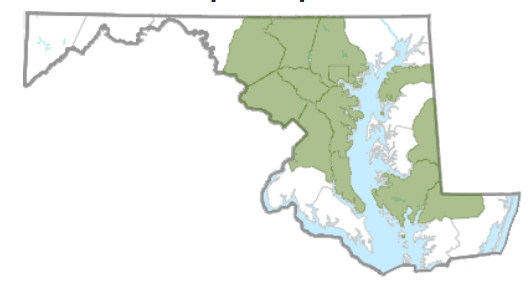
Since then, goldenrain tree has become naturalized at Monticello, and in the years since, it became popular as a landscape tree. It was planted throughout the mid-Atlantic and as far away as California. While initially prized for its resilience and speed of growth, observers and researchers began to recognize its invasive nature as it outcompetes native flora, significantly altering local ecosystems. While it can still be found for sale in many locations, recent regulations and advisories in Maryland now restrict its planting. The Maryland Biodiversity Project reports that documented instances are concentrated in the center of the state. See the map below.
What is it?
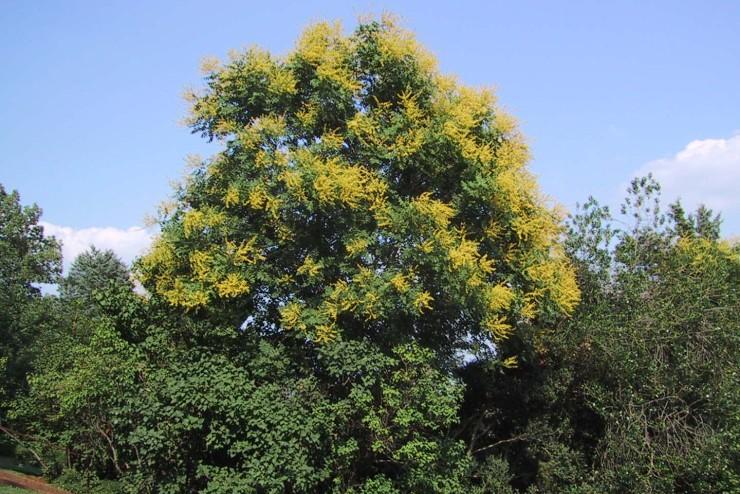
The goldenrain tree (Koelreuteria paniculata) is a medium-sized, fast-growing tree native to Asia, specifically China, Korea, and Japan. The tree grows 30–40 feet tall with a broadly spreading canopy. Once goldenrain tree seeds germinate, they grow rapidly and tolerate drought, pollution, and various soil types, which give them a significant competitive edge over native vegetation. The species’ adaptability means that even small, isolated populations can spread rapidly, creating new stands and crowding out local plant species.
How does it spread?
Goldenrain trees spread primarily by reseeding. The seed pods release numerous small seeds, which are easily dispersed by wind and water. The seeds germinate readily in a variety of soils and conditions, particularly in open or disturbed sites. Birds and water also transport the seeds away from parent trees, resulting in new colonies far from the original planting sites.
How can I identify it?
Goldenrain trees leaves are compound and can reach 18” long, often with deeply serrated leaflets. Clusters of showy yellow flowers bloom in summer; when the blooms are finished, the petals drop to the ground, resembling a "golden rain," hence the common name. These are followed by conspicuous brown, papery pods shaped like lanterns. These may hang on the tree’s branches into the winter, aiding identification. See the photo gallery below.
How can I control it?
Controlling the spread of the goldenrain tree involves a combination of mechanical, chemical, and ecological strategies. Mechanical control includes manually removing seedlings and young plants, as well as cutting down mature trees. Treat the stumps with appropriate herbicides to prevent resprouting. Plant native species in treated areas to reduce the chance of new sprouting.
For more information:
Learn more about paper mulberry:
goldenrain tree:
Koelreuteria paniculata (NC State Extension)
Golden Raintree (Koelreuteria paniculata) (Virginia Cooperative Extension)
Golden rain tree (The Morton Arboretum)