
From Summer 2026 issue of Branching Out. Subscribe to Branching Out here. Read more Invasives in Your Woodland articles here. This article contains information current as of date of publication.
Unlike the subject of last issue’s spotlight, chances are considerably better that this issue’s species is more familiar to Branching Out readers. As is the case with a considerable number of invasive species in North America in general and Maryland specifically, creeping Jenny has become naturalized in ecosystems across the continent. Although it only grows a few inches high, the stems branch out up to six feet and can cause thick mats that displace native species.
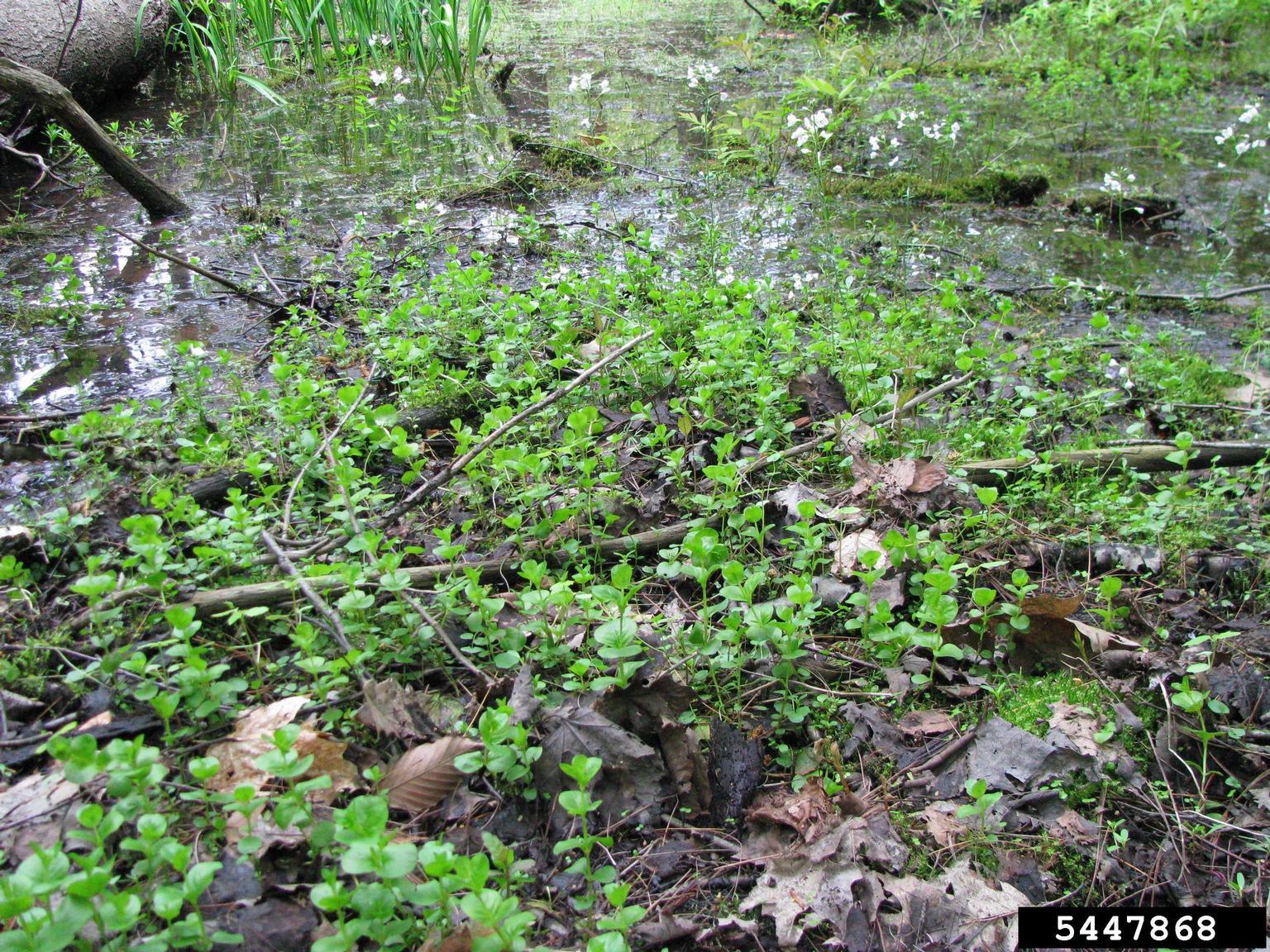
If the term “creeping Jenny” is unfamiliar, consider the other common names applied to this member of the primrose family. They include “creeping Charlie,” “creeping Joan,” “creeping yellow loosestrife,” “running Jenny,” “wandering Jenny,” “wandering sailor,” and “moneywort.” They all refer to the plant Lysimachia nummularia, which is native to Europe and western Asia. Records of creeping Jenny in the U.S. date to as early as 1739, when it was imported as an ornamental ground cover. Its seeds were offered for sale as early as 1833 and appears to have escaped cultivation by 1900.
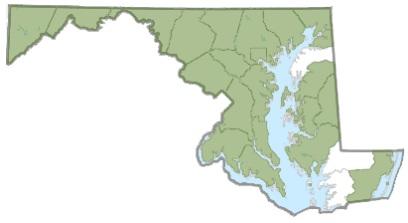
Today, it is widespread in wetland ecosystems, forested floodplains, and other areas of moist soil. It occurs throughout the eastern US, from Minnesota to Louisiana and Georgia to Maine, in several Great Plains states and the Pacific Northwest, and in the provinces of British Columbia and Ontario in Canada. Two writers in Ontario characterize creeping Jenny as a “nasty invader.” In Maryland, is reported in all but three counties: Kent, Wicomico, and Somerset (see map below).
What is it?
Creeping Jenny is a low-growing herbaceous perennial. It grows in a variety of sun conditions, from full sun to partial shade and prefers moist to wet soil for growth. Its low-lying continuous mats prevent native understory plants from thriving.
How does it spread?
Creeping Jenny spreads primarily vegetatively, as its runners will root where its leaf nodes contact soil. It also spreads underground via rhizomes. Small cup-shaped yellow flowers appear in summer. It rarely produces seeds or fruit that can be consumed by wildlife.
How can I identify it?
This perennial has evergreen to semi-evergreen leaves. It forms thick, dense mats in rich soils and in areas such as stream banks, roadside ditches, wet meadows, and swamps. See the photo gallery below.
How can I control it?
Controlling creeping Jenny can be difficult due to the conditions in which it grows. Non-chemical methods should be the first choice, including hand-pulling; all stems and fragments must be carefully removed to prevent them re-rooting. Mowing is ineffective. Use only herbicides that are labeled for use near water.
For more information:
Learn more about creeping Jenny:
Lysimachia nummularia (NC State Extension)
Invasive Plants in Pennsylvania: Moneywort (PA DCNR)
Creeping Jenny (Maryland Biodiversity Project)