
From Spring 2026 issue of Branching Out. Subscribe to Branching Out here. Read more Invasives in Your Woodland articles here. This article contains information current as of date of publication.
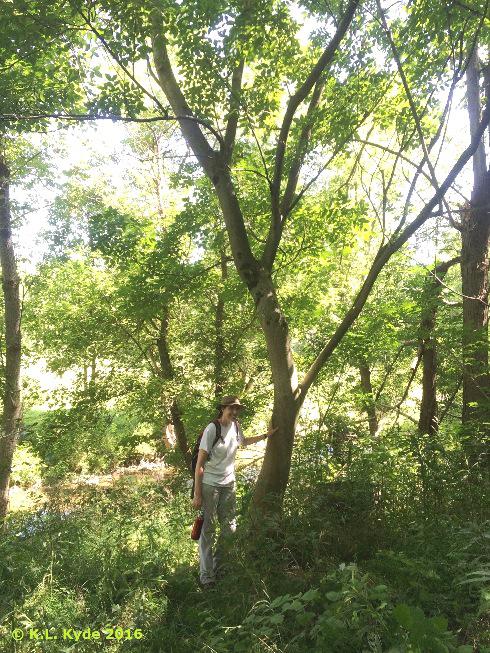
In the last issue of Branching Out, we mentioned in this feature that the Maryland Department of Agriculture (MDA) had updated its Maryland Prohibited Invasive Plant list” of invasive species that were now banned for sale across the state. Along with several invasives that are familiar to readers of this feature is a species less well-known but no less deserving to be included: the bee-bee tree.
The bee-bee tree (also known as Korean Evodia) came to the United States as many other now invasive plants did. It is native to East Asia and arrived in the US in 1905, when seeds were sent to Harvard University’s Arnold Arboretum in Massachusetts for ornamental evaluation. In the 1920s, additional seed was imported from China by the U.S. Dept. of Agriculture’s research station in Beltsville, Maryland, further establishing it in horticultural collections and trial plantings. From these early arboretum and research sites, scattered landscape use and intentional planting by beekeepers led to escapes into nearby forests in states such as Ohio, Pennsylvania, Virginia, and Maryland. For example, it became invasive at the Penn State Mont Alto campus and the neighboring Michaux State Forest, and has naturalized at the Morris Arboretum in Philadelphia and in disturbed forest fragments nearby. In 2015, a Washington County, MD homeowner reported to the Maryland Invasive Species Council that bee-bee tree Infested 4 acres of her property. She had identified the species from bee-keeping websites after a DNR forester completed a forest stewardship plan for the property. A later MDA investigation stated that it posed a minor threat for infestation. Since then, that threat has increased, leading to its inclusion on the 2026 invasive plant list.
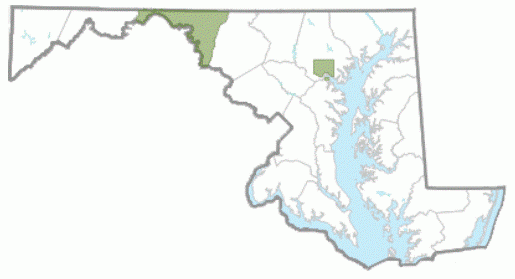
Why, then, are there so few confirmed reports of bee-bee tree in MD (see the map below)? First, it was not deliberately planted as prolifically as some now-invasives (think Callery pear). The other reason is that it may be subject to misidentification when young or not in bloom.
What is it?
The bee-bee tree (Tetradium daniellii) is a deciduous, medium-sized tree, typically 30–50 feet tall and nearly as wide, with multiple low lateral branches. It produces abundant seed, spreads beyond cultivation, forms dense understory thickets, and alters habitat structure and species composition in natural areas.
How does it spread?
This species spreads primarily by seed. Male and female trees both produce white flowers; female trees then produce showy clusters of red-to-purple fruits. Each small fruit contains shiny black seeds that resemble BB pellets and are produced in large numbers. Seeds can be dispersed by gravity, water, and birds or other wildlife that consume the fruits, Seedlings then establish in disturbed forests, forest edges, and along rights-of-way.
How can I identify it?
Bee-bee trees have smooth grey bark at all ages. Leaves are opposite and pinnately compound with 7–11 oblong, entire leaflets on a central stalk. Young trees may resemble ash or tree-of-heaven, but ash has a different fruit and TOH leaflets are alternate. The best diagnostic is the large clusters of small, fragrant white flowers in mid- to late summer when many trees are not blooming. See the photo gallery below.
How can I control it?
Control small seedlings and saplings by hand-pulling or digging, if the entire root is removed and the soil is moist. For larger trees, use a cut-stump treatment by cutting the tree near ground level and immediately applying a systemic herbicide such as triclopyr or glyphosate to the fresh stump to prevent resprouting. Girdling combined with systemic herbicide can also be used where felling is difficult.
For more information:
Learn more about bee-bee tree:
Invasive Plants in Pennsylvania: Bee-bee tree (Pennsylvania DCNR)
The Buzz About Bee-Bee Tree: A New Invader in Maryland (Maryland Grows blog)