Vegetable garden plants obtain non-mineral nutrients (hydrogen, oxygen, and carbon) from air and water. They obtain mineral nutrients from organic matter and clay and silt soil particles. Gardeners apply organic or synthetic fertilizers to supply mineral nutrients that are in short supply.
Fertilizers should be applied based on laboratory soil test results and plant needs.
Nutrient needs vary among plant families and species. For example, tomatoes and leafy greens require more nitrogen than beans.
Vegetable crops generally need nutrients most when they are getting established and during flowering and fruiting.
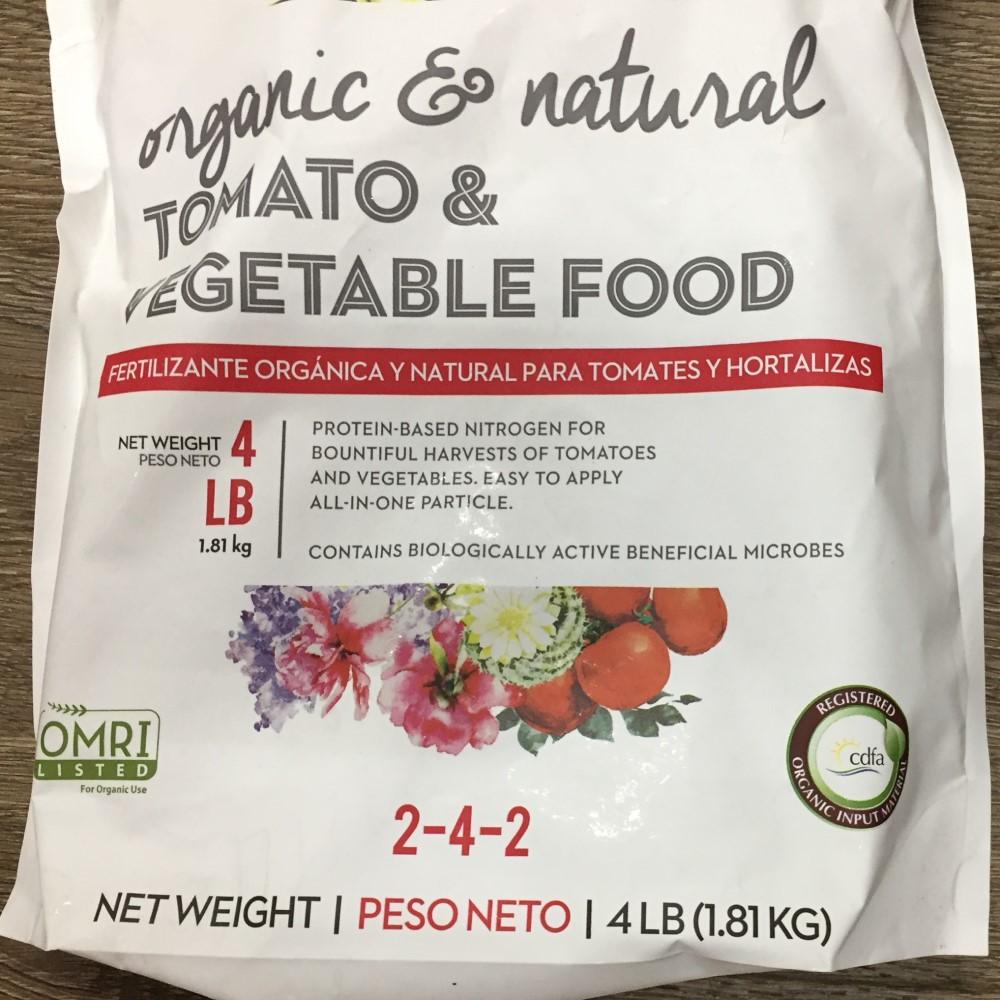
An example of a complete fertilizer suitable for vegetable gardens that contains, by weight, 10% nitrogen, 2% phosphorus, and 8% potassium. Photo: Jon Traunfeld
A complete fertilizer contains all three of the major nutrients: nitrogen (N), phosphorus (P), and potassium (K). A balanced fertilizer contains N, P, and K in roughly equal proportions. Visit Garden Fertilizer Basics to learn more about important nutrients and fertilizer types.
If soil test results are not available to guide fertilizing decisions, select a complete, balanced fertilizer or a complete fertilizer having a higher percentage of nitrogen.
Fertilize spring seedlings and transplants with a soluble fertilizer mixed with water. Switch to a granular (applied dry) vegetable fertilizer as plants grow. The nutrients in soluble fertilizers (particularly nitrogen) are readily accessible to plants, but they get used up or leach away more quickly than nutrients in granular fertilizers.
Applying fertilizer
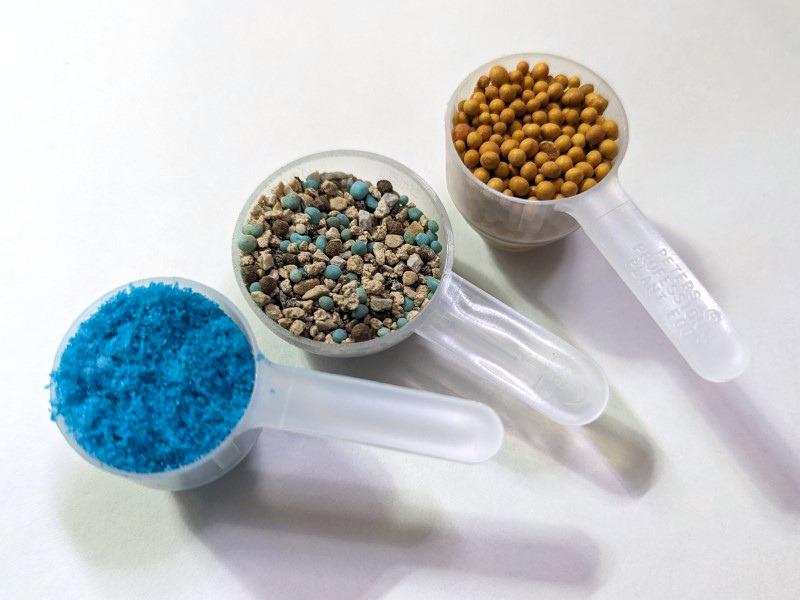
Examples of measuring scoops holding fertilizer: powdered, to be diluted in water (left) and pelleted, slow-release fertilizer that is applied dry (center and right). Photo: Miri Talabac, University of Maryland Extension
Fertilizer supports normal growth and supplements and corrects nutritional deficiencies in a plant. Insufficient nutrients can affect crop yields and plant health, but fertilizer overuse can also damage plants.
Nutrient deficiency symptoms – stunted or slow growth, pale leaves, and low yields – can look similar to the damage caused by other stress factors, such as crowding, insufficient sunlight, compacted soil, and damage from root-knot nematode feeding. Deficiency symptoms may indicate a need to fertilize after plants become established.
Ways to apply fertilizer
Broadcasting: spreading granular (dry) fertilizer (usually sprinkling by hand) over an area where plant roots will be growing, either before or after planting.
Banding: applying granular fertilizer in a narrow band next to a row or furrow where seeds or seedlings will be planted.
Side-dressing: applying granular fertilizer around individual plants or along the sides of a row of plants, after the plants have become established.
Foliar: a mixture of soluble fertilizer and water is sprayed on the leaves.
Where to apply fertilizer
Move mulch aside before fertilizing; replace the mulch afterward.
The nutrients in fertilizer need to be absorbed by the roots. Mix dry fertilizers into the top 2 to 4 inches of soil so the pellets are closer to roots and less likely to be lost to wind or heavy rain. Water-in fertilizer after application if a soaking rain is not expected.
Do not pile fertilizer next to plant stems, or let dry fertilizer granules sit on foliage, which can “burn” (injure) the plant’s tissues.
Supplementing specific nutrients
Use nitrogen-only fertilizers (often organic formulations) rather than complete fertilizers if a soil test report indicates high levels of P (phosphorus) and K (potassium). Adding more P and K when soils already have plentiful levels will not benefit roots and may harm beneficial soil microbes.
Boron (B) is an important micronutrient that is sometimes deficient in sandy soils, causing disorders in some vegetable crops. If a soil test report shows a low boron level, dissolve 1 tablespoon of Borax in 1 gallon of water and apply the solution evenly from a watering can over 100 square feet of the garden.
Avoid fertilizer over-application
Follow the label directions of the fertilizer for the amount to apply. More is not better in terms of frequency or dosage, and extra nutrients will not necessarily stay stored in the soil for future root absorption.
Aside from leaf burn, overapplied synthetic and organic fertilizers can cause root desiccation or (for nitrogen excesses in particular) lush leaf growth at the expense of fruit. Too much nitrogen may also make plants more vulnerable to pest or disease problems.
Avoid fertilizer waste
Weeds compete with vegetables for nutrients; remove them before fertilizing.
Leaching and runoff carry nutrients out of the root zone, reducing what plant roots can access. Address any soil erosion or inundation issues to minimize nutrient loss and prevent pollution of surface water and groundwater.
Don’t fertilize too early in spring, since cool soil temperatures limit nutrient release from organic matter.
Only fertilize the planting area where roots will be growing, not walkways.
Nutrients from organic matter
Soil organic matter (OM) is made up of living, dead, and decomposing plants, small animals, and microorganisms. Materials we think of as dead, like dried fallen leaves or rotting banana peels, are teeming with microbial life. Organic matter is a major contributor to soil health, and most garden plants benefit from increases in soil organic matter.
OM releases plant-available nutrients slowly during the growing season. The need for organic or synthetic fertilizers decreases as the soil’s organic matter content increases.
Aim for a soil organic matter content of 5 to 10% (measured by weight by soil testing labs). Soils in this range are fertile, easy to work, and have a large number of earthworms.
For each 1% of OM, about 0.4 pounds of nitrogen per 1,000 square feet is available for plants (this is a conservative estimate). A soil with a 5% OM level would release about 2 pounds of nitrogen per 1,000 square feet, which is a typical nitrogen recommendation for vegetable gardens.
Soil OM may not supply sufficient nutrients at particular times of the season and at particular stages of plant development, such as in early spring and/or when fruits start to form. The peak for nitrogen release typically occurs in July if soils have adequate moisture.
Many people with well-established, high-OM gardens achieve large harvests without using fertilizers.
Fertilizing using nitrogen only
Plants require large quantities of nitrogen (N); it’s the nutrient they use in the greatest amount compared to other mineral nutrients. The general N recommendation for vegetable crops is 2 pounds per 1,000 square feet, equivalent to 0.2 pounds (3.2 ounces) per 100 square feet.
“Heavy feeders” like tomatoes, broccoli, and beets should receive 3 pounds of N per 1,000 square feet, equivalent to 0.3 pounds (4.8 ounces) per 100 square feet.
High-nitrogen organic fertilizers include cottonseed meal (6-2-1), nitrate of soda (15-0-0), calcium nitrate (16-0-0), blood meal (12-0-0), fish meal (8 to 10% N), and fish emulsion (5% N).
Example of a nitrogen fertilizer calculation
How do I apply 3.2 ounces of N per 100 square feet using nitrate of soda (15-0-0)?
3.2 ounces of N ÷ 0.15 (the % of N in the nitrate of soda) = 21.33 ounces (1.33 pounds) of nitrate of soda.
Converting dosage recommendations of synthetic to organic fertilizer
The following is an example of a synthetic (chemical) fertilizer dosage recommendation converted into an organic fertilizer dosage.
Supply 2 pounds of N per 1,000 square feet by applying 4.35 pounds of urea fertilizer (46-0-0). If you want to substitute cottonseed meal (6-2-1) for the urea:
Solution #1
Divide the percentage of N in the synthetic fertilizer by the percentage of N in the organic fertilizer and multiply by 4.35 (the amount of urea recommended).
0.46 ÷ 0.06 × 4.35 = 33.3 pounds of cottonseed meal per 1,000 square feet
Solution #2
Calculate the amount of fertilizer product needed by dividing the pounds of N needed by the percentage of N in the product.
2.0 ÷ 0.06 = 33.3 pounds of cottonseed meal fertilizer per 1,000 square feet
If the garden is 500 square feet, you would apply half of that calculated amount.
Helpful volume and weight relationships
One cup (8 ounces in volume) of a dry organic fertilizer like cottonseed meal weighs approximately 0.33 pounds (5 ounces in weight).
One cup (8 ounces in volume) of a synthetic granular fertilizer like 10-10-10 weighs approximately 0.50 pounds (8 ounces in weight).
Author: Jon Traunfeld, Extension Specialist (retired), Home/Community Food Gardening, 2020. Revised April 2026. Reviewed by Miri Talabac, Lead Horticulture Coordinator, HGIC. April 2026.
Copy editing by Nancy Klein, Maryland Master Gardener, April 2026.