
Dialing in your corn nitrogen program with corn stalk nitrate test
By Nicole Fiorellino, Extension Agronomist
There are many different techniques and technologies available now to assist farmers with optimizing their corn nitrogen (N) management in-season. The simplest practice is splitting the total amount of N applied to the corn into multiple applications across the growing season. More complicated practices include the use of in-season monitoring tools to precisely prescribe the timing and rate of N application. While the decision to use these tools is made at the discretion of the farmers, I believe that every farmer should rate their N management performance over time to dial in their N management.
Most farmers crudely evaluate the N status of their corn during the season by assessing the greenness of their plants. This is an acceptable means of determining if the corn crop has received too little N. But on the other side of the coin, how do farmers practically determine if the corn has received too much N? And if you can’t think of a feasible way to do this – let’s think about why this matters. In a great corn year, your yields are high and everyone is happy. To most, high corn yields mean high profit. But what if you had the potential to turn your high yields into even higher profits? What if you could have cut your input costs and still received the same high yields? There is no way to determine this in-season by observing the greenness of your crops, but before the end of the season, there is a way to evaluate how well you optimized your N management.
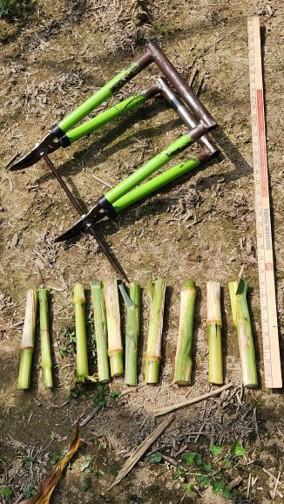
This is where the CSNT comes in. The corn stalk nitrate test (CSNT) is the best tool available to assess whether too much N was applied to your corn in the past growing season. We know that nitrate-N is mobile in the corn plant and when there is nitrate-N in the corn plant beyond what it needed to fill grain, it is redistributed throughout the plant and concentrated near the bottom of the stalk towards the end of the growing season. So a simple sample of the lower cornstalk (Fig. 1) can be analyzed for N concentration and help adjust farmer’s N management in the following seasons.
The important point about CSNT is that it is referred to as a “post-mortem” test, like an autopsy. The sample is collected so late in the season, generally when the field is nearly all at black layer, that there is no action that can be taken in the current growing season. The utility of the CSNT is to adjust the following season’s N management strategy. Ideally, farmers will perform CSNT over multiple years to eliminate the effects of annual weather fluctuations. Over time, continued observance of a build up of nitrate-N in the CSNT samples indicates that a farmer can safely decrease the amount of N applied through the growing season without negatively impacting their yields.
For specific information on how to collect CSNT samples, scan the QR code below or go to https://go.umd.edu/CSNT to view a copy of a UMD Factsheet on the topic. A critical component of successful CSNT sampling is the height from the ground and the length of the corn stalk that is cut and analyzed. It is critical to collect an 8” long sample of stalk that begins 6” above the ground surface – there is a great image of this in the UMD factsheet. My research team has fabricated a CSNT sampler that consists of two loppers welded together 8” apart with a 6” long bolt protruding from the bottom. Figure 2 depicts the sampler we built. Additionally, I have included links to two videos showing the sampling process with a common lopper and with our fabricated lopper, visible in the folder linked in the QR code. Alternatively, a yardstick or measuring tape can be used alongside a single lopper to collect the sample.
Although this process is not required or mandated by law, I believe it to be a crucial component of precision N management, as CSNT sampling is the only method to determine if too much N has been used in the previous growing season. This relatively simple sampling method can provide extremely valuable information to farmers who are seeking to optimize their corn N management and increase their farm’s profitability.