
Cross-Striped Cabbage Worms Appearing in Cole Crops
By Veronica Yurchak, Vegetable Specialist, University of Maryland; vjohnso4@umd.edu
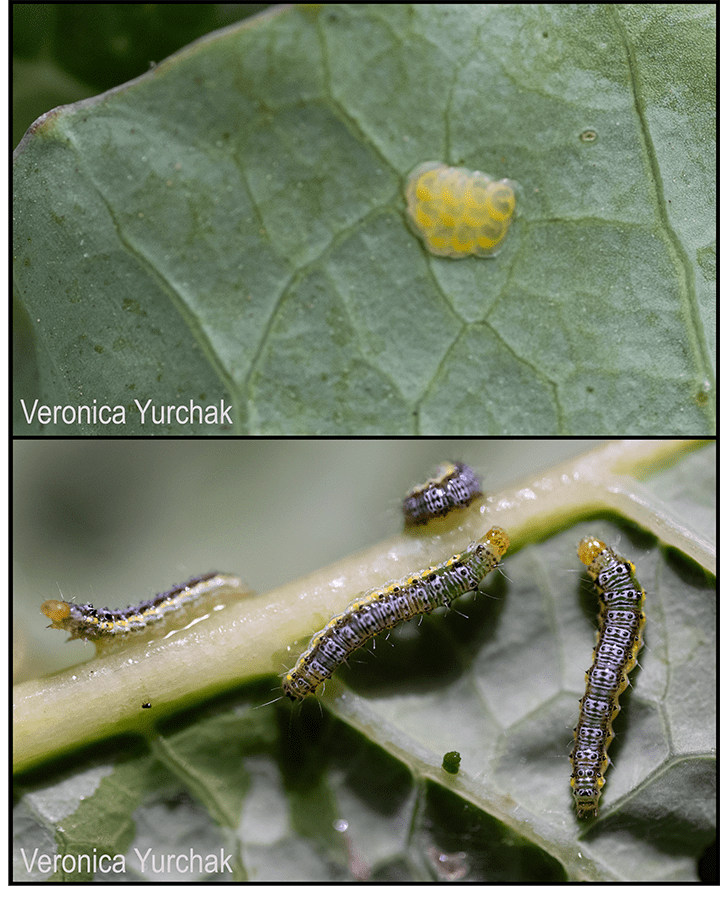
Growers across the state should begin scouting for cross-striped cabbageworms (CSCW). Unlike the more common brassica caterpillar pests which lay their eggs individually, CSCW females lay eggs in clusters of 3 to 25. As a result, a single plant can quickly become infested with numerous hungry caterpillars, resulting in faster, more severe damage. In recent years, we’ve seen CSCW activity ramp up earlier in the season, and this year is no exception. Egg masses and mid-stage caterpillars have already been found in Eastern Shore counties.
Adult CSCW moths are short-lived and nocturnal, and therefore rarely seen. Egg clusters are flattened, yellow, and can typically be found adhered to the underside of leaves (Figure 1). The caterpillars are a bluish-grey color on top and green underneath, with numerous black bands across their backs and a yellow stripe down each side (Figure 2). When feeding, CSCW chew small holes in leaves until only leaf veins remain. They may occasionally also feed on, or burrow into, developing brassica heads. Infestations typically appear as completely skeletonized leaves/plants with adjacent plants undamaged.
Due to the aggressive nature of this pest, treatment thresholds are much lower than those recommended for diamondback moths, imported cabbageworms and cabbage loopers. Scout weekly to twice weekly, and spray when 5% of plants are infested with CSCW. When choosing insecticides, consider more IPM friendly products to help conserve natural enemies, as CSCW are frequently attacked by various insect predators and parasitoids. Some IPM friendly options include diamides, Bt products, and spinosyns. Also avoid over-application of nitrogen fertilizers, as this has been shown to contribute to increases in larval CSCW populations.
This article is featured in the Vegetable and Fruit News, Vol. 16, Issue 3.
Vegetable & Fruit News is a research-based publication for the commercial vegetable and fruit industry available electronically from April through October. Published by the University of Maryland Extension Agriculture and Food Systems team.
Subscribe