
Combining Biosolarization, Cover Cropping, and Strip Tillage for Weed Management in Vegetables
Dwayne Joseph - University of Maryland Extension Educator, Kent County
Alan Leslie – Center Director WMREC, CMREC, LESREC, University of Maryland
Kurt Vollmer - University of Maryland Extension Specialist, Weed Management
Cerruti Hooks - Professor Department of Entomology, University of Maryland
Vegetable farmers face challenges due to the limited availability of herbicides registered for vegetable production compared to row crops. Furthermore, existing herbicides often fail to provide full-season weed control and may pose risks of crop injury if not applied correctly. Weed management issues are even more pronounced in organic systems, where reliance on manual and mechanical control is both time consuming and labor intensive. To address these challenges, we evaluated an integrated weed management (IWM) approach that combines biosolarization, strip tillage, and living mulch.
Biosolarization, a technique similar to solarization, involves incorporating organic amendments into moist soil before covering it with clear plastic for passive solar heating. As the material decomposes, it releases biotoxic compounds that suppress weeds and soilborne pests. Following the 14-day
biosolarization process, the transparent plastic is removed, and the soil is aerated for seven days before transplanting the cash crop. Biosolarization is compatible with organic systems and shows promise when combined with IWM practices such as conservation tillage and cover cropping. This study focused on evaluating a holistic weed management system that integrates within-row techniques such as biosolarization, solarization, and strip tillage, along with between-row strategies like red clover living mulch. We hypothesized that this IWM system would suppress weeds, improve crop yield, and enhance soil health.
Methods
Treatments were organized in a randomized complete block split-plot design and were replicated four times. The whole plot treatments included summer squash and okra grown under the following conditions:
1) in living mulch with no-till (LM-NT), 2) in living mulch and strip tilled (LM-ST), 3) grown in solarized soil (SOL), or 4) in living mulch and grown in biosolarized soil (BIOSOL).
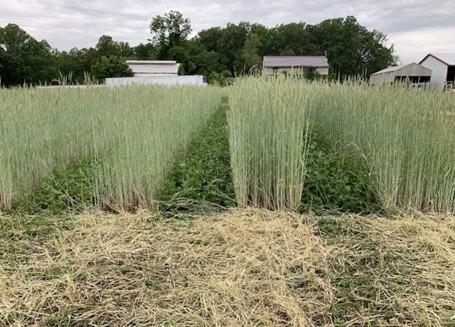
Fall plot preparation – In early fall, red clover + cereal rye mixture was planted in BIOSOL, SOL and LM- ST treatment plots at a 6-inch row spacing. In LM-NT plots, the red clover and cereal rye was seeded in separate, alternating rows. Two& rows o red clover were planted at each border and interna rows were alternated between six rows of cereal rye and four rows of red clover.
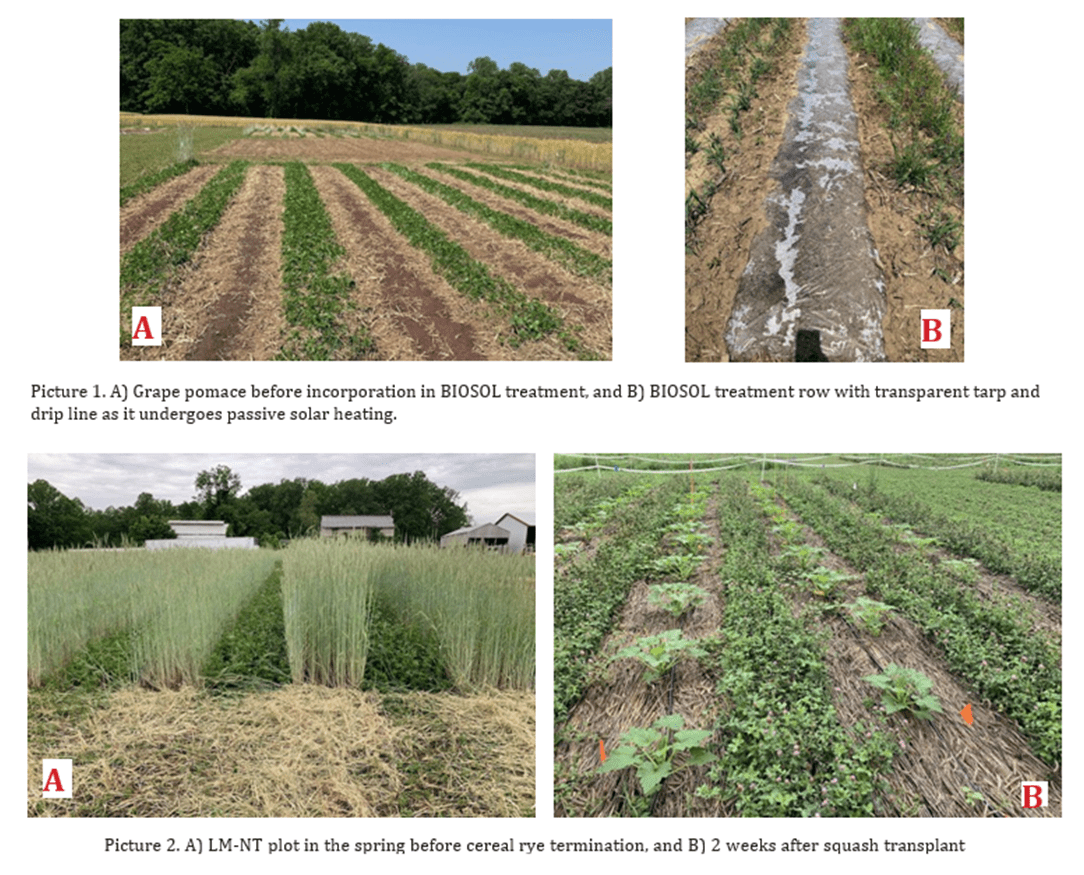
Spring plot preparation – In BIOSOL plots, the entire plot was mowed, the within-row& areas (where the cash crops were transplanted) was strip tilled 40-inches wide. Grape pomace was spread onto the soil surface and incorporated (rotovated), then transparent plastic tarp and drip lines were laid in the stripped zones (Picture 1). The biosolarization process proceeded for 18 days then the plastic tarp was removed and the soil was aerated for seven days before cash crop transplant. In LM-NT plots (Picture 2), the cereal rye was terminated with a roller crimper. In SOL plots, the entire plot was mowed and rotovated. The transparent plastic tarp and drip lines were laid in intra-row areas. In LM-ST plots, the entire plot was roller crimped to terminate cereal rye. The within-row areas were strip-tilled (40-inches wide) prior to transplanting the cash crops. Four rows of summer squash and four rows of okra seedlings were transplanted into all plots on the same day with a within and between-row spacing of 4 ft and 5 ft, respectively. Organic fertilizer was applied (side-dressed) according to crop nutrient requirement throughout the season, and plants were irrigated via drip when necessary.
Data Collection – Individual weed counts (species & number) were taken at 2, 4, 6 and 9 weeks after planting (WAP) from eight randomly (two within- and between-row for both cash crops) placed 100 sq-inch quadrats within each plot. Yield data was recorded from plants within the two internal rows of each cash crop.
Results
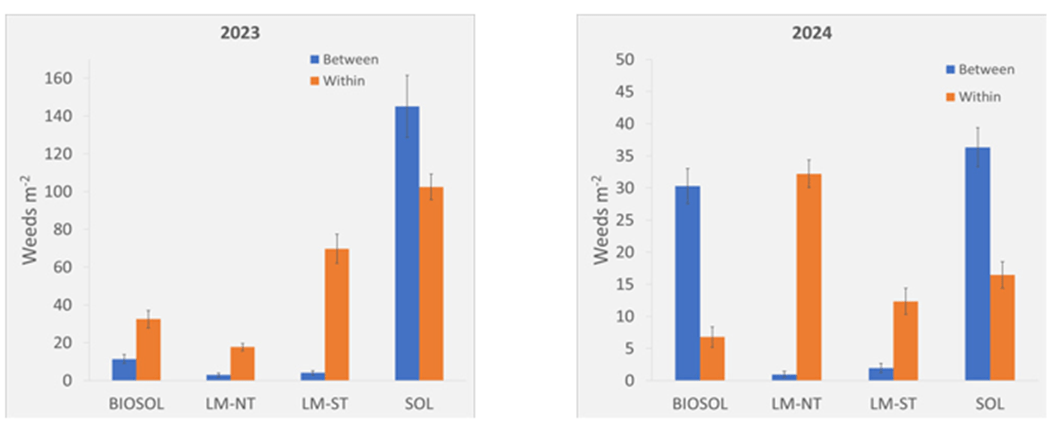
Weed density and crop yield varied notably among treatments and across the two years of study (Figs. 1–2). BIOSOL plots consistently exhibited the lowest within-row weed densities, with a mean of just 7 weeds m⁻² in 2024, the lowest observed across all treatments and years, and 32 weeds m⁻² in 2023, which was the second lowest in that year (Fig. 1). In contrast, the highest within-row weed densities were observed in SOL plots in 2023 (102 weeds m⁻²) and LM-NT plots in 2024 (32 weeds m⁻²).
Between-row weed densities were highest in SOL plots across both years, with 145 and 36 weeds m⁻² recorded in 2023 and 2024, respectively. In contrast, the LM-NT and LM-ST plots maintained the lowest between-row weed densities in both years (Fig. 1), suggesting an advantage of the living mulch system for suppressing between-row weeds.
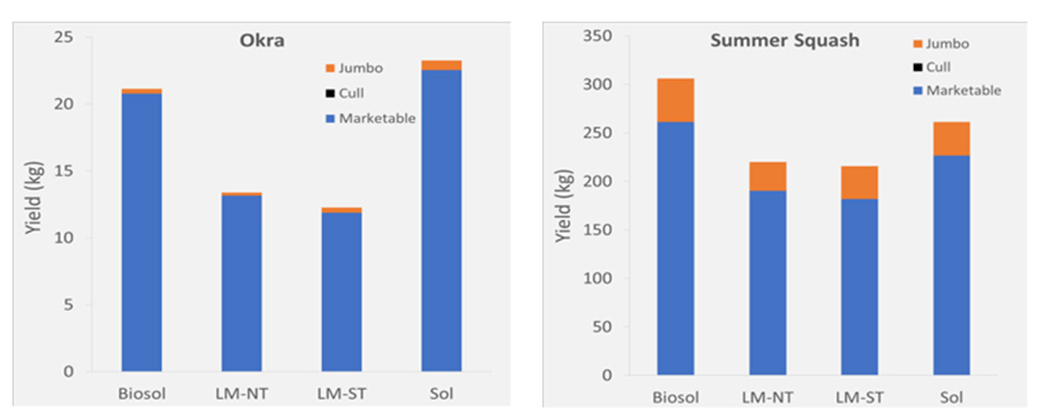
Crop yield responses differed between okra and summer squash. SOL plots produced the highest overall okra yields, followed by BIOSOL, LM-NT, and LM-ST plots, with the latter yielding the least (Fig. 2). For summer squash, however, BIOSOL plots achieved the highest yields, followed by SOL, LM-NT, and again LM- ST, which produced the lowest yields overall (Fig. 2).
Discussion
The living mulch system, particularly with red clover, proved effective in suppressing weed growth be- tween crop rows. Both LM-NT and LM-ST treatments maintained the lowest between-row weed densities across both years, underscoring the potential of living mulch as a non-chemical weed management strategy. However, yield outcomes suggest possible trade-offs. In the case of okra, for example, SOL plots, lacking living mulch but with the overall highest weed pressure, produced the highest yields. This indicates that competition between the crop and the red clover mulch in LM-NT and LM-ST plots, may have negatively impacted crop performance in both crops.
Within-row weed control was most effectively achieved through biosolarization, which consistently sup- pressed weeds better than other treatments. BIOSOL plots had the fewest within-row weeds across both years and also produced the highest summer squash yields, highlighting its dual benefit for weed manage- ment and crop productivity. Biosolarization appears especially promising for organic vegetable systems, offering early-season weed control and giving transplanted crops a competitive advantage without the need for synthetic herbicides.
Nonetheless, some weeds did emerge along the row edges in BIOSOL plots, likely due to soil disturbance during tarp application and removal, which exposes buried weed seeds to light and other environmental stimuli that promote germination. This highlights the importance of refining tarp handling practices to minimize unintended soil disturbance and subsequent weed emergence.
Overall, biosolarization demonstrates its potential as a viable and effective technique for within-row weed management in organic vegetable production systems, particularly when integrated with other weed management practices such as living mulches.
Future Work
To build on these findings, future research should evaluate various pomace materials as biosolarization amendments to enhance weed suppression while focusing on sources that are locally available within the areas where the technique is intended to be used. In addition, optimizing soil aeration and passive solar heating durations will be critical to maximizing weed control. Refining tarp management techniques to minimize soil disturbance during application and removal may also help reduce weed emergence along treated row edges, further improving the efficacy of biosolarization.
____________________________________________________________________________________________________________________________________________