
Sigal Goldstein, University of Maryland Class of 2028
Ghost forests – haunting reminders of once-lush woodlands, now reduced to bleached, lifeless trees – are becoming increasingly common along the U.S. East Coast. The killer of the forests? Saltwater intrusion and coastal flooding are both intensified by rising sea levels. While the damage on the ground is visible, artificial intelligence (AI) is giving scientists a bird's-eye view of these tree graveyards. AI provides maps and insights to synthesize the causes and future risks across the millions of dead trees at unprecedented speed and detail (Dinneen, 2025).
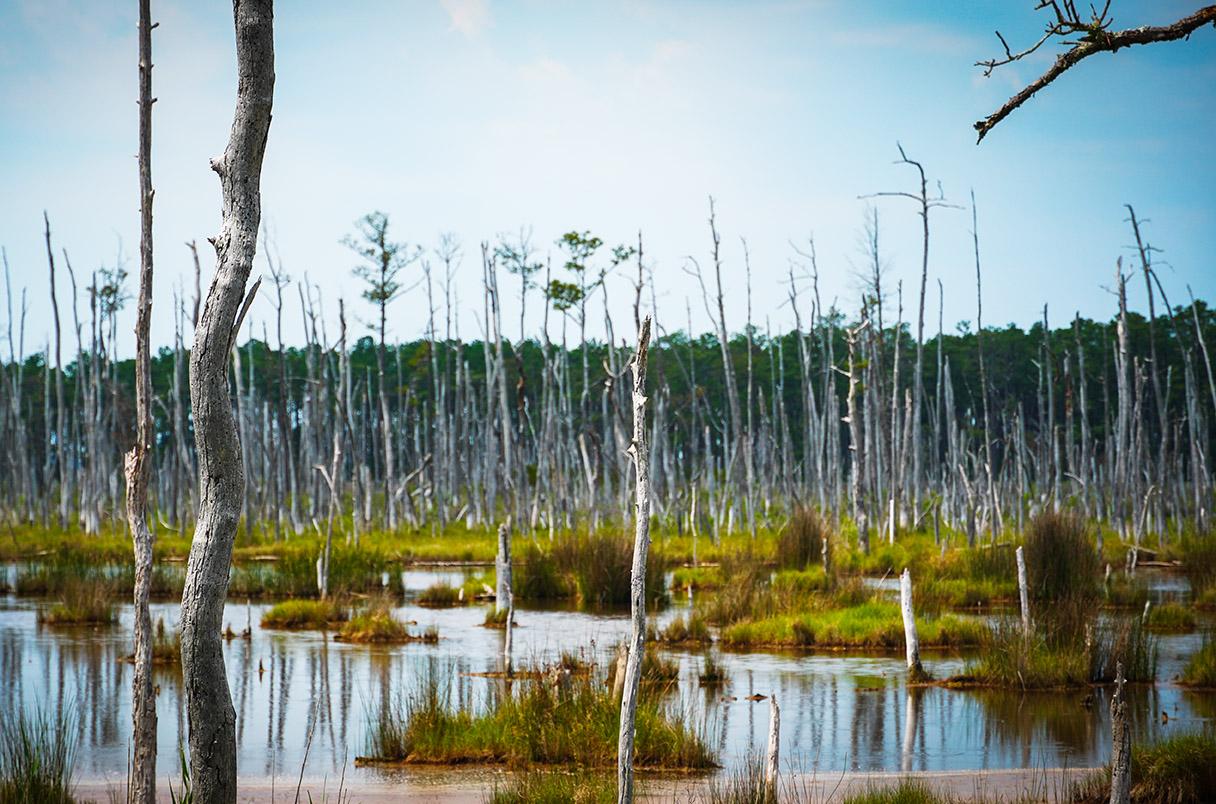
In Maryland, the Blackwater National Wildlife Refuge is an example of an area where marshland and rising waters have created significant acres of ghost forests, marking a shift from forested land to expanding wetland ecosystems. Marshlands filter pollution, provide wildlife habitats, and buffer shorelines against erosion. Forests work in concert with marshland to enhance these services. The death of these trees threatens all three services and the delicate balance of Maryland’s coastal habitat. To tackle the mortality problem, the University of Virginia’s Environmental Institute is using AI to analyze satellite imagery from 430 miles above Earth (Bahorsky, 2025). This technology has counted roughly 12 million dead trees along the East Coast and translated the data into detailed maps- a task impossible for human teams to complete quickly enough to prevent further losses (Bahorsky, 2025). Ghost forests are rapidly spreading across the landscape; AI's contributions to our understanding of them are invaluable, as the technology rapidly tracks mortality in real time, guiding targeted conservation and management efforts before more forests disappear.
While the damage to moribund forests is visible on the ground, AI provides perspectives and data that would otherwise go unnoticed. In this way, AI acts like a doctor, alerting us (the patients) to the severity of forest loss. Although AI infrastructure has many environmental impacts, the resulting technologies offer scientists a significant advantage in analysis and decision-making by enabling them to identify trends in large datasets, anticipate outcomes, and simulate intricate scenarios. The accelerated analysis enables faster paths to solutions. Such capabilities are critical as forests produce oxygen, store carbon, and sustain ecosystems, yet they are disappearing at spooky rates. The rise of ghost forests is more than an environmental anomaly; it is a clear signal that climate change is already haunting our landscapes, and demands urgent action.
Works Consulted
Bahorsky, R. (2025, December 2). AI Maps “ghost forests” from Maine to South Carolina. University of Virginia. UVA College and Graduate School of Arts & Sciences. https://as.virginia.edu/news/ai-maps-ghost-forests-maine-south-carolina
Dinneen, J. (2025, October 1). AI reveals vast ‘ghost forests’ along U.S. coast. SCIENCEINSIDER, 390(6768), 2. https://doi.org/10.1126/science.z1xe4no