

FS-1101 ❘ November 2019
4-H Adventure in Science Program and the Power of Partnership
By: Alganesh Piechocinski
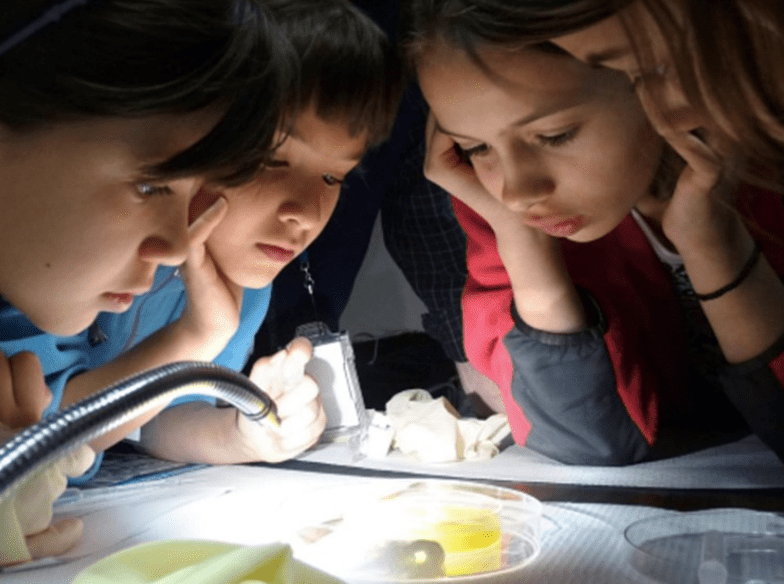
In 1973, Dr. Ralph R. Nash, a scientist at the National Aeronautics and Space Administration saw the need for science educational experiences for youths. Dr. Nash began offering hands-on opportunities and activities in science and math for neighborhood children. He recruited seven children and their families within his community. When more children became interested in participating, the program expanded into the National Bureau of Standards (later renamed the National Institute of Standards and Technology) and incorporated as an all-volunteer, not-for-profit organization named “Adventure in Science” (AIS).
In 1990, Dr. Nash and a few program founders approached the University of Maryland Extension 4-H Youth Development Program to partner and help them expand the science experiential learning program for children in Montgomery County. The program has continued to grow, expanding to various federal organizations and agencies in the County. The program also has been at Michigan State, Baltimore City, Fort Detrick, Frederick County, Maryland, University of Maryland Extension, College Park, Maryland and other sites in counties across Maryland.
Research indicates that high-quality youth development programs like AIS can significantly influence young people’s decisions and choices. We believe that all youth, regardless of their ethnic backgrounds and educational levels can reach their personal goals and fullest potential if guided by competent and caring adults.
Adventure in Science is all about Exploring the World by Doing
The Adventure in Science program’s focus is to present science as an exciting activity and a way of thinking about the world, rather than as a compendium of facts. The goals of AIS are to:
- Stimulate children’s natural curiosity about science, engineering and math
- Teach age-appropriate basic science principles in multiple areas
- Overcome fear of science and show that science is fun and exciting
- Increase interest in the scientific literacy approach even if youth are not necessarily intending to pursue science or technology careers
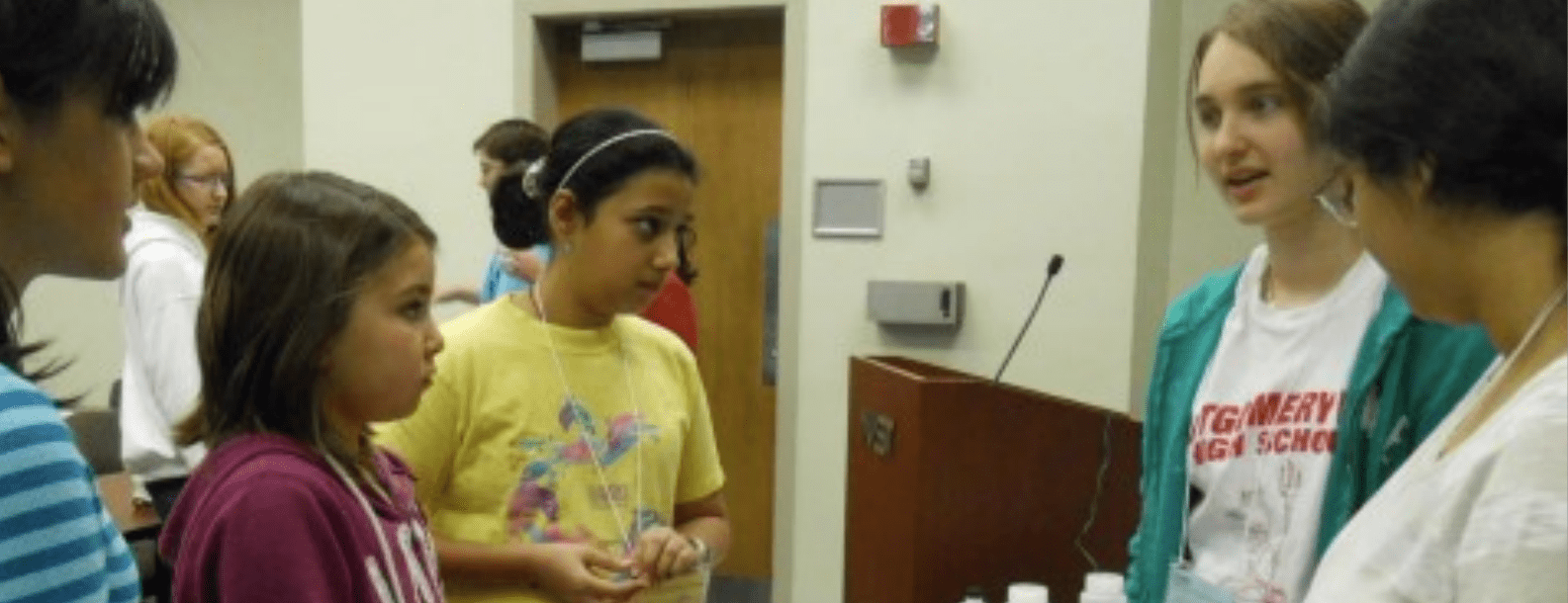
Participation in the 4-H Adventure in Science Program enables youth to:
- Explore fun experiences in science and technology, math and engineering;
- Learn about careers in science and technology and other professions;
- Work with adults to prepare for life in a high-tech world; and
- Develop presentation and communication skills.
AIS has Gone from Dr. Nash’s Basement to Six Sites in Montgomery County
The AIS program has received many local and national awards and recognition and been presented at state and national conferences. The program was selected as one of nine best science programs across the country. AIS was also selected for 4-H Program Excellence in Maryland.
When youth reach age 15, they can apply to serve as teen leaders. Each year, about 300 AIS students meet at all sites for 2-3 hours on 18 Saturdays from October to March for hands-on science and other experiential learning activities. Classes are designed to be very informative, interactive and inspiring.
The 4-H AIS program is published Online at 4-H.org (Riley & Butler, 2012). The program has received many local and national awards and recognition and been presented at state and national conferences.
Volunteers and site managers teach approximately 3,000 hours of weekly classes in the six-month session. Participants choose from different topics such as:
- how medicines are packed into capsules
- sound vibration of musical instruments
- dissecting frogs
- astronomy
- rocketry
- food science
- physics
- physiology
When the program ends in March of each year, participants demonstrate their projects on Parents Day. This event provides youth with an opportunity to present formal projects ( with scientific research and findings) and displays on their chosen topics, such as human brain and artificial intelligence, effects of food on blood glucose, effects of antacid on heartburn, antibiotics in natural products, magnetism, etc. Approximately 400 people attend the youth project demonstration day.
A 4-H Educator oversees the program, manages and coordinates the administrative part of the program as well as providing volunteer orientation and leadership training to older 4-H youth program assistants. Site managers, parents and volunteers manage the weekly 4-H AIS sessions.
Participants do not Need Any Background in 4-H Areas
Most recruitment and promotions happen via word-of mouth, news and notes, demonstration day, AIS website and friends. The goal is to reach youth who are curious about the world around them and have a basic interest in science and technology, math and the environment and food. Each year, new and returning youth are enrolled in AIS. The students are considered 4-H members in the special interest group and are entitled to participate in all 4-H programs and activities in the county and state.
The program is managed by the AIS Board of Directors. Board members meet regularly to oversee the program. The Board of Directors includes site managers, parents and other professionals and the 4-H Educator of the University of Maryland Extension who helps with administrative needs including awards, youth and adult training and conferences.
Each Site is Run by Volunteer Site Managers and Coordinators
A volunteer can be employees/volunteers of the organization hosting and managing the program site. Site managers cooperatively manage program events and activities, recruit volunteers and parent teachers who have an expertise in science, math and technology, food science and environmental areas. Volunteers and adult teachers are recruited through word-of- mouth, neighboring colleges and universities, the AIS web site, newsletters and organizational bulletin board posting. Most teachers are career scientists, college faculty, interns, older AIS students and local retired teachers. Teachers lead hands-on science sessions on Saturday mornings.
An instructor can teach every Saturday or just one or two. Depending on the size of the class, there may be multiple sessions provided at the same time. If there are 50 participants, for example, the site manager must have at least three teachers providing different subject matter. Volunteer teachers are often invited to teach at multiple sites if needed.
Each site manager keeps records/ rosters of student participants and volunteers. An average of 80% of enrolled youth attend throughout the sessions. More than half of each year’s participants do presentations on independent research and findings at the student project demonstration day held at one of the community colleges in March. Each year, 60-70% percent of the participants return and some volunteers return every year even after their children graduated from AIS programs.
The site managers collaborate with each location to create schedules, secure classrooms and labs, and recruit parents and other scientists to conduct classes. Parents are required to devote at least 15 hours to teach or assist in other activities, take pictures, set up and take down equipment, etc. and other tasks as needed. Site managers plan classes and field trips. Volunteers and site managers contribute about 3000 hours a year to the AIS program. AIS participants pay a minimal fee for registration and to support the AIS program each year. The program provides scholarships and financial support for low-income students.
Engaging AIS Older Youth and Adults in Leadership and Community Services Will Help Sustain AIS Program
Volunteers are vital to the success of any programs and events in the community. Volunteerism is the most important tool for 4-H traditional and 4-H outreach programs.
However, the first step in being a leader is to understand your personal qualities and values and how to work with groups to help others achieve personal growth. According to the old adage, "Leadership is helping yourself and others achieve goals."
In Montgomery County, Maryland, there is a great need for youth leadership and community service as the 4-H community and special youth programs continue to grow. By participating and volunteering in AIS, children learn about their rapidly changing communities, and understand that leadership and community service is important.
Since AIS can only continue through volunteerism, parents are encouraged to teach a session, find others to teach, be a teacher’s aide, or help in other organizational activities.
Participating Youth Helped Plan and Conduct Various AIS Programs and Projects
In 2017 and 2018, AIS youth conducted a survey to learn how participants view themselves as leaders and assess their interaction with other team members. The survey results show many positive opinions about AIS:
- Respondents believe it was a good learning experience and they appreciated learning about science and technology careers.
- Youths aged 15 to 18 helped plan the annual AIS presentation and demonstration day for parents and other community observers. The youths served as room monitors and conducted and collected program evaluation forms from parents and students.
- AIS participants organized the AIS poster and hands-on activities at the Annual Rockville Science Day in April for the past three years.
- Feedback from annual surveys of site managers was very positive and encouraging.
- Parents are happy that their older participants are still connected to AIS and can contribute to the program.
- Using written and verbal evaluations, 80% of AIS youth indicated that attending the meetings along with the club environment taught them a different approach to 4-H programs. As a result, some of the AIS participants later joined traditional 4-H clubs.
- Participants indicated that they learned many new things and made new friends.
A Note from the Author
Since 2013, the 4-H AIS assistant (AISA) program in Montgomery County has continued to grow. At the same time, the need for retaining other older AIS students after the completion of the AIS program has become essential. Responding to the needs and interests of the youth participants, I collaborated with a site manager and AISA teen volunteers to recruit, train and expand the AIS program in the areas of 4-H leadership and community engagement.
As of 2018, there are 13 members in this group that meets once a month on Saturdays (for 6-10 months) guided by a site manager and the Extension Educator. The group follow the 4-H club model and policy in selecting a president, vice president and a secretary. The members use the AIS lesson plans to improve and support their leadership skills and community civic engagement.
Recognition and appreciation goes to the 4-H AIS site managers, AIS board members, teachers and volunteers for their contributions and many hours of service to the AIS program.
References
Riley, D., Butler, A., “Priming the Pipeline: Lessons from Promising 4-H Science Programs.” 2012. Policy Studies Associates, Inc., Washington DC.
"4-H 228 Leadership : Skills You Never Outgrow" (1986). Historical Materials from University of Nebraska-Lincoln Extension. 4874. http://digitalcommons.unl.edu/ extensionhist/4874
Shull, R. Children Sample Materials Topics “Adventure In Science.” 2007. Program at NIST. MRS Bulletin 32 (June), 511-512.
Alganesh Piechocinski
algapie@umd.edu
This publication, 4-H Adventure in Science Program and the Power of Partnership(FS-1101), is a part of a collection produced by the University of Maryland Extension within the College of Agriculture and Natural Resources.
The information presented has met UME peer-review standards, including internal and external technical review. For help accessing this or any UME publication contact: itaccessibility@umd.edu
For more information on this and other topics, visit the University of Maryland Extension website at extension.umd.edu
University programs, activities, and facilities are available to all without regard to race, color, sex, gender identity or expression, sexual orientation, marital status, age, national origin, political affiliation, physical or mental disability, religion, protected veteran status, genetic information, personal appearance, or any other legally protected class.
When citing this publication, please use the suggested format:
Piechocinski, A. (2019). 4-H Adventure in Science Program and the Power of Partnership (FS-1101). University of Maryland. go.umd.edu/FS-1101