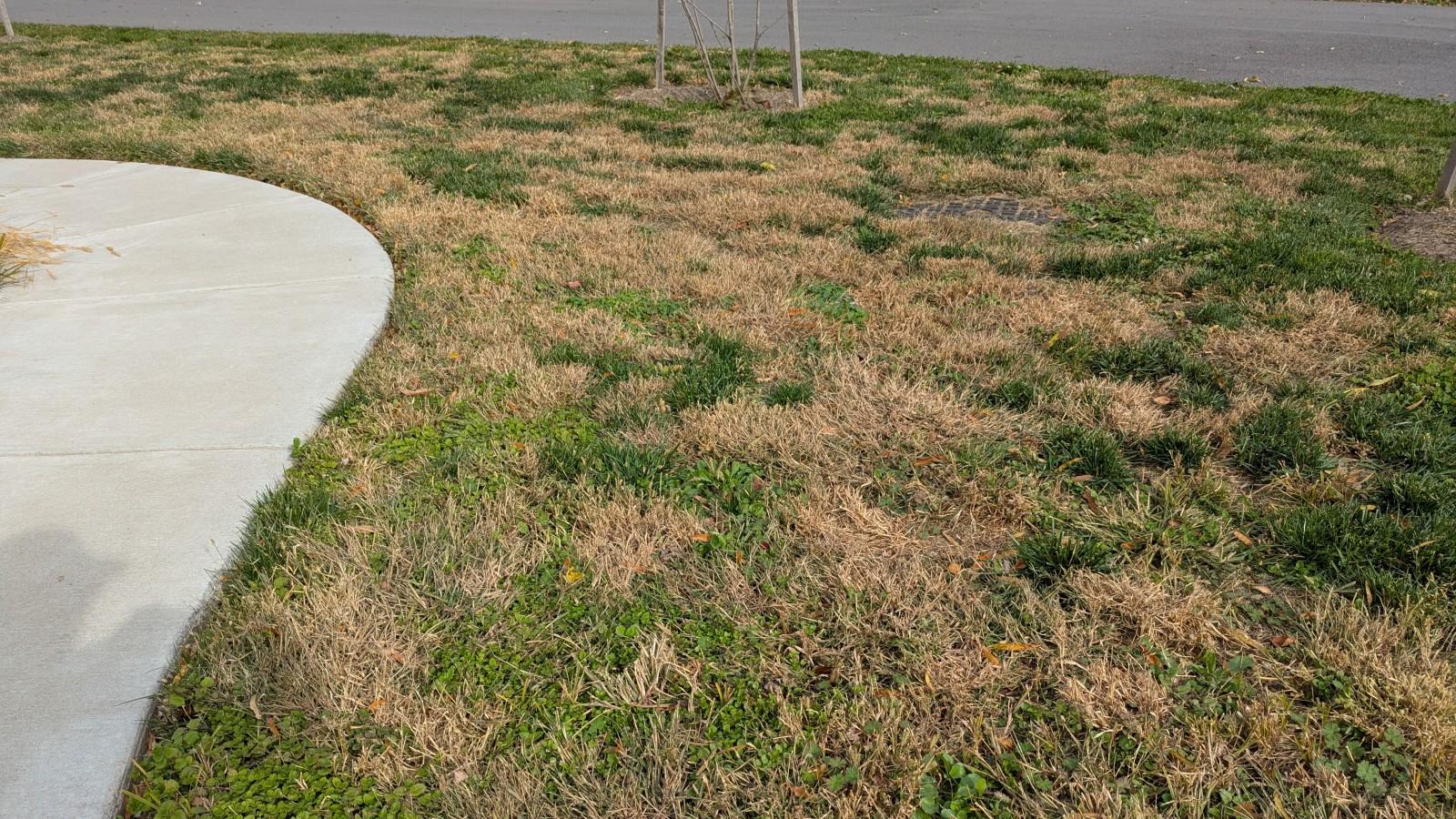
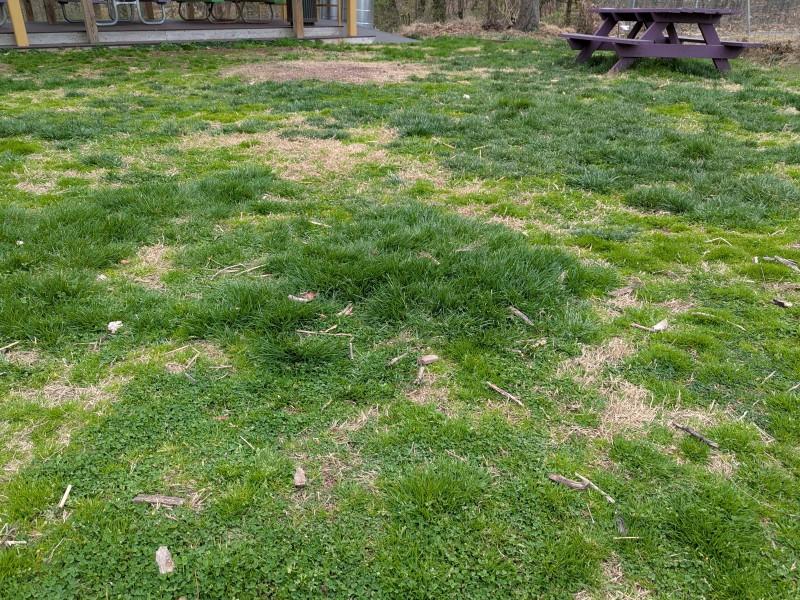
Annual grassy weeds dying off in autumn, leaving little desirable turf. Photo: Miri Talabac, University of Maryland Extension
Updated: March 16, 2026
Key points about improving lawns
Correct any conditions that cause turfgrass to struggle, such as soil compaction and poor drainage, before filling in lawn areas in decline. Failing turf on new home sites may be due to topsoil removal during construction and a poor-quality contractor seed mix.
Overseed sparse or bare areas to create dense growth that outcompetes most weeds and reduces erosion.
Renovate (redo) lawns with more than about 50% weed growth, or when soil conditions over large areas need improving. This is also the simplest way to convert from one turfgrass type to another (warm-season versus cool-season).
Make soil adjustments based on measurements, not assumptions. Any lawn improvement steps involving lime or nutrient application should be based on the results of a laboratory soil test conducted within the last three years.
Attempts to improve a lawn to health won’t necessarily result in a uniform, deep green appearance year-round. Maryland’s location in the climate transition zone means that conditions are generally not favorable for growing lawns. Learn more about The Challenge of Growing a Lawn in Maryland.
Common lawn problems
Learn about typical lawn issues and the options for fixing them in the following sections:
Specialized machines are helpful in managing large lawns, while manual alternatives may be more practical for smaller areas. Although several types of machines are available, most are geared towards use by professional turf personnel. For do-it-yourself lawn care, a core aerator machine will probably be the easiest item to find for rent, and the most practical tool to use. Confusingly, rental businesses might refer to several different pieces of equipment as “dethatchers.”
Core aerator
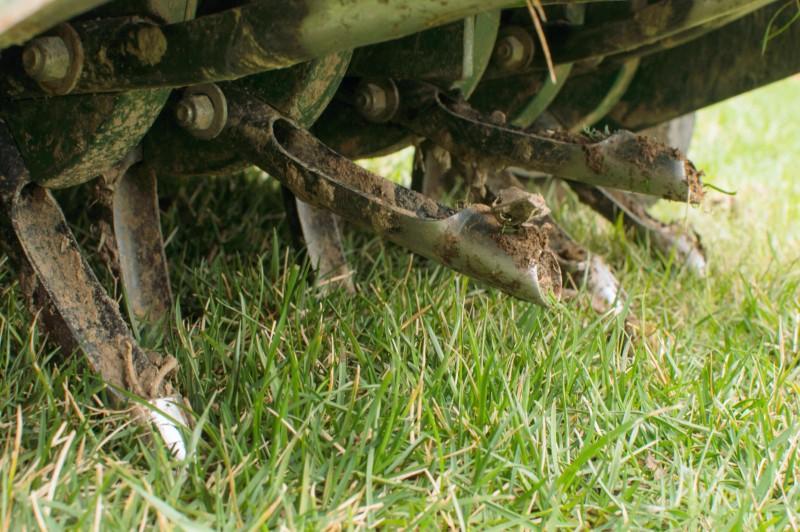
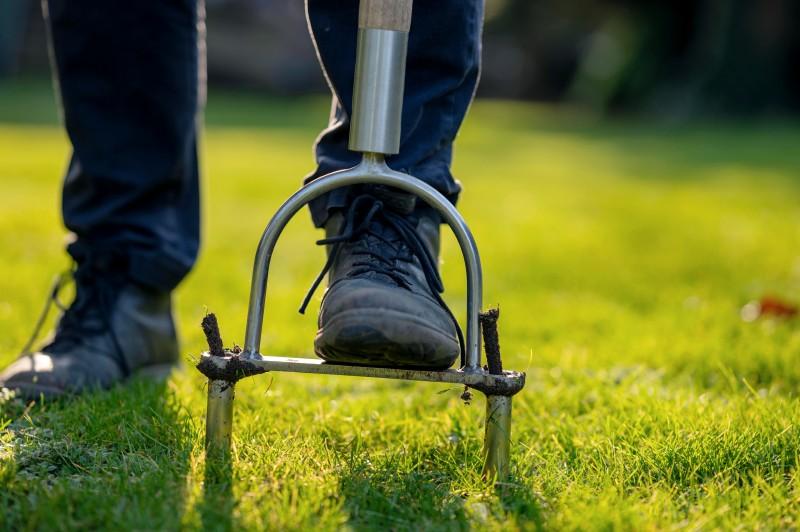
Hollow tines remove cores of soil to create an array of small holes in the lawn. This reduces soil compaction and provides more opportunities for germinating grass seed to establish a root system.
Although manual versions are available for small areas, powered machines are the most practical option for lawns about a quarter-acre in size or larger.
Solid-spike alternatives that merely punch holes in the ground without removing soil cores are not as beneficial.
Aerator machines remove multiple cores at once. Photo: Adobe Stock
Use a foot to push a manual aerator into the ground to remove two plugs at a time. Photo: Adobe Stock
Vertical mower (verticutter)
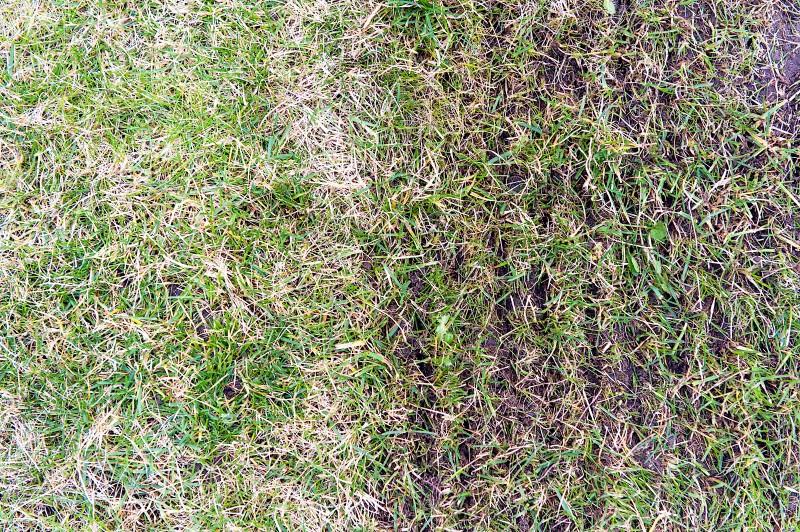
Metal blades make vertical slits into the soil, and cut through any thatch present in the process. The grooves expose soil for germinating grass seed to root into. Verticutters can also act somewhat like a dethatcher, though they are not designed to remove thatch.
Closely-spaced grooves cut into the soil by a verticutter machine. Photo: Adobe Stock
Slit seeder
Similar to a vertical mower, metal tines make narrow, shallow grooves in the soil, then deposit seeds into the slits. As with seeding manually using a spreader, apply half of the seed in one direction and the other half perpendicular to the first for a more even sowing. (For example, use a slit seeder over the lawn in a north-south direction, then in an east-west direction.)
When renting a slit seeder, verify that it deposits the seed after it grooves the soil, not before.
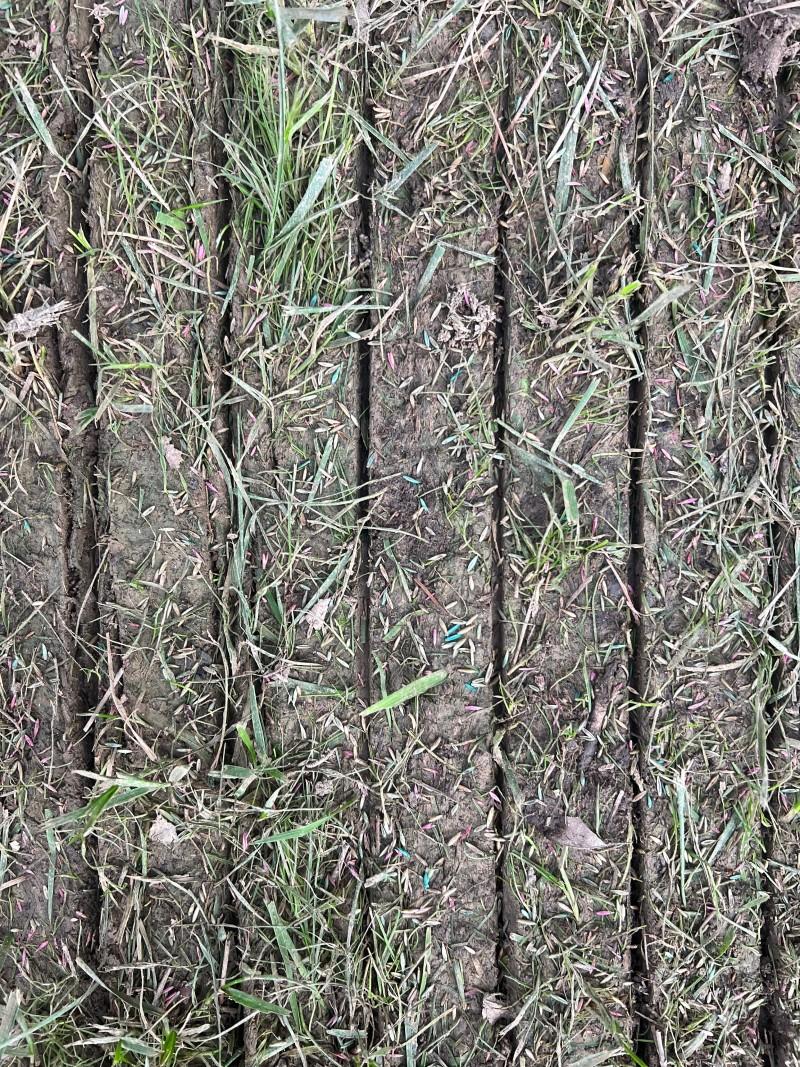
Soil grooved by a slit seeder machine. Photo: Adobe Stock
Dethatcher (power rake)
Rotating metal tines, somewhat like lawn mower blades oriented vertically, dislodge thatch and can break apart soil cores from an aerator. The tines do not cut into soil like a vertical mower.
Dethatchers can cause significant, though temporary, physical damage to grass blades. Since it doesn’t create furrows that improve seed-to-soil contact, it’s not as useful as a verticutter for overseeding.
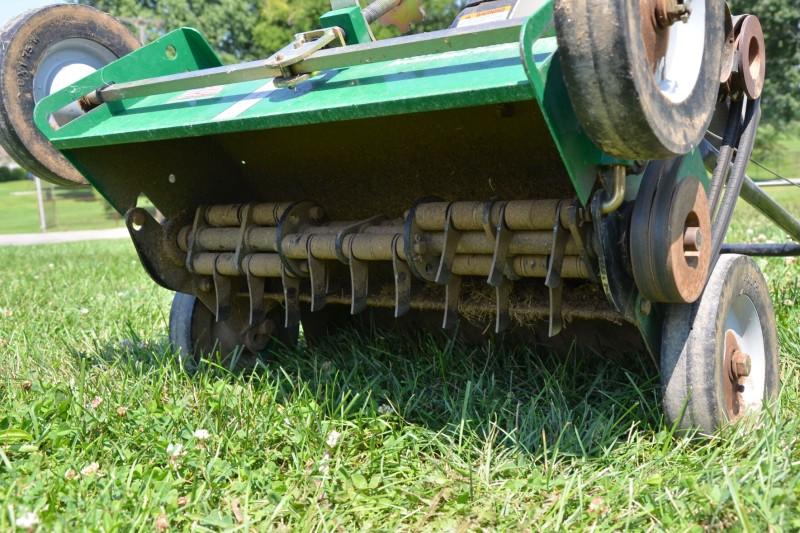
Thatch removal machine. Photo: Gregg Munshaw
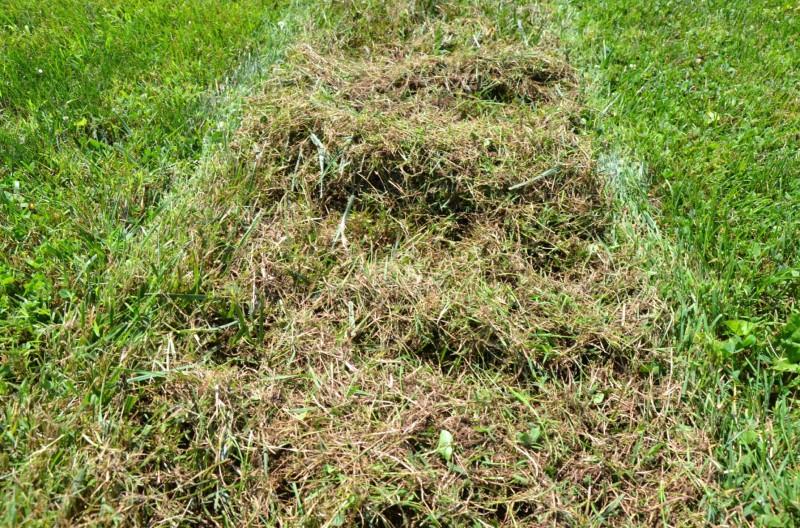
Debris lifted by one pass of a dethatching machine. Photo: Gregg Munshaw
Sod cutter
This turf removal machine slices under the roots and lifts strips of sod from the ground, exposing bare soil. Sod cutters are used for lawn renovation when the site needs to be restored to bare ground.
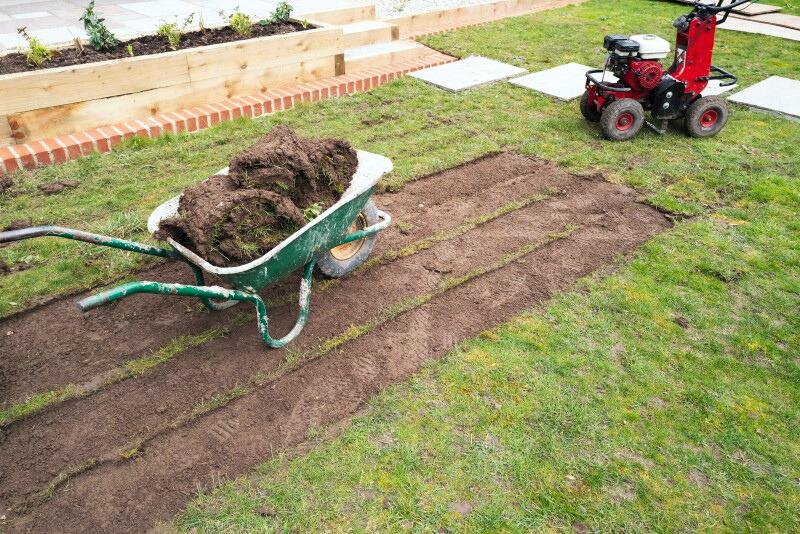
Lawn stripped with a sod cutter machine. Photo: Adobe Stock
Water-filled roller
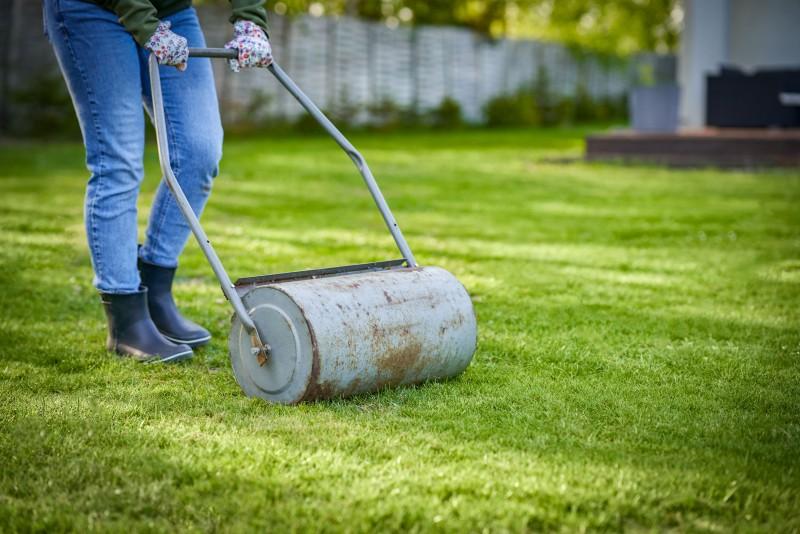
Rollers are weighted drums used to level bare soil before planting seed or sod, and to press sown seed or laid sod firmly onto the soil surface.
Weighted roller used to press sod onto the soil surface. Photo: Adobe Stock
Overseeding sparse or struggling lawns
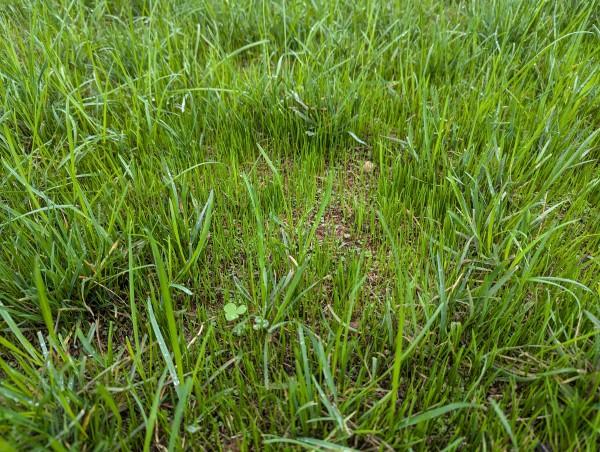
Grass seedlings filling in bare areas of an established lawn. Photo: Miri Talabac, University of Maryland Extension
Individual lawn grasses can die out over time, eventually making a lawn more thin (sparse). Annually adding more grass to the lawn repairs damaged areas and helps to keep it lush and vigorous so it can better “self-repair” from minor damage in the future. Overseeding also presents the opportunity to add top-rated cultivars to the lawn to keep it near peak performance. Use the same type of grass that already forms the bulk of the lawn (typically tall fescue). Very thin lawns might take 2 to 3 consecutive overseedings to fill in.
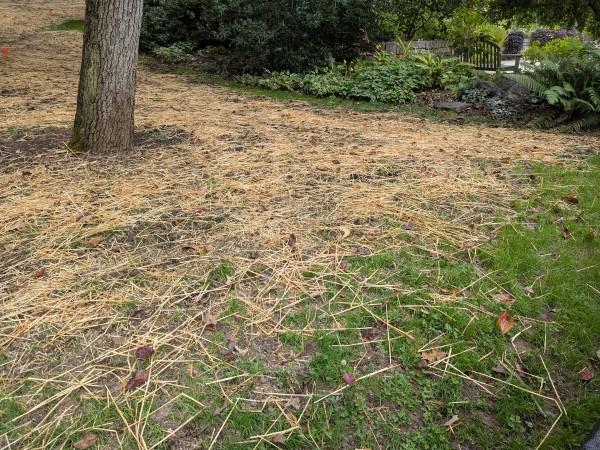
Straw scattered over a newly-seeded area of lawn. Photo: Miri Talabac, University of Maryland Extension
Reseed or re-sod areas of dead or damaged lawn caused by pest or disease outbreaks, foot traffic wear-and-tear, smothering (having been deprived of light for too long, such as under a tarp), or digging (construction, utility work, transplanting, or animals). Rake away any dead grass blades matted on the soil to discourage disease and to give seed or sod direct contact with the soil surface. Level-out uneven ground and use the same soil preparation and planting techniques as for starting a new lawn.
Renovating poor-quality lawns
Lawn with bare patches and numerous broadleaf and grassy weeds. Photo: Miri Talabac, University of Maryland Extension
Lawns fail or degrade over time for a variety of reasons. Signs of a poor-quality lawn include bare areas of exposed soil, sparse growth, and lots of weeds. Consider an overhaul (renovation) of the lawn when it is more than 50% weeds.
Renovation allows for soil improvements to be made, such as leveling uneven areas and boosting organic matter content by incorporating compost. Improving poor soil after a lawn is established is difficult, because to comply with Maryland's Lawn Fertilizer Law, the amount of compost topdressing that can be applied must be dictated by a soil test and a compost nutrient analysis. Usually, adding compost is not necessary for an established lawn where soil organic matter has increased over the years from the breakdown of grass clippings and autumn leaves, compared to the soil in a newer development that was stripped of topsoil during construction.
A lawn overhaul is a lot of work, but it can provide faster, more satisfactory results than attempting to rehabilitate a lawn in poor condition.
Renovation steps
Remove all existing grass and weeds. Begin the process with enough lead time to complete lawn removal before the ideal time of year for establishing the new lawn. If the replacement lawn will be cool-season grass, plan the removal for June/July (if using physical methods) or early August (if using herbicide). When replacing a cool-season lawn with a warm-season lawn (changing from fescue to zoysia), remove the existing lawn in spring.
Physical removal involves renting a sod-cutting machine or, for small areas, hand digging. Using a light-blocking cover (smothering) to kill the lawn before removal can make that step easier, but the process could take several weeks. Physical methods work well on small spaces less than 100 square feet.
If necessary, use chemical removal (herbicide): a non-selective systemic herbicide will kill any plant that is treated, down to the roots.
To minimize herbicide use, physically remove as much growth as possible first, then target what regrows.
Do not mow a few days before or after applying herbicide, and do not remove treated plants too early. It may take 7-10 days or longer for the herbicide to fully kill roots, and a repeat application might be necessary.
Herbicide control of tough perennial grassy weeds (bermudagrass, quackgrass) could take a month.
Proceed to the next step when the weeds have turned brown and no new growth has occurred.
Prepare the soil for planting.
Measure the soil’s acidity level (pH), nutrient profile, and organic matter content by submitting a sample for testing. Laboratory tests are more thorough and accurate than do-it-yourself home test kits. The results determine what type of fertilizer to use and whether lime is needed to raise pH.
If smothering or an herbicide was used to kill the lawn instead of sod removal, use a string trimmer or mower to cut down the debris as low as possible after the turf is dead, and then use machinery to prepare the seedbed. This may involve renting a slit seeder, rototiller, vertical mower, or power rake. Small areas can be cleared of debris with a steel rake and the soil loosened by hand with a garden fork or broadfork. Make two passes over the area.
Apply lime (if needed) and fertilizer. If possible, make the lime application about one month prior to the fertilizer application. This gives the initial pH spike at the soil surface time to settle to a level where the added nutrients will be available to seedling turf roots. If lime is tilled into the soil, waiting before applying fertilizer is less important.
If soil testing measured less than 3% soil organic matter, apply a 1 to 2-inch layer of compost. Use a rake or machine to mix these additions into the soil.
Level the soil with a rake or a water-filled roller.
Plant new turf and monitor it for watering using the information detailed in Starting a New Lawn.
Managing weeds
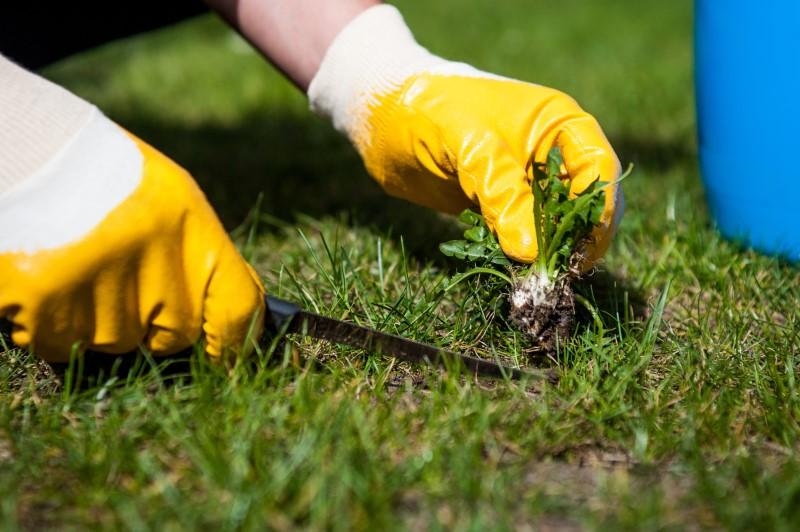
Small, scattered lawn weeds can be dug out by hand. Photo: Adobe Stock
Any plant out of place can be considered a weed. Lawn weeds are normal and to be expected, even in a healthy, well-maintained lawn. Billions of weed seeds reside in topsoil, blow in on breezes, and are carried by stormwater and animals to your landscape.
If well cared for, a newly-sodded lawn tends to remain effectively weed-free for the first two growing seasons after establishment. Weed seeds might sprout before turfgrass seedlings, sprigs, or plugs have filled in, since disturbing the soil to prepare for planting exposes these seeds to water and light for germination. Competition from weeds is greatest on turf sown in early spring compared to autumn, and is the most common cause of lawn failure with spring seeding attempts.
Weed suppression options include manual and chemical methods. Where possible, remove weeds manually by hand-pulling or scraping them up with a hoe. Weeds intolerant of mowing will die back naturally after the lawn is mown several times.
Some weeds will be too difficult to remove manually, or the area to weed may be too large to manage by hand. Chemical weed removal involves herbicide (weed killer). Grassy weeds and broadleaf weeds can invade a lawn, and herbicides will target one group or both.
Pre-emergent herbicides prevent seed germination:
Once applied to the soil surface, the chemical barrier cannot be disturbed or it will no longer be effective. Plug and sprig planting (such as for zoysia) must be done before an application is made.
Certain ingredients may affect weed seeds and desirable turfgrass seeds. For example, applying crabgrass preventer might conflict with the ability to sow cool-season turfgrass seed in spring, if the chemical stops the germination of all types of grass.
Post-emergent herbicides kill weeds that have already sprouted.
Selective herbicides target certain plants and pose less risk to others. The distinction may be between grasses and broadleaf plants, or warm-season and cool-season grasses.
In general, new turfgrass should grow to a mowable height 3 times before applying an herbicide for broadleaf weeds. Avoid pre-emergent herbicide for grassy weeds (such as crabgrass) until the new turf grows to a mowable height at least 4 times. This ensures the new grass is mature enough to better tolerate exposure to the herbicide. Always refer to the product label for specific instructions for use.
Reduce pesticide use and avoid collateral damage to the lawn from non-selective herbicides by spot-treating individual weeds. Spot treatment applies the chemical only to the weeds, it does not broadcast it over the entire lawn.
Addressing problem areas
Prioritize areas of lawn to fix where a high tolerance to foot traffic (people or pets) is needed, since lawns are among the most resilient groundcover options for those conditions. Overseeding, repair, and renovation will have limited success if areas of lawn develop abundant moss or algae growth, or are too shaded or too compacted to support healthy turfgrass.
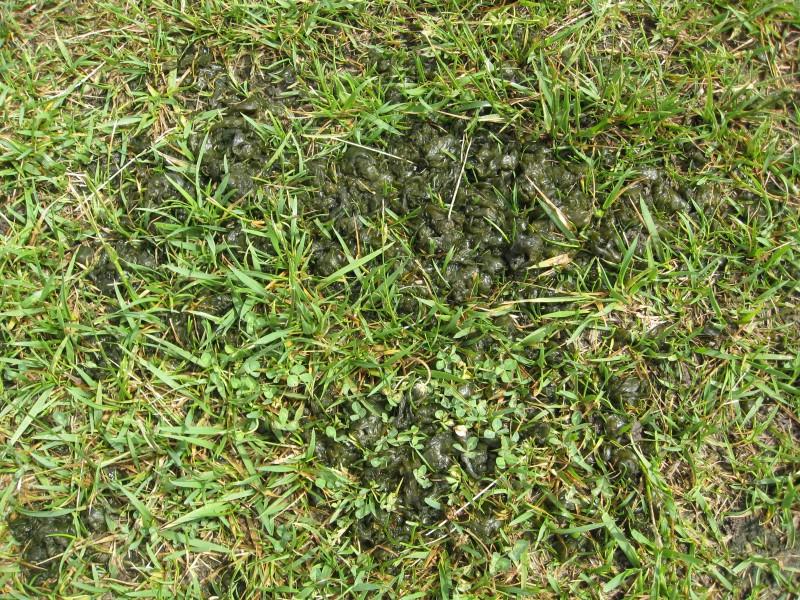
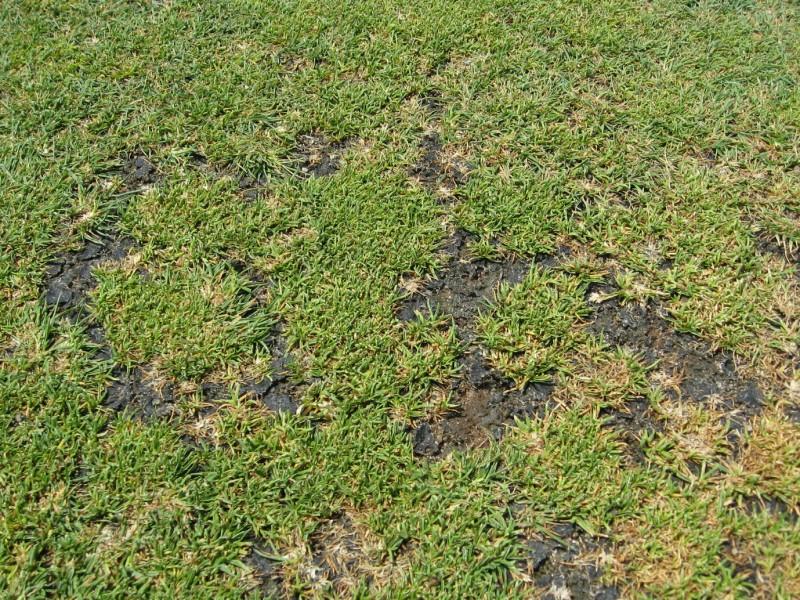
Algae and nostoc in the lawn
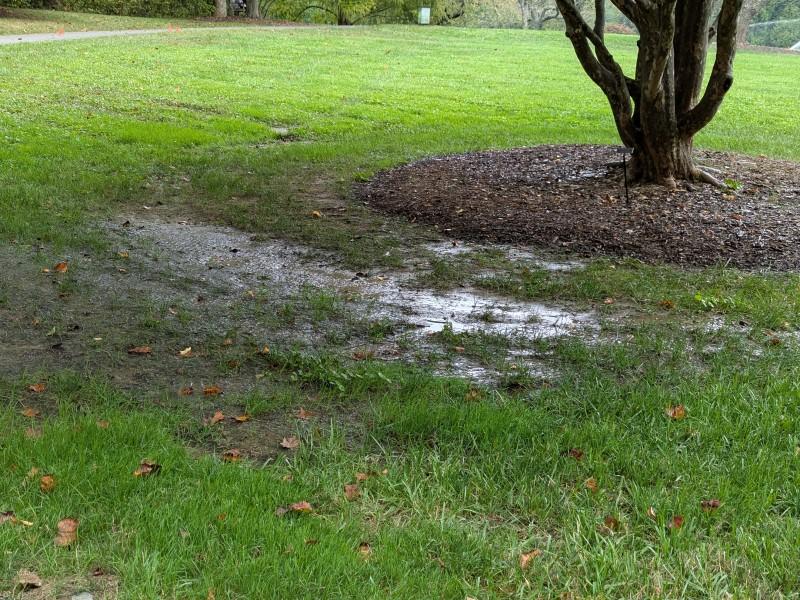
Algae outbreaks indicate that the lawn is staying too wet, either from soil compaction, over-watering, or poor drainage. Nostoc is a type of cyanobacteria, although it resembles algae when dried, forming a dark green or blackish flaky crust on the soil surface. Nostoc thrives in similar conditions to algae, and can be slippery when hydrated, forming green jelly-like clumps.
Nostoc growth in a lawn. Photo: Megan Kennelly, Kansas State University
Algae or nostoc growth in a declining lawn. Photo: Megan Kennelly, Kansas State University
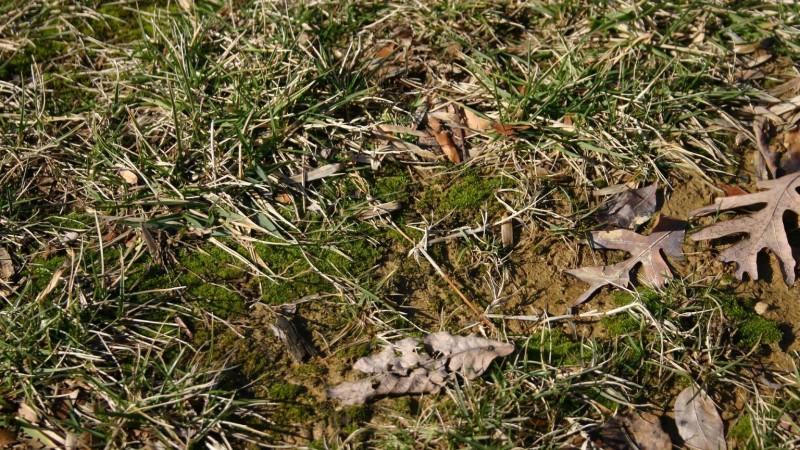
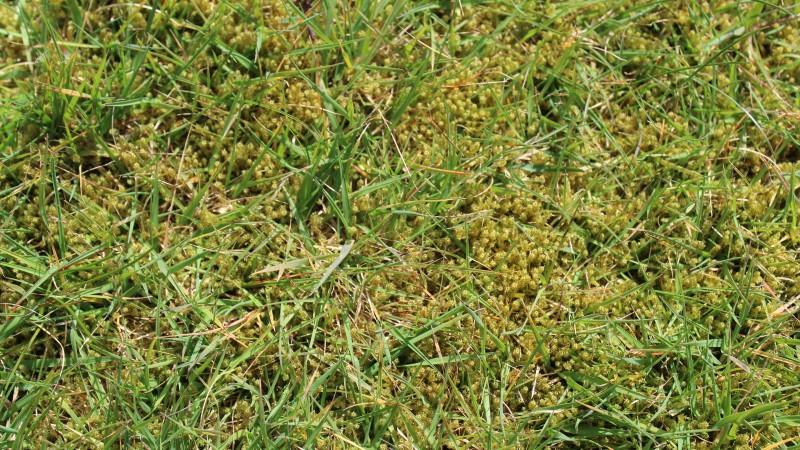
Moss in the lawn
Moss growing near areas of compacted, exposed soil in a lawn. Photo: William Fountain, University of Kentucky, Bugwood.org
Moss is not responsible for lawn decline; instead, it takes advantage of areas where the grass is thinning-out due to unfavorable conditions. Moss growth tends to be associated with moisture, shade, low soil fertility, and acidic soil. However, mosses are a diverse group, and not all species require those conditions. (Use laboratory testing, not the presence of moss by itself, to assess the soil.)
Moss is a valuable groundcover alternative to turf in areas where it is naturally appearing on its own. If it must be removed, it is easy to dislodge because moss does not possess true roots. A rake should successfully pull it off of the soil. Certain herbicides are labeled for the control of moss; active ingredient options include iron sulfate and potassium salts of fatty acids. Follow product label directions for use.
Abundant moss covering the ground between grass plants in a sparse lawn. Photo: Adobe Stock
Discourage algae, nostoc, and moss
Manage water: Redirect water from roof downspouts with a rain garden or rain barrel, reduce irrigation, and increase drainage by core-aerating compacted soil. If tree roots are not in the area, re-grade the soil in low-lying areas that collect moisture.
Increase sunlight: Remove overhanging tree or shrub branches to brighten shaded areas so grass can grow more vigorously. Prune conservatively, however: removing too much growth could risk tree and shrub health. Use shade-tolerant grass varieties for areas where shade cannot be reduced, although this will not suffice for areas with heavy shade.
Keep lawns dense: Overseed and fertilize (based on laboratory soil test results) annually to maintain a thicker stand of turf that out-competes unwanted plants.
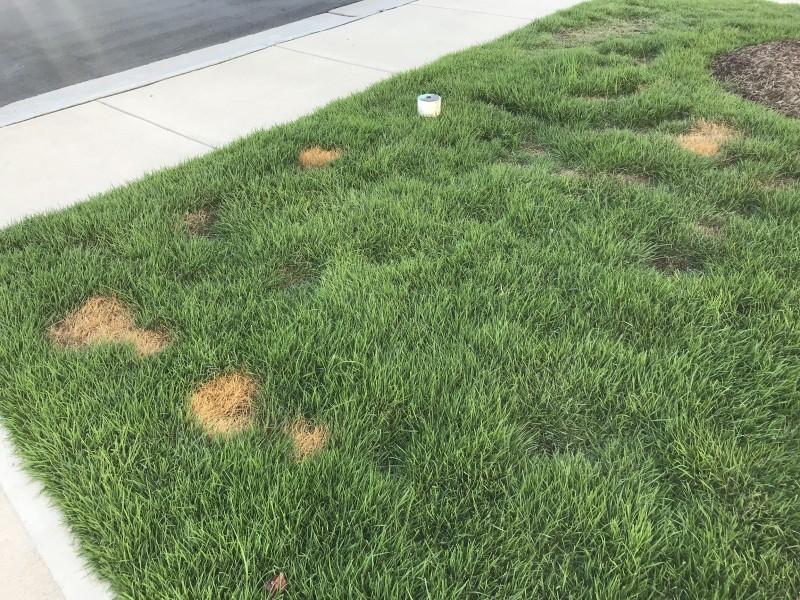
Dog damage
Lawn damage from dog urine and digging is difficult to remedy, and alternative groundcovers will not necessarily tolerate these conditions any better than turfgrass. Bare areas created by digging or heavy foot traffic from play may require regular repair. Although zoysia lawns “self-repair” thinned areas better than tall fescue, zoysia’s tolerance for wear-and-tear is low during winter dormancy.
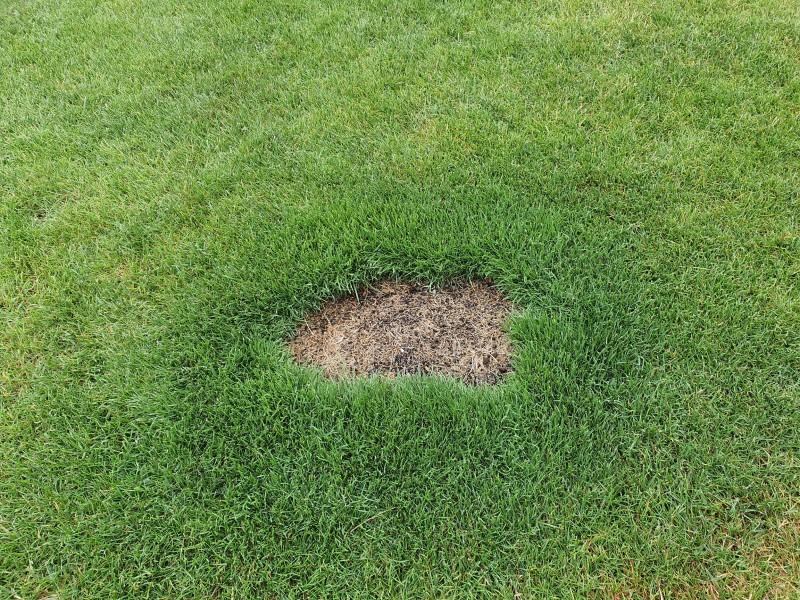
Urea, salts, and lactic acid are the urine components that damage turf. Mild urea exposure will act like fertilizer, causing temporarily deeper green, faster grass growth. Greater exposure will cause straw-brown patches of dead grass, sometimes with darker, lusher edges. In addition to root nutrient toxicity from the urea or salts, the lactic acid component causes leaf tissue damage like an herbicide. Prominent damage is more likely to occur on drought-stressed turf in hot weather.
Dilute the urine by promptly watering the spot to reduce damage, though some turf injury may still result. For more information, refer to the NC State Extension resource Dogs and Turfgrass Interactions.
Dog urine impacts on a zoysia lawn. Photo: Grady Miller, NC State University
Deeper green grass growing more lushly around a dead zone caused by a fertilizer spill. The same pattern can be caused by dog urine. Photo: Adobe Stock
Recurring weed invasions
Soil compaction from regular foot traffic can favor weeds over turfgrass. Paths through the lawn getting regular use can be mulched or converted to paving stones or stairs so those areas of lawn do not need recurring repair. Weed seeds might also be moved into the lawn by wildlife (such as deer feet carrying Japanese Stiltgrass seeds). Where feasible, fencing might reduce this problem in areas where lawns abut natural spaces.
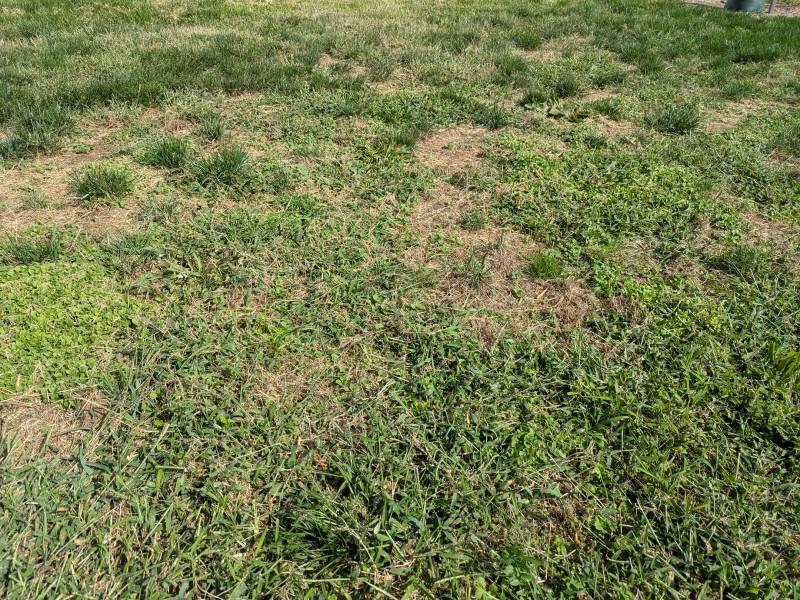
Grassy weeds creating uneven growth and patchy dieback in a lawn. Photo: Miri Talabac, University of Maryland Extension
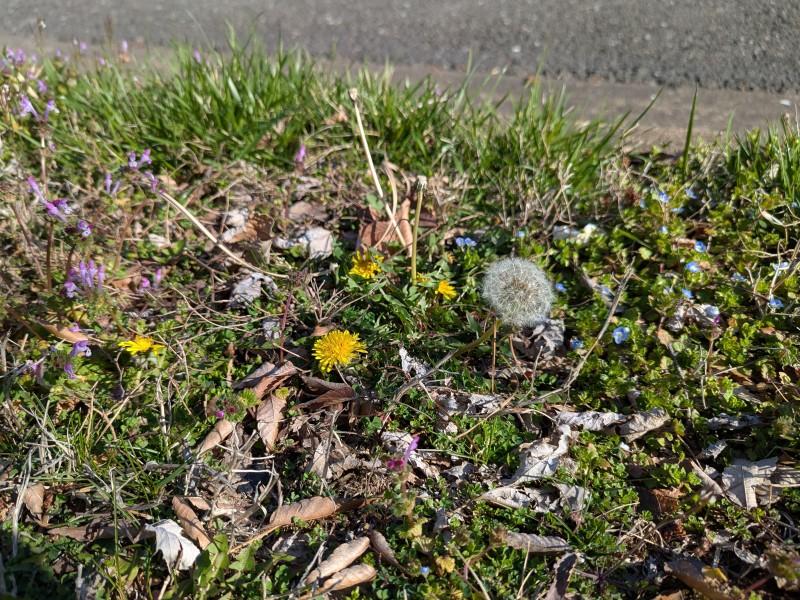
Multiple broadleaf weed species in a curbside lawn. Photo: Miri Talabac, University of Maryland Extension
Ruts and uneven soil
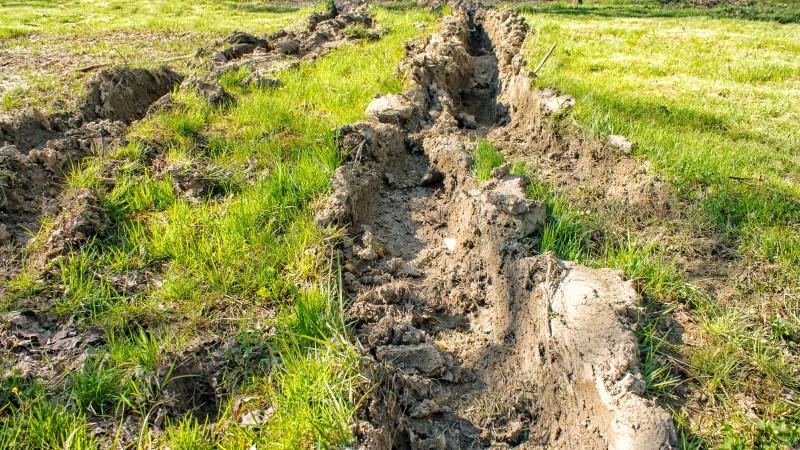
Substantial ruts from mower tires or vehicles, erosion swales from roof downspouts or other water flow, and low-lying areas from uneven grading need to be fixed. Remove the sod, amend the soil to regrade and reduce compaction, and replant turf. Shallow ruts can be filled in without replanting if only a small adjustment is needed: About ¼- to ¾-inch of material (topsoil or compost) can usually be put on the turf without smothering the crown.
Uneven soil and compaction in tire track ruts in a lawn. Bare areas are vulnerable to erosion and weed growth. Photo: Adobe Stock
Thinning lawn near trees
Sparse lawn as a result of poor soil drainage and shade from a mature tree. Photo: Miri Talabac, University of Maryland Extension
In natural landscapes, forests and expanses of grass are completely different habitats. Turfgrasses grow best with a minimum of 6 hours of direct summer sunlight, and have limited tolerance for tree canopy shade and root competition for nutrients and moisture. Lawns planted around trees will gradually thin-out and decline as the tree matures.
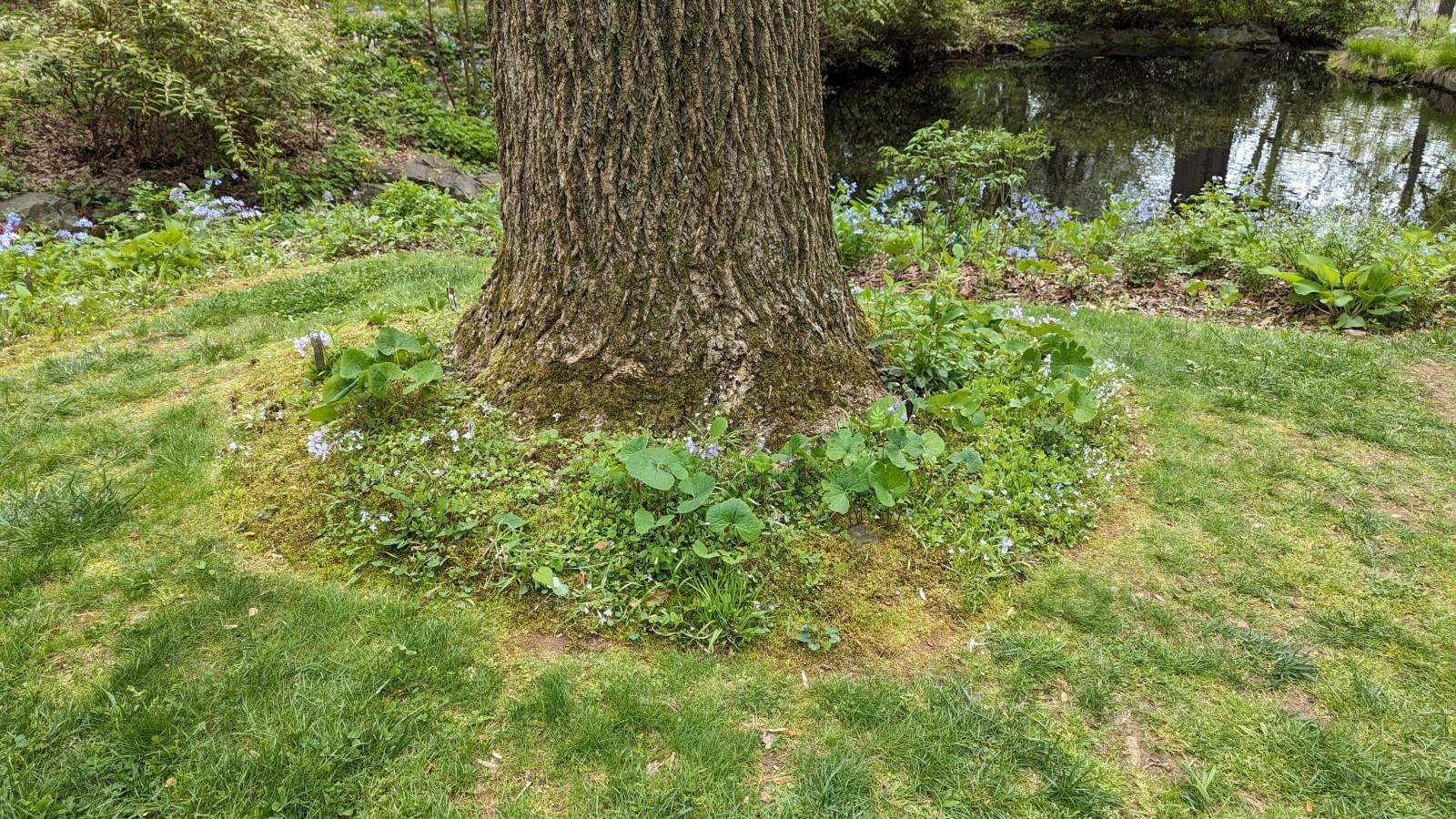
Use mulch or a mix of other groundcovers to protect the soil under a tree’s canopy from erosion and weeds. This buffer will also shield tree trunks from injury due to mowers, string trimmers, and herbicide applications. (Such injuries can seriously damage or kill a tree.)
A mix of native woodland perennials planted around the base of a tree in place of mulch. Photo: Miri Talabac, University of Maryland Extension
Give careful consideration before removing tree limbs to let more light reach a lawn. Pruning creates wounds that risk developing wood decay, and removed branches might not grow back due to shade from the upper canopy. This may result in reduced seasonal privacy, summer cooling, or shade to plantings installed later to replace struggling turf. Consult a certified arborist, when possible, to remove branches; no more than a quarter of the canopy should be removed in any year.
Shady lawn care and problems
Tall fescue and fine fescue are the most shade-tolerant turfgrasses. Tall fescue needs a minimum of 4 hours of direct sunlight during the growing season; fine fescue needs at least 2 hours. Hard fescue is the best-performing type of fine fescue for Maryland.
Fine fescue is not nearly as tolerant of foot traffic as tall fescue, and should also not be mown as regularly, which can make areas planted in this grass look different than the rest of the lawn.
Fertilize shady turf less often: only about once per year, in autumn.
Shade-tolerant weeds (such as Ground Ivy and Indian Mock Strawberry) are more likely to colonize areas with struggling grass, and can be difficult to eradicate without using herbicide.
Yearly autumn overseeding can help to boost lawn density in shaded areas, but will have limited benefits as the new grass gradually loses vigor.
Planting lawn alternatives
Consider using other plants to replace areas of lawn that develop recurring problems, especially if a renovation has failed several times in the same location. This approach is more sustainable and, over the long term, can save money and time compared to the upkeep of a lawn. Native plants provide ecosystem support, and while they are not maintenance- or problem-free in a garden setting, a species-diverse landscape will have fewer serious or widespread issues.
Author: Miri Talabac, Lead Horticulture Coordinator, HGIC. March 2026.
Content reviewed by: Geoff Rinehart, Lecturer and Turfgrass Management Advisor, Institute of Applied Agriculture, September 2025. Charles Schuster, Senior Agent, Extension Educator, Commercial Horticulture (retired), August 2025. David Clement, Ph.D., Extension Specialist in Plant Pathology, December 2025.
Copy editing by Nancy Klein, Maryland Master Gardener, December 2025.