
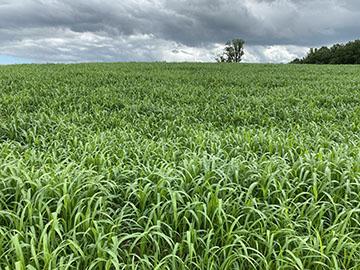
Using Summer Annual Forages as an Alternative to Double-Crop Soybean
By Liz Ridenour, Amanda Grev, and Jeff Semler
As of this writing 99.16% of Maryland is experiencing D0-D4 drought conditions according to the U.S. Drought Monitor. This is down from 100% a week ago and 99.94% on January 1. The recent rains have certainly perked things up but have done little to reduce the long-term impacts of drought that are ongoing across the region. One of those impacts is the reduced yield of first cutting hay and the diminished promise of strong second and third cuttings. This brings us to a potential opportunity.
In most years, soybeans are a common choice for double cropping following wheat harvest in July. This practice can provide a second harvest and source of income for the producer, and allow for nitrogen fixation in the soil in preparation for the fall planting season. However, nitrogen fixation from soybeans is not significant enough to reduce the need for nitrogen fertilizer following soybean harvest, and double-cropping using soybeans may deplete the soil of other nutrients as the growing soybeans draw phosphorus and potassium from the soil.
One viable alternative to soybean double-cropping is the planting of summer annual forages. Summer annual forages have the potential to improve soil health, mitigate pests, suppress weed growth, and reduce soil erosion. They can also be utilized as a fast-growing forage for silage, hay, or grazing, making them an attractive and sustainable alternative to double-crop soybeans.
Summer annuals can help improve overall soil health in several ways. They protect the soil from erosion while their large root systems add organic matter and nitrogen (if legumes are included) back into the soil. They provide shade for the soil during the hot summer months, lowering soil temperatures, aiding in soil moisture retention, and preventing weeds from sprouting. They can also help to break pest cycles by attracting beneficial pollinators and predatory insects.
Summer Annual Forage Options:
| Season Type | Functional Class | Examples |
|---|---|---|
| Cool Season | Brassicas | Radishes, turnips1, kale, rapeseed |
| Cool Season | Grasses | Annual Ryegrass, Black Oats, and Barley |
| Cool Season | Legumes | Crimson Clover, Hairy Vetch, and Peas |
| Warm Season2 | Forbs | Buckwheat, Sunflowers |
| Warm Season2 | Grasses | Sudangrass, sorghum-sudangrass, sorghum, foxtail millet, Japanese millet, pearl millet |
| Warm Season2 | Legumes | Sunn hemp, cowpeas, forage soybeans |
1Barkrant and purple top are heat-resistant varieties
2Warm-season annual forages are well-adapted to high temperatures and can withstand drought, maintaining soil moisture throughout the summer months.
When selecting summer annual forages, it is important to keep both prussic acid and nitrate toxicity in mind. Sorghum species, along with several other species including millet, brassicas, oats, and other small grains, are susceptible to nitrate accumulation. Adverse environmental conditions such as drought or frost can cause the plant to halt its conversion of nitrates to amino acids, leading to a buildup of nitrates in the plant. Nitrate poisoning is most likely to occur when plants are harvested as hay or grazed under stressful growing conditions, especially when grown in soils with high nitrogen fertilizer. Prussic acid is a particular risk in sorghum, sudangrass, and sorghum-sudangrass hybrids. Prussic acid toxicity can occur if plant tissues are damaged by some sort of stressor such as severe drought or frost. Proper field curing or ensiling can help reduce the potential for prussic acid toxicity in harvested forages because prussic acid is volatile and some of the toxic components will dissipate as a gas during the drying or fermentation process.
For those producers that cannot graze these crops or have the equipment to harvest them, this may sound like a non-starter. However, before you pass on this opportunity, think about which of your neighbors could benefit and harvest or graze these crops. This could be a win-win for both of you. The grower receives cash from the crop, and the neighbor can acquire some much-needed forage reserves close to home. Agriculture is a community endeavor, and farmers have often looked out for each other. In this case it could be mutually beneficial.
Before you dismiss this idea, remember the phrase that keeps many in a rut, “this is the way we have always done it.” Rethink your options. Who knows you might open up future opportunities by simply shifting your paradigm. As always, for specific recommendations for your area, contact your local extension agent.
Resources:
Penn State Extension:https://extension.psu.edu/alternative-forages-for-spring-and-summer-planting
Iowa State Extension: https://crops.extension.iastate.edu/post/maximizing-forage-production-summer-annuals
Farm Progress.org: https://www.farmprogress.com/crops/why-i-no-longer-plant-greedy-beans-
Nebraska Institute of Agriculture and Natural Resources: https://cropwatch.unl.edu/2019/summer-annual-forages-after-failed-wheat/
Plant Cover Crops:https://plantcovercrops.com/my-favorite-cover-crop-after-wheat/
This article appears in June 2026, Volume 17, Issue 3 of the Agronomy News.