
Spring Termination of Cover Crops - How Timing Affects Crop Stands and Yields
Ray Weil and Cassandra Gabalis Department of Environmental Science and Technology
Summer 2024 saw extreme drought conditions in Maryland, including at the Central Maryland Research
and Education Center (CMREC) farm in Beltsville, MD. May rainfall was about normal, but the following summer months had almost no rain at all (Figure 1). With the severe drought, the cover crops had a clear effect on conserving summer soil moisture, and the use of winter cover crops affected corn and soybean yields.
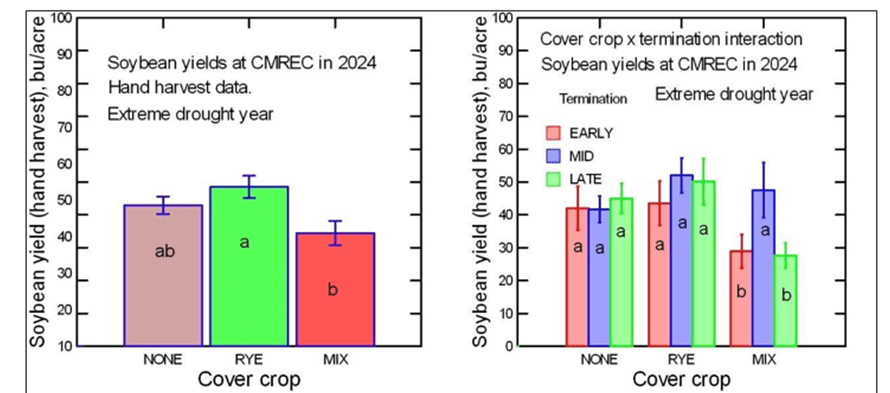
Soybean yields were determined by hand-harvesting. Averaged across in both sandy loam and silty clay loam soils (fields 39A and 7E) and all termination timings, soybean yields in plots with a preceding rye cover crop were significantly higher than in plots with a preceding cover crop clover-rye-radish mixture (Figure 2, left). Looking more deeply into this data, we see that the depressing effect of the clover-rye-radish MIX cover crop did not occur for the mid-termination (planting green and terminating at the same time in early May). Termination timing did not affect soybean yields for the no cover (weeds only) or rye cover treatments.
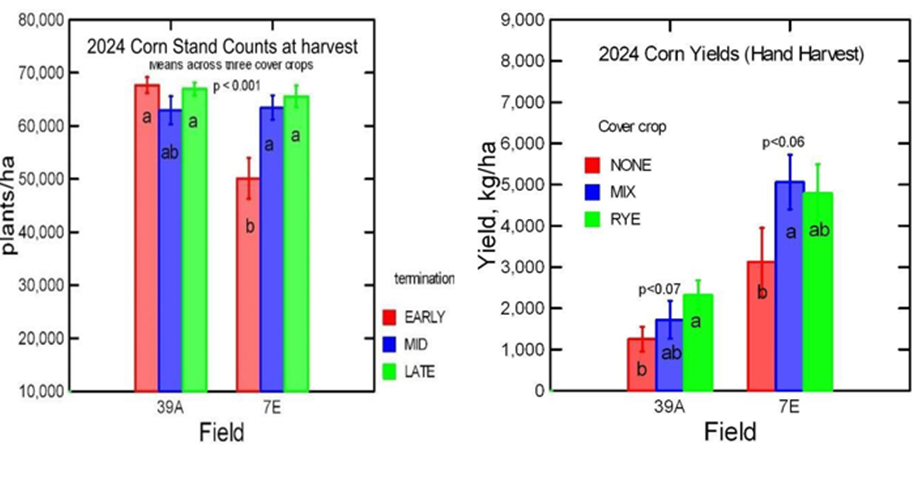
Corn yields and stand counts were determined in two adjacent 6.1 m lengths of row at the center of each plot. Differences in corn stand counts (Figure 4, left) were observed on the silty soil, with early cover crop termination resulting in lower corn stand counts than mid or late termination. In both fields at CMREC-Beltsville corn yields were very low due to severe drought, but higher corn grain yields (Figure 4, right) occurred where cover crops were used. In the sandy field, corn following a rye cover crop yielded higher than corn following no cover crop. In the silty field, corn following a cover crop mixture yielded higher than corn yields than corn following no cover crop. The immediate benefits of high-biomass cover crops and planting green tend to show up most clearly during drought-stressed years.
Severe defoliation also did not affect the number of plants per maize line (P = 0.21, Fig. 3). However, artificial defoliation of 75% of maize leaves at V3 and V5 significantly reduced the yield of two hybrids in a study by Santos and Shields (1998). This might be because of genetic differences in the hybrids compared to those in our study, and/or differences in defoliation methods.
Using insecticide to protect early maize from pests has produced inconclusive effects (Oloumi-Sadeghi et al 1982, Kumar 2002). Control of fall armyworm and black cutworm with insecticide may be
simultaneously reducing other early maize pests (Blanco et al. 2014, Oliveira et al 2022). Insecticide seed coating and spray to prevent pest early damage can affect multiple pests (Harrison et al. 1980, Evans and Stanly 1990, Marenco et al. 1992, Wilde et al. 2007, Jaramillo-Barrios et al. 2020); therefore, the effect of reduction of herbivory by a single pest might be the effect of insecticides on multiple pests.
To assess the effect of different artificial defoliation, 50% of leaves were removed by cutting with scissors in one plant and 50% by punching holes in leaves of another plant that produced leaf damage similar to fall armyworm (e.g., ragged leaf feeding injury). We found no significant difference between the two types of defoliation, nor when compared to the nontreated check (p = 0.23 and p = 0.14) (Fig. 4).
Although the economic injury level by early defoliators of maize will be better understood and validated in multiple countries using different cultivars (Pedigo et al. 2021), it is important to realize that few stud- ies examined yield impact of early defoliation time (VE-V6) in maize. This is true for feeding studies with fall armyworm or black cutworm and mechanical defoliation (Overton et al. 2021, Blanco et al. 2022).
However, following our review of 21 studies summarized in Table 1, most (75%) did not find a significant effect on crop yield by feeding damage by fall armyworm or black cutworm, nor did most studies using artificial defoliation. In a greenhouse study of damage by fall armyworm feeding on maize, direct and indirect yield impacts were observed (Chisonga et al. 2023); however, using Structural Equation Models (SEM), damage by leaf feeding explained less than 3% of the variation in yield. This might be useful in explaining results of previous studies on maize.
Considering lack of significant differences in maize yield in our study to 75% defoliation, as well as most studies reviewed (Table 1; Overton et al. 2021, Blanco et al. 2022) there is substantial evidence that in many scenarios, insecticide use for early season infestation by fall armyworm can often be avoided. Ex- penditures on unnecessary pest control of early defoliators could be better used during the reproductive growth stage to protect developing ears and thus direct benefits toward grain yields. Economic or action thresholds for reproductive stage maize (R1) should be examined for more hybrids and lines.
Funding decisions by farmers for managing fall armyworm might be better allocated for judicious appli- cation of fertilizer, or use of cover crops and other cultural practices to increase plant vigor (Chisonga et al. 2023). Longer term research investments for specific regions also should continue to examine the im- pact of biological control agents, expedite improved maize genetics, including use of maize hybrids, or a shift to medium or longer maize maturities that might allow plants to recover and compensate from ear- ly feeding damage by fall armyworm (Kenis et al. 2022). Such changes in management of fall armyworm are particularly important for millions of smallholders where invasions by fall armyworm continues, and in many cases, farmers are not entirely familiar with the ecology and IPM options to manage fall army- worm (Blanco et al. 2014, Kenis et al. 2022). Not using insecticide during early vegetative growth (VE to whorl) allows new or introduced parasitoids of fall armyworm to thrive, expand their impact (Kenis et al. 2022), and support more effective conservation biological control. This is important for management of fall armyworm in developing and industrial countries where more multi-faceted IPM is necessary to not only avoid unnecessary insecticide use, but also minimize ongoing risk of fall armyworm resistance to insecticides (Gutiérrez-Moreno et al. 2019, Hruska 2019, Harrison et al. 2022, Kenis et al. 2022).