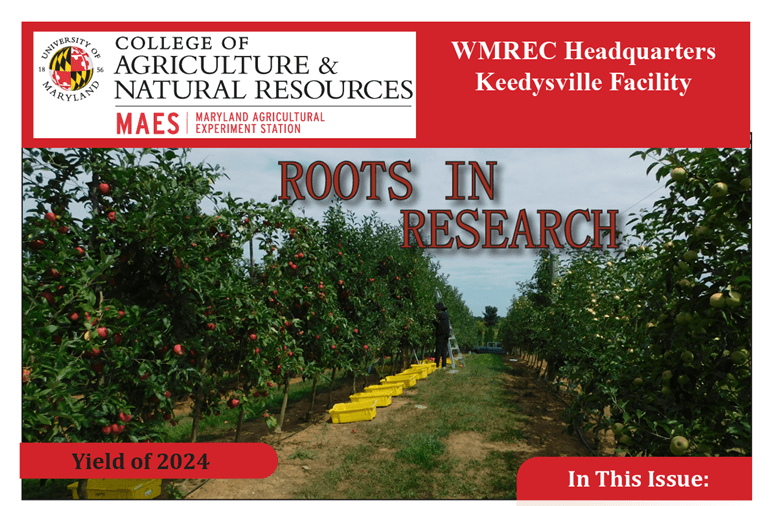
2024 Roots in Research Cover pic
Updated: June 11, 2025

Roots in Research Newsletter

WMREC Headquarters - Keedysville Facility 

Yield Year 2024

2024 was a challenging crop year to say the least for our Western Maryland Research and Education Center. A moist spring led to heavy slug damage in full season soybeans, resulting in patchy stands even after replanting. Overall dry to dusty conditions definitely hurt yields, but a few timely rains kept the grain crops from being a total disaster. On top of it all, a strong storm passing through in August ripped down around half of the hops bines growing in the orchard. It was definitely a good year for any researchers studying slug damage, but a tough one for anyone looking for foliar fungal diseases later in the season. The farm crew has also had to adapt to some losses over the past year. Leonard Greek resigned his position in February after just over two years with WMREC. Sadly, Leonard passed away in May after a long battle with cancer. Lexie Simmons also resigned her position in October after just over two years on the WMREC crew. Both will be missed by WMREC and MAES.

QR Code to see pdf version
QR Code for WMREC

Alan Leslie

AES Center Director
WMREC | CMREC | LESREC                                      

To view this newsletter electronically, scan the QR code!                       

Download PDF of Roots in Research_________________________________________________________________________________________________________________________________________________________________________________________

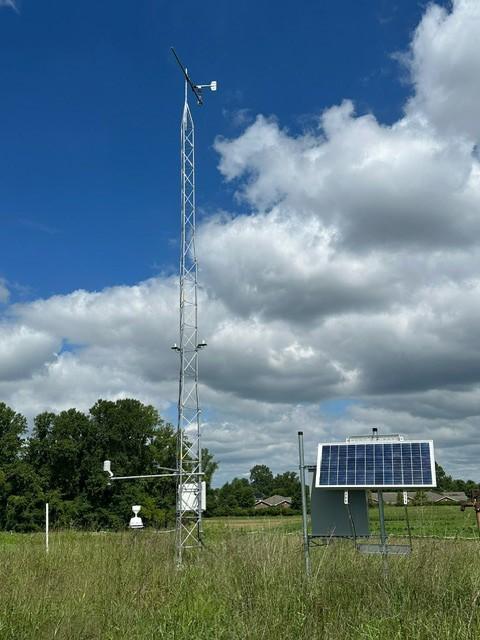
Weather station


New Mesonet Weather Station at Keedysville

In fact, we have had them installed at each MAES station, except Poplar Hill and Beltsville.  Gone are the days of manually checking the weather! Weather data for Keedysville is displayed on our website. The information can be displayed by month, or by the year in a printable format. To compare weather data averages by the month or year, check out our website!  If your research requires this data in a different format, please contact Susan Barnes and she will help to get the information you are requesting.

______________________________________________________________________________________________________________________________________________________

________________________________________________________________________________________________________________________________________

‘Buckeye Gala’ Grafted on Ten Different Rootstocks:  Evaluating Tree Performance and Fruit Quality 

Macarena Farcuh (PI)

This study was conducted in an NC-140 replicated trial that was planted in Spring 2019 and consists of ‘Buckeye Gala’ grafted on 10 different     rootstocks. To date, we have almost 95% tree survival in this planting). 

We were interested in understanding the effects of rootstocks on tree performance and on Gala apple fruit maturity and quality at harvest throughout the years. For achieving this we evaluated different parameters including tree performance measurements (tree size (TCA), yield and crop load), fruit internal ethylene production (IEC), and fruit physicochemical measurements such as fruit weight, skin and flesh color, index of absorbance difference (IAD), red blush percentage, flesh firmness, starch pattern index (SPI), SSC and titratable acidity (TA), on Gala fruit grafted on ten rootstocks at harvest. 

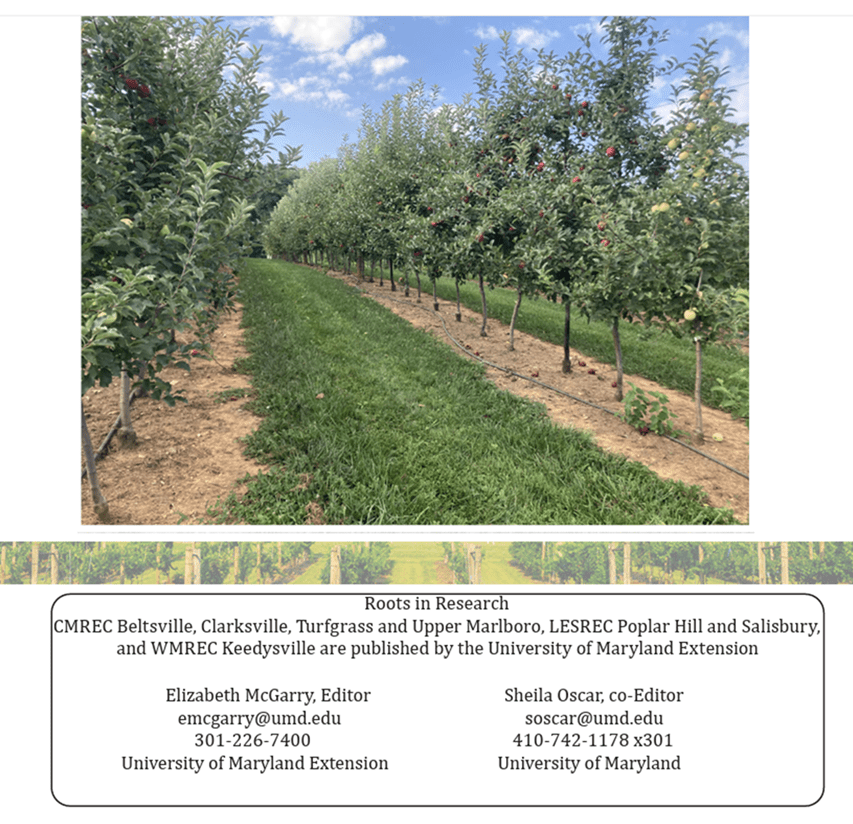
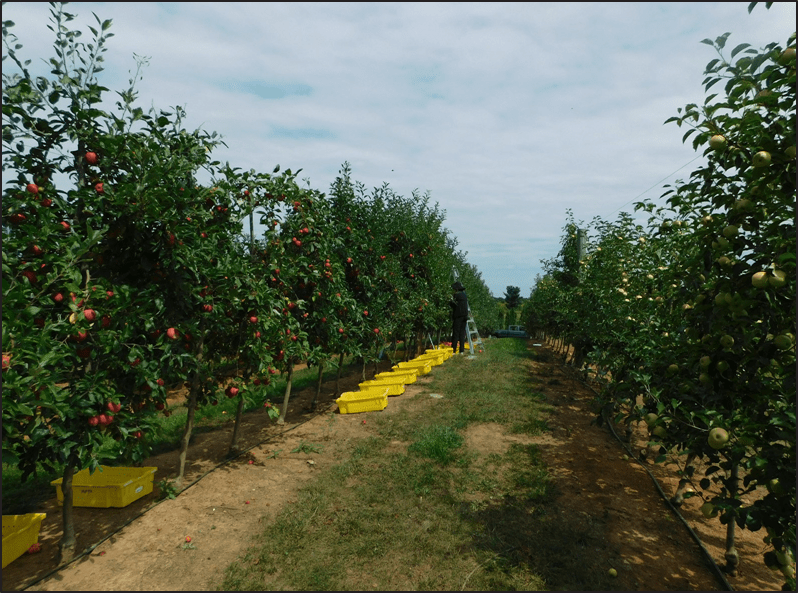
Buckeye Gala trees
Buckeye Gala Apple Trees

From our results we were able to see that results and trends from previous year have been maintained. ‘Buckeye Gala’ scion grafted in a diverse panel of ten rootstock genotypes under Western Maryland environmental conditions showed that there was a trend for delayed fruit maturity, lower fruit weight and higher yield with increasingly vigorous rootstocks. This was demonstrated by the degree of associations of the different assessed parameters with the different evaluated rootstocks. We observed that Gala grafted on G.11 displayed the closest association with IEC, SPI, skin blush and weight, followed by fruit on M.9T337 and G.41that located close to the same parameters as G.11. Next, fruit grafted on NZ.2 displayed a lower association with IEC, SPI, and skin blush. Fruit grafted on B.10 showed a closer association with the parameters of fruit weight and SSC. Gala grafted on NZ.1 and G.814 associated with TCA, firmness, and skin hue angle, while fruit grafted on G.935 had a closer association to the parameters of flesh hue angle, IAD, TA and yield, as well as to TCA, firmness, and skin hue angle. Finally, fruit grafted on G.969 and M.26 presented the closest association with the parameters of skin and flesh hue angles, TCA, firmness, as well as to yield, IAD and TA, and the lowest association to the parameters of IEC, SPI, skin blush and weight. 

From our study, we can conclude that rootstock impact must be considered when making management decisions in ‘Buckeye Gala’ fruit grown under Western Maryland conditions as they are critical in modulating fruit maturity and quality. 

______________________________________________________________________________________________________________________________________________________________

2024 Maryland Soybean Fungicide Efficacy Trials

Andrew Kness, Senior Agriculture Extension Agent, University of Maryland Extension, akness@umd.edu

UME Agriculture & Food Safety picture
Agriculture & Food Systems

JUSTIFICATION

Fungicides are becoming increasingly popular in full season soybean production. These trials provide data that soybean producers can benefit from, 

such as: fungicide efficacy for managing common fungal diseases of soybean, monitor fungicide resistant pest populations, and track the economic impact of foliar fungicide applications over multiple years and environments unique to Maryland.

RESEARCH OBJECTIVES

1. Evaluate the efficacy of select foliar fungicides on full season soybeans grown on two research farms in Maryland by measuring foliar disease incidence and severity. 

2. Determine any greening or green stem effects of the fungicides. 

3. Monitor fungicide active ingredient efficacy over time and identify any fungicide insensitive foliar fungal pathogens. 

4. Determine the yield impact of foliar fungicides and their economic impact.

METHODS

Plot Design 

Field trials were established at three University of Maryland Research farms: Western Maryland Research & Education Center in Keedysville, MD (WMREC), Wye Research and Education Center in Queenstown, MD (WYE), and Central Maryland Research & Education Center (CMREC). Plots were 11’x30’ arranged in a randomized complete block design with five replicates. Planting details are outlined in Table 1. Plots were established in fields with a previous crop of soybeans to maximize conditions for soybean disease development. 

Fertility, insect, and weed management were consistent with University of Maryland Extension recommendations for full-season soybean production.  Read more>>

___________________________________________________________________________________________________________________________

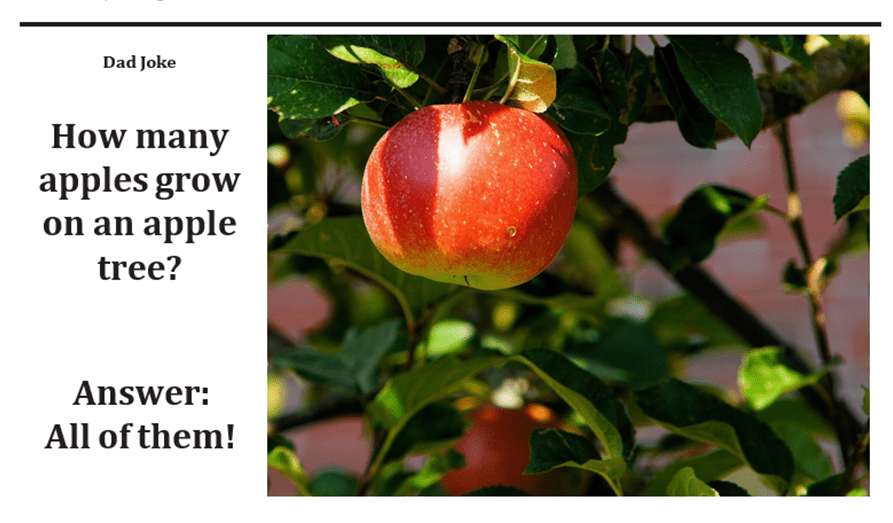
Dad joke

________________________________________________________________________________________________________________________________________________________

Sweet Corn Sentinel Monitoring Network: 2024 Results and Trends with Previous Years

Galen P. Dively, Department of Entomology, University of Maryland

Introduction and Background

Sweet corn sentinel monitoring has been conducted annually since 2017 to track changes in corn earworm (CEW) susceptibility to Cry and Vip3A toxins expressed in Bt corn and cotton. Each year, Syngenta and Bayer-Seminis provide sweet corn seed that is repackage and distributed to volunteer collaborators to establish sentinel plantings of non-Bt and Bt hybrids. All collaborators use the same planting and data collection protocol to generate metrics showing differences in control efficacy between Bt and non-Bt plots. To estimate the allele frequencies for CEW resistance to each Bt toxin, the phenotypic frequency of resistance (PFR) is calculated as the ratio of larval density in Bt ears relative to the density in nbsp;non-Bt ears. Using this approach, a significant reduction in control efficacy coupled with an increased PFR is viewed as a genetically-based change in CEW susceptibility and confirmation of field- evolved resistance. In 2024, the objective was to continue monitoring for changes in resistance development to the Bt toxins, with greater emphasis on the Vip3A toxin and better timing of larger ear samples to detect early signs of resistance. This report summarizes the 2024 results and trends with previous years.

Pests in corn
Corn Earworm
Overall Monitoring Network Results

The 2024 network involved 56 sentinel plantings in 28 states (TX, LA, FL, MS, AZ, MS, GA, MO, SC, NC, VA, MD, DE, PA, NJ, NY, CT, MA, VT, OH, IN, IA, IL, NE, SD, KS, WI, MN, MI) and 4 Canadian provinces (ON, QC, NS, NB).  Collaborators in CT, MD, VA, MN, SC, GA, TX and ON established multiple plantings at different times and/or locations. Forty-two of the plantings included five sweet corn hybrids: Attribute ‘BC0805’ expressing Cry1Ab, Attribute II ‘Remedy’ expressing Cry1Ab and Vip3A, and their non-Bt isoline ‘Providence’ (Syngenta Seeds); and Performance Series 'Obsession II' expressing Cry1A.105+Cry2Ab2, and its non-Bt isoline ‘Obsession I’ (Bayer-Seminis Seeds). Twelve plantings included only larger plots of the Providence and Remedy hybrids to focus more precisely on resistance to the Vip3A toxin. Additionally, other Cry1Ab+Vip3A-expressing hybrids (Milky Way and Revision) were planted at all MD sentinel sites to increase the chances of detecting resistance development to the Vip3A toxin.

Complete data sets of 54 sentinel plantings were submitted and analyzed, whereas two sentinel plantings were not sampled due to poor plant growth and/or animal damage. Altogether, a total of 24,928 ears were examined to record kernel consumption, number of CEW per instar, location of damage (tip, upper, lower), and presence of exit holes. High CEW infestations caused kernel damage to >70% of the non-Bt ears at 37 sentinel plantings. Summed over all plantings, 73.3% of the non-Bt ears were damaged, with an overall average of 1.1 larvae per ear and 5.0 cm2 of kernel consumption per ear. In comparison, the overall percentage of CEW-damaged ears expressing Cry1Ab, Cry1A.105+Cry2Ab2, and Cry1Ab+Vip3A averaged 62.9%, 61.3% and 0.4%, respectively. The number of larvae and kernel consumption averaged 1.23 and 4.79 cm2 per damaged Cry1Ab ear, and 1.05 and 3.92 cm2 per damaged Cry1A.105+Cry2Ab2 ear, respectively. Overall levels of larval numbers and kernel consumption per ear in 2024 were slightly lower the levels in 2023, which was likely due to differences in CEW population pressure, rather a change in the frequency of resistance to the Cry toxins. Read more>>

____________________________________________________________________________________________________________________________________________

2024 Maryland State Soybean Variety Trials

http://www.psla.umd.edu/extension/md-crops

Agronomy Facts No. 32 is Prepared by Dr. Nicole Fiorellino, Mr. Louis Thorne, 
Mr. Gene Hahn, and Ms. Audrey Sultenfuss
Test Procedures

The University of Maryland offers a fee-based, soybean variety performance testing program to local and national seed companies. The results from these replicated trials provide agronomic performance information about soybean varieties tested at four locations in Maryland considered representative of the state's geography and weather conditions Table 1 summarizes the agronomic and production information for each test site.

Varieties tested in 2024 were entered by participating seed companies, listed in Table 3, that were solicited for submission of varieties. These varieties represented those currently available for purchase to experimental lines still under evaluation. Select Pioneer, Agrigold, and Revere varieties were identified for use as checks in the test. The inclusion of the performance data for check or reference varieties that are proven performers in the Mid-Atlantic region allows comparisons of newer varieties to proven varieties. During 2024, 56 varieties were tested using three maturity groups: MG 3 (9 varieties, Table 6), early MG 4 (4.0-4.3, 24 varieties, Table 7), and late MG 4 (>4.4, 22 varieties, Table 8). Check varieties were included in each of the maturity groupings. All genetic traits and seed treatments are listed in Tables 6-8.

Each variety was replicated three times per location. In 2021, we modified a John Deere Maxemerge-2 four-row, 30” spacing, no-till planter, with coulters and trash wheels for use in the variety trials. The modifications included the addition of a single cone planting unit that delivered seed to a spinner powered by a 12v motor to evenly distribute seed to the four planter units. Planting, harvest, and in-season management information is presented in Tables 1 and 2. We aimed for a seeding rate of 6-7 seeds/foot and plot harvest length was approximately 20 feet. Center two rows (~5 ft. swath) were harvested with an Almaco R1 research combine (Almaco Co., Nevada, IA). Grain yield, harvest moisture, and test weight were measured for each plot. These data were collected with a Seed Spector LRX system (Almaco Co., Nevada, IA) and recorded on Microsoft xTablet T1600.

Test Results

The overall performance across the locations for the full season varieties in each maturity group is reported in Tables 12-14 and double crop varieties in Tables 27-29. Variety performance at individual locations can be found in Tables 15-26. The agronomic characteristics reported are yield, in bushels/acre at 13% moisture content and test weight (lb/bu) at 13% moisture. Plot damage at some locations necessitated the removal of outliers, which was performed by location and maturity group. Outliers were determined as two standard deviations above and below the mean for that maturity group. If outlier removal eliminated two of three replicates for any entry, then the entire entry was removal from data analysis. Lodging was estimated by plot at the time of harvest. A least significant difference (LSD) value is reported for each est where statistically significant differences (P ≤ 0.1) for yield was observed among varieties. The mean separation value has been calculated at the 10% probability level (LSD0.1). The LSD can be used to compare two varieties within the same test. For example, when the yield difference between two varieties is greater than the LSD value, there is a 90% certainty that the difference in yield is due to variety performance rather than due to random variability.  Click here to view tables 1 - 29

Relative Yield

The selection of a variety based solely on performance at one location is not recommended. It is better to select variety based upon performance over a number of locations and years, if possible. To compare the performance of each variety across the five locations, relative yield tables (Tables 9-11) are included. Relative yield is the ratio of the yield of a variety at a location to the mean yield of all the varieties at that location expressed in percentage. A variety that has a relative yield consistently greater than 100 across all testing locations is considered to have excellent stability.

Acknowledgments

The University of Maryland Agronomy Program research would not be possible without the assistance and oversight of equipment maintenance, seed packaging, planting, data collection, and plot harvest by faculty research assistant, Louis Thorne. This work could not be accomplished without the assistance of Gene Hahn and Audrey Sultenfuss. Thank you to the crew at Wye Research and Education Center for sharing your experience, tools, and space in your shop with our team as they continue to keep our equipment running.

Tables 1 and 2 outlines the crews at each test location who assisted with land preparation, flagging, plot management, and harvest. I personally would like to acknowledge each farm manager, David Armentrout, John Draper, Ryan McDonald, and Douglas Price for their continued support of the Variety Trials.

Additional Information

The inclusion of varieties in these tests is not an endorsement by the University of Maryland. Advertising statements about a company’s varieties can be made as long as they are accurate statements about the data as published. Statements similar to “See the Maryland Soybean Tests Agronomy Facts No. 32” or “Endorsement or recommendation by the University of Maryland is not implied” must accompany any reproduced information.

Funding for purchase of check varieties provided by Maryland Soybean Board

(Project # 24063120). This work is supported by the Crop Protection and Pest Management program [grant no. 2024-70006-43556/project accession no. 1032889], from the U.S. Department of Agriculture’s National Institute of Food and Agriculture.

Maryland Soybean Board Logo

_________________________________________________________________________________________________________________________________________________________________________________________________________________

USDA Notice to Beneficiaries
WMREC Facility Personnel list