
Mind the Height: Postemergence Herbicide Cutoffs in Corn
By Hayden Schug, Agriculture Agent, Charles County, and Kurt Vollmer, Weed Management Specialist
University of Maryland Extension
As corn pushes through vegetative growth stages in late June and early July, it’s important to keep a close eye on plant height when making herbicide decisions. Many postemergence herbicides have label restrictions tied directly to corn height or growth stage (Table 1).
| Herbicide | Active Ingredient(s) | Max Height (Broadcast) | Max Height (With Drop Nozzles) | PHI (Pre-Harvest Interval) |
|---|---|---|---|---|
| 2,4-D Amine | 2,4-D (dimethylamine salt) | 8" | Before tassel (directed spray) | Varies (usually 7 days for forage) |
| 2,4-D Ester | 2,4-D (ethyl ester) | 8" | Before tassel (directed spray) | Varies (usually 7 days for forage) |
| Accent Q | Nicosulfuron + safener | 20" or V6 | Up to 36" or V10 | 70 days (grain), 45 days (forage) |
| Acuron GT | S-metolachlor + mesotrione + glyphosate | 30" or V8 | Not listed | 45 days |
| Armezon PRO | Topramezone + dimethenamid-P + safener | 30" or V8 | Not listed | 45 days |
| Atrazine | Atrazine | 12" | Not allowed beyond 12" | 60 days for forage |
| Basagran | Bentazon | Before tassel | Not listed | 30 days for forage |
| Bromoxynil + atrazine | Bromoxynil + atrazine | 12" | Not listed | 60 days for forage |
| Cadet | Fluthiacet-methyl | 48" or before tassel | Up to tassel | 40 days |
| Callisto Xtra | Mesotrione + atrazine | 12" | Not listed | 45 days |
| Capreno | Tembotrione + thiencarbazone-methyl + safener | 20" or V7 | Not listed | 45 days for forage |
| DiFlexx | Dicamba + safener | 36" | 45 days | |
| DiFlexx DUO | Dicamba + tembotrione + safener | 36" | Directed spray V7-10 up to 15 days prior to tassel | 45 days |
| Distinct | Dicamba + diflufenzopyr | V6 | 20-36" | 72 days for grain and 32 days for forage |
| Enlist One/Duo | 2,4-D choline (+ glyphosate in Duo) | 30" or V8 | 30-48" | 30 and 50 days for forage |
| Liberty | Glufosinate | V6 | up to 36" | 70 days grain, 60 days for forage |
| Halosulfuron | Halosulfuron-methyl | Up to layby | Not listed | 45 days |
| Harness Max | Acetochlor + atrazine + mesotrione | 11" | Not listed | 45 days |
| Hornet | Flumetsulam + clopyralid | 20" or V6 | Up to 36" | 85 days for grain and 45 days for forage |
| Impact/Armezon | Topramezone | V8 or 20" | Up to 36" | 45 days |
| ImpactZ | Topramezone + atrazine + safener | 12" | Not listed | 45 days |
| Katagon | Dicamba + tembotrione + safener | V5 or 20" | Not listed | 70 days |
| Laudis | Tembotrione + safener | V8 | Not listed | 45 days for forage |
| Laudis + atrazine | Tembotrione + atrazine + safener | 12" | Not listed | 60 days for forage |
| Mesotrione | Mesotrione | 30" or V8 corn | Not listed | 45 days |
| Perpetuo | Pyroxasulfone + fluthiacet-methyl | V2 to V6 stage | Not listed | 28 days |
| Realm Q | Rimsulfuron + mesotrione + safener | 20" or V7 | 20" or V7 | 70 days for grain and 45 days for forage |
| Resolve Q | Rimsulfuron + thifensulfuron + safener | 20" corn | Not listed | 30 days |
| Resource | Flumiclorac-pentyl | V10 | Not listed | 28 days for forage |
| Shieldex | Tolpyralate + safener | 20" or V6 | Not listed | 45 days for grain and 21 days for forage |
| Solstice | Fluthiacet-methyl + mesotri | 30" or V8 | Not listed | 45 days |
| Status | Dicamba + diflufenzopyr | 36" or V8 | Not listed | 72 days for grain and 32 days for forage |
| Steadfast Q | Nicosulfuron + rimsulfuron + safener | 20" or V6 | Not listed | 45 days |
| Stinger | Clopyralid | 24" | Not listed | 40 days for forage |
| Tough | Pyridate | V8 stage | Not listed | 68 days |
| Widematch | Fluroxypyr + clopyralid | V5 stage | Not listed | 90 days |
| Yukon | Dicamba + halosulfuron-methyl | 20" | 20-36" | 30 days for forage |
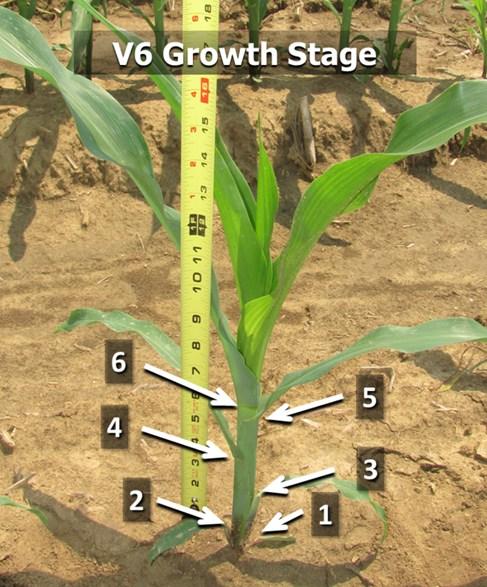
In Maryland, warm weather and ample soil moisture can push corn through several inches of growth in just a few days. That means the application window for certain herbicides, especially those containing atrazine or growth regulators like 2,4‑D and dicamba, can close quickly. Once corn exceeds the labeled height or growth stage, continuing to spray those products can damage the crop or result in an off-label application. Plant height and growth stage are both used to determine herbicide cutoffs, and labels typically specify one or the other, or whichever comes first. For example, a product might instruct users to apply it before corn reaches 12 inches or the V6 stage (Figure 1). In those cases, the more restrictive condition applies. It’s also important to note that labels refer to the height from the soil surface to the top of the extended leaf, not the leaf collar or the whorl.
Tank mixtures can complicate things further. Products like Acuron GT and Halex GT contain atrazine, and cannot be used once corn is taller than 12 inches, even if the other components are still legal to apply.
Once corn exceeds label height limits, herbicide options are limited. Drop nozzles become essential to direct spray below the whorl and reduce the risk of leaf burn and arrested ear development. At that stage, coverage is also more difficult, and weed control can suffer.
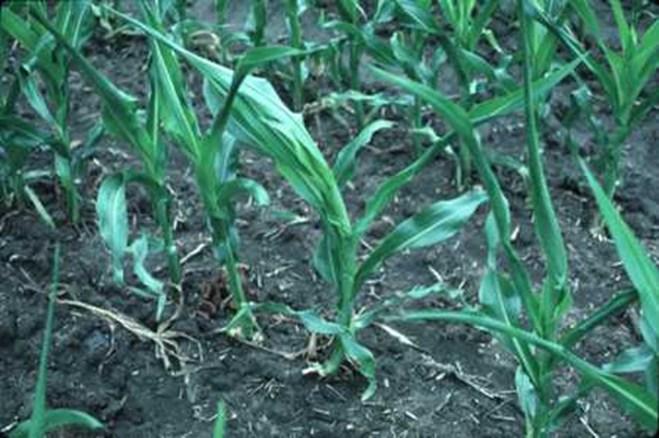
To stay on track, scout fields frequently and prioritize those nearing cutoff thresholds. Make sure to double-check labels, especially when using tank mixes that contain multiple active ingredients with different restrictions. When in doubt, use the most restrictive height or stage to stay within legal application limits. Also, some herbicides can harm plant growth if applied within the whorl of the corn (Figure 2). Use proper drop nozzle spacing and application to avoid this.
In short, postemergence herbicide timing in corn is a race against growth. Read labels, measure products carefully, and don’t wait too long to act.
References available upon request.
This article appears in July 2025, Volume 16, Issue 4 of the Agronomy News.