
Lodged soybeans? Check to make sure Dectes stem borer isn’t the cause
Andrew Kness, Senior Agriculture Agent, University of Maryland Extension, Harford County; Hayden Schug, Extension Educator, University of Maryland Extension, Charles County; Veronica Yurchak, Extension Specialist, University of Maryland Extension, Commercial Vegetable Production; and Kelly Hamby, Extension Specialist, Department of Entomology, University of Maryland
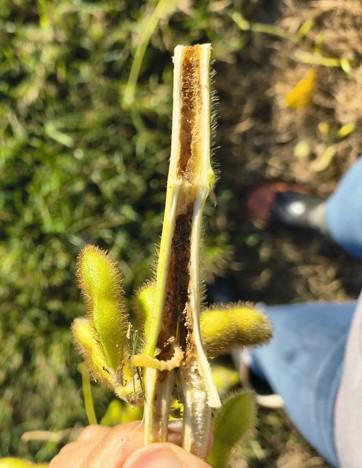
Recent observations across Maryland, particularly on the Eastern Shore, show fields with considerable lodging. It is easy to attribute this to variety standability and/or strong storms, but growers and crop consultants should take a moment before harvest to look closer at these fields to determine the underlying cause. We recently scouted several fields of lodged soybeans at the Wye Research and Education Center and uncovered significant incidence of Dectes stem borer with about 60-70% of stems affected. The larvae of this native beetle tunnels into the stem of soybeans, compromising their strength and causing them to be easily lodged. Growers and consultants alike will want to determine if Dectes stem borer is the cause of lodged soybeans and take proper steps to manage this pest for future crops.
What to look for
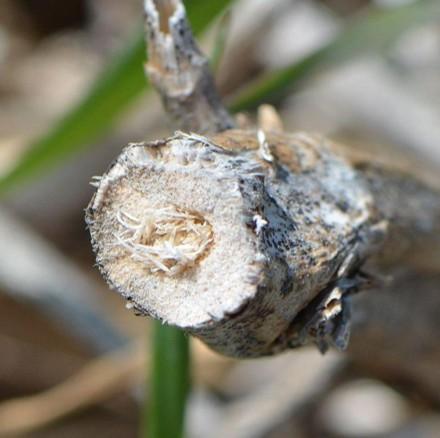
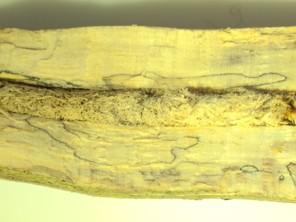
Dectes stem borer adults are elongated gray beetles about 5/8 inch long with slender antennae that are longer than their body. Antennae have alternating grey and black striping on them. They can often be found while sweep netting soybean fields in July and August. The larvae are creamy white to yellow, accordion-like in shape with a darker head, and about ½ inch when fully grown (Fig. 1). They tunnel into the main stem and eat the pith as they move down, leaving powdery excrement. As plants begin to dry down, they move toward the base of the plant near the ground to make an overwintering chamber. This chamber is formed by girdling the plant stem from the inside and making a plug from their excrement (frass plug). Plants typically break off at the girdled point, leading to the lodging you often see associated with this pest.
How to protect this year’s crop
Once infestation has occurred, the only strategy for avoiding losses is timely harvest. The probability plants will lodge increases the longer they are in the field exposed to weather events that break the weakened stems. Prioritize harvest in heavily infested fields.
Management best practices for next year
Crop rotation away from soybeans can help reduce risk because larvae overwinter in soybean stubble and will reinfest subsequent plantings located in close proximity. Previous work in our area has indicated that the areas with greatest risk for infestation coincide with areas with more years in soybean.
Narrow (≤ 15 inches) row spacing may help reduce losses due to lodging because plants can be kept upright by their neighbors. It has been suggested in both soybeans and sunflowers, an additional host plant, that earlier maturing plantings experience greater damage. This may be because the plants dry down earlier and trigger girdling by the larvae earlier in the season.
Tillage (fall disking) and trap cropping (sunflower) are other methods that can successfully reduce Dectes stem borer infestation, but are often less compatible and more complicated to integrate into Maryland soybean production.
In addition to sunflower, ragweed is another preferred host plant for Dectes stem borer. If left uncontrolled during years when fields are rotated away from soybeans, it can act as a host bridge, allowing the pest population to persist and undermining the pest control benefits of crop rotation. Ragweed should be thoroughly managed within fields and along field borders (mowed) to protect rotation efficacy.
Insecticides are not recommended for Dectes stem borer management because they are unlikely to be effective or economic. Previous work in this region and recent work in South Dakota have found that insecticide applications targeting Dectes stem borer rarely reduce infestation or improve yield.
More information
Maryland Farm and Harvest, 2021. Dectes stem borer: a tiny soybean pest that causes big problems, https://www.youtube.com/watch?v=ZZ5l9vLGE_c&t=88s
Hamby, K., Leslie, A., and Owens, D. 2022. Dectes stem borer management in Soybeans. University of Maryland FS-1196, https://extension.umd.edu/resource/dectes-stem-borer-management-soybeans-fs-1196/
Varenhorst, A.J., Shrestha, G., Valmorbida, I., et al. 2026. Profile of the Dectes stem borer (Coleoptera: Cerambycidae) in sunflower and soybean. Journal of Integrated Pest Management 17(1): pmag032, https://doi.org/10.1093/jipm/pmag03
This article appears in October 2026, Volume 17, Issue 7 of the Agronomy news.