

FS-2024-0746 | January 2026
Growing Impact: Multiplying Efforts in 4-H Programs
By Santana Sparks (Mays), Agent Associate; Karen Wood, Senior Agent Associate; Jessica Mellon, Senior Agent Associate; Torrey Silliman, Agent Associate; Vernelle Mitchell-Hawkins, Senior Agent, University of Maryland Extension
Introduction:
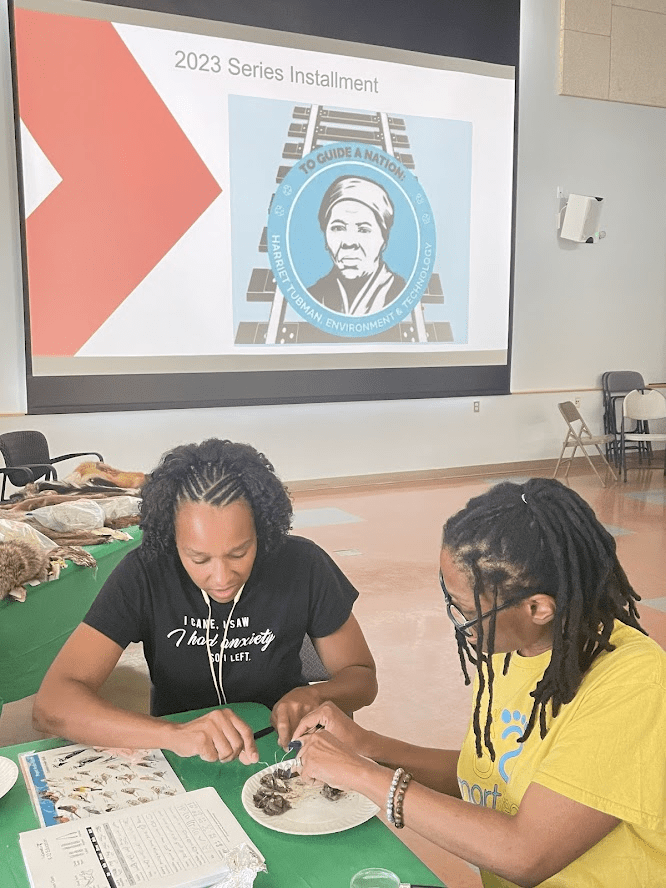
4-H’s reach is unparalleled. As part of the nation’s Cooperative Extension Service, there are 4-H programs in every county, city, and parish. Collectively, 4-H reaches nearly 6 million youth annually through 3,500 professionals and a network of 500,000 volunteers (4-H, 2023). For 4-H to continue to meet the needs of our communities, 4-H professionals and volunteers need to multiply their efforts. One way to do so is to strengthen their interactions both inside and outside the Cooperative Extension Service.
The Smith-Lever Act established the service in 1914 to connect publicly funded land-grant institutions to the broader community. Focusing on using science and research-based problem-solving to support communities, Extension’s work is a form of community education (National Institute of Food and Agriculture, n.d.).
4-H professionals can increase capacity and multiply their efforts by sharing their knowledge with community partners, volunteers, and Extension personnel, expanding their reach and impact in the community. Enhancing a 4-H educator’s efficiency could reduce burnout by enabling them to achieve the same level of impact while optimizing resources. According to a study at Clemson University, 4-H educators are experiencing burnout at a higher rate than other Extension employees, identifying factors such as low pay, lack of work-life balance, and long working hours as key contributors (Hwang, 2023).
In this publication, the following methods to multiply an individual 4-H educator’s efforts will be discussed:
- Delegating
- Collaborating Internally
- Collaborating Externally
- Communicating through Publishing
The above methods are followed by a discussion of reporting Extension efforts. Educators engaged in community education have a responsibility to report the impacts of their work. Impact reporting is an essential tool that allows educators to highlight their efforts in the community. It is not only required by local, state, and federal agencies but also helps Extension share its successes with stakeholders.
It’s important to recognize that some of the methods outlined, especially those centered around collaboration, demand considerable time investment to build relationships, define roles, and manage complexities effectively.
1. Delegating:
1. Delegating: A 4-H educator often faces many demands, sometimes in areas needing expertise. However, delegating programming can help manage these demands and extend the reach of 4-H efforts. The goal of delegating is to reach as many people as possible by utilizing existing structures.
Here are some ways to create connections that can lead to successful delegation:
- Train teachers, Recreation Activity Centers, and volunteers through a train-the-trainer approach.
- Invite clubs, club leaders, and Extension Advisory Committee (EAC) members to participate in community events.
- Use Teen as Teachers programs to empower older 4-H members to train younger ones.
- Leverage volunteers who specialize in specific areas of interest or expertise.
- Hire a 4-H program assistant passionate about extension education, teaching, nonprofit work, or youth development.
Example of Train-the-Trainer:
All 4th-grade students must learn about living organisms’ internal and external structures in the county’s school system. The 4-H educator hosts a train-the-trainer workshop for 4th-grade science teachers, introducing them to 4-H curricula like “ChickQuest,” which aligns with state standards and includes lessons on hatching chicks in the classroom (ChickQuest, 2024). During the workshop, the educator guides the teachers through lessons, provides resources, and outlines the next steps. The teachers then use the curriculum to teach their students, with the 4-H educator available for support. Afterward, the teachers submit data for reporting. By training five teachers, each of whom teaches 40 students, the 4-H educator reaches 200 students in just one training session.
2. Collaborating Internally:
Extension is a function of cooperative work, and collaborating with educators is vital. Collaboration among Extension educators (across program areas) can enhance programs. One way to do this is to work with other educators within the local Extension office, or partner with other educators within your program in different localities. Collaborating internally helps strengthen programs by adding more expertise and support in specific skill areas.
In 4-H programs, internal collaborations can also involve volunteers, teachers, or club leaders, who can serve as project leaders at an event or workshop. Considering the vast number of skills volunteers bring to the program, this form of collaboration is ideal.
Some examples include:
- Partner with Master Gardeners to provide youth lessons on planting and gardening.
- Support Agriculture educators by providing youth programming at a farming program.
- Invite Extension Advisory Committee (EAC) members to give presentations on their areas of expertise.
- Invite 4-H All-Star (alumni) members to help with various classes that may interest them.
- Invite 4-H educators from other counties/city units to teach at a workshop or team-teach a topic that is new to you.
3. Collaborating Externally:
Maximizing reach and efforts in 4-H youth programming involves finding partnerships within the community to help leverage resources. To follow protocol, a formal agreement between the two parties is necessary. These agreements require signatures to demonstrate approval of program and service delivery (e.g., Memorandum of Agreement & Assurance Statements).
Some examples include:
- Work with existing youth organizations in the community, connecting with afterschool programs, Girl Scouts, Boy Scouts, homeschool cooperatives, local libraries, faith-based organizations, etc.
- Utilize train-the-trainer to share research-based 4-H curriculum with schools.
- Partner with FFA youth in area high schools to help with events that interest them.
- Provide Service-Learning Opportunities for youth to help with programs.
- Use area attractions in the community to offer lessons that will enhance the 4-H program.
- Partner with museums that exhibit items that could be used for educational purposes.
- Partner with AmeriCorps or Governor’s Office volunteers.
When deciding how and when to partner with the community, take time to determine if and how the outcomes of programming as a result of these relationships can be captured for reporting purposes. Consider utilizing a memorandum of agreement to clarify expectations and reporting requirements.
4. Communicating through Publishing:
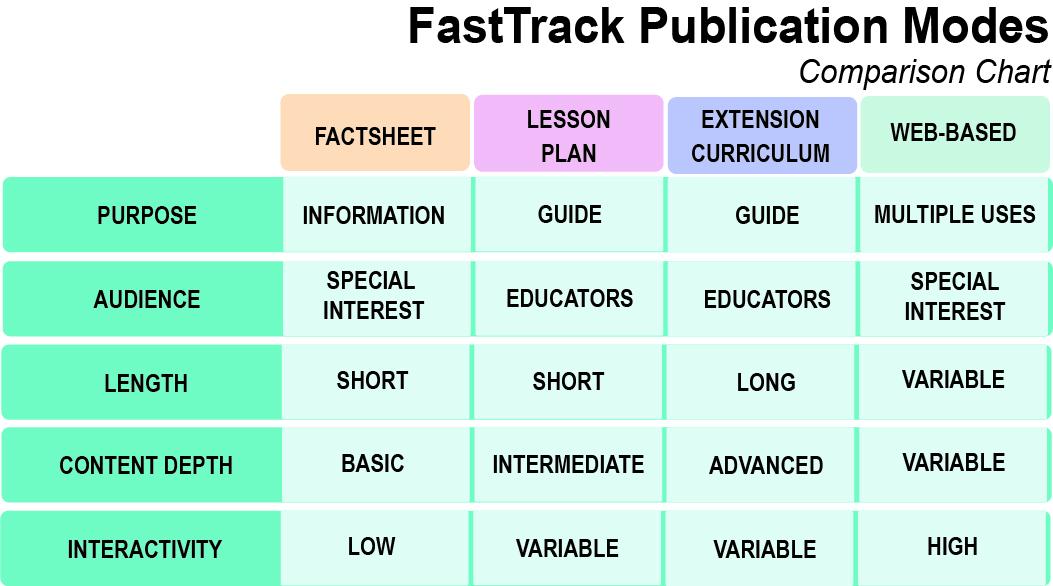
Publications are a powerful way for 4-H professionals to extend their reach and impact across a broader audience. University of Maryland educators have access to the University of Maryland Extension’s FastTrack publication process; a wide array of resources can be created that are accessible to youth, educators, and community members beyond the immediate scope of standard programming. The Extension publication process ensures that materials are reviewed for accuracy and relevance. Investigate the publishing options available through your employer or local land grant university.
Different types of publications allow 4-H Educators to tailor resources to meet the needs of a diverse audience. The most relevant modes for 4-H are Fact Sheets, Lesson Plans, Extension Curricula, and Web-Based Learning. Utilizing the University of Maryland Extension’s FastTrack ensures that materials are accessible and professional.
- Fact sheets are valuable and effective resources, making them ideal for sharing quick, practical information.
- Lesson Plans provide a detailed description, implementation, and evaluation of a specific learning objective.
- Curricula offer more in-depth guidance for educators, 4-H volunteers, and youth leaders, enabling them to facilitate structured learning experiences over time.
- Web-based learning expands a 4-H Educator’s reach to youth, particularly in today’s digital age, as online resources provide flexible, on-demand learning opportunities.
A secondary avenue to explore is the National 4-H Council’s CLOVER platform. CLOVER by 4-H is an online learning platform that offers interactive content and learning experiences for youth to explore new possibilities. 4-H Educators can submit their activities, curricula, and learning experiences to the platform for review. A comprehensive content development toolkit is available on the CLOVER website to support submissions. For detailed submission guidelines and access to the submission portal, visit https://4-h.org/resources/professionals/ curriculum-development/activity-submissions/
Reporting of Efforts:
When partnering with other entities to expand 4-H’s reach, intentional efforts can be made to collect the impacts. Here are some ways an educator can collect data while multiplying efforts:
- Train-the-trainer: Have the trainer submit data at the start or end of a program. Ensure that reporting of data is a clear expectation during the training. Consider using a Memorandum of Agreement to formalize these expectations.
- Shared teaching: When partnering with organizations and using a modified or shared train-the-trainer model, try to start and end the program in person so that information can be collected
- Ripple Effect Mapping: Ripple Effect Mapping is an evaluation tool designed to capture the impacts of programs within the communities. It also highlights how these impacts relate to the collections and reporting of data.
Examples of how the data can be used:
- Grant reporting (report program efforts to get new grants or report findings to current funders)
- Report completed work efforts to the community (via Extension publications, newsletters, annual reports, social media etc.)
- Impact statements for federal funders
- Showcase teaching effectiveness/quality of efforts
- Required university reporting system to show the impact of Extension work in the community
Conclusion:
Significant opportunity exists to improve 4-H Educator resiliency by strengthening programming using the strategies above to multiply teaching efforts. Every community has a wealth of skills, interests, and knowledge. Utilizing the available resources helps educators enrich existing programming, access broader audiences, and add value to society. The Land Grant model was built upon the understanding that community education is a cooperative effort involving collaboration among county/city, state, and federal stakeholders (National Institute of Food and Agriculture, n.d.). Multiplying efforts using the strategies herein keep the cooperative extension model relevant and timely.
References
4-H. What is 4-H? (2023). https://4-h.org/about/
Hwang, E., Eck, C., Layfield, K., Vernon, K. (2025) An Assessment of Clemson Cooperative Extension Agents’ Perceptions of Work-Related Factors Leading To Burnout. Journal of Agricultural Education, 66(1), 43. https://doi.org/10.5032/jae.v66i1.2775
National Institute of Food and Agriculture. (n.d.). Extension. National Institute of Food and Agriculture. https://www.nifa.usda.gov/about-nifa/howwe-work/extension
Ohio State University Extension, Ohio 4-H Youth Development (n.d.). ChickQuest. https://ohio4h.org/
SANTANA SPARKS (MAYS)
smays1@umd.edu
KAREN WOOD
kwood125@umd.edu
JESSICA MELLON
jmellon2@umd.edu
TORREY SILLIMAN
VERNELLE MITCHELLHAWKINS
vmh@umd.edu
This publication, Growing Impact: Multiplying Efforts in 4-H Programs (FS-2024- 0746), is a part of a collection produced by the University of Maryland Extension within the College of Agriculture and Natural Resources.
The information presented has met UME peer-review standards, including internal and external technical review. For help accessing this or any UME publication contact: itaccessibility@umd.edu
For more information on this and other topics, visit the University of Maryland Extension website at extension.umd.edu
University programs, activities, and facilities are available to all without regard to race, color, sex, gender identity or expression, sexual orientation, marital status, age, national origin, political affiliation, physical or mental disability, religion, protected veteran status, genetic information, personal appearance, or any other legally protected class.
When citing this publication, please use the suggested format:
Sparks (Mays), S., Wood, K., Mellon, J., Silliman, T., & Mitchell- Hawkins, V. (2026). Growing Impact: Multiplying Efforts in 4-H Programs (FS-2024-0746). University of Maryland Extension. go.umd.edu/FS-2024-0746.