
Key points
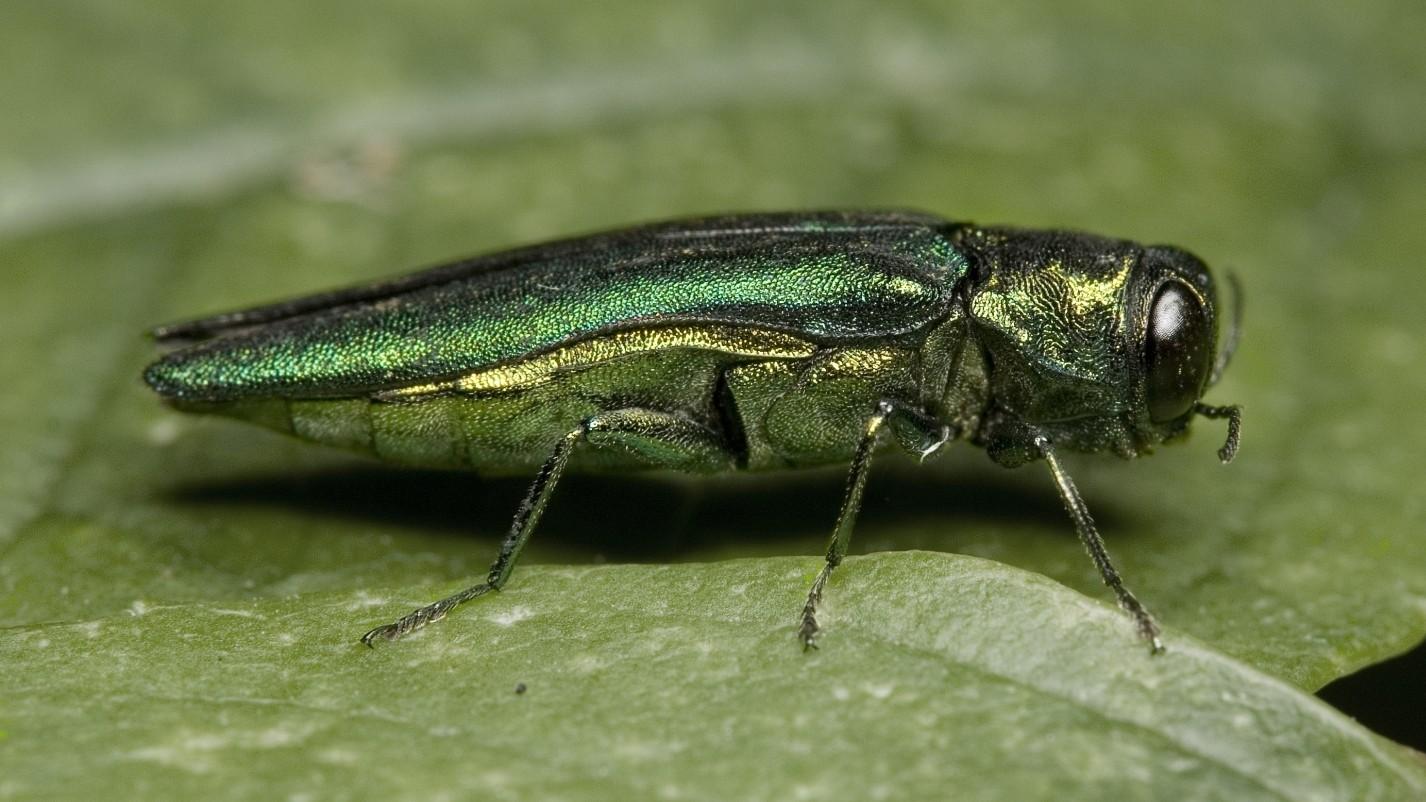
- Emerald Ash Borer (EAB; Agrilus planipennis) is an invasive beetle from Asia that feeds on and kills ash trees (Fraxinus species). Since it was introduced to North America, it has killed millions of ash trees across the Midwest and Eastern U.S.
- This invasive pest is well-established in Maryland. It was first introduced into Prince George's County in 2003, and was confirmed to be infesting ash trees on the Eastern Shore in 2015.
- EAB can kill large ash trees within three years of infestation.
- Horticulturally, ash trees were one of the most common and important landscaping trees used in Maryland and were common in western Maryland forests. As a forestry product, ash wood is used for all traditional applications of hardwood, from flooring and cabinets to baseball bats.

Photo: David Cappaert, Bugwood.org
Emerald ash borer detection

Photo: Jim Tresouthick, Village of Homewood, Bugwood.org
- The presence of the emerald ash borer typically goes undetected until trees show symptoms of being infested. Usually, the upper third of a tree will thin and then die back. This is usually followed by a large number of shoots or branches arising below the dead portions of the trunk.
- Woodpecker activity can be an indication that an ash tree is infested with EAB larvae. As the birds chip off the bark to reach the larvae underneath, the paler inner layer becomes noticeable from a distance. This color change in the bark is called "blonding."
- Other symptoms of infestation include small D-shaped exit holes in the bark where adults have emerged, vertical splits in the bark, and distinct serpentine-shaped tunnels beneath the bark in the cambium, where larvae effectively stop food and water movement in the tree, starving it to death.
- Adult beetles begin flying in the spring about the time that black locust trees (Robinia pseudoacacia) are flowering.

Photo: Kenneth R. Law, USDA APHIS PPQ, Bugwood.org

Management

As of July 31, 2015, the Maryland Department of Agriculture (MDA) rescinded the statewide quarantine prohibiting the movement of hardwood from the Western to the Eastern Shore of Maryland. EAB is no longer under Federal quarantine regulations as of January 14, 2021.
- If you have ash trees that you want to protect from EAB, treatments should be made after ash trees are finished flowering, to protect pollinators. Best Management Practices Michigan State University Extension.
- Large specimen trees will need to be treated by a certified arborist or licensed tree expert.
- Consult the North Central IPM Center's fact sheet for options: "Insecticide Options for Protecting Ash Trees from Emerald Ash Borer" (PDF) (3rd edition). Be sure to check labels and instructions to make sure that Emerald Ash Borer is on the label.
- To help you make a decision on treatment, Purdue University co-produced a decision guide (PDF).
- Hire a reputable, insured, licensed arborist or tree company to remove infested or dead ash trees or to discuss the control or prevention of EAB. Obtain estimates from multiple companies; ask for proof of insurance and a written estimate. The estimate should include wood disposal information and site cleanup. Ask for references.
- Ash trees killed by EAB become brittle and dangerous to people, property, and tree removal professionals.
Preventing EAB problems
- Don’t move firewood – buy it where you burn it. Hauling firewood is the most common way for damaging forest pests to be moved from one area to another.
- Don’t plant ash trees. Diversified plantings of alternative tree species are recommended for residential landscaping.
- Dead trees located in yards, near buildings, or as street trees will become hazardous as they deteriorate and should be removed promptly by a reputable tree company. Ash trees become very brittle when they die, and tree companies will not climb them for removal if they have been dead for more than 6 months. Depending on the situation, a crane may be needed, increasing the cost of removal.