

FS-2026-0806 | May 2026
Efficacy of Chelated Iron in Turf Weed Control
By Kelly Nichols, Ag Agent, University of Maryland Extension, Montgomery County
In 2019, a law went into effect in Montgomery County, Maryland, which restricted pesticides allowed for use in lawns, playgrounds, mulched recreation areas, and childcare facilities (Mont. Cty. Code, §33B-10). Under this law, pesticides can only be applied if they:
- are minimum risk pesticides (25b pesticides under the Federal Insecticide, Fungicide, and Rodenticide Act); or
- contain active ingredients which are recommended by the National Organic Standards Board (Mont. Cty. Code, §33B-2).
Examples of allowed active ingredients include acetic acid, ammonium soap of fatty acids, caprylic/capric acid, citric acid or oil, corn gluten, iron, and soybean oil (Montgomery County, Maryland, n.d.). Most of these active ingredients are non-selective, meaning that they will injure or kill any plant on which they are applied, including turfgrass. Of these, iron is a unique active ingredient, as it is a selective herbicide for broadleaf weeds in grasses. It also has some efficacy on crabgrass species (Lyons & Watson, 2021; Neudorff North America 2023). Iron is a naturally occurring nutrient that plants need in small quantities. When iron is used in herbicides, a chelating agent is added to keep the iron in a soluble form and increase uptake. Broadleaf plants, which includes many turfgrass weeds, can absorb this chelated iron in larger quantities and more easily than grasses, causing toxicity to the broadleaves without injuring turfgrass (Smith-Fiola & Gill, 2024). Research on chelated iron has been conducted in other states and Canada; however, research in Maryland is limited (Smith-Fiola & Gill, 2024). Chelated iron comes in both liquid and granular formulations. The granular formulation is a new product, and published research evaluating it is only now emerging.
Disclaimer: Commercial products are mentioned in this publication solely for the purpose of providing specific information. Mention of a product does not constitute a guarantee or warranty of products. Reference to commercial products or trade names is made with the understanding that no discrimination is intended and no endorsement by University of Maryland Extension is implied.
Methods
To investigate potential alternatives for turf professionals and their clients for weed control in lawns, University of Maryland Extension conducted research trials from 2023 to 2025 at the Paint Branch Turfgrass Research and Education Center in College Park. The objective was to determine the efficacy of chelated iron using Fiesta® products at various application rates and follow-up timings (Table 1). Perennial ryegrass plots were used in 2023 and 2024. In 2025, an unmanaged tall fescue area was used. Plots were five feet by five feet and mowed at three to four inches. Treatments were replicated three times (2023 and 2024) or four times (2025).
Corn gluten meal, nitrogen fertilizer, a standard synthetic herbicide, and an untreated check were also included for comparison. Corn gluten meal is an organic product which aids in crabgrass suppression; the product SaferPlay® was used in this research. The nitrogen fertilizer treatment was included since corn gluten meal contains nitrogen and nitrogen is essential for maintaining turf vigor and outcompeting weeds. Nitrogen fertilizer was applied in the form of ammonium sulfate (21% nitrogen) at a rate to match the amount of nitrogen applied at the high rate of SaferPlay® (0.5 lb N/1,000 ft2). Ferti-lome Weed Free Zone® was used as the standard treatment in 2023, while Spectracide Weed Stop for Lawns® was used in 2024 and 2025. Both herbicides contain the active ingredients 2,4-D, MCPP, and dicamba, which target emerged broadleaf weeds. Ferti-lome Weed Free Zone® also contains carfentrazone, another post-emergent broadleaf weed active ingredient. Spectracide Weed Stop for Lawns® also contains dithiopyr, which targets grassy weeds pre-emergence.
The first applications were made on June 30, 2023; April 10, 2024; and April 1, 2025. Second applications were made three, four, or six weeks later. The later initial application date in 2023 was due to a delay in obtaining product. Visual ratings were taken throughout the growing season for percent weed control, percent of plot area covered in weeds, and/or fertilizer response of the turfgrass. Weed populations and treatments varied across the three years, so results from individual years are provided.
| Product or Material Evaluated | Active Ingredient(s) | Rate Level | Rate (per 1,000 ft2)a | Cost ($ per 1,000 ft2)b | 2023 Application Interval (wks) | 2024 Application Interval (wks) | 2025 Application Interval (wks) |
|---|---|---|---|---|---|---|---|
| Fiesta Turf Weed Killer® | chelated iron | Low | 12.6 fl oz | 8.26 | 3, 4 | 3, 4 | N/A |
| Fiesta Turf Weed Killer® | chelated iron | Mid | 25.2 fl oz | 16.51 | 3, 4, 6 | 4, 6 | N/A |
| Fiesta Turf Weed Killer® | chelated iron | High | 50 fl oz | 32.76 | 3, 4, 6 | N/A | N/A |
| Fiesta Granular Weed & Feed® | chelated iron | Low | 3 lbs | 11.18 | N/A | 3, 4, 6 | N/A |
| Fiesta Granular Weed & Feed® | chelated iron | Mid | 5 lbs | 18.63 | N/A | 3, 4, 6 | 0, 3, 4, 6 |
| Fiesta Granular Weed & Feed® | chelated iron | High | 8 lbs | 29.80 | N/A | 3, 4, 6 | 0, 3, 4, 6 |
| Ammonium sulfate (21% N) | Ammonium sulfate | N/A | 2.4 lbs | N/A | N/A | N/A | N/A |
| SaferPlay® (10% N) | corn gluten meal | Low | 3 lbs | 4.01 | 4 | 4 | N/A |
| SaferPlay® (10% N) | corn gluten meal | High | 5 lbs | 6.69 | 4 | 4 | 4 |
Standard Ferti-lome Weed Free Zone®
| 2,4-D + MCPP + dicamba + carfentrazone | N/A | 2 oz | 4.75
| 0 | N/A
| N/A
|
Standard Spectracide | 2,4-D + MCPP + dicamba + dithiopyr | N/A | 3.6 lbs | 5.99 | N/A | 4 | 4 |
| Untreated | N/A | N/A | N/A | N/A | N/A | N/A | N/A |
aDelivery rate of the liquid applications were 2.5, 4.9, and 10 gal/1,000 ft2 for the low, mid, and high rate of
Fiesta Turf Weed Killer®, respectively. Delivery rate for the Ferti-lome Weed Free Zone® was 1 gal/1,000 ft2.
bAverage retail cost from regional suppliers, as well as ammonium sulfate market price, in March 2026.
N/A indicates that the treatment as not used that year.
White Clover
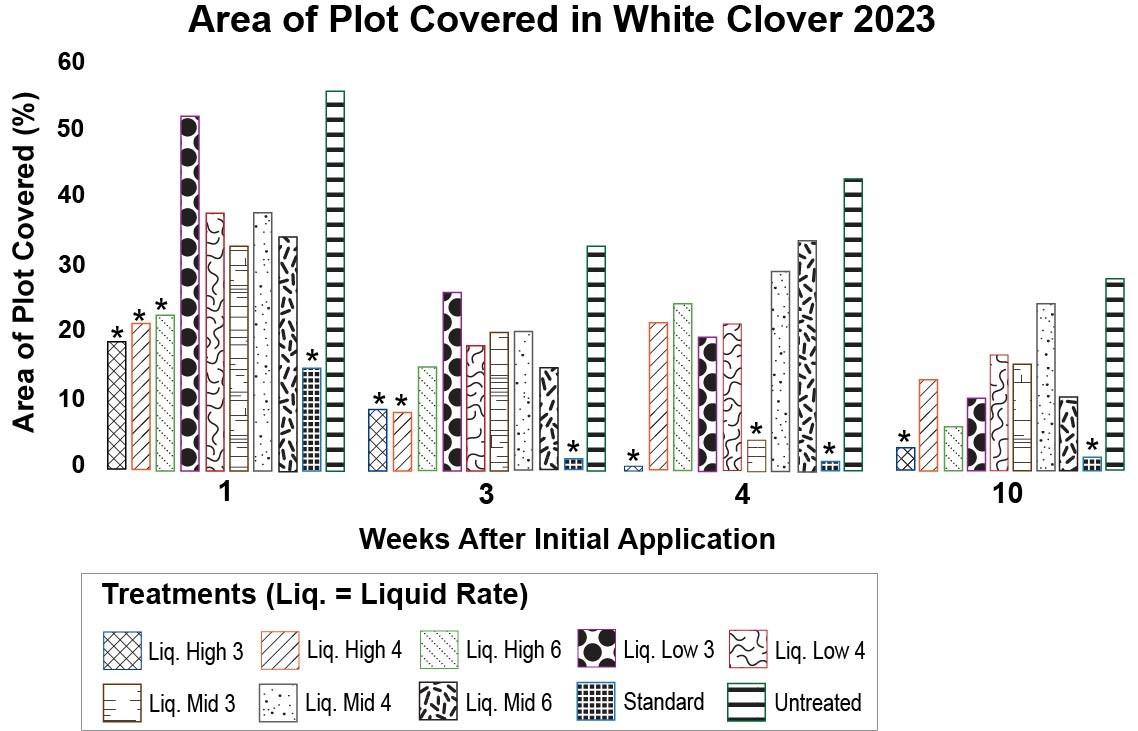
In 2023, the liquid Fiesta® applied at the high rate three weeks apart and the standard treatment provided similar control throughout the season (Figure 1). One week after the initial application, the high rate of Fiesta® and standard plots had 23% or less of the area covered in white clover, while the untreated plots had 57% coverage. At the end of the study (ten weeks after the initial application), the standard and the liquid Fiesta® applied at the high rate three weeks apart had two and three percent white clover coverage, respectively, while the untreated plots had 28% coverage. The liquid Fiesta® applied at the high rate six weeks apart had 7% of the plot covered in white clover, but it was not statistically different than the untreated. In 2024, there was not enough white clover present in the plots to rate. In 2025, plots had 1% to 23% white clover coverage three days after the initial application and 1% to 33% white clover coverage at six weeks (Table 2). No significant reduction in area of the plot covered was seen between treatments. SaferPlay® was not included in the 2025 data analysis due to missing data from one out of the four replications; however, in the three replications, the percent of the plot covered in white clover remained unchanged from three days to six weeks. The 2023 and 2025 applications were made in late summer and spring, respectively. In this study, better control was achieved with the late summer applications, which are closer to the most effective fall timing for white clover herbicide applications (Abbey, Delvalle, & Landschoot, 2025).
| Treatment | % Plot Covered in White Clover 3 Days | % Plot Covered in White Clover 6 Weeks | % Plot Covered in White Clover 7 Weeks |
|---|---|---|---|
| GranHigh0 | 3 | 3 | - |
| GranHigh3 | 2 | 1 | - |
| GranHigh4 | 2 | 1 | - |
| GranHigh6 | 1 | 2 | 1 |
| GranMid0 | 14 | 13 | - |
| GranMid3 | 4 | 4 | - |
| GranMid4 | 8 | 7 | - |
| GranMid6 | 15 | 22 | 16 |
| N | 24 | 33 | - |
| Standard | 8 | 2 | - |
| Untreated | 10 | 5 | - |
Large Crabgrass
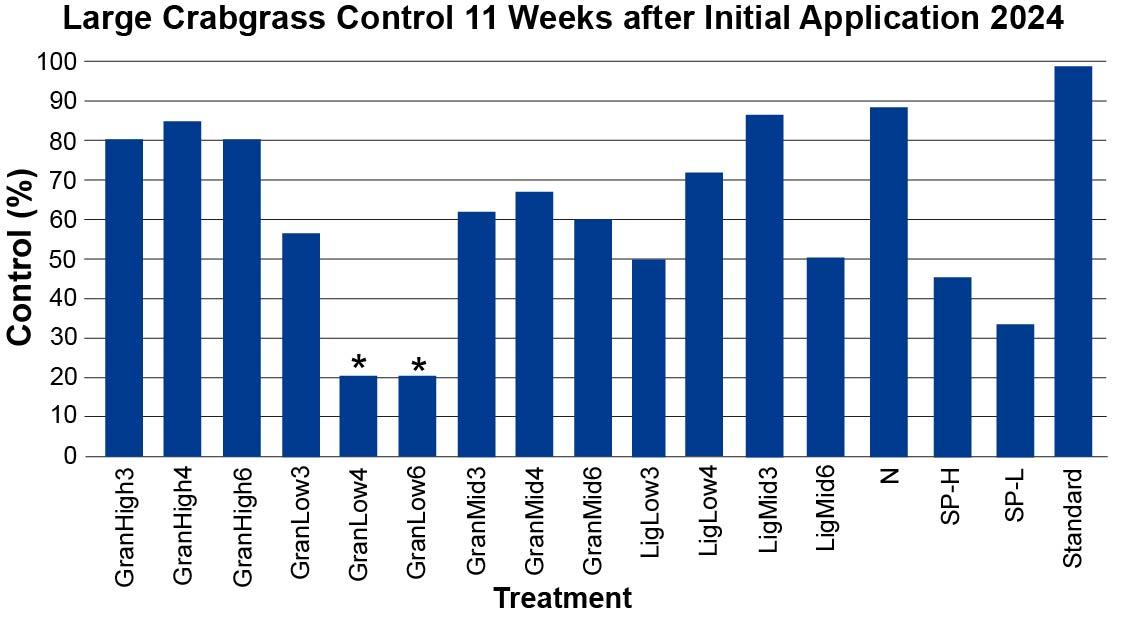
In 2023, applications were too late for effective control, and in 2025, there was minimal large crabgrass present (0-5% of the plot covered). Ratings were able to be taken in 2024. At the end of the season (11 weeks after the initial application on April 10, 2024), most Fiesta® treatments provided >60% control, similar to the standard (Figure 2). The granular formulation at the low rate applied 4 and 6 weeks apart provided 20% control, significantly less than the standard. Therefore, for effective large crabgrass control, the granular formulation needs to be applied at the higher rate or at shorter intervals if using the lower rate. SaferPlay® provided 33 to 45% control while nitrogen provided 88% control; however, these were not significantly different from each other or from the standard. Using sound cultural practices like proper soil fertility can assist with large crabgrass suppression. This also demonstrates that the nitrogen fertilizer in corn gluten meal is responsible for assisting with large crabgrass control, not the herbicide effects of the product.
Dandelion
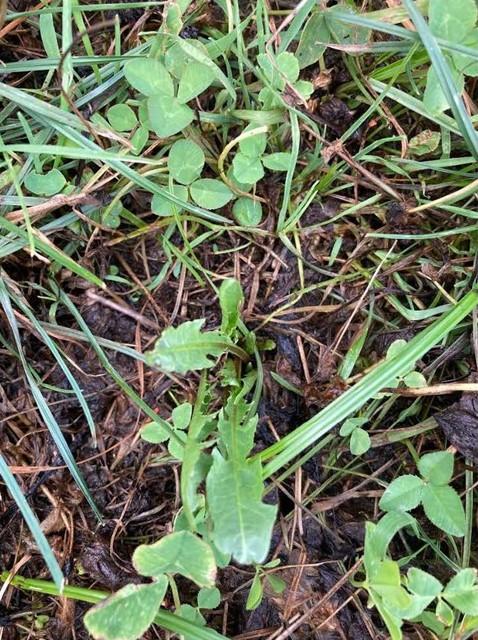
An adequate dandelion population was present in the plots in 2023 and 2025. In both years, all Fiesta® treatments provided an initial burn. This initial burn ranged from partial leaf injury to complete necrosis of all leaves on an individual plant. However, within one to two weeks, all dandelion plants regrew (Figure 3). This pattern of burn and regrowth is typical for a contact herbicide like Fiesta® on perennial weeds like dandelion. More than two applications at high rates would be needed to suppress or control dandelion.
Fertilizer Response
Both nitrogen and iron are nutrients that stimulate chlorophyll production and therefore deepen the shade of turfgrass. Chelated iron applications resulted in an initial rust-colored staining on the turfgrass, but the turfgrass grew out of it within one to two weeks. This staining was observed to occur more with the liquid formulation of Fiesta® than the granular formulation. To quantify mid- to late-season turfgrass color, visual response ratings were taken in 2024 and 2025 on a scale of one (yellow green) to five (dark green). Ratings of four or five would be appealing to most individuals. In 2024, the granular Fiesta® at the high rate provided more consistent green turfgrass compared to the low and mid rates of both the liquid and granular Fiesta®, as well as the nitrogen and SaferPlay® (Table 3). In 2025, the granular Fiesta® appeared to continue the trend of more consistent green turfgrass compared to the untreated; however, end of season ratings were not able to be completed.
| Treatment | Fertilizer Response Rating 5 Weeks | Fertilizer Response Rating 11 Weeks |
|---|---|---|
| GranHigh3 | 5* | 2.3 |
| GranHigh4 | 5* | 3* |
| GranHigh4 | 4 | 3.7* |
| GranLow3 | 4 | 2 |
| GranLow4 | 4 | 2 |
| GranLow6 | 3.3 | 2 |
| GranMid3 | 5* | 2 |
| GranMid4 | 5* | 2 |
| GranMid6 | 3.7 | 2.3 |
| LiqLow3 | 3.3 | 2 |
| LiqLow4 | 3.7 | 2 |
| LiqMid4 | 4.3* | 2 |
| LiqMid6 | 3.3 | 2 |
| N | 5* | 2 |
| SP-H | 4.7* | 2 |
| SP-L | 3.3 | 2 |
| Standard | 3 | 2 |
| Untreated | 3 | 2 |
Other Weeds
Fiesta® applications only provided a slight burn of plantain species leaves (broadleaf and buckhorn/ narrowleaf). Plantain species are perennial weeds and difficult to control with contact herbicides. A side study was conducted in the early spring of 2024 to determine the efficacy of Fiesta® on Japanese stiltgrass. Fiesta® was applied at the two-leaf stage and three weeks later. The mid and high rates of the liquid formulation, as well as the high rate of the granular formulation, were included. All applications of Fiesta® only burned the tips of the leaves.
Indian mock strawberry was present in 2025. The high rate of the granular formulation provided 22 to 56% control one week after the second application. Ratings could not be taken later in the season; however, control did appear to decline after this time, indicating that Indian mock strawberry is slower to regrow compared to dandelion and plantain.
Summary
The low rate of chelated iron as found in Fiesta® formulations, especially when applied four or more weeks apart, is too low to provide adequate weed control for white clover, large crabgrass, and dandelion. Higher rates and applications closer together (less than four weeks apart) are more effective. Spring applications on dandelion and plantain caused an initial burn with regrowth occurring within two weeks. More than two applications throughout the year, including in late summer, may be needed to control dandelion and plantain, perennial weeds with more carbohydrate storage in their taproots. Late summer applications of the liquid Fiesta® reduced the amount of white clover similar to the standard herbicide.
Even though products such as chelated iron show some efficacy and can have a place in a turf weed control program, there are challenges. In the professional lawn care industry, herbicide applications are typically made four to six weeks apart. While the higher application rates of chelated iron may fit into this window, applications made more frequently (e.g. three weeks apart) are not practical due to the large number of properties that lawn care companies manage. Cost is a limiting factor, too, as Fiesta® is $2.26 to $28.02 per 1,000 square feet more expensive than the standard treatments used in this study (Table 1). From a nitrogen fertilizer standpoint, SaferPlay® is $3.02 to $5.69 per 1,000 square feet more expensive compared to ammonium sulfate. To help balance the cost, especially for the liquid formulation of Fiesta®, spot spray applications could be made instead of broadcast applications.
Cultural weed management methods to ensure healthy and competitive turfgrass should not be overlooked, especially in situations with limited herbicide options. Applying fertilizer and lime based on soil test results, aerating, mowing no less than four inches, irrigation management, and overseeding areas with less-than-ideal turfgrass coverage, for example, will be vital to assisting with weed control.
Acknowledgements
The author would like to thank Dave Funk, Steven Holman, and Joe DeRico, the farm crew at the University of Maryland Paint Branch Turfgrass Research and Education Center. Thanks also to Neudorff North America for providing Fiesta® and financial support and Branch Creek Organics for providing SaferPlay®.
References
- Abbey, T., Delvalle, T., & Landschoot, P. (2025, October 28). Lawn and turfgrass weeds: White clover. Penn State Extension. https://extension.psu.edu/lawn-and-turfgrass-weeds-white-clover
- Lyons, E.M., & Watson, J.R. (2021). Pre- and post-emergent control of smooth and large crabgrass using Fiesta products in a cultivated area of soil. University of Guelph. https://hdl.handle.net/10214/27299
- Montgomery County, Maryland, Code §33B-2. (2015). https://codelibrary.amlegal.com/codes/montgomerycounty/latest/montgomeryco_md/0-0-0-143429
- Mont. Cty., Md., Code, §33B-10. (2015). https://codelibrary.amlegal.com/codes/montgomerycounty/latest/montgomeryco_md/0-0-0-143541
- Montgomery County, Maryland. (2026). Allowed Organic Pesticides. https://www.montgomerycountymd.gov/government/departments-agencies/department-environmental-protection/property-care/organic-lawns/pesticidelaw/allowed-organic-pesticides
- Neudorff North America. (2023). Fiesta USA fact sheet. https://www.neudorffpro.org/_content/resources/Fiesta%20USA%20sell%20sheet_web.pdf
- Smith-Fiola, D., & Gill, S. (2024, October 24). Iron-based herbicides. University of Maryland Extension. https://extension.umd.edu/resource/ironbased-herbicides/
This publication, Efficacy of Chelated Iron in Turf Weed Control (FS-2026- 0806), is a part of a collection produced by the University of Maryland Extension within the College of Agriculture and Natural Resources.
The information presented has met UME peer-review standards, including internal and external technical review. For help accessing this or any UME publication contact: itaccessibility@umd.edu
For more information on this and other topics, visit the University of Maryland Extension website at extension.umd.edu
University programs, activities, and facilities are available to all without regard to race, color, sex, gender identity or expression, sexual orientation, marital status, age, national origin, political affiliation, physical or mental disability, religion, protected veteran status, genetic information, personal appearance, or any other legally protected class.
When citing this publication, please use the suggested format:
Nichols, K.. (2026). Efficacy of Chelated Iron in Turf Weed Control (FS-2026-0806). University of Maryland Extension. go.umd.edu/FS-2026-0806.