
Effect of Downforce and Irrigation Management on Corn
Hemendra Kumar, PhD, Precision Agriculture Specialist
Central Maryland Research and Education Center, Upper Marlboro, University of Maryland
Donald L. Murphy, Facility Manager
Central Maryland Research and Education Center, Upper Marlboro, University of Maryland
Introduction
Precision downforce management techniques in corn planting stand as indispensable elements within contemporary agricultural practices, profoundly influencing the success and productivity of this pivotal crop. The increase in vertical loads on the row units is usually done by a system known as downforce. Accurate management of downforce plays a critical role in ensuring optimal soil conditions during planting, which directly impacts the consistent and proper placement of seeds at the required depth in the soil. The significance lies in striking the right balance: excessive downforce can lead
to the formation of compacted zones within the soil and lead to poor root development. Conversely, insufficient downforce can lead to inadequacies in planting depth, potentially compromising seed-to- soil contact essential for uniform germination and emergence. The implementation of advanced corn planting technologies for downforce management stands as a critical need for Maryland farmers aiming to enhance crop productivity and sustainability.
Irrigation plays a crucial role in improving crop yield by ensuring that crops receive adequate water at the peak growth stage. Proper irrigation helps maintain optimal soil moisture levels, promoting strong root development, efficient nutrient uptake, and improved photosynthesis, which collectively enhances plant health and yield potential. Crops under irrigation are better able to withstand environmental stresses such as heat and drought, leading to more uniform growth and higher productivity. In contrast, lack of irrigation or water scarcity can result in water stress, poor germination, stunted growth, and reduced nutrient availability, ultimately lowering crop yield. Severe water deficits during critical growth stages, such as flowering and grain filling, can significantly reduce yield quality and quantity. Therefore, managing irrigation effectively is essential to sustaining and maximizing crop production.
Objectives
The primary objective is to determine the effect of planter downforce and seeding rate with and with- out irrigation on crop yield potential. This initiative aims to empower farmers with innovative tools and data-driven insights that revolutionize planting techniques, fostering a more sustainable, efficient, and profitable agricultural sector in Maryland.
Materials and methods
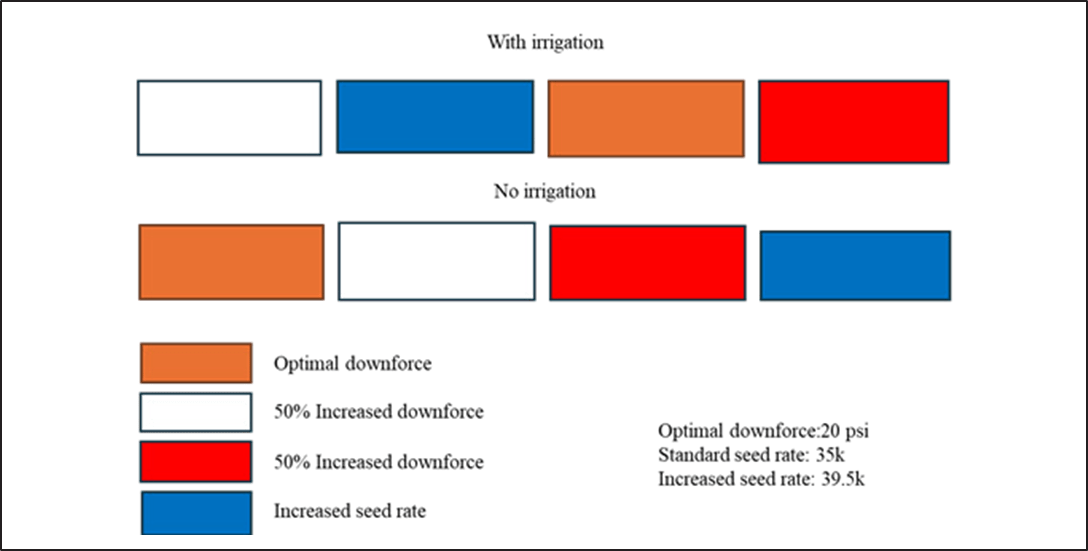
The study was conducted at the Central Maryland Research and Education Center (CMREC) Upper Marlboro of the University of Maryland. The study design was developed with four different treatments as shown in Figure 1. The optimal planter downforce (OD) was 20 psi for our controlled treatment, 50% increased planter downforce (ID) was 30 psi, and 50% decreased planter downforce (DD) was 10 psi. The standard seeding rate of 35 thousand was used in this study. The Increased Seeding Rate (ISR) of 39.5 thousand seeds with optimal downforce was the fourth treatment in this study. Each treatment was under irrigation and no irrigation scenarios (Figure 1). The corn was planted on 02 June 2024 and harvested on 18 October 2024. The row spacing for corn in this study was 20 inches, and each plot covered 0.03 acres.
Results
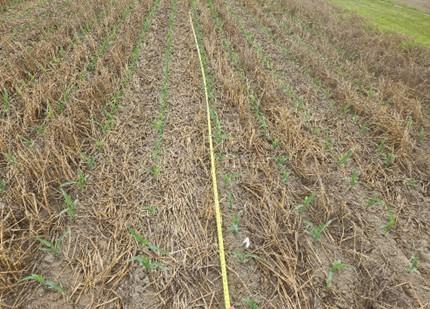
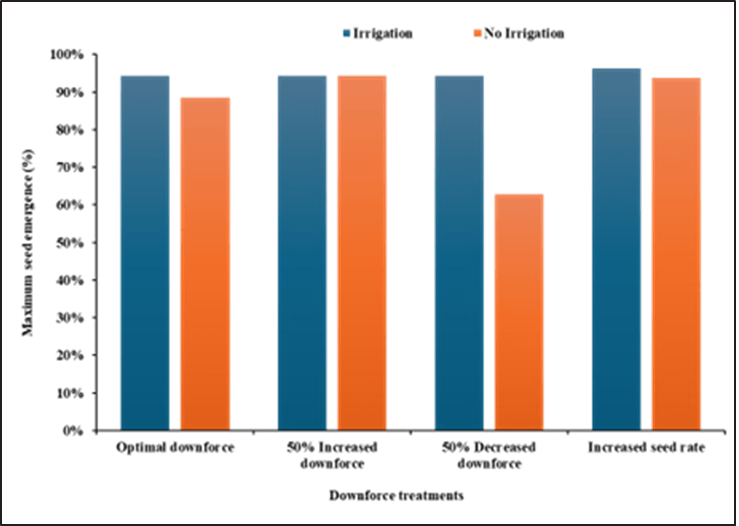
Effect of downforce and irrigation on emergence After the corn planting, the seed emergence counting was done until we found maximum emergence of the corn in the plots for each treatment. Multiple 26 feet long corn rows were selected randomly to count the plant emergence in each plot and extrapolated with the number of rows and length of the plots (Figure 2). On 10 June, 2024, the OD, ID,DD, and ISR had 94%, 91%, 89%, and 94% of emergence, respectively. In terms of the number of plants, OD, ID, and DD had 33,000, 32,000, and 31,000 emergences when planted at the rate of 35,000 seeds. However, ISR had the emergence of 37,000 when planted at the seed rate of 39,500. With the maximum emergence rate, the OD, ID,and DD had an emergence of 94%, and ISR had an emergence of 96% under irrigation conditions.
However, OD, ID, and DD had the maximum seed emergence of 89%, 94%, and 63%, respectively, without irrigation. Initially, on 10 June 2024, the emergence rate was similar in all the treatments under irrigation and no irrigation except DD. The DD had the lowest emergence rate of 49% without irrigation compared to 89% with irrigation. The decreasing downforce indicates the lower depth seed placement and reduced soil and seed contact to maintain the soil moisture, which could affect the emergence initially.
During the growing season, the emergence of no irrigation was always lower when compared to irrigation and without irrigation treatments. Corn requires maximum water during the critical growth stages, and inadequate irrigation during this period negatively impacts crop growth.
Effect of downforce and irrigation on the loss of seed emergence
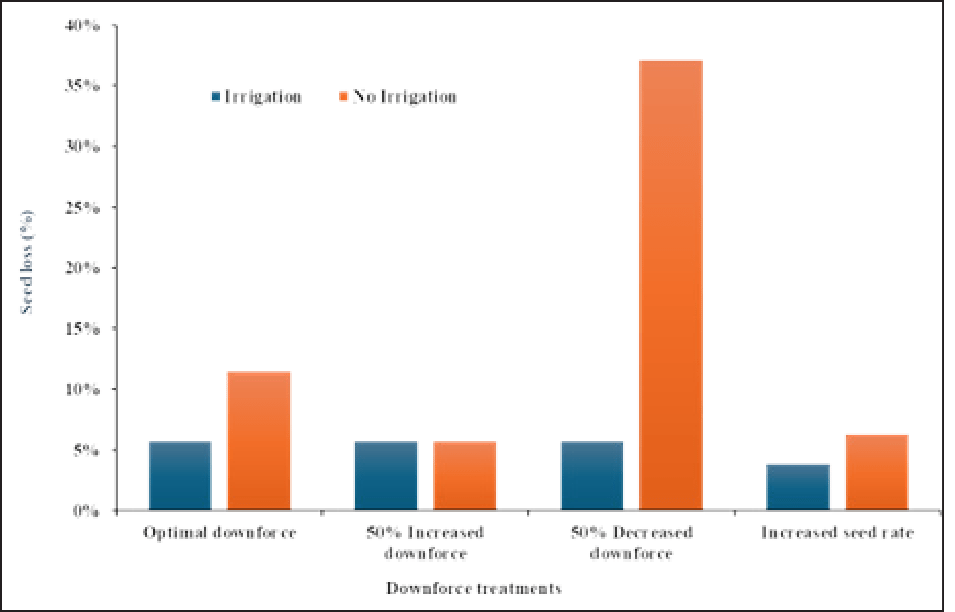
The effect of planter downforce and irrigation on seed emergence loss was evaluated under varying field conditions. Results indicated (Figure 5) that seed loss was consistently higher under non- irrigated conditions compared to irrigated conditions.Based on maximum emergence, OD, ID, and DD had a 6% seed loss and ISR had a 4% seed loss under irrigation. However, OD had an 11% seed loss, ID and ISR had a 6% seed loss, and DD had a 37% seed loss under no irrigation.
Effect on corn yield
Under irrigated conditions, the corn yield values (Figure 5) were relatively higher across all downforce strategies due to adequate soil moisture. The results demonstrated an interaction between downforce levels, seed rate, an irrigation status on final grain yield. Under irrigated conditions, the highest corn yield of 189 bushels/acre as observed with OD, indicating that properly adjusted downforce under sufficient soil moisture conditions promotes better
seed-soil contact and uniform seedling emergence, which enhances plant growth and yield potential. Under non-irrigated conditions, the impact of downforce on corn yield was more pronounced due to soil moisture limitations. Optimal downforce produced a yield of 126 bushels/acre,which was the highest among the treatments, indicating that balanced downforce under limited moisture conditions facilitates better seed-soil contact and root development without inducing excessive soil compaction.
Increased downforce under irrigation resulted in a lower yield of 179 bushels/acre, which may be attributed to soil compaction caused by excessive pressure, leading to restricted root development and reduced nutrient uptake. Increased downforce under non-irrigated conditions resulted in a sharp stressed conditions, where restricted root growth further exacerbates water uptake limitations.
Decreased downforce produced the lowest yield under irrigation (141 bushels/acre), likely due to inadequate seed-soil contact, resulting in poor germination and uneven crop establishment. Decreased downforce produced 111 bushels/acre under non-irrigated, which was higher than increased downforce but lower than optimal, suggesting that while reducing downforce minimizes compaction, it may lead to poor seed placement and uneven emergence.
At an increased seed rate, the yield improved to 181 bushels/acre under irrigation, suggesting that adjusting seeding density can partially compensate for suboptimal downforce settings by improving plant population. The increased seed rate under non-irrigated conditions resulted in a yield of 92 bushels/acre, reflecting the challenges of adjusting plant population under moisture stress, where increased competition for limited water and nutrients restricts overall yield potential.
Irrigating crops to meet their water demands at different growth stages is essential for maximizing crop productivity, especially for water-sensitive crops like corn during the growing season. Meeting irrigation water demand is crucial for sustaining corn growth and maximizing yield, particularly in regions with variable rainfall or limited soil moisture. Corn has high water requirements, especially during critical growth stages such as tasseling, silking, and grain filling, where daily water uptake can reach up to 0.70 cm. Water stress during these key phases can reduce leaf area index, and actual root water uptake, and decrease overall yield. Effective irrigation scheduling based on crop water needs ensures that water availability aligns with crop water demand, promoting optimal root development, nutrient uptake, and biomass accumulation. Therefore, adopting data-driven irrigation strategies tailored to crop-specific water demands is essential for maximizing corn yield along with downforce management.
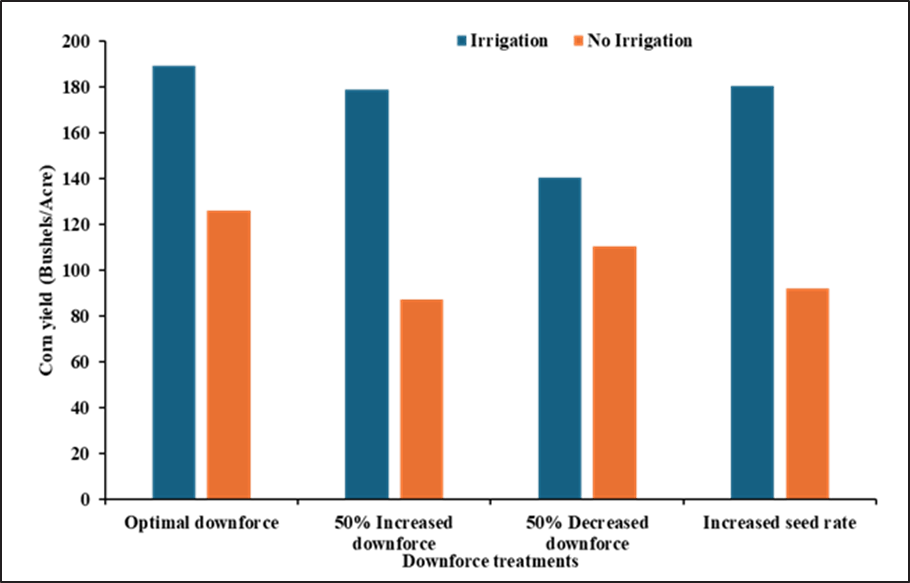
Figure 5. Corn yield variation due to downforce management
Conclusion
These findings underscore the importance of optimizing downforce settings based on soil moisture availability to maximize seed-soil contact, improve crop establishment, and enhance yield potential. Under irrigated conditions, increased downforce can be partially tolerated due to sufficient moisture availability, whereas under non-irrigated conditions, excessive downforce exacerbates soil compaction, leading to reduced root development and impaired nutrient uptake, ultimately limiting yield potential.
Acknowledgment
The author extends sincere gratitude to the Facility staff and his dedicated team for their exceptional support in conducting this study.