
Don’t Let Alfalfa Weevil Sneak Up on You This Spring
By Hayden Schug, UMD Extension, Charles County
Alfalfa weevil is one of the key early-season pests to watch in Maryland alfalfa. While populations can be kept in check by natural enemies, outbreaks can still occur and cause significant damage if not caught early.
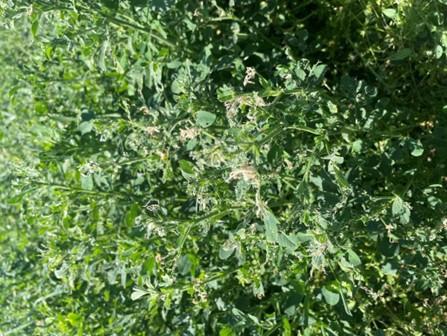
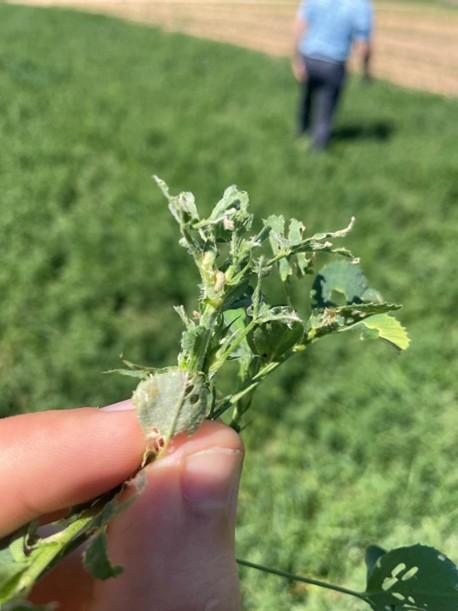
Larvae are the damaging stage of this pest and feed on developing leaves, starting as small pinholes and progressing to skeletonized foliage. As feeding increases, fields can take on a gray or dull appearance. Most of this damage occurs leading up to and during the first cutting, and heavy pressure at that time can reduce both yield and forage quality.
Scouting is critical for managing alfalfa weevil. Populations can build quickly, and fields can go from light feeding to heavy damage in a short period of time. Begin scouting now and continue weekly until the first harvest. Early detection is especially important in years with mild winters when activity can start earlier than expected.
The best way to determine if treatment is needed is by sampling stems using the bucket method. Walk the field and randomly collect about 30 stems, cutting or breaking them at the base. Be gentle so as not to dislodge any larvae before putting them in the bucket. Place the stems upside down into a bucket and shake or beat them against the sides. Count the number of larvae collected and compare that to plant height and growth stage to determine if populations are approaching threshold levels. This method gives a much better estimate than sweep netting alone and helps guide management decisions.
| Stand Height (inches) | Indication of Problem (% tip feeding) | Problem Confirmation (larvae per stem) | Recommended Action |
|---|---|---|---|
| 6 | 25 | 1 | Recheck in 7 days |
| 9 | 50 | >1 | Spray |
| 12 | 75 | >2 | Spray or Harvest |
| 16 | 100 | >4 | Harvest Early |
If thresholds are exceeded (Table 1), early harvest can be an effective control option if the crop is close to cutting. If not, an insecticide application may be needed. Steward (Indoxacarb) is one option that can provide a good knockdown of alfalfa weevil. It is typically more expensive than our pyrethroids, but it has better efficacy. As always, follow label directions.
The key takeaway is to stay ahead of this pest. Regular scouting and proper sampling are the best tools to prevent yield and quality losses. If you would like to read more about alfalfa weevil, you can find additional information here: https://extension.umd.edu/resource/alfalfa-weevil-fs-1096/
This article appears in April 2026, Volume 17, Issue 1 of the Agronomy News.