
When farmers think about pest management, insects are typically the focus. Yet there are other species to consider, like meadow voles, and other small rodents that cause significant damage to crops, ornamental plantings, and horticultural plots.
Thankfully, Mother Nature has already offered a powerful solution. At the University of Maryland’s Central Maryland Research and Education Center (CMREC) in Clarksville, researchers are demonstrating how birds of prey can become valuable partners in integrated pest management while advancing wildlife conservation.
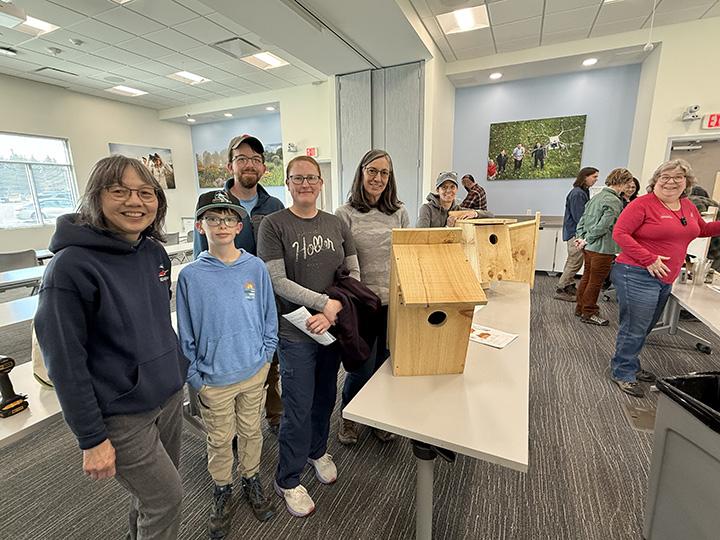
Through a partnership with the Maryland Farmland Raptor Program, and the Howard County Bird Club (a chapter of the Maryland Ornithological Society,) CMREC hosted a hands-on conservation workshop focused on supporting two species of farmland raptors that are declining statewide: American kestrels and barn owls. The event combined education, nest box construction and implementation, and field demonstrations, highlighting how properly managed habitat can benefit both farmers and wildlife.
“If we can play a role in supporting American kestrel and barn owl population recovery, it could also potentially support our integrated pest management efforts,” said Dr. Stacy Small-Lorenz, residential landscape ecologist at CMREC, who believes this type of conservation work can support practical farm management. “Raptors do a great job of keeping the rodents in check.”
The numbers are impressive. A barn owl family can consume approximately 3,000 to 4,000 rodents in a single year, with meadow voles making up much of their diet. A family of American Kestrels can eat more than 500 small rodents annually. Those natural predators can help reduce rodent populations in fields without relying on chemical controls.
Small-Lorenz encourages people to reconsider the widespread use of rodenticides. “If we’re poisoning those rodents, then we’re potentially poisoning their predators as well,” she said. “When we start thinking about relationships—the wider web of life—it can start to influence our decision-making and land stewardship ethic.”
Taking that perspective, she hopes farmers and gardeners will come to view raptors as valuable allies. “We can be thoughtful caretakers of ecosystems and benefit in the process,” she said. “I’m hoping we can help to shift people’s first reaction from ‘How do I kill it?’ to ‘How is this organism important in the greater scheme of things, and how can I support its habitat in ways that benefit humans and other wildlife?’”
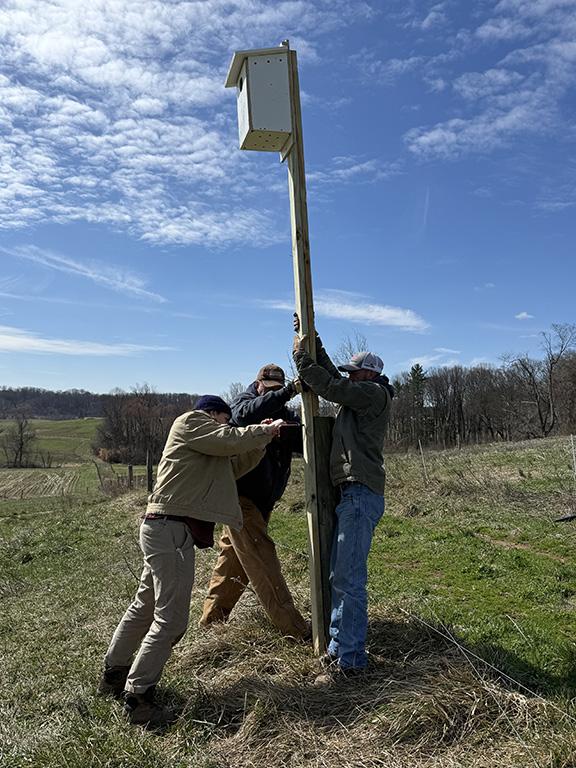
Small-Lorenz emphasizes that nest boxes should not be installed casually. Successful conservation requires proper design and placement, ongoing maintenance, and scientific monitoring. CMREC plans to monitor occupied nests using a small, pole-mounted camera and contribute observations to Cornell University’s NestWatch database while working with the Maryland Farmland Raptor Program to band chicks and collect valuable population data, once the boxes are occupied by target species.
She advocates creating landscapes that support biodiversity by conserving or restoring habitat features such as native meadows and open fields that serve as hunting grounds for the birds and tree cavities that provide natural nesting sites near hunting grounds.
CMREC is working to address both needs. Along with installing new nest boxes, Small-Lorenz has worked with volunteers and CMREC faculty and staff to establish a native demonstration meadow that provides potential vole-hunting habitat, while supporting pollinators and other beneficial insects. Those meadows, combined with nearby agricultural fields and wetlands, create promising conditions for kestrels and potentially barn owls.
“It’s kind of a new thing at CMREC Clarksville, and I think it’s a good way to connect Marylanders to opportunities for farmland raptor conservation on their land,” said Small-Lorenz. “I want our research and education centers to be go-to places to see all types of habitat conservation practices in action on a working farm that’s embedded in an increasingly suburban landscape.”
For her, the project represents more than bird conservation. It demonstrates how thoughtful land stewardship can strengthen agricultural productivity while restoring ecological balance. “We need food, the raptors need food—it’s a win-win situation, if we go about it the right way,” she said.