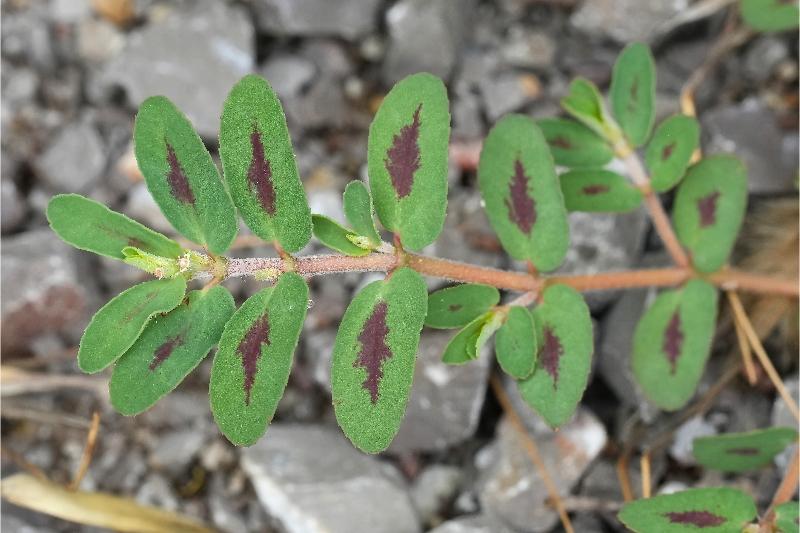
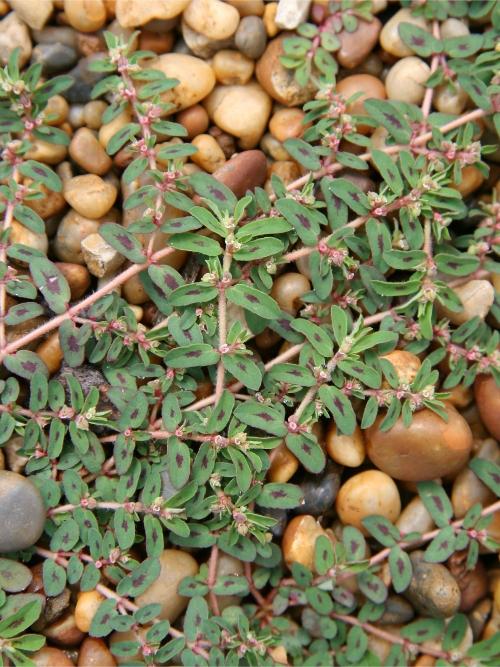
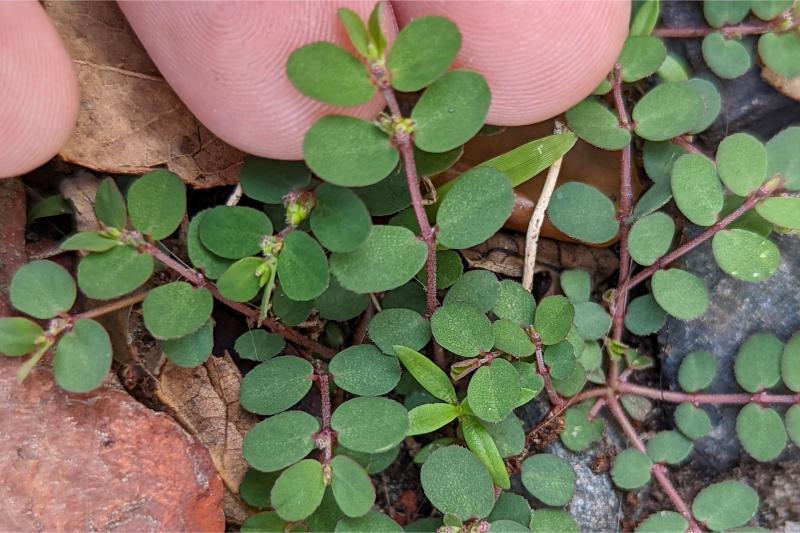
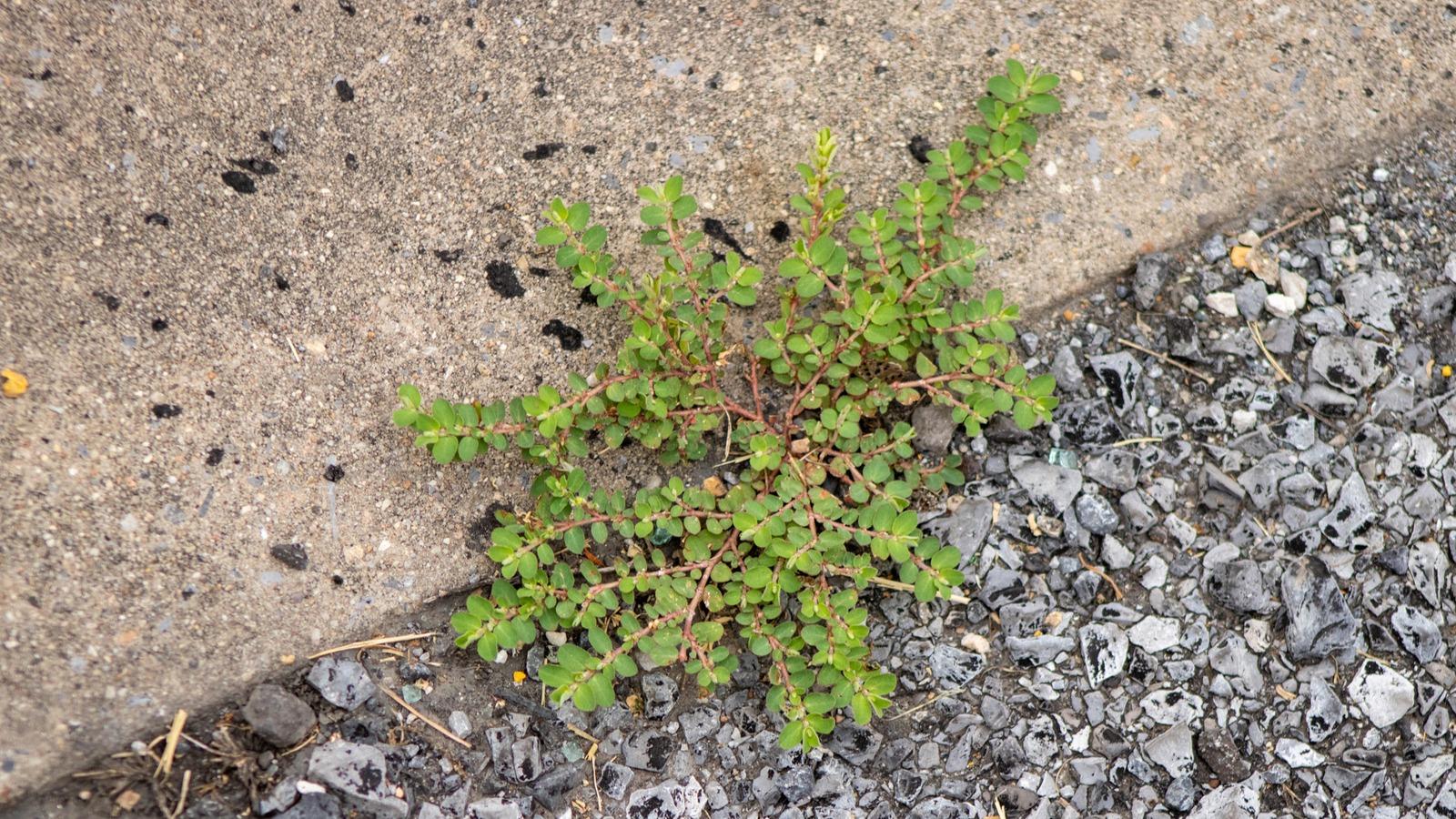
A prostrate spurge plant with small, green, paired leaves, rooted into the crevice between pavement and a sidewalk. Sprawling stems are radiating out from the center of the plant.

Prostrate spurge growing in a crevice between two adjoining types of pavement. Spotted spurge has the same growth habit and favors the same site conditions. Photo: Ian Wolfe, no rights reserved, iNaturalist.org.

Updated: November 11, 2026

Prostrate spurge, also called spotted spurge and spotted sandmat (Euphorbia maculata, formerly Chamaesyce maculata), is a common native species found throughout Maryland.

Around two dozen Euphorbia species occur in Maryland, roughly half of them non-native. Another species sharing the common name of prostrate spurge (Euphorbia prostrata, also called prostrate sandmat) may be confused with spotted spurge due to its similar growth habit and leaf shape. However, Euphorbia prostrata appears to be far less abundant in Maryland, so is less likely to be encountered as a lawn and garden weed. In either case, the management options for both plants are the same.

Identification

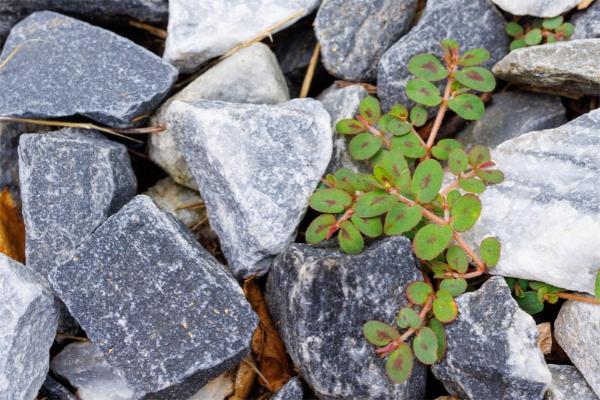
  • Growth habit: prostrate and sprawling, only a few inches tall; can become about 15 inches wide
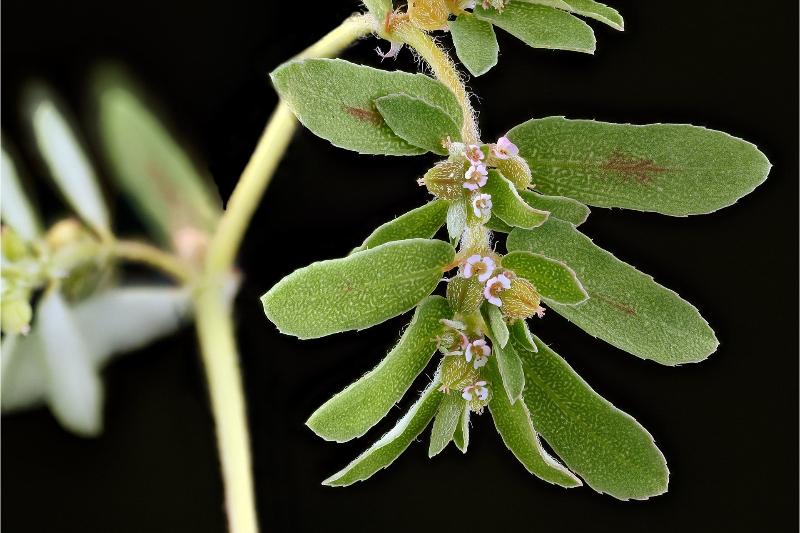
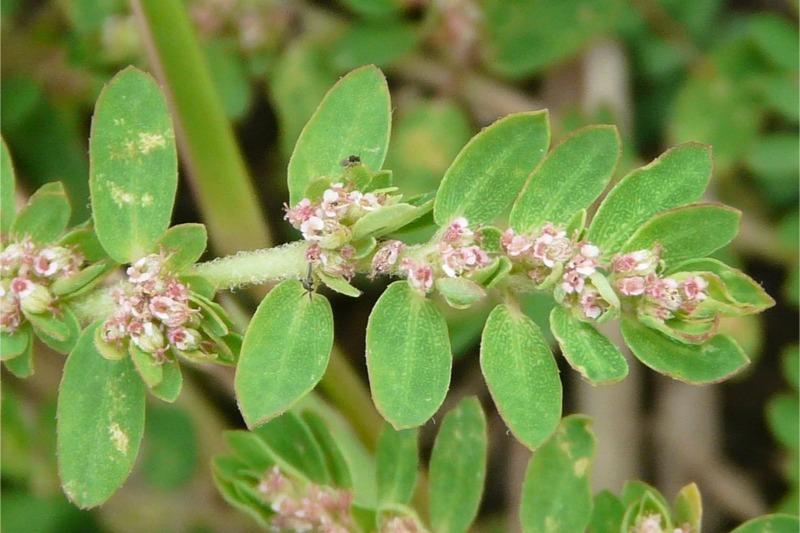
  • Flowers: miniscule and inconspicuous; pinkish-white; arise from leaf axils (where a leaf attaches to the main stem) near the stem tips
  • Leaves: oval or oblong, with mostly entire margins (they do not have lobes, serrations, or scallops along their edges), although subtle teeth may be present near the tips of the leaves
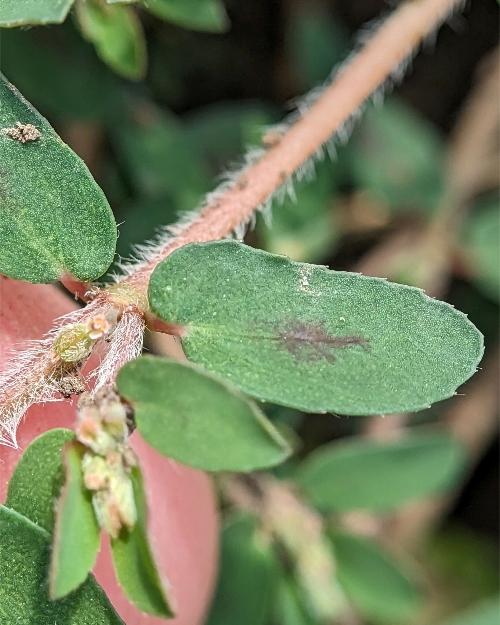
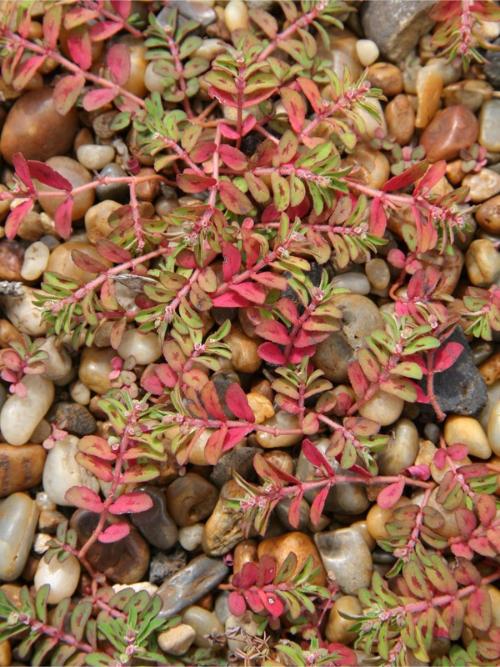
    • usually has a reddish blotch in the center of the leaf, although this is not a reliable trait and spotless leaves are common; the hairy leaf undersides may be maroon or pale, or the entire leaf surface can turn reddish
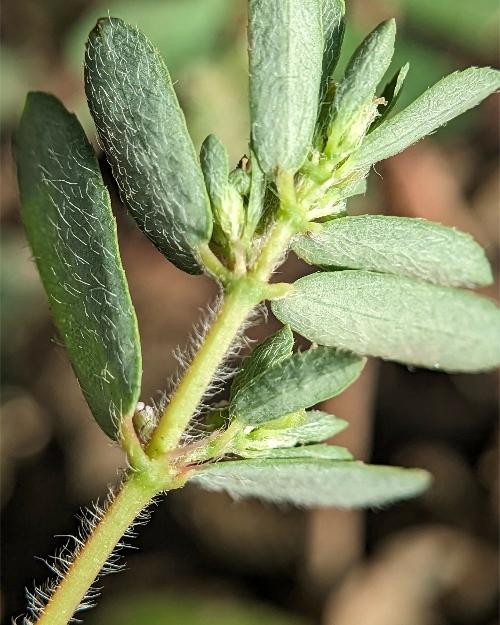
    • very short petiole (stalk attaching the leaf to the stem)
    • opposite leaf arrangement (pairs of leaves attach to the stem directly across from each other)
  • Stems: densely hairy (appearing somewhat felted) and often pinkish in color
    • ooze a milky-white, latex-like sticky sap when broken
    • do not root at the nodes (where leaves join the main stem), unlike some sprawling weeds

Similar species

Spreading sandmat (Euphorbia humistrata, also called spreading broomspurge or ground spurge), a native species which confusingly also can share the common name of prostrate spurge, has similar features to spotted spurge, but its stems root at the nodes. It does not appear to be as widely distributed across Maryland as spotted spurge.

Prostrate spurge (Euphorbia prostrata), native in North America but not within Maryland, also appears to have a limited presence in the state. Its leaves are more rounded than those of spotted spurge and do not have a dark spot, although that trait by itself is not always a reliable way to distinguish spotted spurge. Prostrate spurge leaves are more crowded on the stem in terms of spacing than with spotted spurge. Like spotted spurge, prostrate spurge stems do not root at the nodes.

A few other spurge species may look superficially similar to spotted spurge, but they have an upright growth habit and will not sprawl along the ground. Other small-leaved creeping weeds will not have the milky sap seen when a spurge stem is broken.

Life cycle and reproduction

Prostrate spurge is a summer annual: seeds primarily germinate in spring, the plants grow and bloom in summer, and ripen seeds prior to dying by autumn. Annual plants have a one-year life cycle.

Prostrate spurge blooms from late spring or early summer through early autumn. This species spreads by seed, which are flung a foot or two from the seed that bursts pod when ripe. Germination can begin later in the growing season than other summer annual weeds and continue into the summer, although seedlings mature quickly and are capable of producing seed themselves only about a month after sprouting.

Conditions that favor growth

Most often noticed on exposed sites like atop gravel mulch or along driveway seams or edges, prostrate spurge favors sunny, dry areas with little competition. It handles drought well and tolerates sandy, nutrient-poor soil. It more easily out-competes turfgrass in areas of low soil nutrients, such as under-fertilized lawns with insufficient nitrogen. It can also grow in areas with little to no mulch and exposed soil, or in compacted soil like in the joints between walkway pavers.

Prostrate spurge management in lawns

General lawn care practices that discourage weeds

Maintain healthy, dense turf that can compete with weeds and prevent weed germination and establishment. Fertilize the lawn as recommended (based on season and turf type), mow high, and overseed cool-season lawns each autumn to keep the lawn dense and better able to crowd-out seedling weeds. Core-aerate to reduce soil compaction. Learn about fertilizing, mowing, overseeding, and aeration in the resource: Maintaining an Established Lawn.

Lawn care and maintenance

Mechanical management

Remove prostrate spurge plants (including the central, short taproot) by hand or with a manual weeding tool. Doing this when the soil is moist makes the task easier. Pulling up or digging out individual plants is a viable option at the beginning of an infestation (when the plants are not yet abundant) and for young spurge plants. The latex-like sap may cause skin irritation: use gloves when hand-weeding and do not get the sap in your eyes.

Manage Weeds Without Chemicals

Chemical management

Herbicide use should always be a last resort when managing weeds. Check for any local pesticide restrictions before buying and applying a product. For example, the Montgomery County pesticide law does not allow most synthetic pesticides (which includes herbicides) to be used on lawns. The active ingredient glyphosate is also prohibited on lawns in Baltimore City.

Learn about herbicide classifications and terminology:

Herbicide Options for Managing Common Lawn Weeds

Post-emergent herbicide

Spot-treat individual prostrate spurge plants or infested areas with a liquid broadleaf herbicide applied when the weeds are actively growing. Look for a product with one or more of the following active ingredients: 2, 4-D, MCPP (mecoprop), dicamba, or triclopyr. An application of non-selective herbicide may work, but would also damage any turfgrass exposed to the herbicide.

CAUTION: Do not spray herbicides containing dicamba over the root zone of desirable trees and shrubs. Roots or leaves may absorb this ingredient and be substantially damaged. Refer to the product label for other precautions.

References

Del Tredici, P. (2010). Wild Urban Plants of the Northeast: A Field Guide. Comstock Publishing Associates.

Neal, J.C., Uva, R.H., et. al. (2023). Weeds of the Northeast. (Second edition.) Comstock Publishing Associates.

Still have a question? Contact us at Ask Extension.