
Planting Date Impacts on Double Crop Soybean Yield Much Clearer than Full Season Soybean Yield
By Nicole Fiorellino, Extension Agronomist
Recent research performed in Maryland and Delaware (Miller et al., 2025) demonstrated unclear benefits of early planting of full season soybeans. There are many factors besides planting date that occur throughout the growing season that can impact yield, so it is not expected to see a strong relationship between planting and crop yield, in general. In the Southeastern US, early planting of full season soybeans typically extends the vegetative growth period of soybeans, which means more nodes per plant which equals more pods per plant which equals more seeds per plant and higher yield. In the Southern region, there is less risk of early season weather volatility and pest pressure compared to the Mid-Atlantic region – so fewer occurrences of problems throughout the season that are likely to decrease yield. Our early season weather volatility in the Mid-Atlantic is likely why Jarrod Miller and I were unable to demonstrate consistent yield increase with early planting of full season soybeans in our research. However, as some parts of the state are still working through wheat harvest and double crop soybean planting, I want to highlight regionally-collaborative research carried out by my predecessor, Dr. Bob Kratochvil, that demonstrates the clear benefits of early planting of double crop soybeans, or rather, the penalties of delaying double crop soybean planting.
This article, Early high-moisture wheat harvest improves double-crop system: II. Soybean growth and yield, published in 2020, includes multiple site years of data from Pennsylvania, Maryland, Delaware, Virginia, and North Carolina evaluating double crop soybean yield impacts of planting date, from early June through the end of July. Figure 2 in the publication (and reprinted here) shows a clear decrease in relative yield as planting date is pushed later into June and July for all the locations of the study. For the Maryland data, the R2 is 0.81, meaning that planting date explains 81% of the variability in relative yield across planting dates. Research in other areas of the country have indicated that planting date of double crop soybeans is an important factor in determining yield – likely due to the shortened growing season when soybeans are grown in double crop systems. To maximize the success of your double crop systems, focus on timely harvest of small grains and timely planting of double crop soybeans.
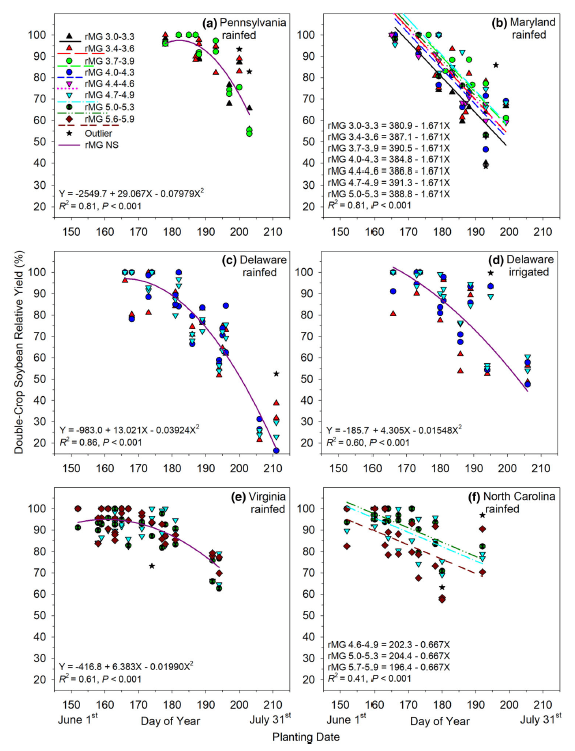
A direct quote from the paper: “In Maryland, soybean yield was decreased 1.7% per day of delay (for a total of 56%) in planting from 15 June to 18 July regardless of soybean maturity group. In Delaware, planting date affected soybean yield from the first day of planting under both rainfed and irrigated conditions and there was a total 80% yield loss from 15 June to 30 July planting under rainfed conditions and 55% yield loss from 15 June to 25 July planting under irrigated conditions.”
This article appears in July 2026, Volume 17, Issue 4 of the Agronomy News.