
Keep an Eye Out for Fall Armyworm
By Hayden Schug, Agriculture Agent, University of Maryland Extension, Charles County
As we move into July, growers should keep an eye on corn fields for fall armyworm. Most of Maryland's fall armyworm population does not overwinter here, just like the corn earworm. Instead, moths mostly migrate north each summer from southern states, with most economically important infestations typically beginning in late June and continuing through the remainder of the growing season. While infestations vary from year to year, late-planted and silage corn are at the greatest risk for economic injury, and it is usually not an economic concern for field corn.
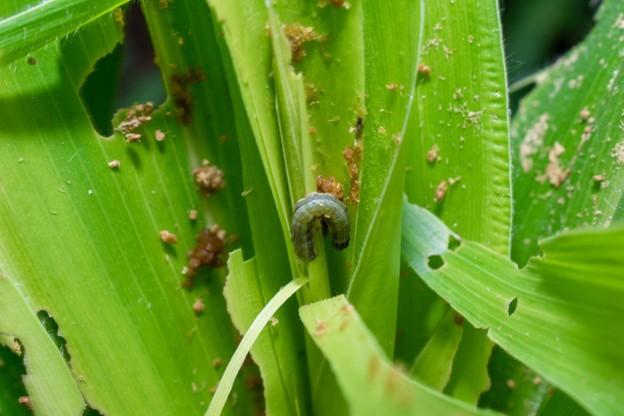
Female moths lay egg masses on leaves, and newly hatched larvae initially feed on leaf surfaces before moving into the whorl, where they are protected from predators and insecticide applications. As larvae grow, feeding produces the characteristic ragged holes and shredded leaves that become visible after the whorl unfurls. Heavy infestations can leave plants looking as though they have been damaged by hail. However, it will not be even throughout the stand and will likely be clustered. Large amounts of frass in the whorl and on the leaves are another key sign of fall armyworm feeding activity.
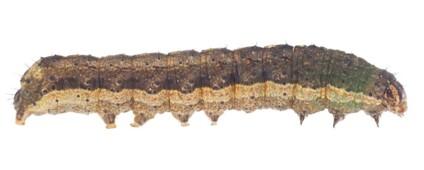
One of the easiest ways to identify fall armyworm is by examining the head capsule. Mature larvae have a distinct white/light yellow, inverted Y marking on the head. During the day, larvae typically remain hidden within the whorl, so fields showing fresh feeding injury should be inspected carefully for live caterpillars. You can do this by pulling back the leaves and inspecting where they attach to the stem. You can pull out the top leaf to see if larvae are actively eating inside the whorl.
Although corn can tolerate a fair amount of leaf feeding, especially in the reproductive stage, significant injury can occur when larvae feed on young vegetative plants or damage the growing point. Once larvae become large, they are more difficult to control because they remain protected within the whorl, especially during typical spraying hours. For this reason, timely scouting is critical. Clemson recommends considering treatment when approximately 25% of plants are infested with larvae in whorl-stage corn. Applications are most effective against small larvae and should be directed into the whorl whenever possible.
Several insecticides provide good control of fall armyworm when applications are made early in the infestation. Products containing chlorantraniliprole (IRAC Group 28) generally provide excellent residual control, while several pyrethroid products can also be effective on smaller larvae, although this is becoming less effective.
Regular scouting over the next several weeks will be the best defense against fall armyworm. Fields planted later than normal, or those still in vegetative growth, should receive particular attention as moth migration into the region continues through the summer.
This article appears in July 2026, Volume 17, Issue 4 of the Agronomy News.