

FS-2026-0803 | May 2026
Guide for FAA Part 107 Certification and Drone Registration
By Rashmi Sahu, Faculty Assistant, Digital and Precision Agriculture Lab, AgFS, University of Maryland Extension; Dr. Hemendra Kumar, Precision Agriculture Specialist, Digital and Precision Agriculture Lab, University of Maryland Extension; Dr. Andrew Ristvey, Extension Specialist, Commercial Horticulture, University of Maryland Extension; Dr. Luke Macaulay, Wildlife Management Specialist, University of Maryland Extension; Stanton Gill, Former Extension Specialist, IPM Entomology, University of Maryland Extension
Introduction
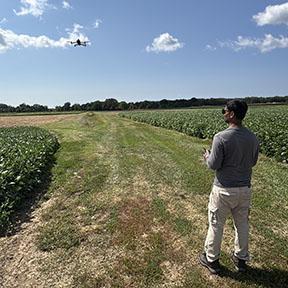
Federal Aviation Administration (FAA) Part 107, part of the FAA Code (14 CFR Part 107), was created to regulate the commercial use of drones. It provides rules for remote pilots who operate drones for purposes other than for recreation, such as photography, inspections, or agricultural work. To operate under Part 107, individuals must pass an aeronautical knowledge test and obtain a remote pilot certificate. This certification helps to ensure safety, to prevent accidents, and to protect people, property, and aircraft. It also ensures legal compliance, since it is illegal to fly a drone commercially without Part 107 certification, and it standardizes drone regulations across the United States.
Certified pilots are responsible and understand airspace regulations, weather, emergency procedures, and safety procedures. A Part 107 certificate allows the operator to conduct aerial photography, infrastructure inspections, crop monitoring, soil surveys, and emergency relief operations. This certification provides legal authorization, enhances professional credibility, and creates business opportunities. It also allows the operator to access restricted airspace with FAA approval and the ability to apply for waivers for advanced operations, such as flying at night or beyond visual line of sight. Overall, FAA Part 107 ensures that commercial drone operations are safe, legal, and professional.
Step-by-step process for obtaining a Part 107 certification
This section describes the process for obtaining an FAA Part 107 Remote Pilot Certificate. It begins with the eligibility requirements and the preparation needed to pass the FAA Knowledge Test, which assesses understanding of airspace, regulations, and safe UAS operations. The section then explains how to submit the application and receive FAA approval. It also highlights the responsibilities of remote pilots once certified, including adherence to operational rules and safety protocols. Finally, it provides guidance on maintaining compliance to ensure lawful and responsible drone operations.
Step 1: Meet the Basic Requirements
Applicants should:
- be a minimum of 16 years old.
- possess the ability to read, write, speak, and comprehend the English language, and
- maintain good physical and mental health to operate a drone safely.
These requirements ensure that the operator has the foundational skills and health to fly responsibly and adhere to FAA regulations.
Step 2: Create an FAA Tracking Number (FTN)
An FAA Tracking Number (FTN) is required to track your certification process. Obtain it by registering on the Integrated Airman Certification and Rating Application (IACRA) website at iacra.faa.gov. This unique number connects the operator’s test results, application, and certificate within the FAA system throughout the Part 107 process.
Step 3: Schedule the Part 107 Test
After getting FTN, the applicant needs to schedule the Part 107 knowledge test, known as the Unmanned Aircraft General (UAG) exam. The test can be taken at any FAA approved Knowledge Testing Center across the country. Applicants can schedule the test at PSI Exams (https://faa.psiexams.com/faa/login). The test fee is typically around $175, and scheduling in advance allows applicants to choose a convenient location and date for taking the test.
Step 4: Study for the Test
The knowledge Test includes 60 multiple-choice questions in the following areas: airspace rules and classifications, Part 107 regulations, weather effects, drone performance and loading, emergency procedures, and crew resource management. Applicant will need a score of at least 70% (42 correct answers) to pass. Resources for studying for the test are included in the “Online Study Resources” section below.
Step 5: Take the Test
On the day of your FAA Part 107 Knowledge Test, applicants must bring a valid government‑issued photo ID to the testing center, where the exam is administered electronically on a dedicated computer workstation provided by the center; applicants do not need to bring their own device, and the test is monitored and proctored by testing staff. The exam consists of 60 multiple‑choice questions and must be completed within two hours. Preliminary results are typically available immediately upon completion at the testing center, and official results are uploaded to the FAA system shortly thereafter for use in the certificate application process. If an applicant does not pass, they may retake the test after a 14‑day waiting period, must schedule a new appointment, and pay the test fee again; there is no FAA‑imposed limit on the number of attempts. This process ensures that candidates have adequate time to review areas of weakness before their next attempt.
Step 6: Apply for the Certificate
Once the applicant passes the test, the next step is to apply for the Remote Pilot Certificate through IACRA. Log in with FTN and complete the official Remote Pilot Certificate application (FAA Form 8710-13). The test results are automatically linked to the individual application to verify the scores and process the certificate.
Step 7: Await Results of a TSA Security Background Check
After submitting the application, the FAA forwards it to the Transportation Security Administration (TSA) for a security background check to confirm the operator’s eligibility. If the operator passes the TSA review, the individual will receive a temporary certificate via email, usually within 1-3 weeks, which allows the operator to fly drones commercially while waiting for the permanent certificate.
Step 8: Receive Your Permanent Certificate
The FAA will send the permanent plastic Remote Pilot Certificate to the operator by mail within 6–8 weeks. The certificate is the operator’s official proof that they are authorized to fly a drone as a remote pilot for commercial purposes under the rule outlined in Part 107. Remote pilots must carry their certificate during flight operations and be prepared to present it to an FAA inspector, law enforcement officer, or authorized representative upon request.
FAA Drone Registration
After obtaining a remote pilot certificate under FAA Part 107, the next step is to ensure that the aircraft itself is compliant with federal requirements. Regardless of certification status, drones meeting applicable weight or operational criteria must be registered with the FAA before operation. Most drones weighing between 0.55 and 55 pounds need to be registered with the FAA before flying in the United States. The purpose of registration is to identify the owner of the drone and help ensure safe flight. To register, visit the FAA Drone Zone website at faadronezone-access.faa.gov. Create an account, enter the name of the drone owner, address, and e-mail address, and pay a $5 fee. Drone registration through the FAA Drone Zone is valid for three years. While one registration number may cover multiple recreational drones owned by the same individual, each aircraft in commercial operations must be registered separately. Once the registration is approved, the owner will receive a unique registration number that has to be placed on the drone. Both recreational and commercial drones must be registered, and commercial pilots also need to follow Part 107 rules. Flying without registration can result in fines up to $27,500.
Remote ID requirement: If the drone does not have a Remote ID included, one must be attached to the drone for legal flying. Remote IDs are available online for approximately $35.
Agricultural Sprayer Drones
To use a drone for agricultural spraying, a remote pilot must have both an FAA Part 107 license and a Part 137 certificate. Part 137 covers the safety and environmental rules for applying agricultural chemicals, similar to crop-dusting regulations. If the drone weighs more than 55 pounds, the remote pilot will also need a Part 137 exemption to show it meets FAA safety standards. In addition to federal rules, most states require a commercial aerial applicator license, which may involve training, an exam, field demonstrations, knowledge of environmental regulations, and insurance. Overall, these FAA and state requirements ensure agricultural drone spraying is done safely, legally, and responsibly. The remote pilot must submit an application to the FAA describing the proposed operation, including the intended use of the UAS, the chemicals or materials to be applied, and the area and scope of the operation. The application must also demonstrate compliance with applicable safety requirements, including procedures for handling and storing materials and measures to prevent environmental contamination. After reviewing the application, the FAA may conduct an on-site inspection to verify that all safety requirements and operational procedures are met. If the applicant is found compliant, the FAA will issue an Agricultural Aircraft Operator Certificate, authorizing the remote pilot to conduct aerial agricultural operations with a UAS in accordance with federal regulations.
Resources
Disclaimer: Please note that the mention of or the reference to a service or organization in this section does
not imply endorsement by the authors. The exclusion does not imply a negative evaluation. Descriptions are
provided by the supplier and not verified or monitored by the University of Maryland Extension.
- Summary of the Part 107 Rules
https://www.faa.gov/sites/faa.gov/files/2021-08/Part_107_Summary.pdf - FAA’s Unmanned Aircraft Systems (UAS) FAQs
https://www.faa.gov/uas/faqs/ - Recurrent Training Courses for Drone Pilots Available Online
https://www.faa.gov/newsroom/recurrent-training-courses-drone-pilots-available-online/ - Free Part 107 Test Study Guide from Rupprecht Law
https://jrupprechtlaw.com/part-107-test-study-guide - Mastering the Aeronautical Chart Video Series from America View
https://www.youtube.com/playlist?list=PLEHyYp32cIJH3E-4mPIbg6DxUCVxHnixs - Study Guide with Companion Videos
https://northrup.photo/free-faa-part-107-suas-drone-certification-study-guide/ - TheDroneCoach
https://www.youtube.com/@TheDroneCoach - Study Checklist
http://www.dronepilotgroundschool.com/wp-content/uploads/2016/08/Study-Guide-Checklist_DPGS.pdf - 3DR Webinar on Part 107
https://www.youtube.com/watch?v=zygbga-E_zk
Study Guides and Books
- Remote Pilot Small Unmanned Aircraft Systems Study Guide (FAA-G-8082-22). FAA, 2016
Official study guide from the FAA. Summarizes important facts of the regulations with links to more in-depth documents. 87 pages. https://www.faa.gov/sites/faa.gov/files/regulations_policies/handbooks_manuals/aviation/remote_pilot_study_guide.pdf - FAA Advisory Circular 107-2
Easiest to read summary of new regulations. 52 pages.
https://www.faa.gov/documentlibrary/media/advisory_circular/ac_107-2.pdf - Airman Knowledge Testing Supplement for Sport Pilot, Recreational Pilot, and Private Pilot (FAACT- 8080-2G) This FAA test supplement contains the actual charts and tables you’ll be given at the testing center to answer exam questions.
https://www.faa.gov/training_testing/testing/supplements/media/sport_rec_private_akts.pdf
Also available in hard copy from online sellers. - Remote Pilot Test Prep - UAS. ASA Test Prep Board
Study guide from ASA, ~$15
https://asa2fly.com/test-prep/remote-pilot/
Practice Exams
- 5 Most-Missed Questions
http://www.dronepilotgroundschool.com/missed-part-107-test-prep-questions - Prepware Remote Pilot App ($5)
https://play.google.com/store/apps/details?id=com.asa2fly.prepware.remote&hl=en
https://itunes.apple.com/us/app/prepware-remote-pilot/id1135991142?mt=8
Courses
- Virginia Tech: Remote Pilot Certification Test Prep (2-day online workshop)
https://virginiaview.cnre.vt.edu/workshops-events/ - Drone Pilot Ground School (online course)
http://www.dronepilotgroundschool.com/
$300, access to materials for 5 years - Drone School by University of Maryland Extension
Contact: hemendra@umd.edu or aristvey@umd.edu
Other
Part 107 classes may also be offered through learning sites such as Udemy. Private classes are sometimes advertised on Meetups.
FAA Part 107 Drone Limitations
- Maximum Altitude: Under FAA Part 107, drones may not exceed 400 feet above ground level, except when flying within 400 feet of a structure; in such cases, the drone may fly up to 400 feet above the structure being inspected, while remaining close to it.
- Visual Line of Sight: Under FAA Part 107, the drone must remain within the visual line of sight of the remote pilot or a visual observer at all times. In addition, the remote pilot must maintain a minimum visibility of 3 statute miles from the control station to ensure safe operation and the ability to see and avoid other aircraft, obstacles, and terrain.
- Daylight Operations: Under FAA Part 107, drones may be flown only during daylight hours. Drones mat be operated during civil twilight, defined as 30 minutes before sunrise and 30 minutes after sunset, provided they are equipped with anti-collision lights to ensure visibility and safety.
- Speed Limit: The drone’s maximum allowable speed may not exceed 100 mph (87 knots).
- Airspace Restrictions: Cannot fly in controlled airspace (near airports) without FAA authorization.
- Over People and Moving Vehicles: Under FAA Part 107, drones may not be flown over people, moving vehicles, or stadiums unless the operation meets one of the specific Part 107.39 classifications, or the remote pilot has obtained a waiver from the FAA. These classifications include certain small drones with safety features, or operations conducted in ways that minimize risk to people on the ground.
- Weight Limit: Drones must weigh less than 55 pounds (25 kg) at takeoff to be operated under FAA Part 107 or as a recreational drone without a Remote ID. This weight limit ensures compliance with safety and operational regulations.
- No careless or reckless operation: Drones must always be flown safely to avoid endangering people or property.
- Crew Requirements: Only one remote pilot in command is required; visual observers can assist but are optional.
- Pre-flight Inspection: The pilot must perform a pre-flight check to ensure the drone is safe to fly.
Maryland state or local laws may impose additional restrictions, such as:
- State Parks and Wildlife Areas: Some state parks and wildlife refuges prohibit drone flights without special permission.
- Local Ordinances: Certain cities or counties may have rules about drone flights over private property, near government buildings, or at public events.
- Privacy Laws: Maryland has laws that protect people’s privacy, so flying over private property to capture images without consent could violate state law.
Acknowledgement
This publication is dedicated to the memory of Stanton Gill, a former extension specialist. The corresponding author gratefully honors his remarkable contributions, guidance, and leadership at the University of Maryland.
Correspondence:
Hemendra Kumar, Ph.D.
Central Maryland Research and Education Center
University of Maryland
Upper Marlboro, Maryland 20774
RASHMI SAHU
rsahu@umd.edu
HEMENDRA KUMAR
hemendra@umd.edu
ANDREW RISTVEY
aristvey@umd.edu
LUKE MACAULAY
lukemac@umd.edu
STANTON GILL
This publication, Guide for FAA Part 107 Certification and Drone Registration (FS-2026-0803), is a part of a collection produced by the University of Maryland Extension within the College of Agriculture and Natural Resources.
The information presented has met UME peer-review standards, including internal and external technical review. For help accessing this or any UME publication contact: itaccessibility@umd.edu
For more information on this and other topics, visit the University of Maryland Extension website at extension.umd.edu
University programs, activities, and facilities are available to all without regard to race, color, sex, gender identity or expression, sexual orientation, marital status, age, national origin, political affiliation, physical or mental disability, religion, protected veteran status, genetic information, personal appearance, or any other legally protected class.
When citing this publication, please use the suggested format:
Sahu, R., Kumar, H., Ristvey, A., Macaulay, L., & Gill, S. (2026). Guide for FAA Part 107 Certification and Drone Registration (FS-2026- 0803). University of Maryland Extension. go.umd.edu/FS-2026-0803.