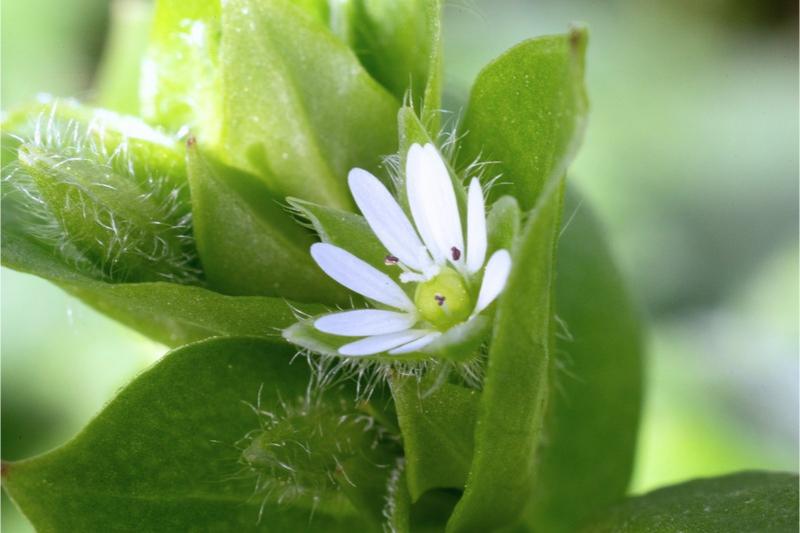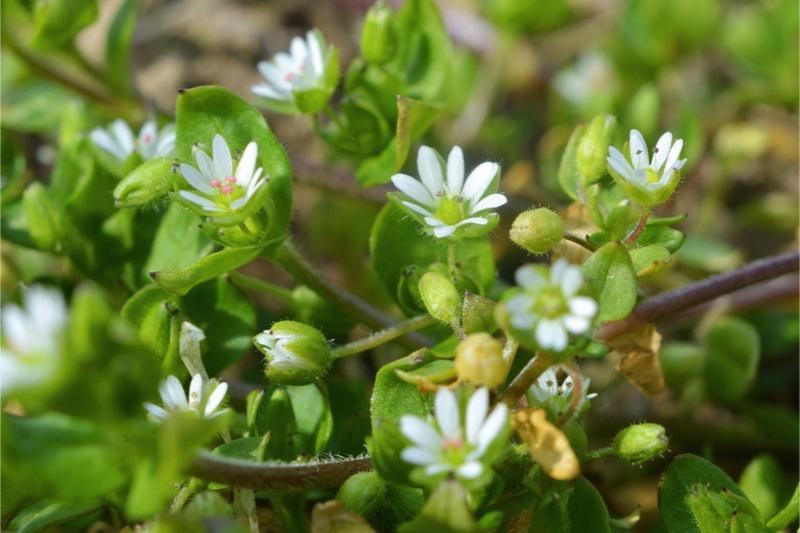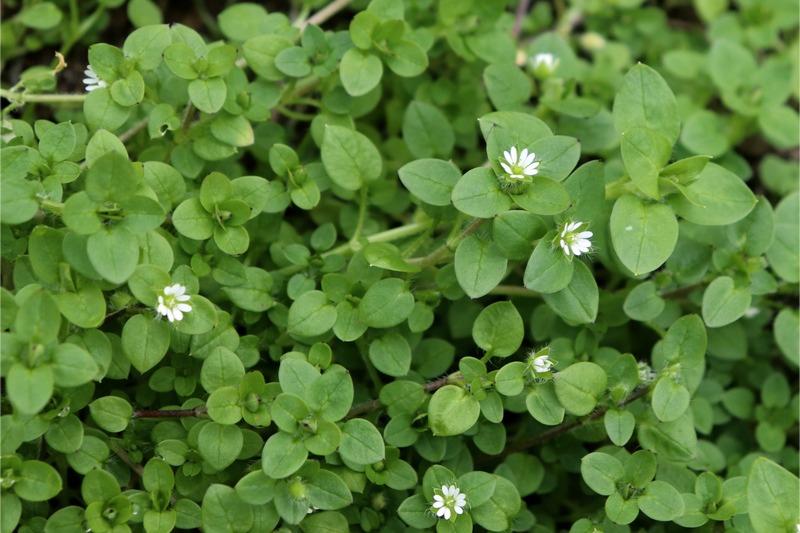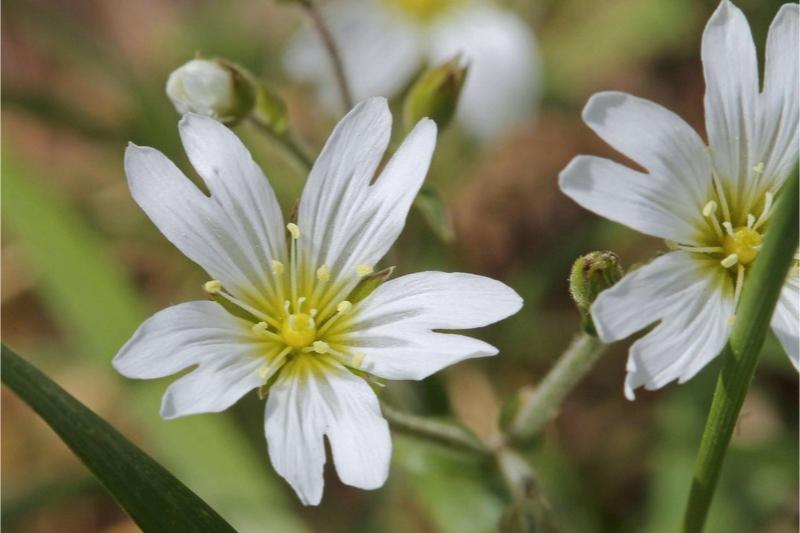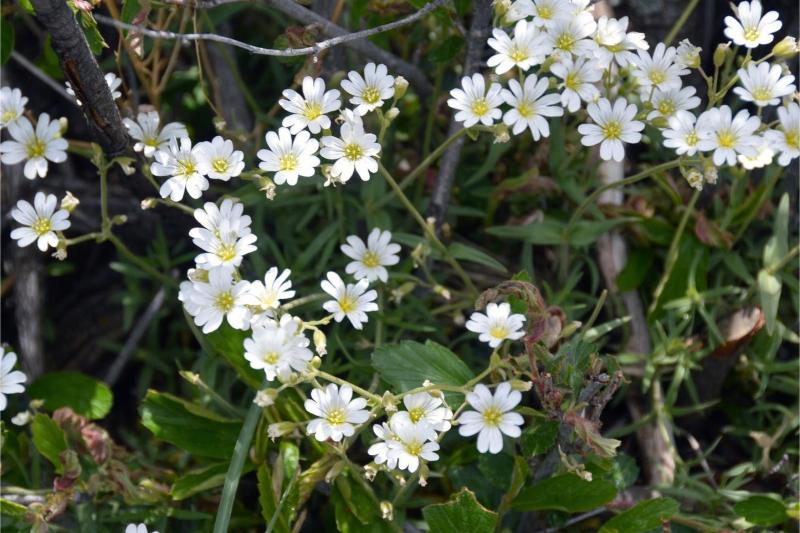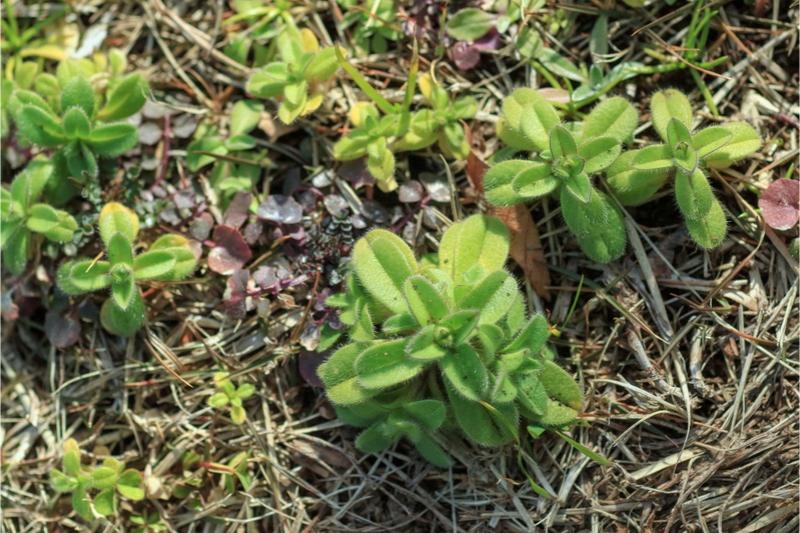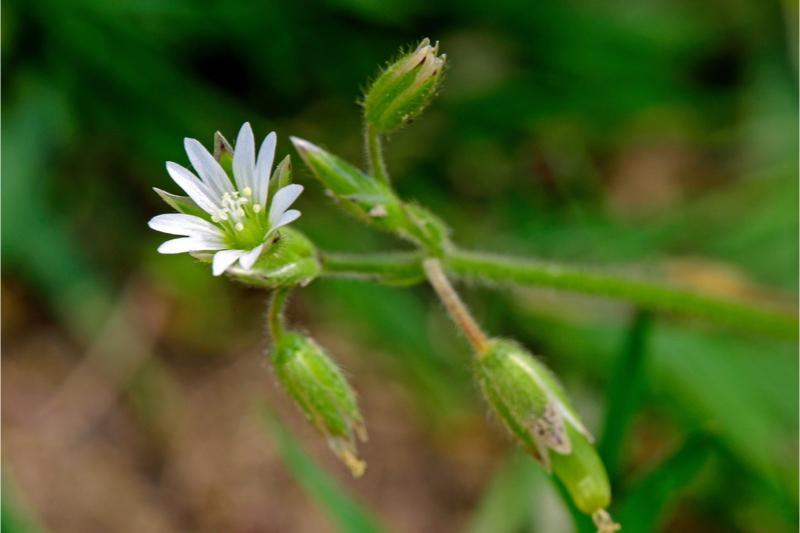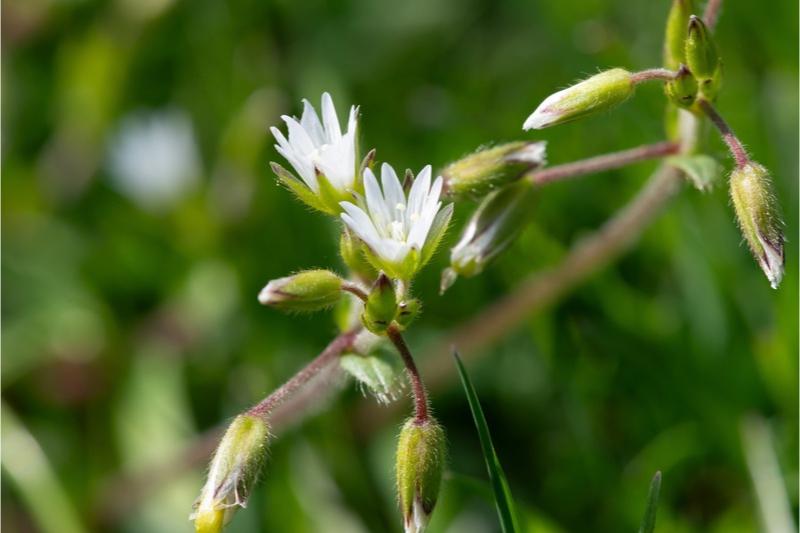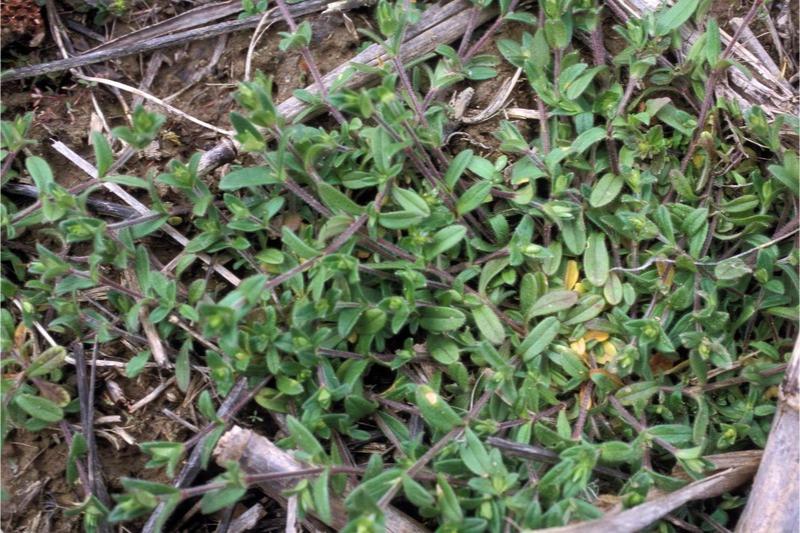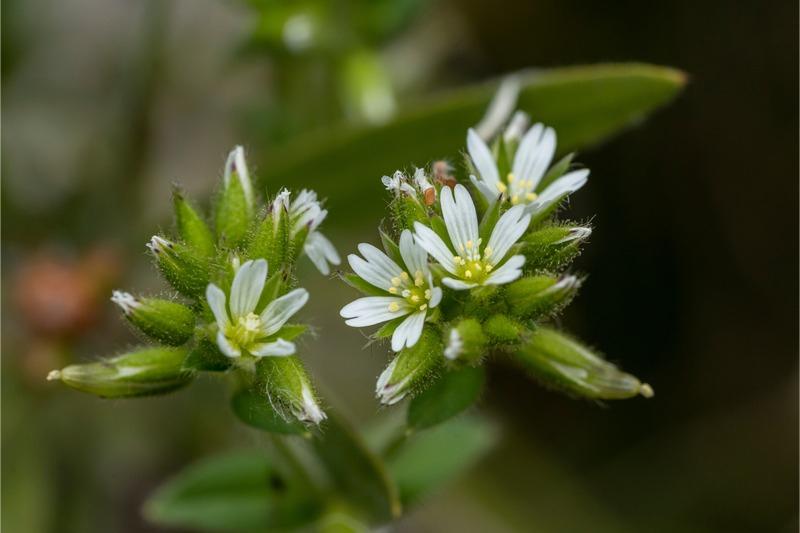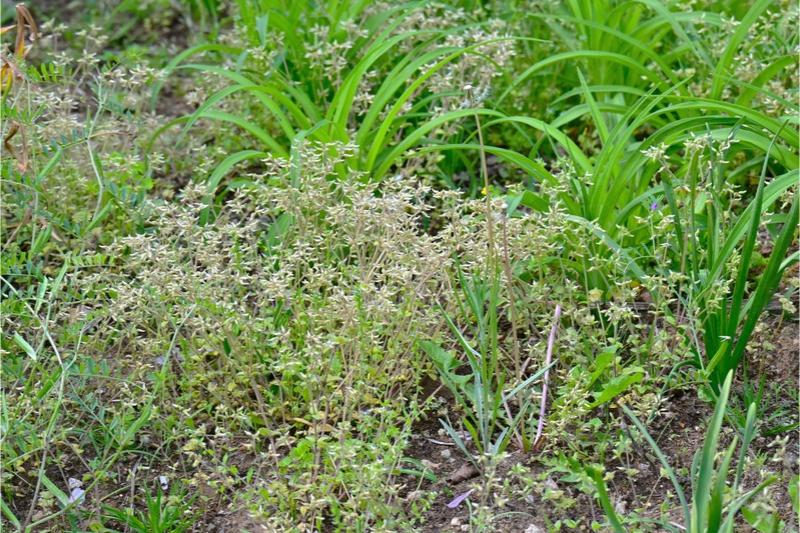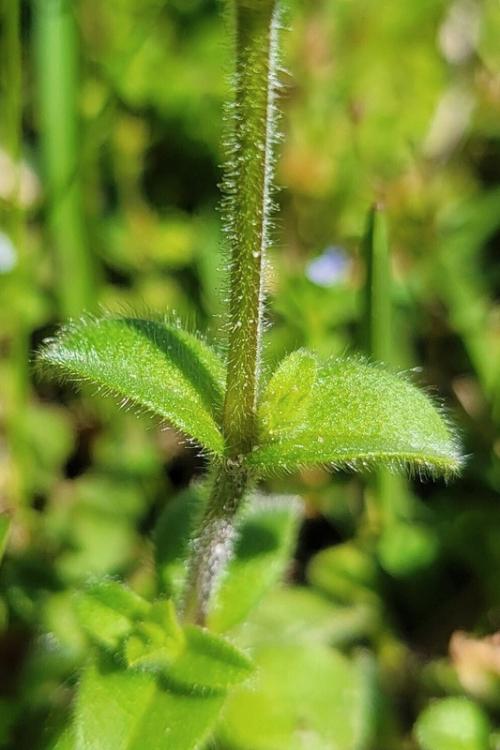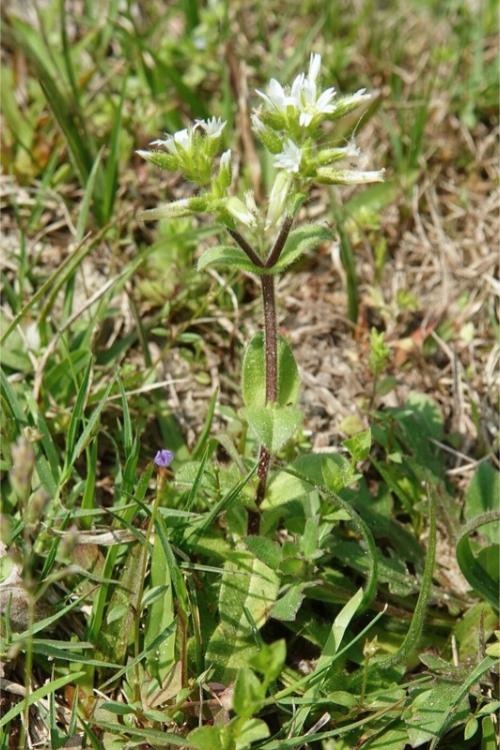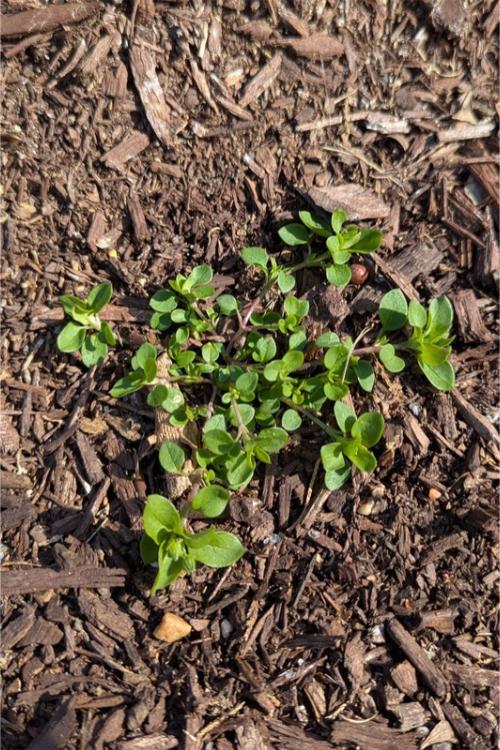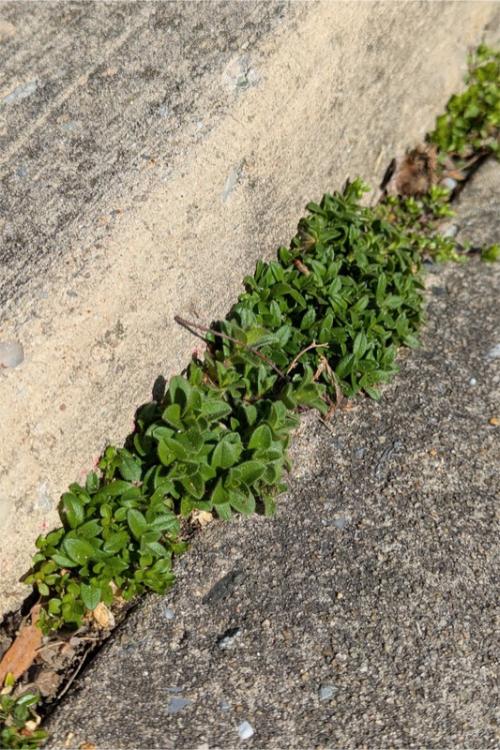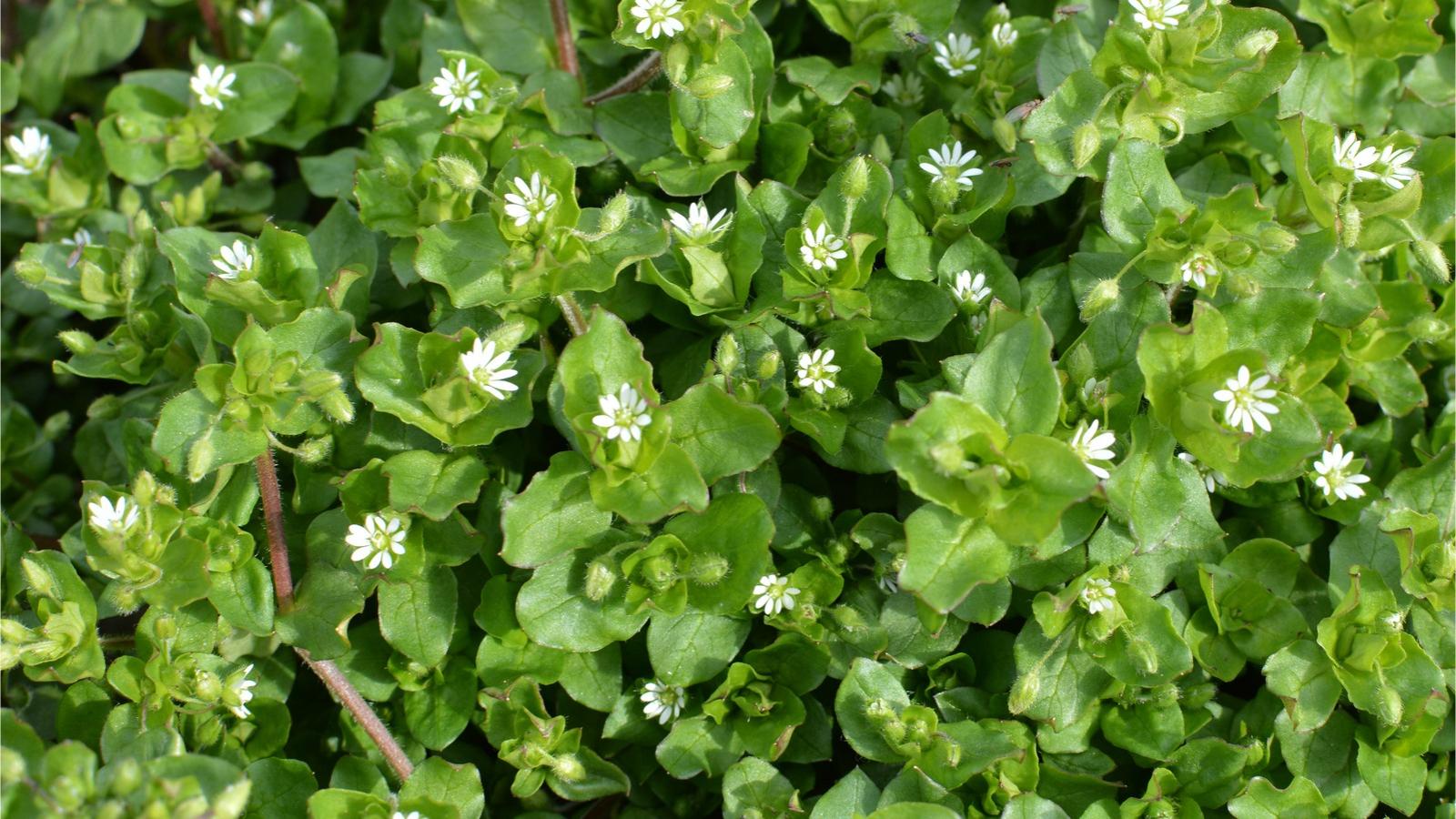
A low-growing plant with small leaves and numerous white starry flowers.

Common chickweed in bloom. Photo via Adobe Stock.

Updated: October 22, 2026

Several species of chickweed grow in Maryland; some are native and others are non-native. Members of the carnation plant family (Caryophyllaceae), they can occur in lawns and garden beds. The species often encountered growing as weeds include:

  • common chickweed (Stellaria media)
  • field chickweed (Cerastium arvense subspecies arvense)
  • mouse-ear chickweed (Cerastium fontanum subspecies vulgare, formerly named C. vulgatum)
  • sticky chickweed (Cerastium glomeratum)

There are very few species in the genera Stellaria and Cerastium that are native in Maryland. Of those, Star Chickweed (Stellaria pubera) is the most widespread, but not likely to be found growing as a weed in a typical yard or lawn setting. A native subspecies of field chickweed (Cerastium arvense subspecies strictum) may occur locally, but its distribution compared to the non-native subspecies is not yet known. View photos of the plants for comparison to commonplace chickweed species on the linked pages.

What traits do these chickweeds have in common?

Common, field, mouse-ear, and sticky chickweed share several flower and foliage traits, and they all spread by seed.

  • The small flowers are white with 5 deeply-cleft petals (each petal has two side-by-side lobes), which give the appearance of having 10 petals.
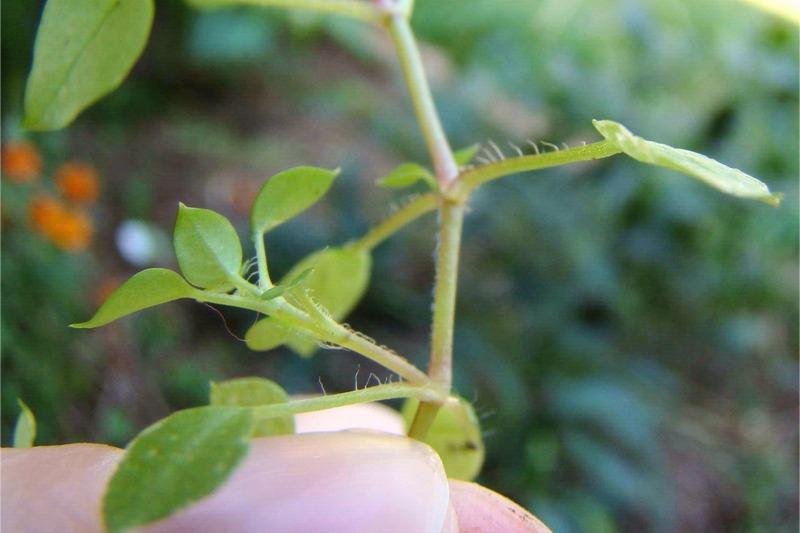
  • The leaf arrangement is opposite on the stem: pairs of leaves attach to the stem directly across from each other.
  • Leaves are small and simple with entire margins, meaning that they do not have lobes, serrations, or scallops along their edges.

How do these chickweeds differ?

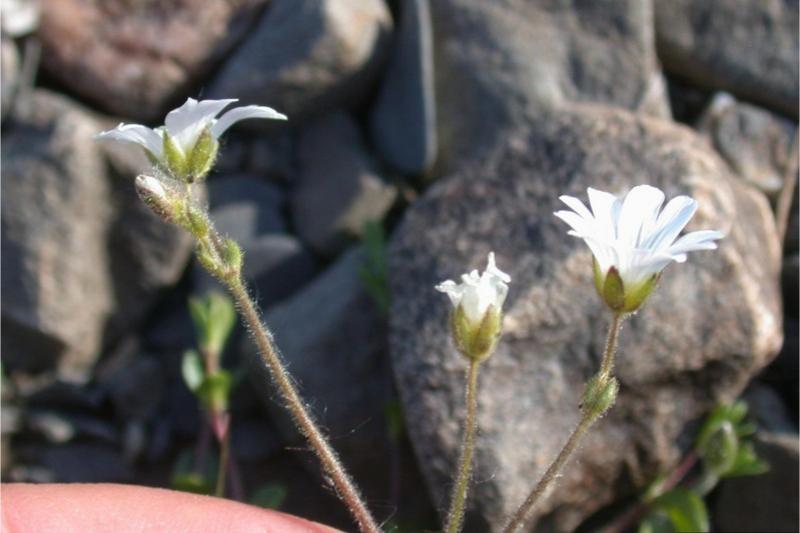
One trait to examine is the length of the sepals in relation to the length of the petals. Sepals are modified leaf-like structures that help to protect the flower bud and support the flower which are located immediately underneath the petals. For these species, the sepals are green.

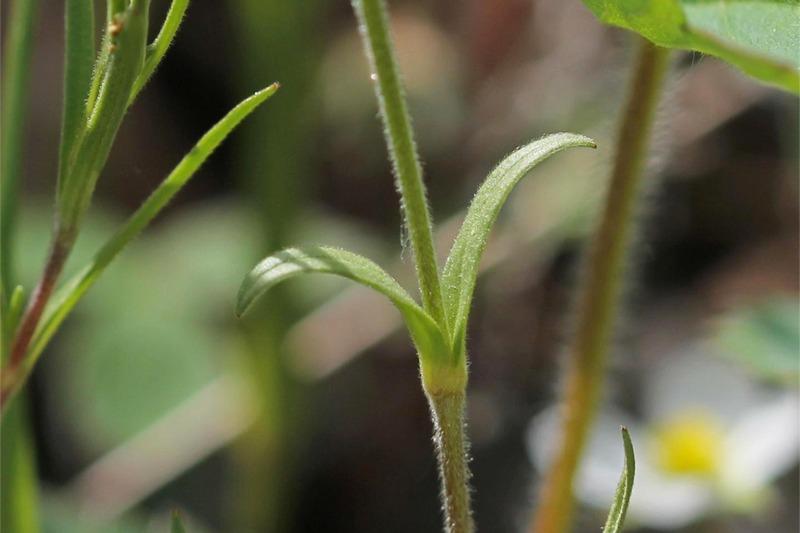
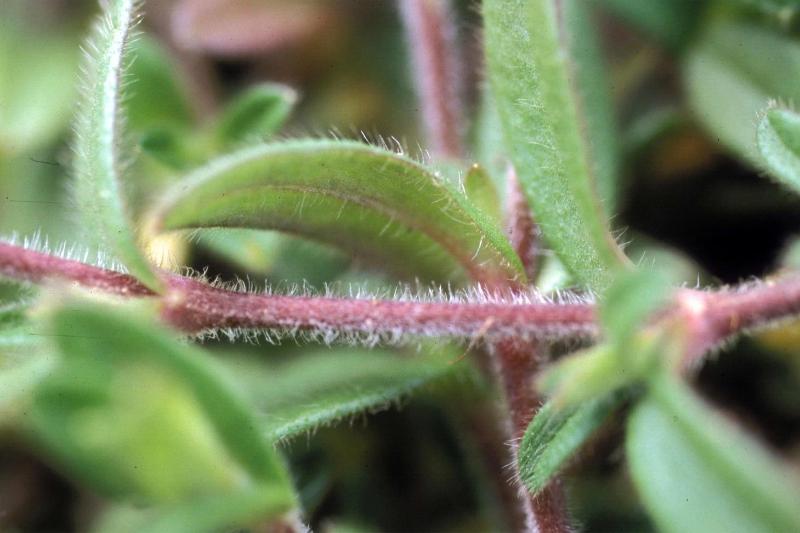
Another distinguishing trait is whether the leaves and stems are hairy or smooth.

Distinguishing features of four chickweed species
TraitCommon ChickweedField ChickweedMouse-ear ChickweedSticky Chickweed
Flowersabout ¼ inch across; sepals hairyabout ¾ inch across; petals 2 to 3 times longer than the sepalsabout ¼ inch across; petals about equally long as (or slightly shorter than) the sepals; sepals hairyabout ¼ inch across; hairy sepals
Leavessmooth; elliptical or ovate and pointed at the tip; lower leaves stalked (have a petiole) and upper leaves often stalkless (sessile)moderately hairy; narrowly ellipticalhairy; oblong or ovate and pointed at the tip; stalklesssticky hairs; elliptical or ovate
Stemsmostly smooth; does not root at the nodesvariably hairy or smooth; can root at lower nodeshairy; roots at the nodes; slightly swollen at the nodessticky hairs
Growth habit and sizeprostrate, usually 3 to 6 inches tall when growing in full sun; can reach 18 inches tall in more shadeupright, to nearly 2 feet tallprostrate, usually only a few inches tall; may form a mound almost 1 foot tall in unmown areasprostrate to upright; can reach 12 to 18 inches tall
Life cycleannualperennialperennialannual

Common chickweed

Common chickweed (Stellaria media) can have several generations a year during cool, wet seasons, and forms dense prostrate patches in lawns, flower beds, and vegetable gardens. It is similar in appearance to mouse-ear chickweed, and can be very common in lawns where the grass isn't growing densely and vigorously.

Life cycle and reproduction

This species is a winter annual: seeds germinate starting in autumn, the young plants overwinter, and they mature and flower in spring. Seeds ripen before the plant dies by summer. Annual plants have a one-year life cycle.

Seed is dispersed in spring and germinates in autumn. Seeds in the soil can remain viable (capable of germinating) for 10 or more years. They can germinate from a depth of just over an inch, in temperatures from a few degrees above freezing to the more ideal range of about 55 to 65°F.

Field chickweed

Field chickweed (Cerastium arvense) has shorter hairs on the stems and leaves and a more linear leaf shape.

Mouse-ear chickweed

Mouse-ear chickweed (Cerastium fontanum subspecies vulgare) tends to be evergreen in winter and can form dense mats or mounds as it matures.

Life cycle and reproduction

This species is a perennial: it lives for several years. Blooms can appear any time from late spring to mid-autumn. It is not drought-tolerant, so hot, dry conditions can kill mouse-ear chickweed.

Seeds germinate between late summer and early spring. In areas kept moist by irrigation, seeds might also germinate in summer.

Multiple seedling mouse-ear chickweed plants with congested pairs of hairy, small, oblong green leaves.
Seedling mouse-ear chickweed plants with hairy, stalkless leaves. Photo via Adobe Stock.

Sticky chickweed

Sticky chickweed (Cerastium glomeratum) is named for its glandular (sticky) hairs on the stems and leaves.

Life cycle and reproduction

This species is a winter annual: seeds germinate starting in autumn, the plants overwinter, and mature in spring, when they flower and ripen seeds before dying by summer. Annual plants have a one-year life cycle.

Conditions that favor chickweed growth

When chickweeds grow in a lawn, they favor areas of sparse, weak turfgrass where it is easier for them to compete with the grass. They out-compete turfgrass especially well in poorly-drained sites (especially when that is caused by soil compaction), but the plants can also be common in a wide range of soils and conditions, such as in flower and vegetable beds and gaps in pavement.

Chickweed management in lawns

General lawn care practices that discourage weeds

Maintain healthy, dense turf that can compete with weeds and prevent weed germination and establishment. Fertilize the lawn as recommended (based on season and turf type), mow high, and overseed cool-season lawns each autumn to keep the lawn dense and better able to crowd-out seedling weeds. Core-aerate to reduce soil compaction. Learn about fertilizing, mowing, overseeding, and aeration in the resource: Maintaining an Established Lawn.

Lawn care and maintenance

Mechanical management

Remove chickweed plants (including the root system) by hand or with a manual weeding tool. Doing this when the soil is moist makes the task easier. Pulling up or digging out individual plants is a viable option for scattered plants in a garden bed or a small area of lawn (when the plants are not yet abundant), but would not be practical for heavier infestations.

Manage Weeds Without Chemicals

Chemical management

Herbicide use should always be a last resort when managing weeds. Check for any local pesticide restrictions before buying and applying a product. For example, the Montgomery County pesticide law does not allow most synthetic pesticides (which includes herbicides) to be used on lawns. The active ingredient glyphosate is also prohibited on lawns in Baltimore City.

Learn about herbicide classifications and terminology:

Herbicide Options for Managing Common Lawn Weeds

Pre-emergent herbicide

A pre-emergent applied in late summer or early autumn can prevent chickweed from sprouting during its main season for germination. However, when applied to a lawn, you will not be able to sow cool-season grass seed like fescue around the same time.

Post-emergent herbicide

Spot-treat individual, actively-growing chickweed plants or infested areas with a liquid broadleaf herbicide in early spring. Look for a product with one or more of the following active ingredients: 2,4-D, MCPP (mecoprop), dicamba, or triclopyr. An application of non-selective herbicide may work, but would also damage any turfgrass exposed to the herbicide.

CAUTION: Do not spray herbicides containing dicamba over the root zone of desirable trees and shrubs. Roots or leaves may absorb this ingredient and be substantially damaged. Refer to the product label for other precautions.

References

Neal, J.C., Uva, R.H., et. al. (2023). Weeds of the Northeast. (Second edition.) Comstock Publishing Associates.

Royer, F., and Dickinson, R. (1999). Weeds of the Northern U.S. and Canada. The University of Alberta Press.

Still have a question? Contact us at Ask Extension.