

FS-2025-0800 | August 2026
Restoring Salt-Impacted Farmland: Native Grasses for Saltwater Intrusion Adaptation (FS-2025-0800)
By Patricia Ramalho de Barros a, Alison N. Schulenburg a, Jarrod Miller b, Katherine L. Tully a
a University of Maryland Department of Plant Science and Landscape Architecture, College of Agriculture and Natural Resources; b University of Delaware Department of Plant and Soil Sciences, College of Agriculture and Natural Resources
Drivers of Saltwater Intrusion
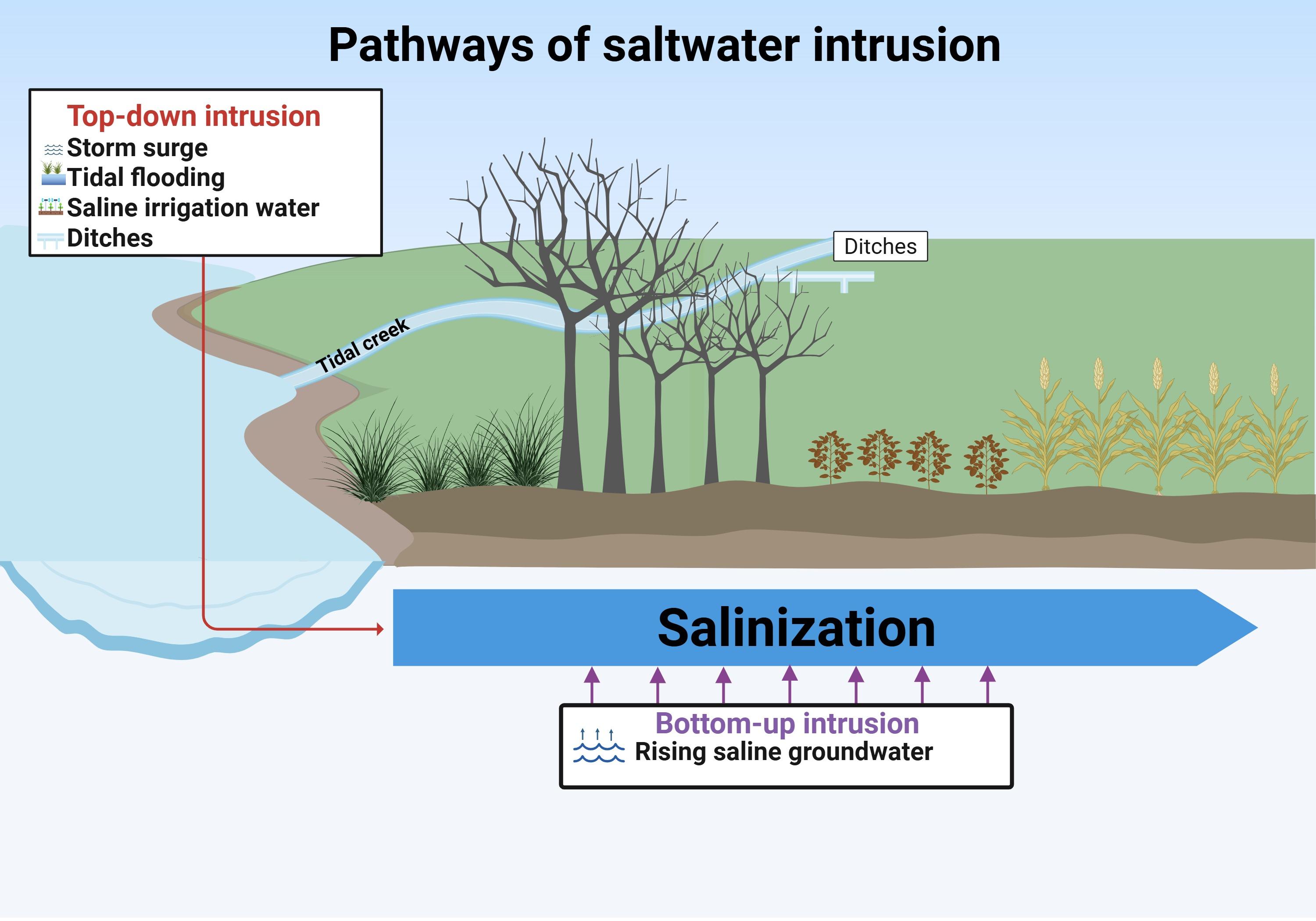
Sea level rise (SLR) poses a significant threat to coastal regions. Along the Eastern Seaboard of the United States, coastal agricultural fields are particularly vulnerable. As sea levels continue to rise along the coasts, saltwater can encroach into uplands, a phenomenon known as saltwater intrusion (SWI) (Tully et al., 2019).
SWI occurs when seawater floods low-lying areas or infiltrates freshwater systems, raising groundwater levels and salinity. Prolonged droughts exacerbate this impact by depleting freshwater availability and increasing evaporation, which in turn further concentrates salts in the soil.
There are two primary pathways by which SWI affects coastal farmlands:
Bottom-up intrusion
This process occurs when elevated groundwater levels or pressure from nearby saline bodies gradually force saltwater into lower soil horizons. This process alters soil chemistry, damages root systems, and reduces soil fertility. Consequently, bottom-up SWI can be particularly insidious because it occurs below the soil surface, posing distinct challenges for agricultural management and making it difficult to detect and remediate (de Barros et al., 2025).
Top-down intrusion
Top-down saltwater intrusion is caused by tidal flooding, storm surges, or overtopping of saline ditches, which deposit salt directly onto the soil surface. Though more visible, this process can be intermittent, depending on the frequency of flooding events.
In many coastal agricultural areas, bottom-up and top-down intrusion often interact. Drainage ditches designed to remove excess water can act as conduits that transport saline water inland. At the same time, groundwater salinity increases from below, creating a dual front of salinization that threatens the long-term productivity of farmland.
Effects of SWI on Farmland and Vegetation
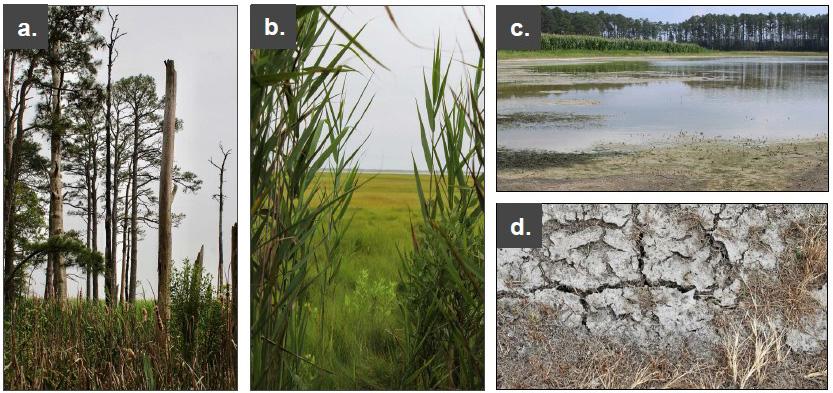
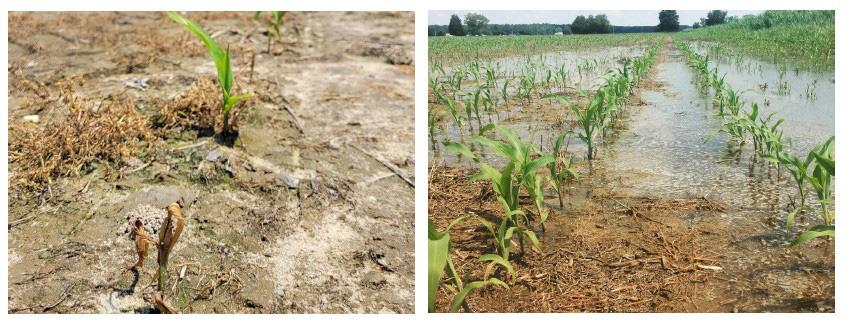
SWI increases soil concentrations of chloride (Cl⁻), sodium (Na⁺), calcium (Ca²⁺), magnesium (Mg2+), potassium (K⁺), and sulfate (SO₄²⁻) (Tully et al., 2019a, Tully et al., 2019b). Increased flooding and elevated salinity degrade soil structure, reduce infiltration, and disrupt nutrient balance, thereby limiting the growth of commercial plants. The resulting decline in soil quality and crop yield often leads to farmland abandonment and the formation of degraded or fallow areas. In abandoned or unmanaged fields, saline conditions favor invasive and weedy species such as Phragmites (Phragmites australis) and promote a shift toward woody vegetation rather than native marsh species (Gedan & Fernández-Pascual, 2019).
From Farmland to Functional Wetlands
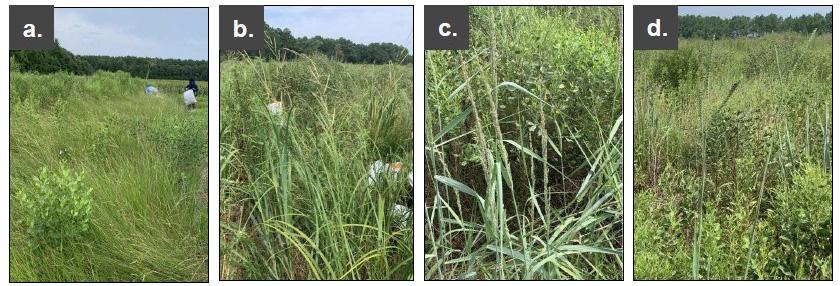
For farmland that saltwater intrusion has degraded beyond recovery for crop production, active restoration can guide these areas toward becoming functional coastal wetlands. Establishing native warm-season grasses accelerates the transition of degraded farmland to functional wetlands by improving soil structure, stabilizing shorelines, and enhancing habitat value.
Spartina species (S. patens and S. pectinata), for example, can survive in highly saline environments by regulating salt concentrations within their tissues, allowing them to maintain growth under conditions where traditional crops fail (Maricle et al., 2009; Morris et al., 2019). They are particularly suited for shoreline stabilization, wetland restoration, and wildlife habitat creation.
In our previous study (de Barros et al., 2025), we examined the performance of several native warm-season grasses, including Eastern gamagrass (Tripsacum dactyloides), Saltmeadow cordgrass (Spartina patens), Prairie cordgrass (Spartina pectinata), Coastal panicgrass (Panicum amarum), Switchgrass (Panicum virgatum), and Florida paspalum (Paspalum floridanum). We found that Eastern gamagrass (Tripsacum dactyloides) produced the highest biomass among the species evaluated and showed a strong capacity to absorb phosphorus from the soil, reducing nutrient runoff and improving water quality. The other species also established successfully and contributed to erosion control, forage production, and riparian protection.
Together, these six warm-season native grasses provide a versatile set of options for restoring land impacted by SLR and SWI and supporting ecosystem services essential for maintaining the resilience and long-term sustainability of coastal regions.
Management and Policy Implications
Restoring salt-affected farmland with native warm-season grasses offers both ecological and economic advantages. Expanding federally funded Conservation Practice Standards (CPS) programs through the Natural Resources Conservation Service (NRCS), to include these native salt-tolerant species could create new opportunities for coastal farmers through participation in conservation and ecosystem-service initiatives. By supporting the establishment of effective management practices for salt-affected lands, participation in these programs may also provide an alternative source of income for farmers whose fields are no longer suitable for conventional crops. Many CPS are optimal applications of incorporating salt-tolerant grasses (Table 1). For example, Eastern gamagrass (Tripsacum dactyloides) is compatible with multiple practices, including Conservation Cover (CPS 327), Field Borders (CPS 386), and Riparian Herbaceous Cover (CPS 390), reflecting its high biomass production, forage value, and capacity for phosphorus uptake. Similarly, Coastal panicgrass (Panicum amarum) and Switchgrass (Panicum virgatum) can also d. be used under CPS 327, CPS 386, and CPS 390, as well as wildlife habitat practices (CPS 645), and shoreline stabilization (CPS 580), given their successful establishment, biomass accumulation, and documented benefits for nutrient retention and habitat creation. Although Saltmeadow cordgrass (Spartina patens) and Prairie cordgrass (Spartina pectinata) are not currently eligible for several on-field CPS, their strong performance under saline conditions suggests they should be considered for inclusion in practices such as CPS 390, Wetland Restoration (CPS 657), and CPS 386. Florida paspalum (Paspalum floridanum) is suitable for a wide range of CPS (Table 1), and when used in mixtures, it enhances shoreline stabilization, early‐stage restoration outcomes, wildlife habitat, and forage diversity.
| Species | Common name | 327 – Conservation Cover | 386 – Field border | 390 – Riparian Herbaceous Cover | 420 – Wildlife habitat | 422 – Hedgerow/ wind barrier | 512 – Pasture and Hay | 512 – Biomass | 580 – Stream/ Shore stabilization |
|---|---|---|---|---|---|---|---|---|---|
| Panicum amarum | Coastal panicgrass | Yes | Yes | Yes | Yes | Yes | No | Yes | Yes |
| Panicum virgatum | Switchgrass | Yes | Yes | Yes | Yes | Yes | No | No | Yes |
| Paspalum floridanum | Florida paspalum | Yes | Yes | Yes | Yes | No | Yes | Yes | Yes |
| Spartina patens | Saltmeadow cordgrass | No | No | Yes | Yes | No | No | Yes | Yes |
| Spartina pectinata | Prairie cordgrass | No | No | Yes | Yes | No | No | Yes | Yes |
| Tripsacum dactyloides | Eastern gamagrass | Yes | Yes | Yes | Yes | No | Yes | No | Yes |
Farmers interested in adopting these conservation practices can enroll by visiting their local Soil Conservation District office and consulting with NRCS field staff to identify which CPS best align with their field conditions and management goals. A directory of NRCS service centers for all U.S. states is available at https://www.nrcs.usda.gov/contact/find-a-service-center.
This outreach was supported by USDA-NIFA: 2018-68002-27915
References
de Barros, P.R., Schulenburg, A.N., Gedan, K., Miller, C., Tully, K.L., 2025. Effects of saltwater intrusion on candidate restoration species in coastal agricultural fields. Agric. Ecosyst. Environ. 392, 109757. https://doi. org/10.1016/j.agee.2025.109757
Belt, S., Miller, C., 2021. U.S. Department of Agriculture, Natural Resources Conservation Service. 2021. Selection and Use of Native Warm-Season Grasses for the Mid-Atlantic Region. East NTSC Plant Materials Technical Note No. 5. Greensboro, NC.
Gedan, K.B., Fernández-Pascual, E., 2019. Salt marsh migration into salinized agricultural fields: A novel assembly of plant communities. J. Veg. Sci. 30, 1007–1016. https://doi.org/10.1111/jvs.12774
Maricle, B.R., Koteyeva, N.K., Voznesenskaya, E.V., Thomasson, J.R., Edwards, G.E., 2009. Diversity in leaf anatomy, and stomatal distribution and conductance, between salt marsh and freshwater species in the C4 genus Spartina (Poaceae). New Phytol. 184, 216–233. https://doi.org/10.1111/j.1469- 8137.2009.02903.x
Morris, L., Yun, K., Rutter, A., Zeeb, B.A., 2019. Characterization of Excreted Salt from the Recretohalophytes Distichlis spicata and Spartina pectinata. J. Environ. Qual. 48, 1775–1780. https://doi.org/10.2134/jeq2019.03.0102
Tully, K., Gedan, K., Epanchin-Niell, R., Strong, A., Bernhardt, E.S., BenDor, T., Mitchell, M., Kominoski, J., Jordan, T.E., Neubauer, S.C., Weston, N.B., 2019. The Invisible Flood: The Chemistry, Ecology, and Social Implications of Coastal Saltwater Intrusion. BioScience 69, 368–378. https://doi.org/10.1093/ biosci/biz027
Tully, K. L., Weissman, D., Wyner, W. J., Miller, J., & Jordan, T., 2019. Soils in transition: saltwater intrusion alters soil chemistry in agricultural fields. Biogeochemistry, 142(3), 339–356. https://doi.org/10.1007/s10533-019-00538-9
PATRICIA RAMALHO DE BARROS
prbarros@umd.edu
ALISON N. SCHULENBURG
aschul98@umd.edu
JARROD MILLER
jarrod@udel.edu
KATHERINE L. TULLY
kltully@umd.edu
This publication, Restoring Salt-Impacted Farmland: Native Grasses for Saltwater Intrusion Adaptation (FS-2025- 0800), is a part of a collection produced by the University of Maryland Extension within the College of Agriculture and Natural Resources.
The information presented has met UME peer-review standards, including internal and external technical review. For help accessing this or any UME publication contact: itaccessibility@umd.edu
For more information on this and other topics, visit the University of Maryland Extension website at extension.umd.edu
University programs, activities, and facilities are available to all without regard to race, color, sex, gender identity or expression, sexual orientation, marital status, age, national origin, political affiliation, physical or mental disability, religion, protected veteran status, genetic information, personal appearance, or any other legally protected class.
When citing this publication, please use the suggested format:
de Barros, P. R., Schulenburg, A. N., Miller, J., & Tully, K. L. (2026). Restoring Salt-Impacted Farmland: Native Grasses for Saltwater Intrusion Adaptation (FS-2025-0800). University of Maryland Extension. go.umd.edu/FS-2025-0800.