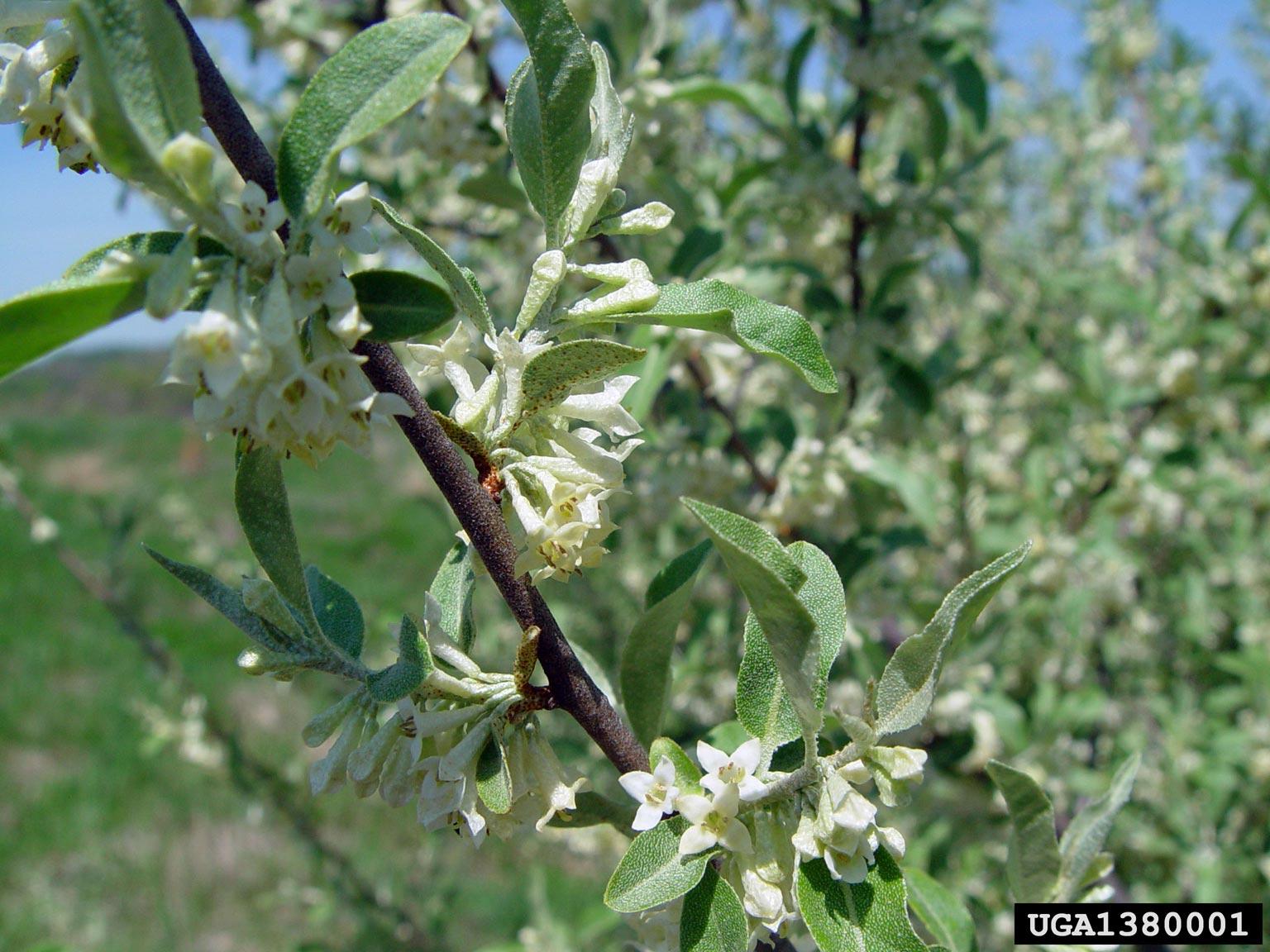
Autumn olive (Elaeagnus umbellata) flower clusters. Photo: Chris Evans, University of Illinois, Bugwood.org
Updated: February 3, 2026
Autumn olive (Elaeagnus umbellata) is a deciduous flowering shrub native to Asia. It was introduced to the U.S. in 1830 and used for ornamental gardens, windbreaks, wildlife cover, and the restoration of soils degraded by deforestation and mining. Additional species of Elaeagnus occur in Maryland, all of which are non-native; the most widespread is autumn olive.
Physical features of autumn olive
Silvery foliage and strongly fragrant flowers are the prominent features of autumn olive, especially when numerous shrubs colonize an area. In Maryland, flowers usually open in mid-spring and fruits ripen late summer to early autumn. The leaves may turn pale yellow before falling in autumn, but the color change is not showy.
Growth rate and habit: rapid growth rate; generally rounded to broad, multi-stemmed habit; large shrub or small tree
Typical mature size: 10 to 20 feet in height; potentially up to 30 feet wide if not crowded or shaded
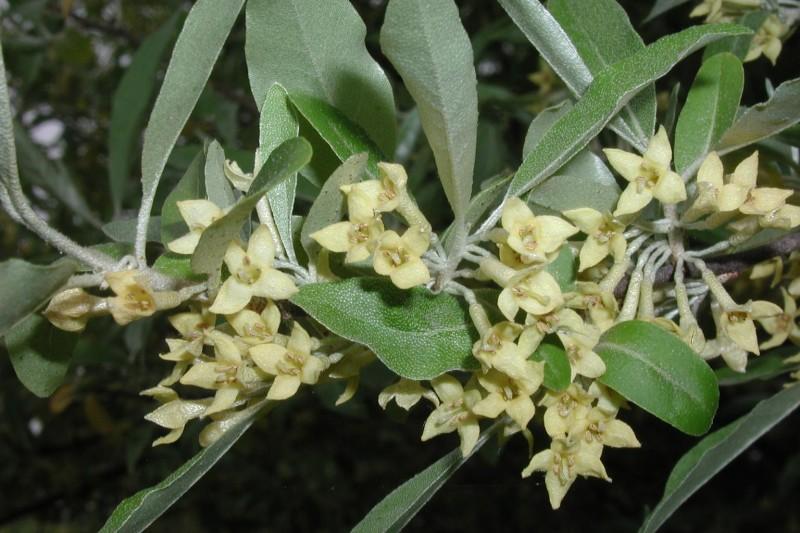
Blooms: abundant clusters of pale yellow to creamy white flowers with four petals
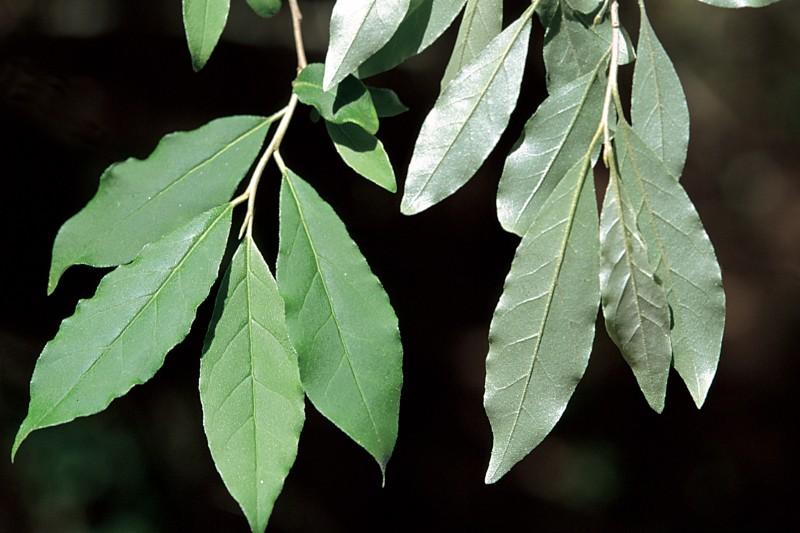
Leaves: simple (not divided into leaflets) with smooth margins; ovate to lanceolate in shape; alternate arrangement on the stems; green in color with silvery scales, the density of which give the leaf undersides a noticeable silvery-white sheen
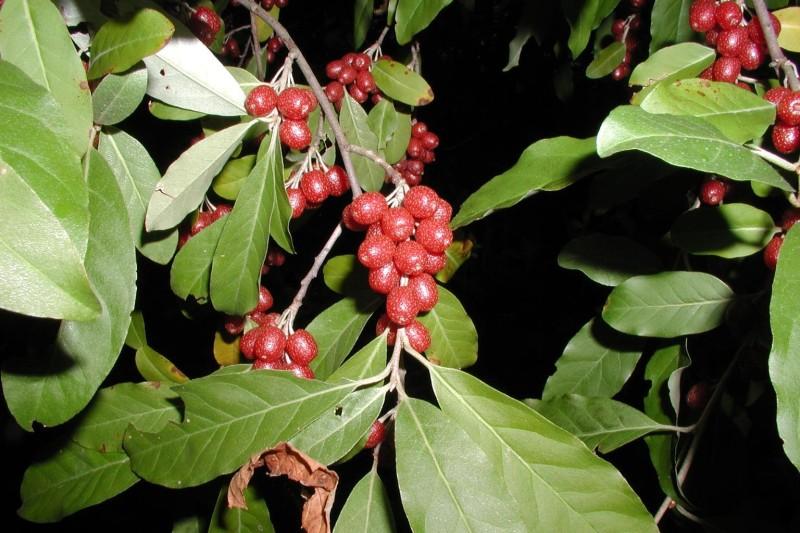
Fruit: red berries speckled with scales, on short stalks
Branches: reflective scales on the bark of young twigs them a metallic sheen; branches bear spines
Abundant four-petaled, pale yellow flowers on a branch tip. Photo: Leslie J. Mehrhoff, University of Connecticut, Bugwood.org
Silvery leaf undersides (right) compared to green upper leaf surfaces (left). Photo: James H. Miller, USDA Forest Service, Bugwood.org
Ripe berries are red with metallic speckles, held on short stalks along the branches. Photo: Leslie J. Mehrhoff, University of Connecticut, Bugwood.org
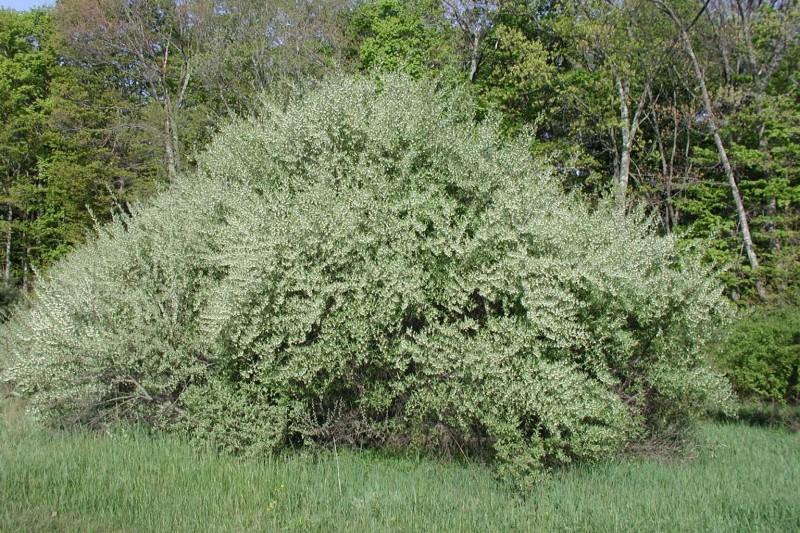
Mounded, broad canopy on a mature autumn olive growing in full sun. Plants in more shade may be narrower and less dense. Photo: Leslie J. Mehrhoff, University of Connecticut, Bugwood.org
Environmental impacts of autumn olive
Autumn olive is an invasive species that produces a large amount of seeds with a high germination rate. Seeds are dispersed by birds and mammals, and the shrub regrows easily when cut down. It displaces native plants by creating dense shade, altering soil chemistry and nutrient cycling, and interfering with natural plant succession. Autumn olive roots associate with nitrogen-fixing bacteria that enable the plant to grow well in nitrogen-poor soils.
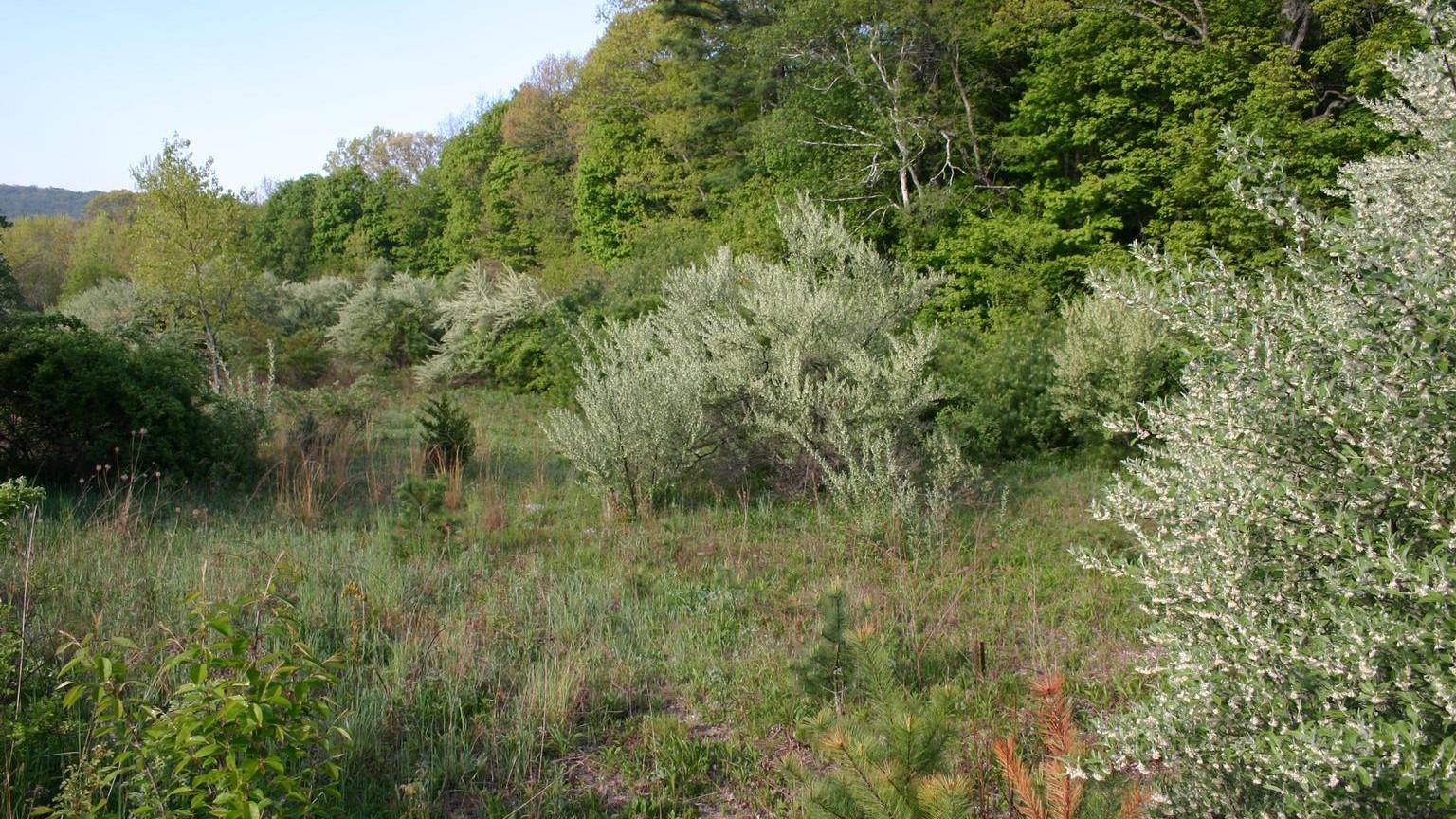
Autumn olive colonizing open grassy habitat along the edge of a forest. Photo: Leslie J. Mehrhoff, University of Connecticut, Bugwood.org
Conditions that favor growth
Autumn olive grows best in full sun but is tolerant of partial shade. It prefers well-drained soils and has good drought tolerance. Commonly growing along roadsides and occurring in all Maryland counties, it tolerates salt exposure. Autumn olive also tolerates very acidic soils having a pH as low as 4.0. This shrub is most often found in open forests and along forest edges, in fields, and along streams and floodplains.
Alternatives to autumn olive
Do not plant autumn olive, and replace existing specimens when possible. The Maryland Department of Agriculture (MDA) regulates the sale of invasive plants and conducts invasive plant species status assessments. Autumn olive is on a list of species prioritized for assessment. Refer to the MDA's Invasive Plants Prevention and Control resource page for more information and a list of regulated species.
Several native or non-invasive shrubs and small trees have fragrant spring flowers or berries that can be harvested, left for wildlife, or used as a seasonal point of interest. Candidates for decorative berries include winterberry holly (Ilex verticillata), spicebush (Lindera benzoin), and gray dogwood (Cornus racemosa).
Bayberry and wax myrtle (Morella species) and their relative Sweetfern (Comptonia peregrina) can fix nitrogen as an adaptation to grow in nitrogen-poor soils, a trait shared with autumn olive.
Swearingen J., K. Reshetiloff, B. Slattery, and S. Zwicker. 2002. Plant Invaders of Mid-Atlantic Natural Areas. National Park Service and U.S. Fish & Wildlife Service, Washington, DC.
Compiled by Christa Carignan, reviewed by Debra Ricigliano, University of Maryland Extension, May 2018.
Revised by Miri Talabac, Lead Horticulture Coordinator, Jan. 2026.