
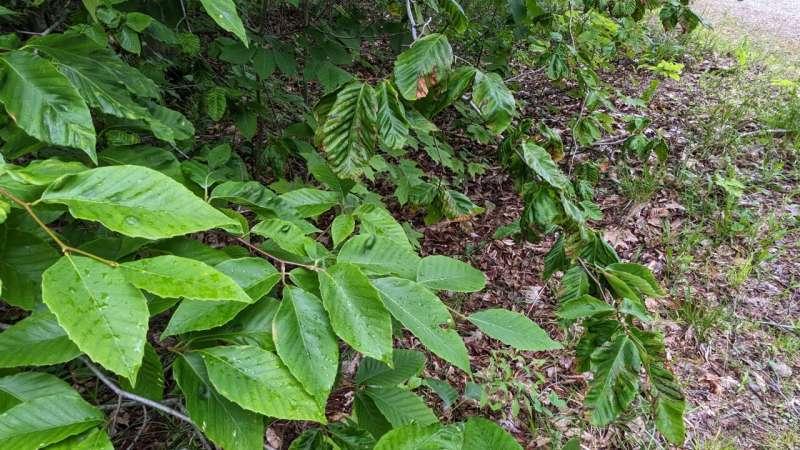
A study led by scientists at the Holden Arboretum in Kirtland, OH has found evidence that beech leaf disease (BLD) symptom development is genetically controlled, providing the first evidence that some American beech trees may have genetic resistance. This finding supports further investigation and development of breeding populations for BLD resistance. Nearly a third of beech trees near BLD's epicenter in northeastern Ohio, the majority of which were smaller trees, have died since the disease was discovered in 2012.
The new research, published in the journal Forest Pathology this past August, was led by David Burke, vice president for science and conservation at Holden Forests & Gardens, along with Mary Mason and Jennifer Koch of the USDA Forest Service's Northern Research Station.
For years, forest professionals in the region have noticed that in BLD-affected areas, not every beech shows the same severity of symptoms. They've been documenting and monitoring trees that appear healthier in otherwise heavily symptomatic areas, building a roster of these special trees.
Such trees will be conserved for use in further experiments to determine if genetic resistance to BLD can be passed from parent trees to their progeny, an essential step in developing a breeding program to create resistant trees.
The research also confirmed that the presence of the nematode suspected of being responsible for BLD is the root cause of the disease, and not any bacteria or microbes that might be associated with it.
Next, the team will continue their search for low- and no-symptom American beech in forests where BLD has been established for at least a decade. Additional trees, and more propagated copies per tree, need to be tested to confirm the genetic control and better understand its variation and strength.