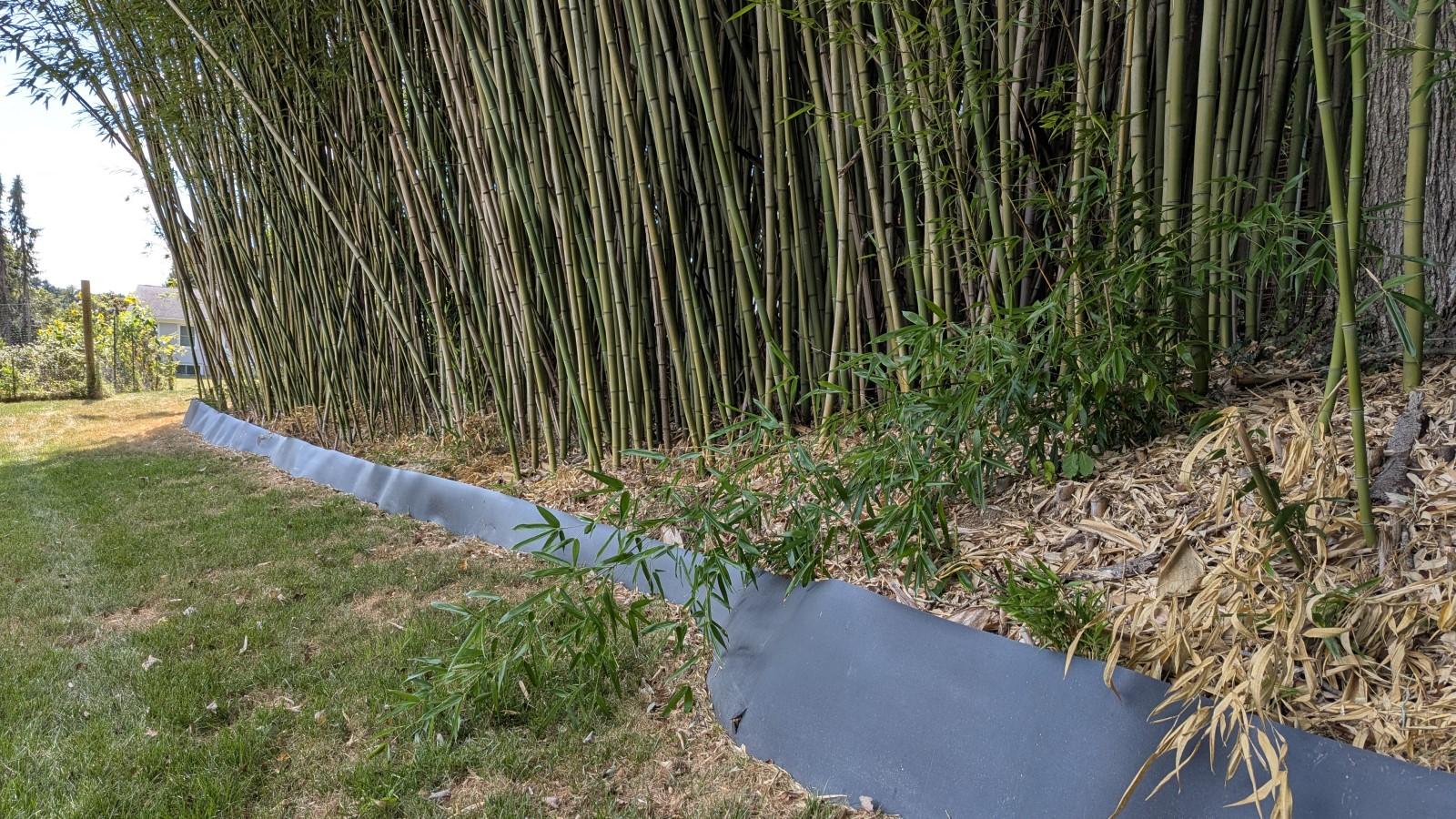
Plastic containment barrier visible above the soil installed around a dense patch of bamboo.

Rhizome barrier installed around a large patch of running bamboo.
Photo: Miri Talabac, University of Maryland Extension

Updated: January 21, 2026

Key points about bamboo

  • Bamboo is categorized into two groups: running (spreading) and clumping.
  • Several species of running bamboo are invasive in the U.S. Running bamboo can spread into neighboring yards and colonize natural areas, where it displaces native plants.
  • Running bamboo can be difficult to control and remove, due to its extremely vigorous growth and resilience.
  • As with any invasive plant, eradication requires greater effort and expense than merely suppressing further spread.

In Maryland, invasive bamboos belong to four genera: Phyllostachys, Pleioblastus, Pseudosasa, and Bambusa. Two of these species are currently regulated by the Maryland Department of Agriculture (MDA): Golden Bamboo (Phyllostachys aurea) and Golden Groove Bamboo (Phyllostachys aureosulcata). You can explore the list of all area invaders by using the Mid-Atlantic Invaders Tool and selecting “bamboos.”

Where possible, the removal of bamboo will require less long-term effort than attempts at containment. Nonetheless, each approach requires vigilance and persistence.

How bamboo grows

Bamboo structure

Bamboo is unique in that it is a large grass with wood-like attributes.

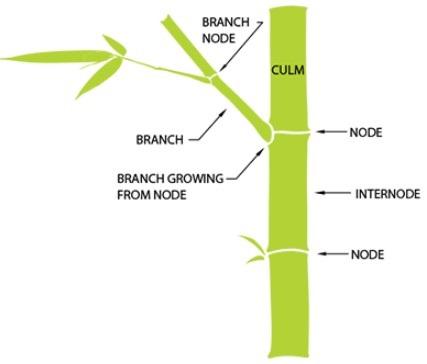
  • illustration of bamboo culm (shoot) anatomy

    Diagram of bamboo structure
    Photo: Bamboo Botanicals

  • bamboo culm cutaway, the inside is hallow

    Cut-away view of a culm with roots and nodes
    Photo: Bamboo Botanicals

  • Culms are the upright stems, also known as canes.
  • Rhizomes are perennial stems that run horizontally underground and contribute to the spread of the colony; they grow roots and culms as they travel.
  • Nodes are the joints between sections of culm or rhizome, and are the point from which leafy branches or roots emerge; in bamboo, the nodes are solid.
  • Internodes are any sections of culm or rhizome that are between nodes; in bamboo, internodes are hollow.
  • Sheaths are the papery protective covers on new emerging culms; they shed as the culms grow (timing depends on species) and add to the leafy litter mulching the ground at the plant’s base.

Clumping versus running bamboo

  1. Pachymorph is the term for types of bamboo that clump; their slow-spreading rhizomes have culms spaced closely together, and their root systems are extremely dense and compact. Clumping bamboos are considered non-invasive; Fountain Bamboo (Fargesia) is the main genus of clumping-type bamboos that can be grown in Maryland. There are several species known by an array of common names.
  2. Leptomorph is the term for types of bamboo that spread or “run”; their fast-spreading rhizomes have culms spaced further apart. Mature colonies of running bamboo create forests of growth. Rhizomes can run indefinitely unless damaged at the growing tip, at which point they stop producing new culms. 
root, cleaned of soil, illustrates how the roots spreads and sprouts new culms and roots along its length as it grows
This sample of rhizome, cleaned of soil, illustrates how the rhizome spreads and sprouts new culms and roots along its length as it grows.
Photo: Bamboo Botanicals

Seasonal growth and maturation

new and young bamboo shoots growing from a mature stand of bamboo
Edge of a mature colony of bamboo in late spring showing new culm growth and typical leaf litter.
Photo: Jon Traunfeld, University of Maryland Extension
  • New culm growth primarily occurs during one period of time in spring, in a roughly 6-12 week window between March and May.
  • Growing culms extend like a telescoping rod to reach their full height during their first year (30 ft. or more for a mature running bamboo).
  • Individual culms never change thickness – unlike trees that grow wider trunks with age, culms emerge from the ground the diameter they will stay.
  • As plants establish, each spring round of emerging culms will be thicker and grow taller than prior generations until the colony is mature. This is how the colony grows in overall height.
  • Older, thicker, stronger rhizomes will produce the thickest culms.
  • Branch and leaf growth can increase on culms from year to year, but for some species, the first branches on a new culm won’t appear until its second year.
  • Despite being considered evergreen plants, leaves are continually being replaced: some, like Phyllostachys, shed old leaves in spring as new culms are growing; others, like Fargesia, shed in autumn to minimize winter water loss; each shedding window is only about 2-3 weeks.
  • Plants are in a constant state of renewal: young culms strengthen internally as they age, but then gradually decline and become more brittle as new growth replaces them.

Bamboo look-alikes

Other grasses

  • There are three native American bamboos, commonly called Switch Cane or River Cane, in the genus Arundinaria. They are very rare in Maryland and should be protected when found, but most if not all garden encounters with bamboo will be with the non-native species.
  • Nimblewill is a native perennial grass that often appears as a lawn weed. It looks a bit like bamboo in miniature in terms of its rhizome spread and leaf shape, but it never develops woody culms.
  • Japanese Stiltgrass is an invasive annual grass whose leaves resemble bamboo, but plants completely die off each winter and never attain the heights or strong stems of bamboo. 

Heavenly bamboo or sacred bamboo (Nandina domestica)

This evergreen shrub is related to Barberry and is not a grass like bamboo. As an invasive species, Nandina is also regulated by the MDA. Easily-discerned features of Nandina that are not present in bamboo include compound leaves, white flowers, red berries, yellow wood under the bark, and rough-textured bark on the stems.

Lucky bamboo (Dracaena sanderiana)

Despite the plant's name, it is not a true bamboo. Lucky bamboo is grown as a houseplant and is not winter-hardy outside in Maryland. Lucky bamboo stems are jointed but fleshy, not hardened as in bamboo. They also do not grow nearly as rapidly nor as tall as bamboo.

Japanese Knotweed (Reynoutria japonica)

Japanese Knotweed is an invasive herbaceous perennial which will die back completely to the ground in winter. Re-emerging stems are visibly jointed but the foliage is quite different from the grass-like blades of bamboo.

How to contain running bamboo

Selective physical removal

If bamboo is spreading onto your property from an outside colony, you won’t be able to remove it entirely without cooperation or permission from the adjacent landowner, so efforts should focus on containment. This will be a long-term project that will need attention every year the parent clump exists, and vigilance is key to keeping the plant restrained.

new bamboo shoots and rhizomes with woody shoots
Tender young culm (bottom), older culm (center), and dug rhizome (top).
Photo: Jon Traunfeld, University of Maryland Extension

Emerging culms in spring are tender and easily damaged. Scout for them regularly during the two-month window of emergence and knock them over with a foot or shovel, or cut them off. Any you miss will solidify during summer and require cutting by tools that can handle the toughness of the woody stem. This approach does not prevent rhizome spread, but will at least remove above-ground sprouts invading your yard and may help slow it down.

You can also dig a trench along the side of the colony that enters your yard. By leaving the trench exposed, you can see where rhizomes are emerging and can cut them back as they appear. This works well only if there are no rhizomes already established in your soil. When digging the trench, an ax or mattock will be needed to cut through rhizomes.

Rhizome barriers to contain bamboo

The purpose of a rhizome barrier is to direct rhizome growth up and out of the soil where it can be seen and cut. Ideally, the entire colony is encircled with one or more forms of a barrier. Any break in the barrier can allow rhizomes to spread undetected, so be sure seams are secure and monitored for degradation. Specialty bamboo nurseries and other web businesses supply them; try searching online for “rhizome barrier.” Growing running bamboo in a container is not a viable long-term alternative, as the rhizomes will escape through the drain holes and eventually break the walls of the pot itself.

Barrier depth

  • Aim for a 30- to 36-inch width roll of material, which will be sunk vertically into the ground around the perimeter of the colony.
  • About 6 to 8 inches of the barrier should remain above-ground to increase the visibility of rhizomes reaching the barrier. Soil and decomposing plant debris can build up along the inside edge, allowing rhizomes to grow over the barrier if it’s not high enough. 

Barrier material

  • Look for products made from a minimum thickness of 60 mil. (mil = thousandths of an inch) polypropylene [PP] or high-density polyethylene [HDPE]; 80 mil. may be ideal for more mature or vigorous colonies.
  • Clamps, adhesives, or built-in joints in the material hold the ends together to fully encircle the colony.
  • Materials to avoid, because they are more prone to developing holes and failing over time, include wood, other types of plastic, concrete, and sheet metal.
  • Open air or water, like a trench or moat, can work as a barrier but may be difficult to maintain due to erosion or its risk as a trip hazard.

Barrier installation to contain bamboo

  1. Dig a trench just deep enough to accommodate the material width minus the several inches that will remain above-ground. Try not to create sharp turns as the material should curve gently to avoid potential cracking from bending stress. You may need to hire someone with a mini (compact) excavator to dig the trench.
  2. Keep the soil removed from the trench, especially if it is heavy clay, but make sure there are no rhizome pieces in the soil. Remove any stones or sharp debris that could puncture the barrier.
  3. Install the material vertically, securing any seams.
  4. Backfill the trench with the retained soil, compacting it firmly as you fill. (Pounding it with a wooden 2x4 piece or a garden tamper can work better than using your feet.) This compaction will force wandering rhizomes to seek looser soil at the surface, where they will be easier to find, instead of trying to grow under the barrier.
  5. Do not use mulch up against either side of the barrier lip, as this can hide rhizome growth. Keep leaf litter clear for the same reason.
  6. Make sure all soil outside of the new barrier is rhizome-free, or if their removal isn’t possible, cut back culms repeatedly to kill off any fragments of the colony that remain.

Installing a Bamboo Barrier

How to completely remove bamboo

Non-chemical control involves physically removing as much growth as possible. The easiest are the culms (canes, stems) that sprout above-ground. The most difficult are the underground rhizomes, which allow the plant to spread for a hundred or more feet in any unobstructed direction. Rhizome removal is the fastest and most effective approach, but the trade-off is that it will be more disruptive to your landscape and cost significantly more.

Flocks of some bird species will roost in bamboo. For respiratory safety, wear a mask and gloves when cutting and removing culms where large numbers of birds are roosting, due to health hazards from accumulated bird droppings.

Cutting culms

The method of removal with minimal environmental impact is cutting culms. This may also be your only option if the colony is growing among desirable trees or other valuable landscape plants. As with any plant, continual removal of foliage deprives the plant of its way of feeding itself, thus eventually starving it to death. Energy stores are used in re-sprouting, and when they are not allowed to photosynthesize, the plant eventually runs out of energy. With bamboo, this process may take a long time, as much energy is stored in underground tissues. In addition, sprouts that appear outside of your yard, unnoticed or untreated, will continue to feed the root system and circumvent efforts to starve the plant. Therefore, for this method to work well, you must be thorough.

Tender new culms appearing in spring can simply be kicked- or knocked-over. Check for new shoots weekly as they grow rapidly. Culms that re-appear in summer will need to be cut down with loppers or a small folding saw with small razor-sharp teeth.

Removing rhizomes

Removing the rhizomes is another way to eradicate bamboo without resorting to herbicides. Hand removal is extremely difficult and requires sturdy tools and lots of effort. Some landscaping companies use power equipment, like mini-excavators, to lift rhizomes out of the soil after the culms are cut and removed. Such equipment will need room to maneuver in an established landscape or else plantings may be damaged. There will also be soil compaction during its use and possible regrading needed after removal. Any missed fragments of rhizome can re-sprout, so be prepared to cut new shoots at the soil level as soon as they appear.

For large bamboo patches, check with your local government to see if a permit is needed before excavating. Use erosion control measures to protect nearby surface water.

Chemical control

Herbicides should be the method of last resort and require non-selective, systemic products that are absorbed by plant tissues and transported down into the roots. (Glyphosate is one example of a systemic active ingredient.) Be careful with applications, as non-selective herbicides will damage desirable plants if spray drifts or drips onto them. Due to the waxy nature of bamboo leaves, herbicides may benefit from the addition of a spreader-sticker, which helps the spray adhere to the leaf. If you are in a wetland habitat or near open water, utilize herbicides manufactured for this environment only, with no surfactants.

When and How to Apply Herbicides

1. Don’t attempt to spray a mature stand of running bamboo without first cutting-down as much growth as you can. This greatly reduces the amount of herbicide needed and avoids you having to spray over your head.

2. Small, leafy shoots (under 5 feet tall) can be sprayed anytime during the growing season. Systemic herbicides are most effective when applied from mid-September to mid-October and repeated in 14 days.

3. Cut culms and spray or paint a non-selective herbicide on the pruning cut within 5 minutes of cutting.

How to dispose of bamboo

Unless you employ a landscaper who can haul away the removed debris, you may have a lot of material to dispose of. Cut culms can be dried and used as plant stakes, vine supports, or an array of craft projects; fellow gardeners may also eagerly take some off your hands. Contact your county or local landfill to ask about the acceptance of bamboo fragments as yard waste.

Alternatives for replacement

Native species would make excellent replacements for a stand of bamboo. As with any planting, consider your site conditions (summer sunlight exposure, soil moisture and drainage, soil type, deer issues) and desired wildlife benefits in order to narrow down your options. The lists linked below are great resources for helping with selection.

Grasses provide extra dimensions of interest in the garden in terms of movement and rustling sounds in a breeze. Such features provided by running bamboo can be supplied by other grasses, either clumping bamboo species or native grass species whose seeds can feed migrating or overwintering birds.

The evergreen appeal of bamboo can be substituted with other species, either grasses (which may not stay green but whose foliage will persist most of the winter) or broadleaf evergreens or conifers. Several achieve the large stature of bamboo and have fairly rapid growth.

Additional resources

Native switch cane (Arundinaria tecta) distribution map and gallery | Maryland Biodiversity Project

Mistaken Identity: Invasive Plants and Their Native Look-alikes | Switch Cane vs. Golden Bamboo comparison, pages 36-37

Author: Miri Talabac, Lead Horticulture Coordinator, HGIC. Revised Jan. 2026.

Still have a question? Contact us at Ask Extension.